Best Overnight Pulse Oximeters for Sleep Apnea (Lab Tested)

Brent Baker

Brent Baker / February 24, 2026

Our work is reader-supported; if you buy through our links, we may earn an affiliate commission.

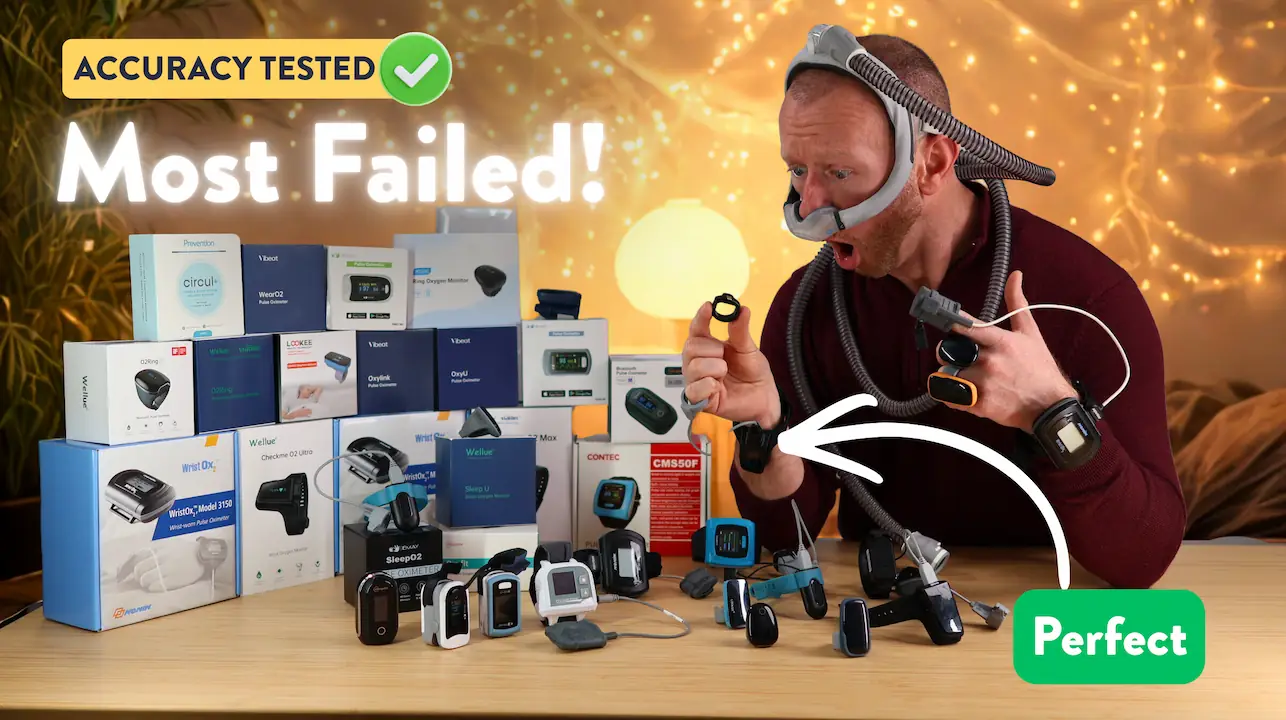
A man wearing a CPAP mask looks shocked at a pulse oximeter on his finger, surrounded by various oximeters and boxes. Text reads “Most Failed!” with labels “Accuracy Tested” and “Perfect” on the image.
Best overall

EMAY SleepO2

A black wrist-worn pulse oximeter with an adjustable strap, a green indicator light, and a wired sensor clip attachment, used for measuring blood oxygen levels and pulse rate.

Honestly, if a simplistic design is important to you, the EMAY’s 96.5/100 accuracy score, 1-second sample rate, and unbeatable morning sleep report makes it the perfect hidden-gem for you.

Best fda-cleared

Wellue Checkme O2 Max

A hand with a device on it.

If you want the “Tesla” of sleep monitors, the Checkme O2 Max gives you an FDA-cleared sensor, built-in vibration and audio alarms, a massive 3-day battery, and the absolute best app we tested to help you perfectly optimize your night.

Most Comfortable

LOOKEE Ring

A hand wearing a LOOKE fingertip pulse oximeter displays SpO2 99% and pulse 78. Next to it, a smartphone shows oxygen level, pulse rate, and motion graphs from the device on a health monitoring app.

If you want maximum freedom of movement while you sleep, this travel-ready ring features a smart vibration alarm, exceptional accuracy, and a premium app experience in a tiny, completely wire-free footprint.

  • Medical Disclaimer: I am a researcher, not a doctor. This review is based on personal data testing and is for informational purposes only. It does not constitute medical advice or diagnosis. Always consult a medical professional for health concerns.

If you have—or suspect you have—sleep apnea, you already know the morning headaches and brain fog. You’re here to catch oxygen drops, check your severity, or verify your CPAP. I’ve been in your shoes, wasting money on cheap overnight monitors only to realize the data is completely worthless.

Over the last 60 days, I personally tested 20+ of the most popular overnight pulse oximeters against the clinical gold standard: the $1,500 Nonin 3150. We generated over 2.5 million lines of data to find the few oxygen monitors that actually tell the truth.
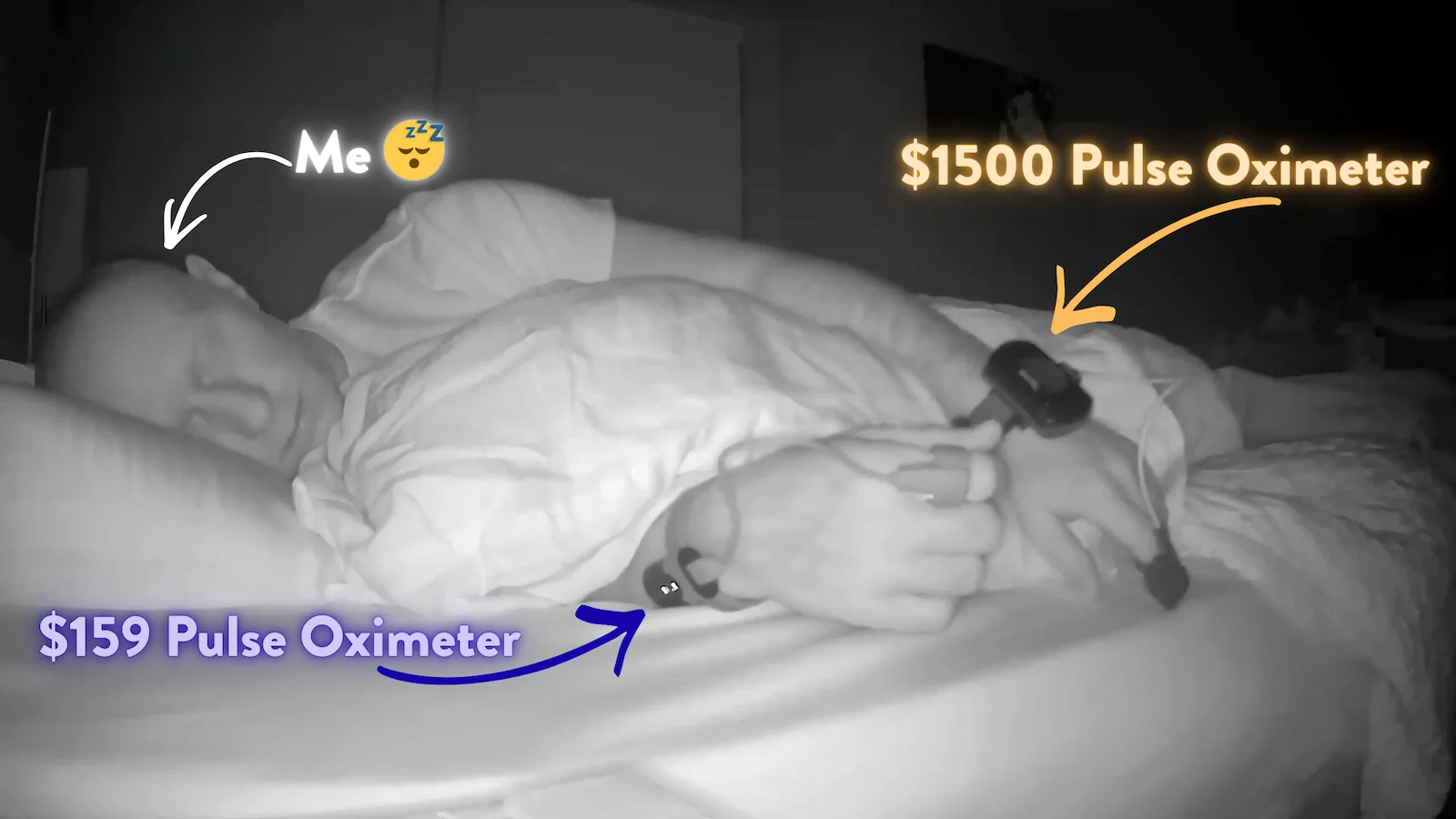
A person sleeps on their side in a dark room, wearing two pulse oximeters on each hand. Labels point to the $159 Pulse Oximeter on one wrist and the $1500 Pulse Oximeter on the other, with an arrow labeled Me above the sleeper.

Before we get into the recommendations, you may want to familiarize yourself with some of the factors that make an overnight pulse oximeter actually worth buying. So feel free to read on or skip straight to the recommendations.


Overnight Pulse Oximeter Buying Guide: 4 Key Features

To assist you in choosing the overnight oxygen monitor you need; here are the four non-negotiable features you need to look for:

1. The Sample Rate And Accuracy

This is the single most important factor. Sleep apnea events (where you temporarily stop breathing) often only last 10 to 20 seconds. If your smartwatch only checks your oxygen every 3 to 15 minutes, you are essentially flying blind; it will mathematically miss your oxygen drops completely.

You need a dedicated oxygen monitor that records a sample every 1 to 4 seconds to catch those dangerous micro-desaturations. But the flip side of sample rate is raw accuracy. The more frequently your device checks-in on you throughout the night, the higher chance it has at catching oxygen dips. That is why we only recommend the oxygen monitors that scored the highest in our tests, because absolute accuracy is the only reason to wear one of these to bed.

2. Wearable Comfort

Next in importance, is comfort. You are going to be wearing this for 8 hours a night. During my extensive testing, I learned the hard way (see below) just how brutal some oximeters with hard plastic frames can be. Several of the heavy, bulky models pinched the tip of my finger so tightly that I woke up with my finger throbbing in the middle of the night.
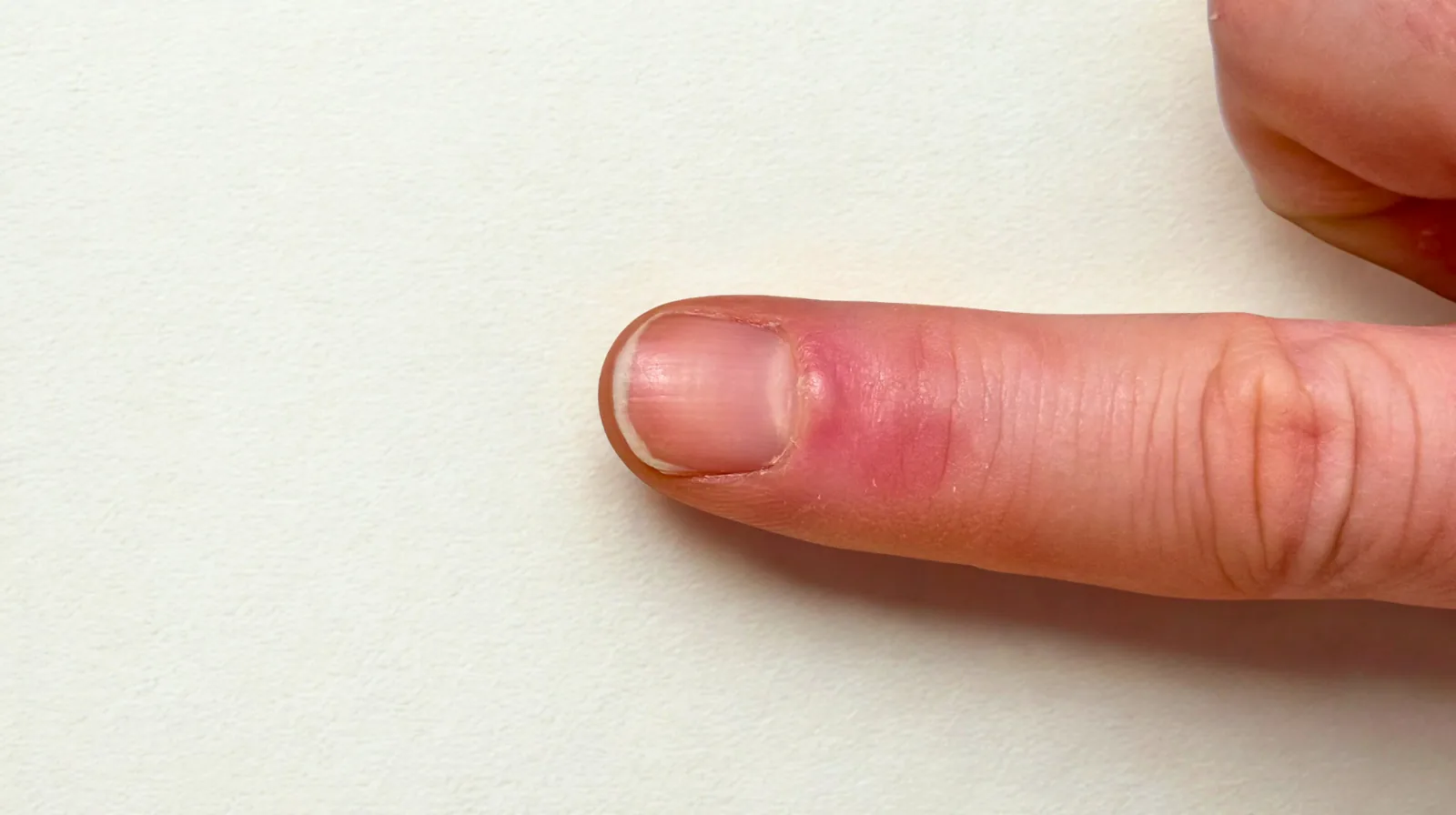
A close-up of a persons index finger with redness and swelling around the nail, indicating possible infection or irritation, against a plain light background.
A nice blister from a device I won’t be recommending.

You must prioritize flexibility and lightweight materials. Any lightweight, soft silicone sensor that gently contours to your finger and offering the finger some mobility is a win, and is literally the difference between a restful night’s sleep and waking up in pain. To avoid this nightmare, we take this in to account for our recommendations.

3. Data Transparency & File Formats

Accurate tracking is completely useless if your data is held hostage. A few overnight oxygen monitors I tested only give you a basic JPEG screenshot of your morning summary while others will time travel you back to the early 2000s (see below). This makes it impossible to dig into the raw data to verify if the device is actually telling the truth. You need a device that offers data transparency in useful formats and a summary report that provides metrics that are helpful for your screening.
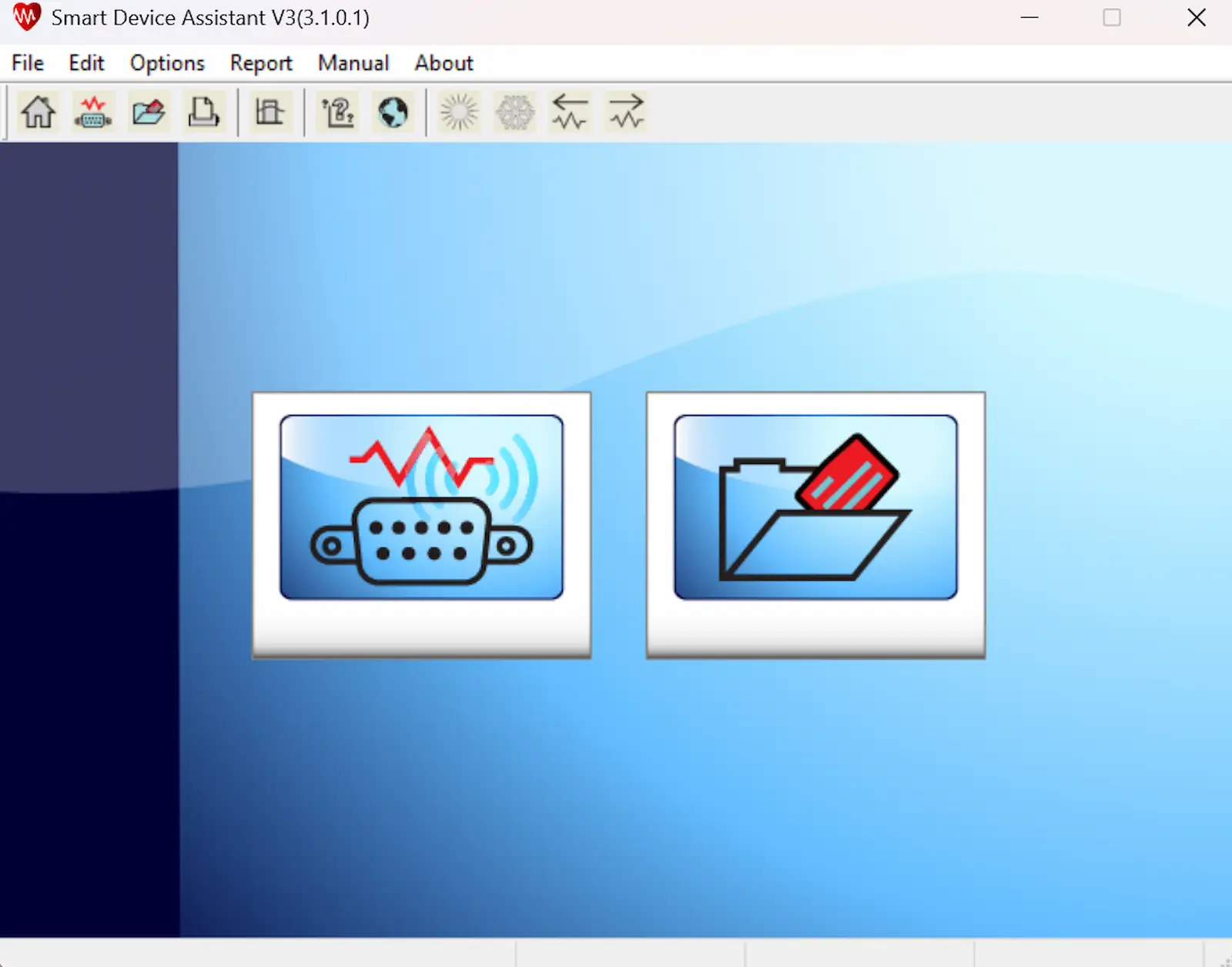
Screenshot of the Smart Device Assistant software showing two large icons: one with a port and red waveform, and one with a folder containing a red card, on a blue background. Menu options are visible at the top.
Software for the Contec CMS50F. Let’s just say, not ideal. 😂

Look for pulse oximeters that generate a clean PDF for an easy-to-read summary report, and export your raw, second-by-second data as a CSV (the gold standard for data analysis). As a bonus, premium monitors will also export specialized files that integrate seamlessly into CPAP software like OSCAR.

4. Onboard Memory (Phone-Free Sleeping)

Your monitor must have reliable “onboard memory.” This means the device records and stores your entire night of sleep data internally on the sensor itself. You don’t have to sleep with your phone right next to your head.

You can simply leave your phone turned off or in another room while you sleep. In the morning, you just open the free app, and the device will effortlessly sync your entire night of data in seconds. That’s what you want!

How Did We Test (Simple Version)

  • Testing Disclaimer: FDA validation uses controlled hypoxia and arterial blood sampling. I didn’t do that. Instead, I used the next best real-world approach: simultaneous overnight benchmarking against a hospital-grade reference device.
  • The hospital-grade Nonin was worn on one hand, and a test overnight monitor on the other
  • Every morning, I exported the raw data files from both pulse oximeters
  • Our custom built Python script cleaned, aligned, and compared the data line-by-line
  • All the metrics were averaged across 3 nights to reduce randomness

The Best Overnight Pulse Oximeters

Without any further delay, here are all of my recommendations!

  1. Best Overall: EMAY SleepO2
  2. Best FDA-Cleared: Wellue Checkme O2 Max
  3. Most Comfortable: LOOKEE Ring
  4. Best Battery Life: Wellue Checkme O2 Ultra
  5. Best Smart Alarm Value: Vibeat OxyU

Best Overall: EMAY SleepO2

The EMAY SleepO2 is a dedicated overnight pulse oximeter that performed a near-perfect 96.5/100 on our Overall O2 Accuracy Score.

Its soft silicon duckbill sensor contours the tip of your finger surprisingly well and offers enough movement to wear night-after-night.

You will love its beautifully simplistic design with a dedicated power button, meaning you can purposefully start and stop your recording whenever you are ready.

The real treasure is the fantastic morning sleep summary report with very detailed metrics that the EMAY app generates. One of the best we have tested!
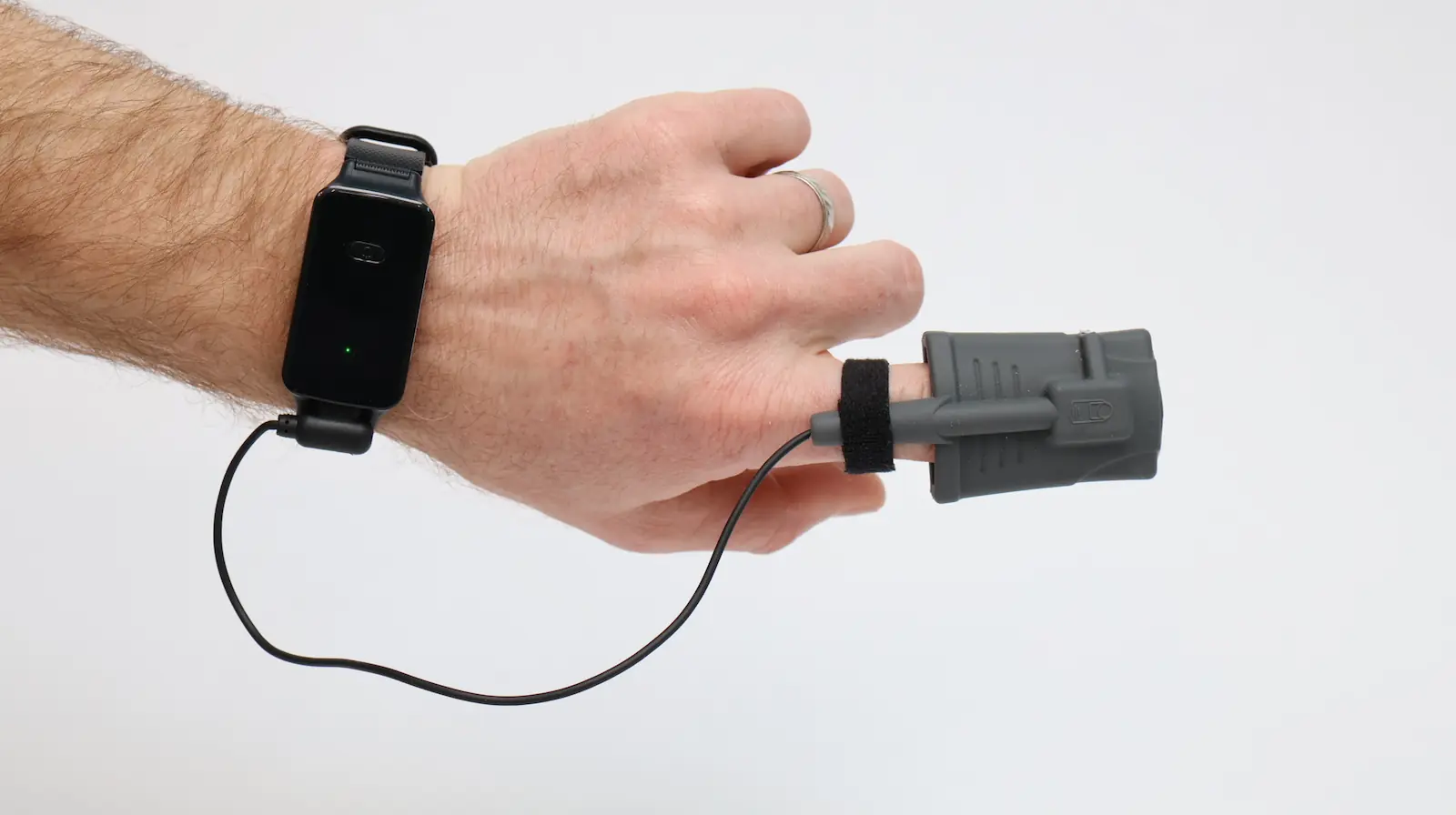
A hand wearing a smartwatch with a wire connected to a gray medical sensor clipped onto the index finger, against a plain white background.

This hidden-gem is my favorite overnight pulse ox right now. If you want more details check out my full review here.


EMAY SleepO2
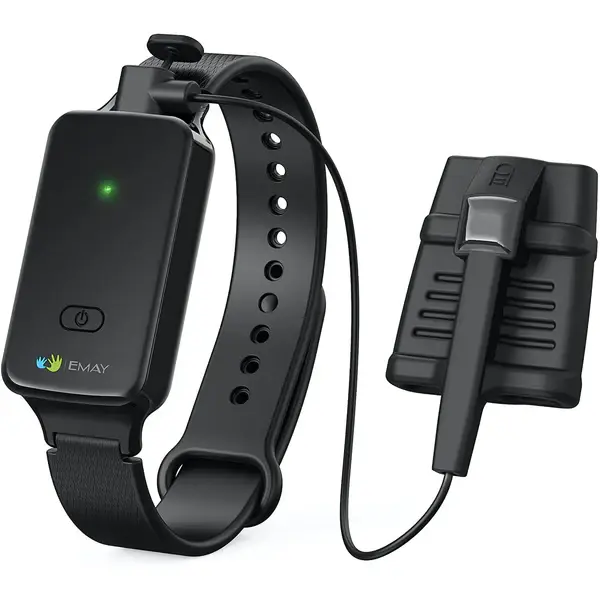
A black wrist-worn pulse oximeter with an adjustable strap, a green indicator light, and a wired sensor clip attachment, used for measuring blood oxygen levels and pulse rate.

Pros:

  • 96.5%/100 on our Overall O2 Score accuracy test
  • Summary report includes useful metrics many devices don’t
  • Clean CSV export (huge if you care about data)
  • Simple physical power button
  • Fast morning download + easy sharing
  • 1 second recording intervals

Cons:

  • Green LED stays on all night
  • Duckbill finger sensor can feel oversized (especially on slimmer fingers)
  • Charging port feels dated

Best FDA-Cleared: Wellue Checkme O2 Max

The Checkme O2 Max is Wellue’s premium oximeter. It scored a stellar 90.7/100 on our Overall O2 Score while flaunting it’s clinical-backed FDA-cleared reliability.

Impressively, the Max has both a vibration and an audible beep alarm, excellent sampling interval of 2 seconds, while managing to display a stunning design. Make no mistake, immediately upon holding this you know it is a premium piece of hardware and not a toy.

The incredible 72-hour battery life gives you some freedom from charging everyday. It can record a full three nights of sleep on a single charge which is very nice.

But the real treasure here is the patented silicone ring sensor, meaning you can fully bend your knuckles while the device stays perfectly locked in place without falling off!
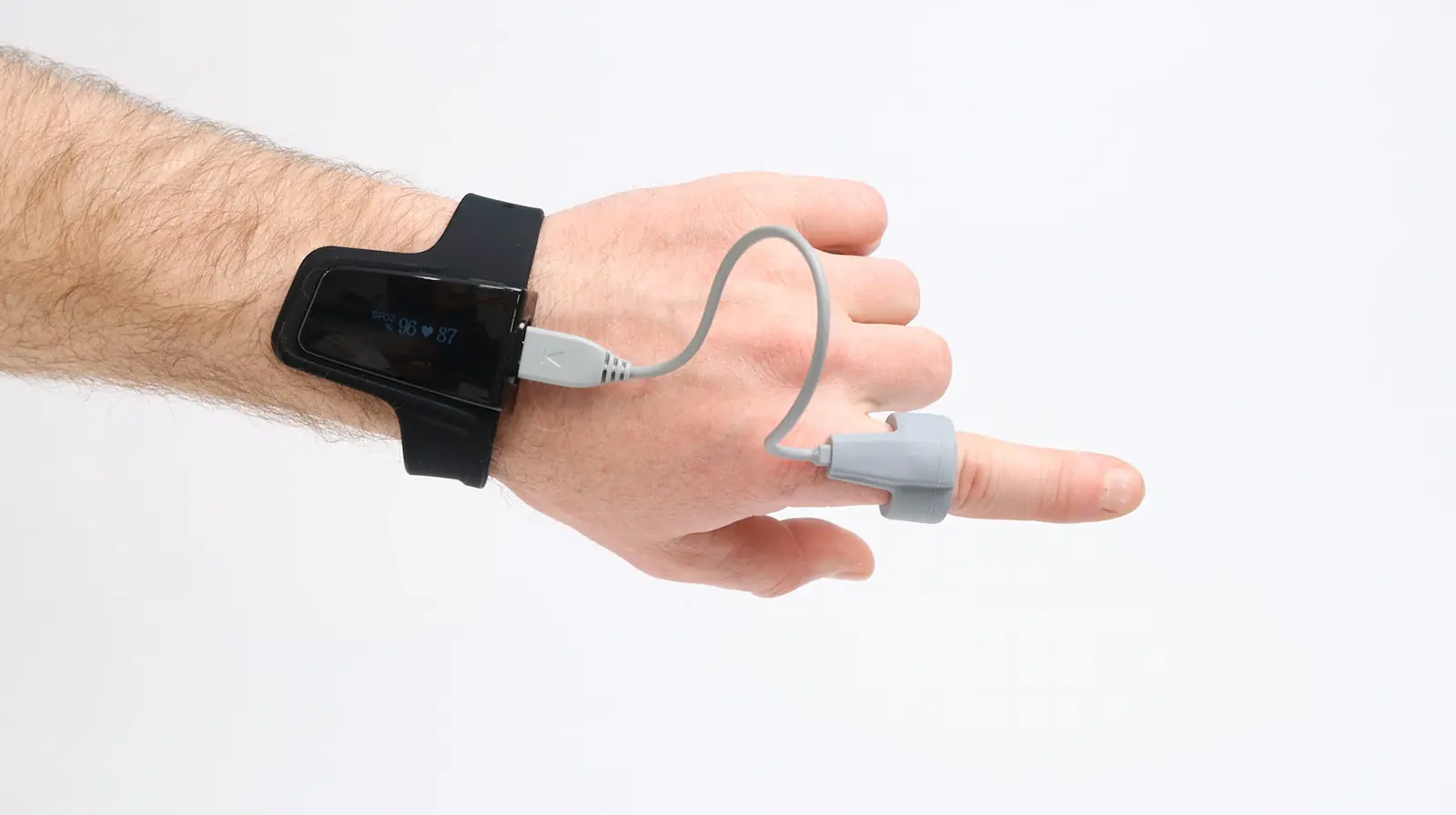
A hand wearing a black wrist device connected by a gray cable to a sensor clipped on the index finger, against a plain white background.

If you want to know more on why this device is amazing, check out my full review here.

Wellue Checkme O2 Max
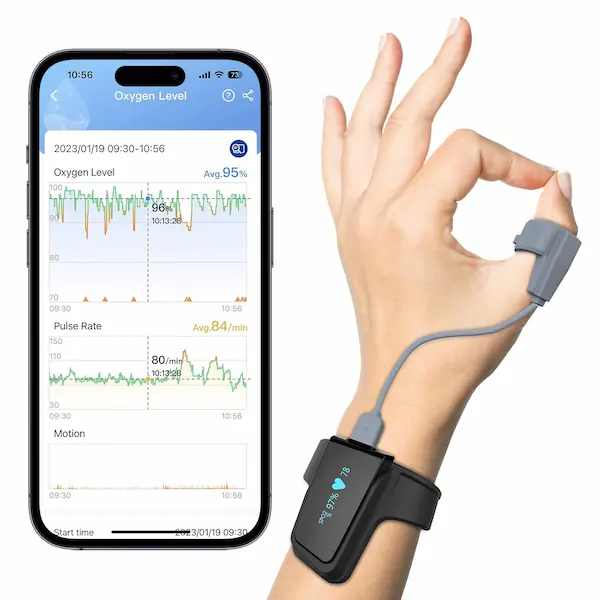
A hand with a device on it.

Pros:

  • 90.7/100 on our Overall O2 Score accuracy test
  • FDA Cleared as a Class ll medical device. Strict clinical trailed tested
  • Clean CSV export (huge if you care about data)
  • 72-Hour Battery: Last 3 full nights
  • Smart Vibration Alarm
  • 2 second recording intervals

Cons:

  • Stiff wrist clasp: secure, but tricky to put on one handed
  • Left-handed Orientation: Designed to be worn on your left hand only

Most Comfortable: LOOKEE Ring

The LOOKEE Ring is a minimalist dedicated continuous pulse oximeter. It scored an impressive 93.0/100 on our Overall O2 Score for accuracy. The main trait that sticks out for this device is its tiny footprint, which supercharges in the way of comfort, and makes this my most comfortable recommendation right now.

The LOOKEE requires daily morning charging unlike the bigger battery wrist-based models, but it makes up for this in several ways.

For one, it is an all-encompassing unit that sits solely at the base of your finger, meaning you won’t have any cables to worry about while sleeping. Also you will have great mobility in your finger, which you will love. When you put it on, it feels like a sleek piece of modern jewelry rather than a medical device, with that compact shell.

This ring does come equipped with an adjustable silent vibration alarm, and a remarkably modern user friendly app.

It is punching above its weight by still offering export Binary files natively. Meaning you can drop your raw oxygen data directly into OSCAR software.
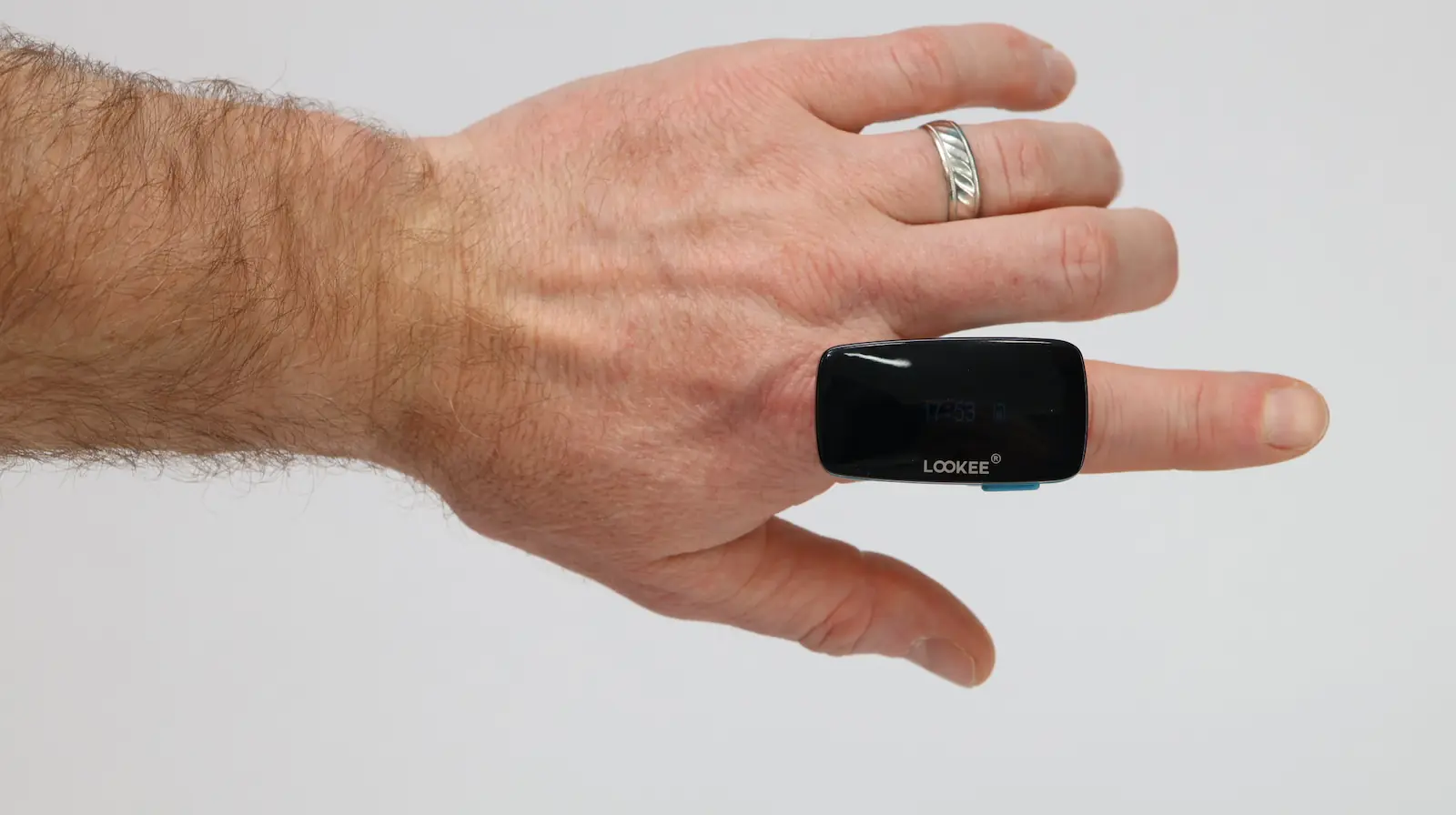
A hand with a silver ring on the ring finger is shown wearing a black electronic device labeled LOCKEE on the index finger against a plain white background.

If you are a light sleeper who wants the most compact device while having reliably accurate data at the same time, I would recommend you grab this one.

LOOKEE Ring
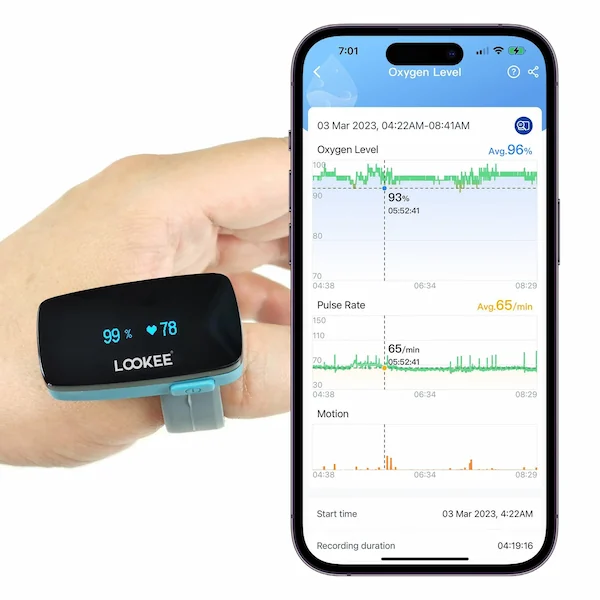
A hand wearing a LOOKE fingertip pulse oximeter displays SpO2 99% and pulse 78. Next to it, a smartphone shows oxygen level, pulse rate, and motion graphs from the device on a health monitoring app.

Pros:

  • 93/100 on our Overall O2 Score accuracy test
  • 100% Wire-Free: No wrist straps or cables
  • Binary file export (flawless native OSCAR integration)
  • Smart Vibration Alarm: Gently wakes you without waking your partner
  • Smallest Footprint: The absolute best choice for light sleepers
  • Nice tactile power button to start and stop recordings

Cons:

  • Daily Charging: Smaller battery means you need to plug it in every morning
  • Can Twist: May rotate slightly on very thin fingers during the night

Best Battery Life: Wellue Checkme O2 Ultra

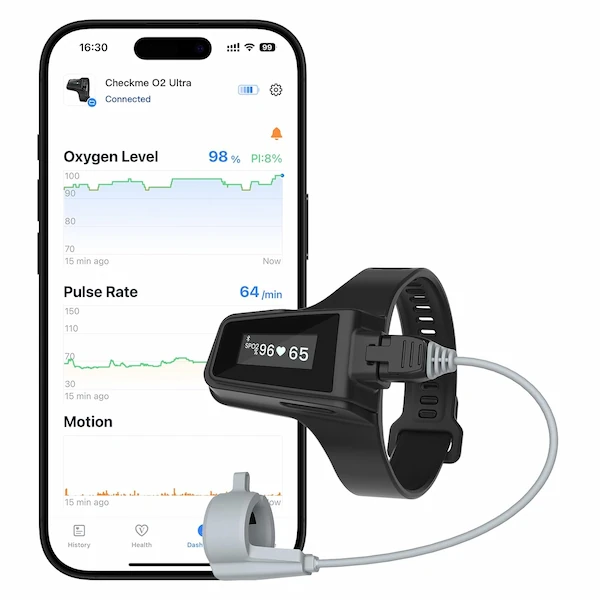
The Checkme Ultra is the newest kid on the block in the Checkme family. Scoring a solid 87.3/100 on our Overall O2 Score for accuracy while presenting a monster of a battery. The overnight power plant is what I would call it.

The Ultra’s wrist device is slightly larger than most. The tradeoff though is the incredible 100+ hour multi-day capacity. In other words, you can record four 12-hour nights of sleep on a trip without even needing to pack your charging cable.

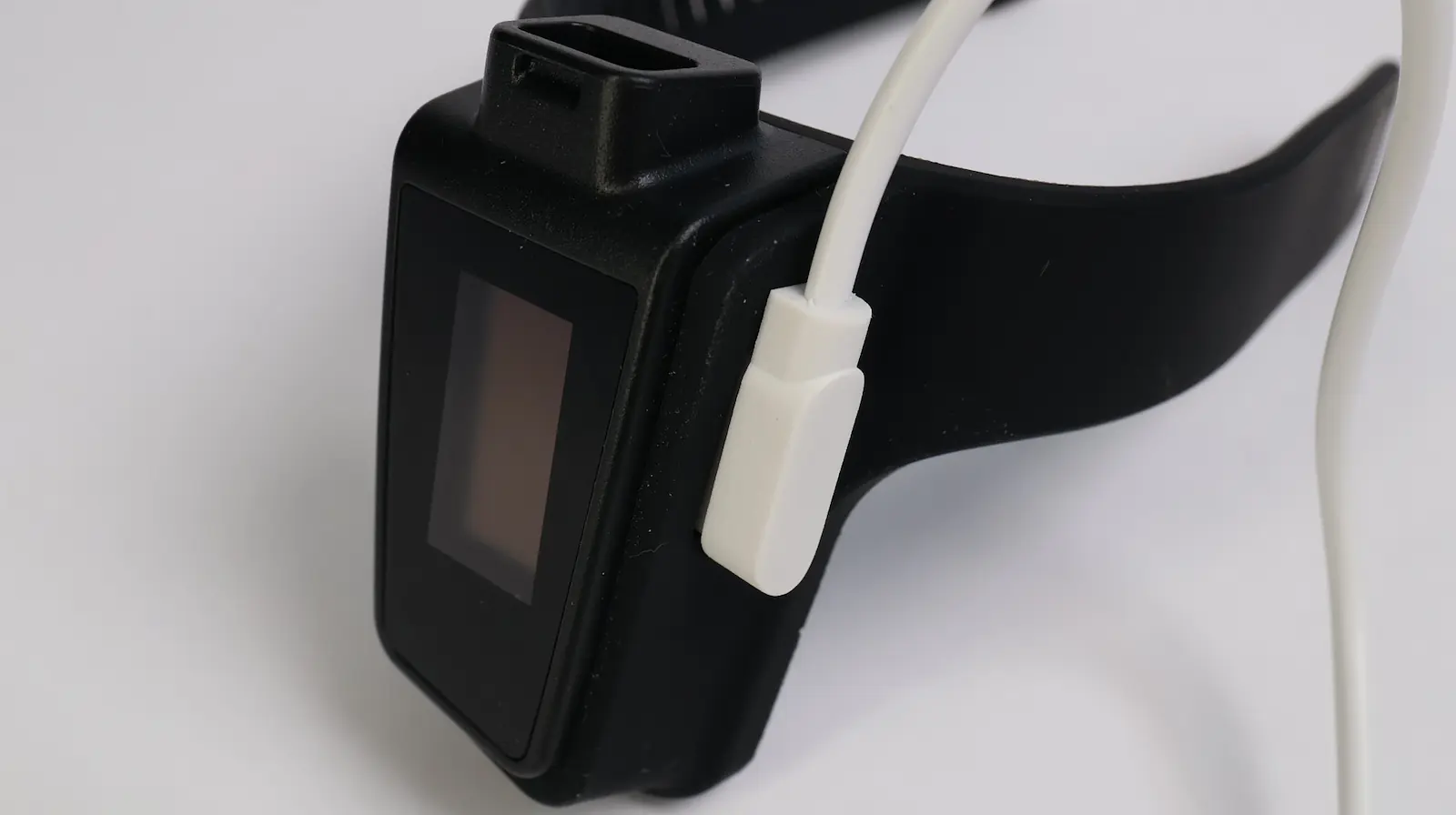
The Ultra also uses a super convenient snap magnetic charger, unlike the traditional delicate plug-ins. This charges to full in a lightening fast two hours!
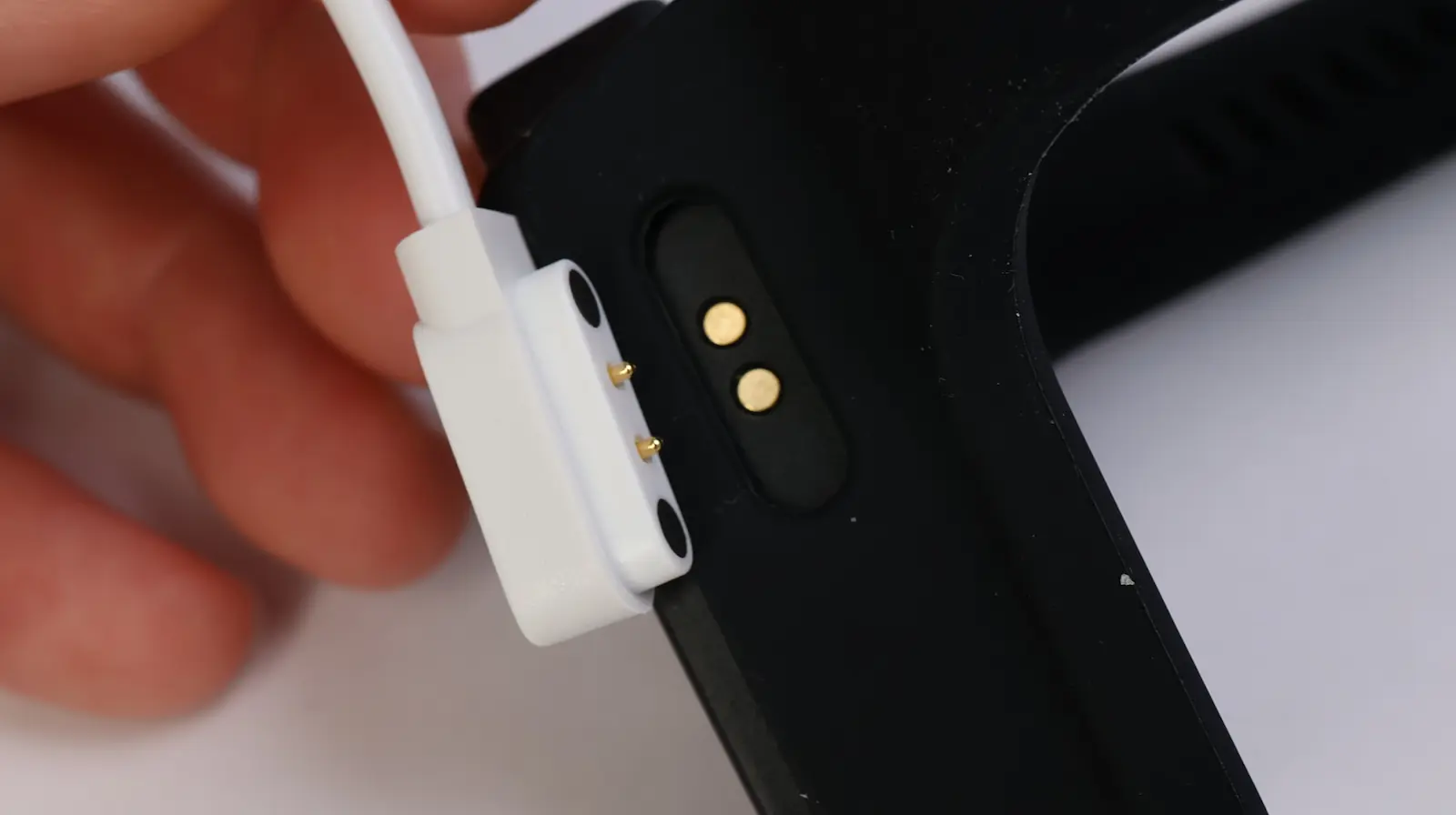
A close-up of a hand holding a white magnetic charger near the charging pins on the back of a black fitness tracker or smartwatch.
A black smartwatch is shown on a white surface, with a white charging cable connected to its side. The screen of the watch is off or inactive.

In the app you can adjust the sample rate interval from 1 second to 4 seconds, depending on how detailed you want your data. I would recommend keeping it at 1 second.

How is this different than the Max? Honestly, you will think this is the commercial version in the Checkme line up. Everything just feels beefier. Look at the connector for the ring, it does not just push in, it has a robust safety clip that firmly snaps in. If you move a lot while sleeping you will appreciate the robustness of the connections. The Ultra still offers the premium ViHealth app integration, 1 second sample interval, desktop software access, and a innovative smart alarm that makes this oximeter stands out. Lastly, if remembering to charge your device often is a issue for you, this overnight power plant is the pulse oximeter for you!
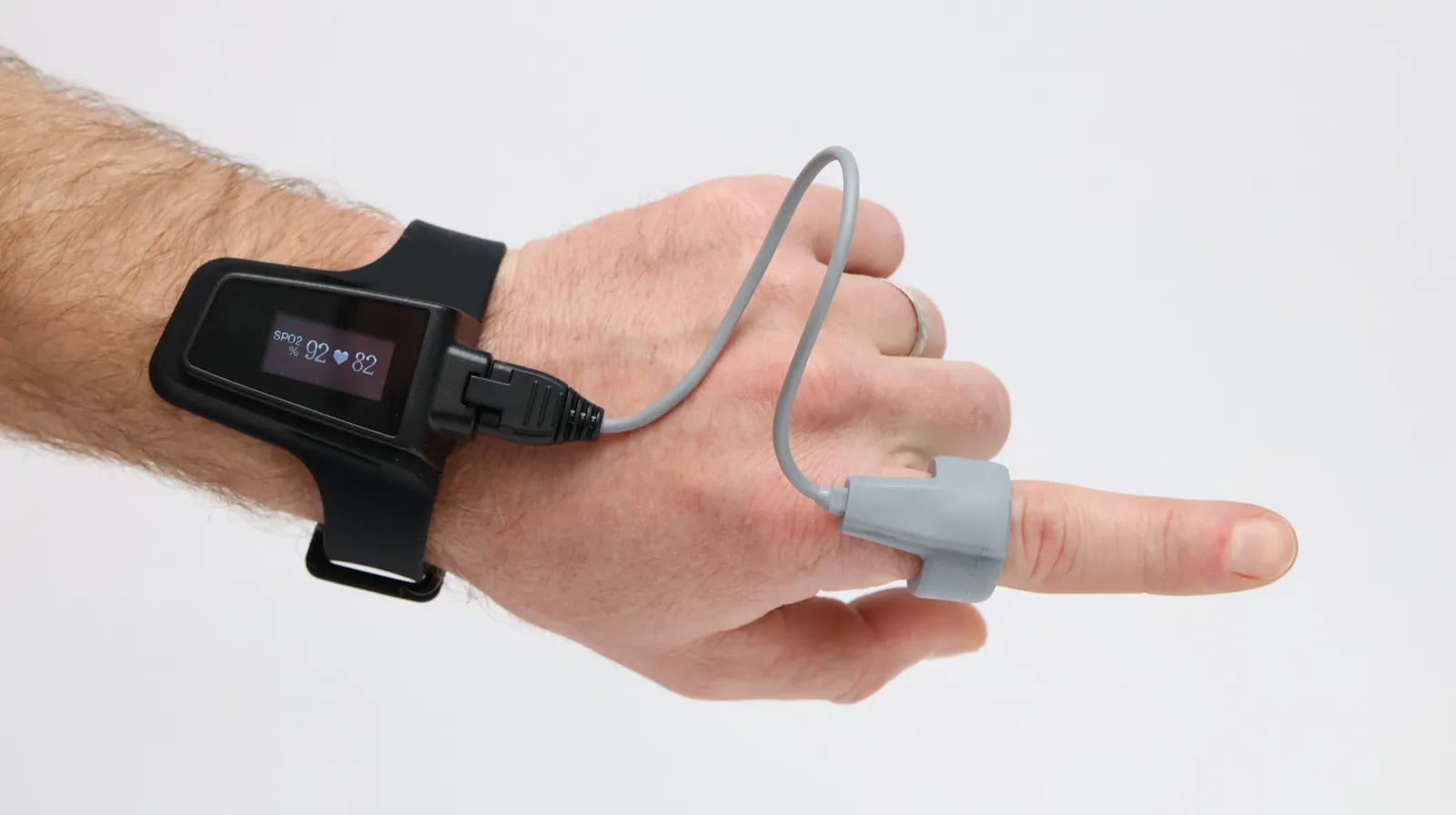
A person’s hand wearing a black wrist device with a display, connected by a cable to a gray sensor clipped on their index finger, likely for monitoring vital signs such as oxygen level or heart rate.

Wellue Checkme O2 Ultra

A smartphone displays health tracking data, including oxygen level and pulse rate. In front is a black wearable device with a finger sensor connected by a cable, used for measuring blood oxygen and heart rate.

Pros:

  • 87.3/100 on our Overall O2 Score accuracy test
  • 4 nights of onboard memory
  • Lightening fast magnetic charger. Charges in 2 hours.
  • 1 second sample interval
  • CSV, PDF, and Binary file export
  • Nice sleep report for every recorded night

Cons:

  • Can fell heavy on your wrist.
  • Pricier than most other oximeters in its class

Best Smart Alarm Value: Vibeat OxyU

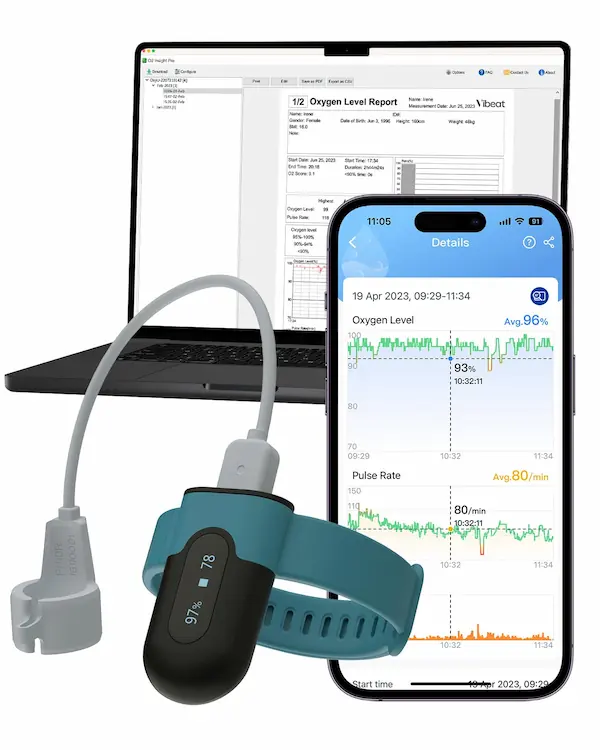
The OxyU is Vibeat’s middle-ground offering. While scoring a whopping 89.1/100 on our Overall O2 Score, OxyU’s combination of premium features and affordability provides a heck of a nice overnight pulse oximeter.

Right off the bat, you get the premium feature of the adjustable smart vibration alarm without the expensive price tag. Additionally, you get access to the Vihealth app with PDF, CSV, and Binary export files for OSCAR integration.

The OxyU also feels incredibly sleek and aerodynamic on the wrist and weighing in at only 32g, making it the lightest wrist oximeter we tested. It offers a nice small screen that displays your SPO2 and HR. This shuts off after 2 minutes at night.

Overall, if you are looking for some high-end features, reliable accuracy for screening, and a compact wrist pulse oximeter without breaking the bank; this is the one for you!
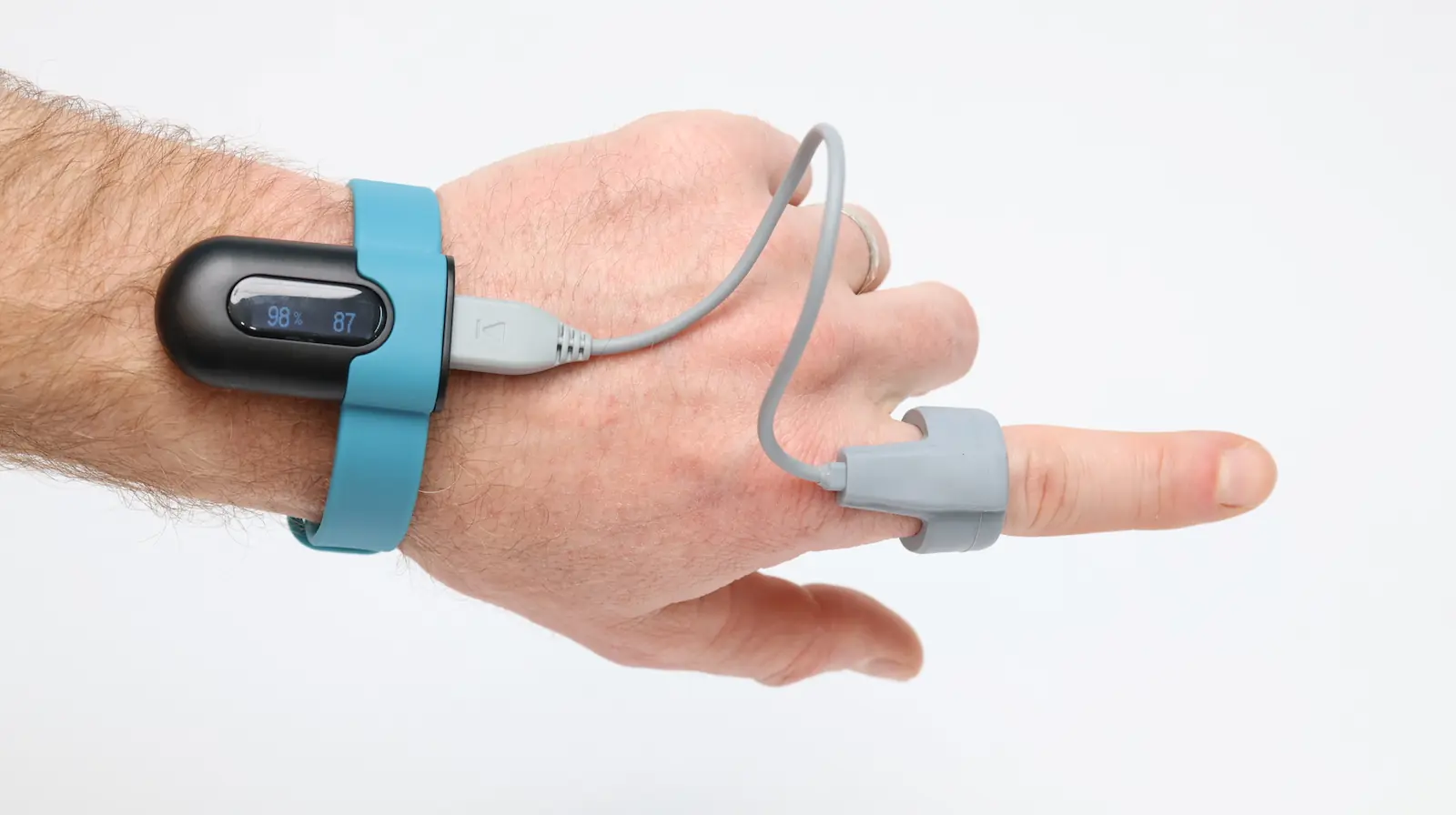
A hand wearing a blue wrist device connected by a cable to a gray sensor clipped onto the index finger, displaying readings on a small screen against a plain white background.

Vibeat OxyU

A laptop, a smartphone displaying health data graphs, and a blue wearable pulse oximeter with a finger sensor, used for monitoring oxygen levels and pulse rate.

Pros:

  • 89.1/100 on our Overall O2 Score accuracy test
  • Smart Vibration Alarm: Adjustable alerts instantly nudge you when your oxygen drops
  • Binary file export (flawless native OSCAR integration)
  • On-Wrist OLED Display: Easily check your exact numbers
  • Great price for the premium features you get

Cons:

  • 4 second sample interval
  • No desktop software
  • Battery only last 16 hours

Frequently Asked Questions

Apple Watches and fitness rings are incredible tools for overall health, but their sampling rate for SpO2 is too low for apnea detection. They take “spot checks” every few minutes. A dedicated overnight sleep monitor like the Checkme O2 Max uses 1-to-4-second interval sampling, providing the continuous monitoring granularity needed to see the rapid “sawtooth” pattern of sleep apnea.

Yes. Dark nail polish (blue, black, green) or thick artificial acrylics can block the infrared light, causing the device to read artificially low or fail to track altogether. For the most accurate data, use a finger without polish (NIH Study).

Many cheap wellness devices on Amazon claim to be “FDA Registered,” which simply means the factory paid a fee to be on a list. “FDA-Cleared” (like the Checkme O2 Max, under 510(k) clearance (K191088) means the device has undergone rigorous clinical testing and proven to the U.S. government that it is substantially equivalent to hospital-grade equipment for safety and accuracy.

According to clinical standards, a healthy blood oxygen saturation (SpO2) level during sleep is typically between 95% and 100%. If your oxygen levels drop below 88% for more than 5 minutes, this is a clinical sign of hypoxemia.

For biohackers, optimizing your breathing to keep this number pinned at 96% or higher all night is the ultimate goal for systemic recovery. Always consult your healthcare provider if you consistently see readings below 90%.

Yes, and this is a major ongoing clinical issue. Recent studies have shown that many standard pulse oximeters suffer from “occult hypoxemia” in patients with darker skin pigmentation. This means the device overestimates their oxygen levels and fails to show dangerous drops. Because melanin absorbs light, it can interfere with the sensor’s optical readings. In January 2025, the U.S. Food and Drug Administration (FDA) issued a new draft guidance requiring manufacturers to test their devices on larger, diverse populations using objective skin tone scales to ensure clinical equity (FDA.gov)

A pulse oximeter works by acting like a tiny, smart flashlight. It shines two different types of light through your finger: a regular red light and an invisible infrared light. Oxygen-rich blood is bright red and absorbs more infrared light, while oxygen-poor blood is darker and absorbs more red light. The sensor measures the light that pulses with your heartbeat, filtering out skin and bone, and calculates the exact ratio of absorbed light to give you your SpO2 percentage.

A pulse oximeter measures blood oxygen saturation and heart rate, which are strong indicators of sleep apnea. However, it cannot officially “diagnose” the condition, as it does not measure airflow, respiratory effort, or brainwaves. It is highly effective as an initial screening tool. According to clinical studies published by the National Institutes of Health (NIH), overnight pulse oximetry is a valuable first step in identifying severe oxygen desaturations. If your device shows a high ODI (Oxygen Desaturation Index) or frequent drops throughout the night, you should take that report to a sleep specialist to see if you need a polysomnography (a full clinical sleep study) for an official diagnosis.

You might not wake up gasping for air if your oxygen drops. Instead, low oxygen often damages your body silently. According to the Mayo Clinic and Mass General Brigham, repeated nighttime oxygen drops commonly cause:

  • Morning Headaches: Caused by carbon dioxide building up in your blood while you sleep.
  • Excessive Daytime Sleepiness: Your brain constantly micro-wakes you to breathe, destroying your deep sleep.
  • Dry Mouth or Sore Throat: From heavy mouth-breathing or snoring as your body struggles for air.
  • Night Sweats: Oxygen drops trigger a “fight or flight” panic response that spikes your heart rate.
  • High Blood Pressure: Repeated oxygen crashes put dangerous, long-term strain on your cardiovascular system.

Medical Note: If your overnight monitor shows frequent oxygen drops alongside these symptoms, take your data to a sleep specialist for an official evaluation.

  • Four pairs of blue light blocking glasses with orange and red lenses surround the words Best Blue Blocking Glasses on a light background.

    The 4 Best Blue Light Blocking Glasses for Sleep (Lab Tested)

    We tested 120+ pairs of blue blockers. See our spectral data for TrueDark, Infield, and BlockBlueLight to find the best glasses for sleep.

    Read More
  • Purple graphic with bold black text reading, The Science Behind Sunrise Alarm Clocks and How to Use Them. White arrows and the Optimize Your Biology logo appear at the bottom.

    Science of Sunrise Alarms: Do They Actually Work?

    Does a sunrise alarm actually help? We analyze the studies on dawn simulation for winter depression (SAD) and circadian alignment. See the science inside.

    Read More
  • Text on a yellow background reads “Sleep Pod by Hug Sleep: An Honest Review.” Below is a small brain icon and the words “Optimize Your Biology.” White arrows point toward the main text.

    Hug Sleep Pod Review: Better Than a Weighted Blanket?

    Is the Hug Sleep Pod the ultimate adult swaddle? We tested this Shark Tank product. Discover if it beats a hot weighted blanket for anxiety relief.

    Read More
Subscribe
Notify of
guest
0 Comments
Inline Feedbacks
View all comments