My verdict
Brighter Lamp
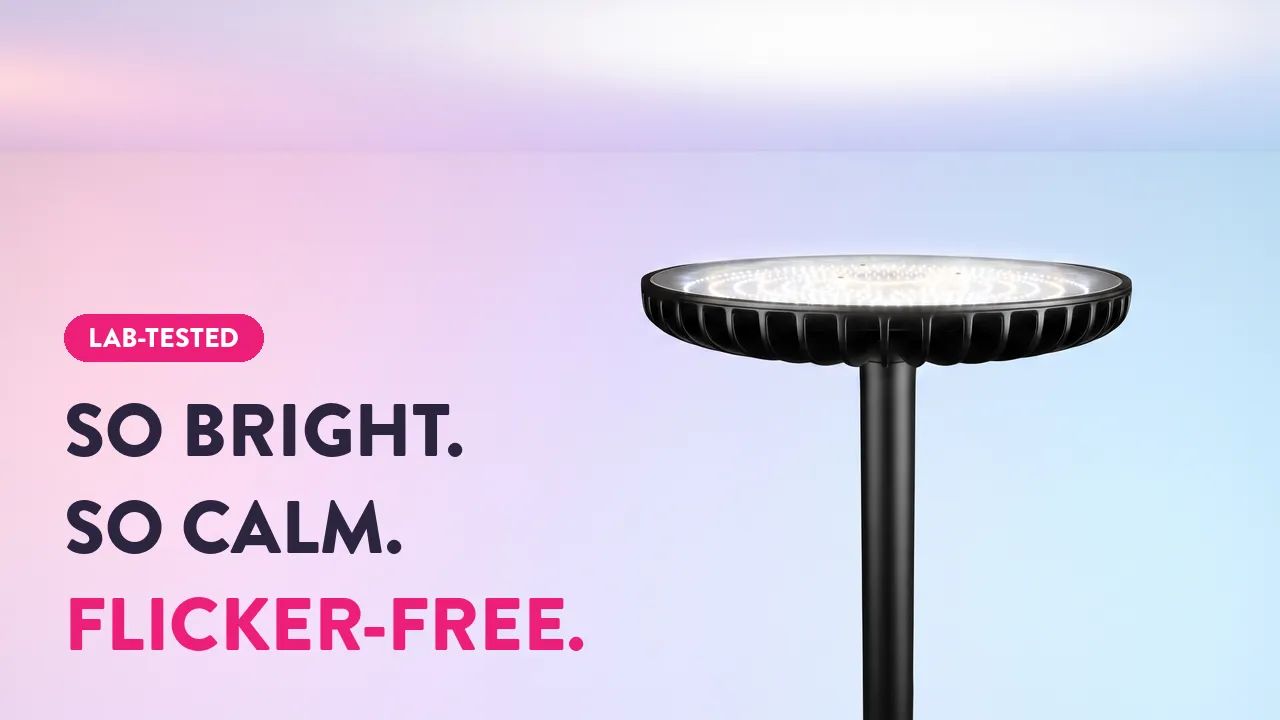
The brightest home lamp I've ever measured, and it actually backs the claim up. It's genuinely flicker-free, smart-home ready, and half the price of the Chroma Skylight. It runs hot and its warm end isn't true night light, but for a wall of clean daylight in a room, nothing else comes close.
- Pro: ~48,650 lux at 2 ft (measured)
- Pro: Effectively flicker-free
- Pro: Tunable 2500–7000K white
- Pro: Matter smart-home + Apple Home adaptive lighting
- Pro: Easy assembly, premium build
- Pro: $1,199
- Con: Runs hot (~199°F)
- Con: Warm end isn't dim enough for late-night
- Con: Laggy control knobs
- Con: Short power cord
See the lab results
Cool setting 2 ft · measured Jun 29, 2026
- 24,140m-EDI
- Melanopic EDI
- 23,950lux
- Brightness
- 7047K
- Color temp
- 0.69%
- Flicker
Spectrum
Spectrum chart. Brighter Lamp, 7047K, melanopic DER 1.00.
Flicker, dimmed
Chart by time. Brighter Lamp.
Brighter says its lamp puts out 60,000 lumens. On my meter, full power threw 48,650 lux at two feet. That’s roughly five times what I measured from the Chroma Skylight.
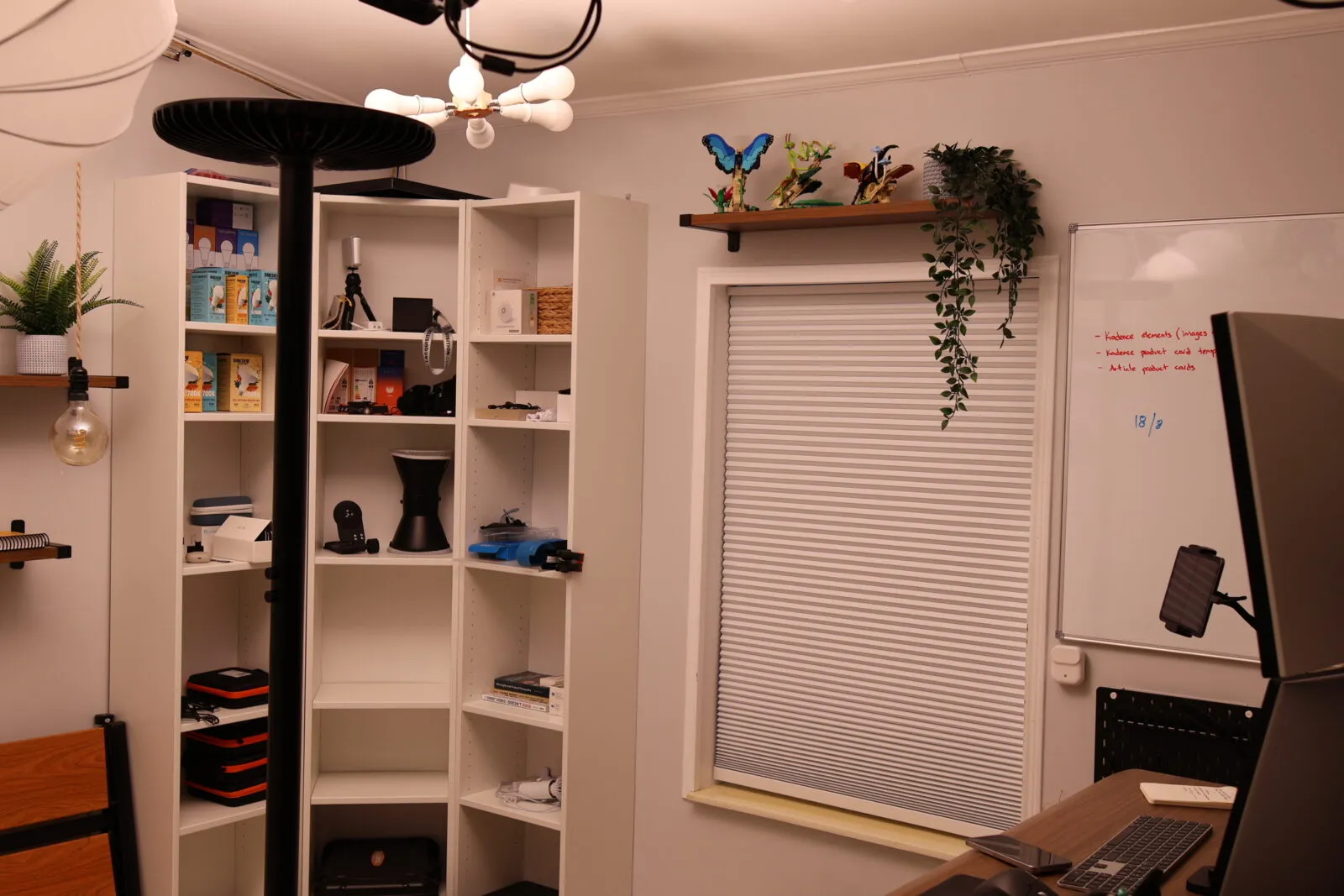
So this Brighter Lamp review won’t spend long on whether it’s bright. It is. The real question is whether you need that much light, and what you trade to get it.
What It Is
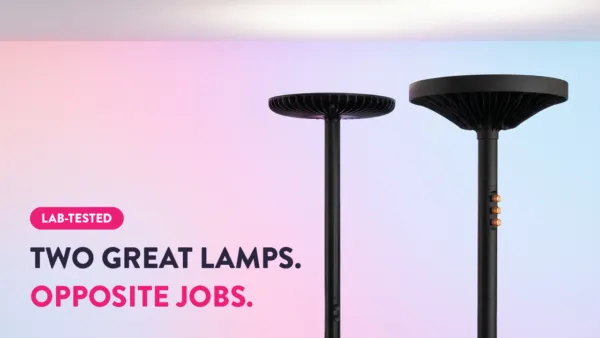
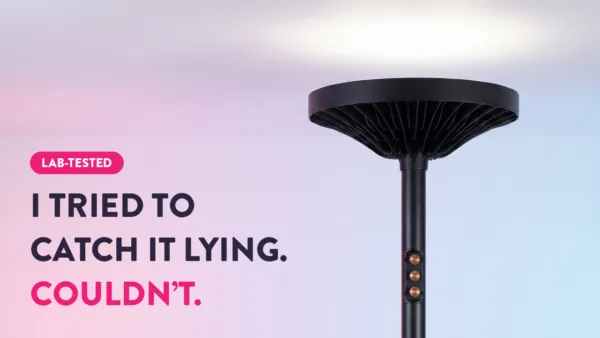
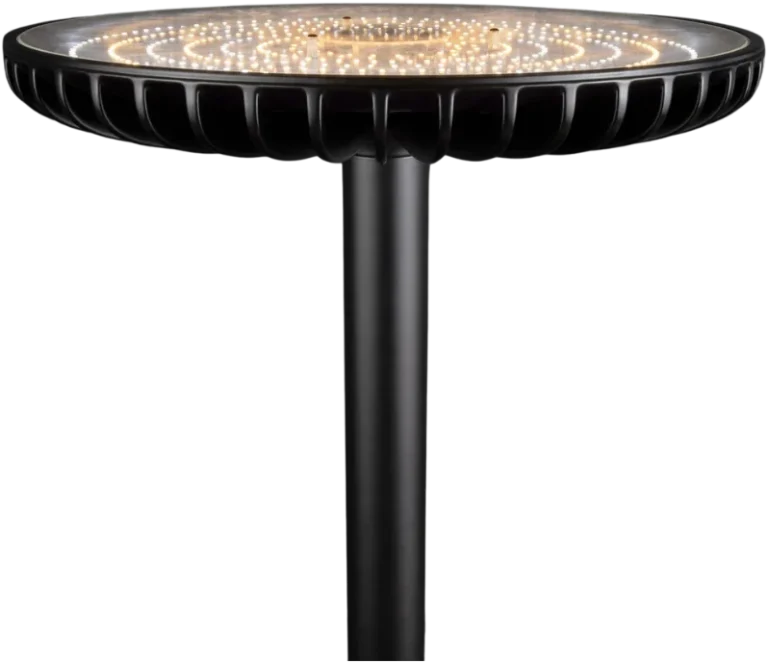
The Brighter Lamp is a 6-foot-3, 50-pound floor lamp built around one idea: overwhelming brightness. One dial sets brightness, the other sets color temperature, sweeping from a warm 2500K up past a cool 7000K.
It started as an Indiegogo campaign literally called “the world’s brightest floor lamp.” At $1,199 it’s aluminum, steel, and glass, and it pairs with your smart home over Matter.
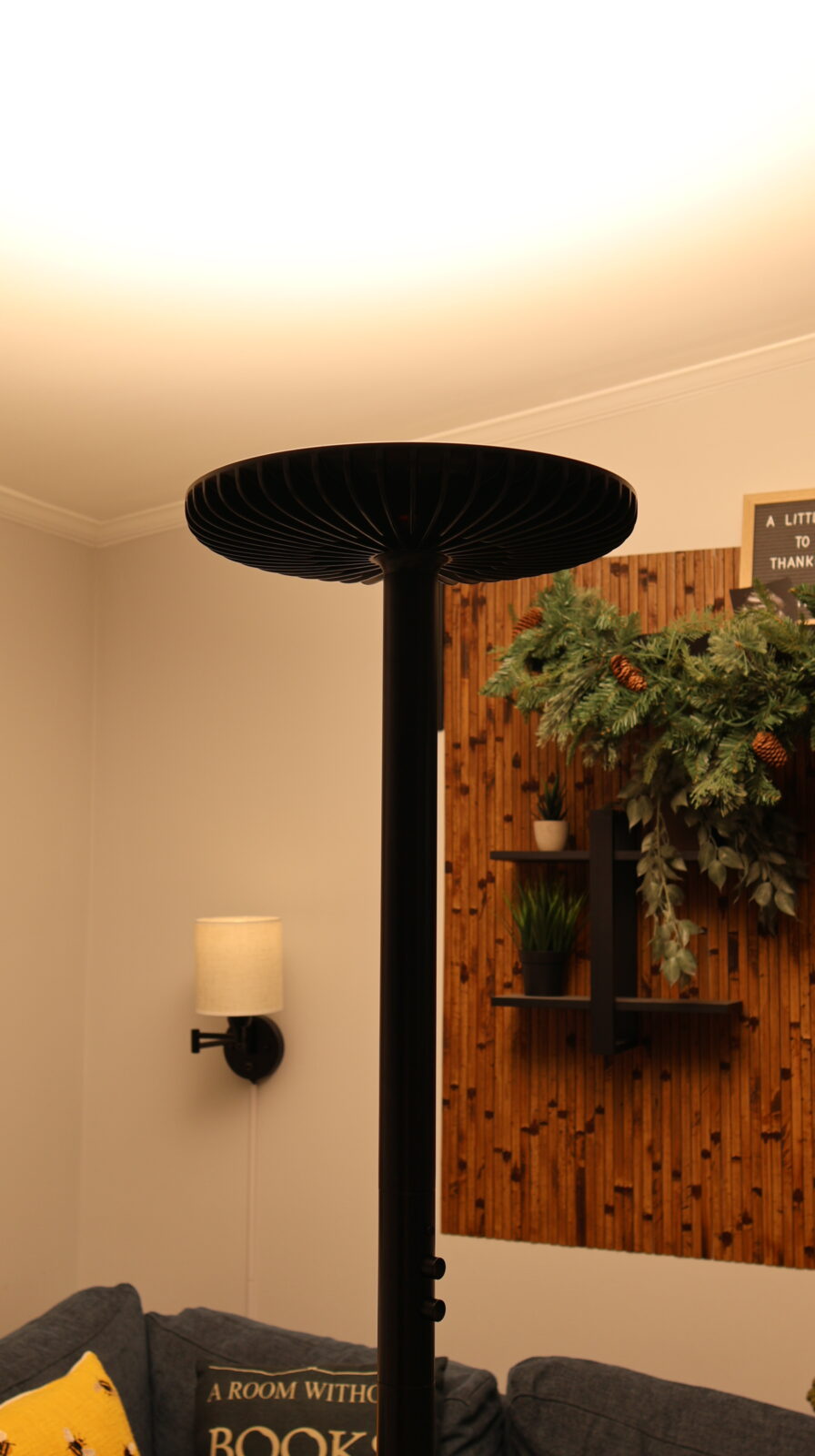
It’s not a light box you sit in front of. It’s a room light. You point it up and let it flood the space off your ceiling.
Free · 95 pages
You're reading about one piece of this. The book is the whole day.
The Circadian Blueprint covers setting your body clock with light — the timing, the doses, and which products actually deliver them. Every number came off my own spectrometer.
How Bright Is It, Really?
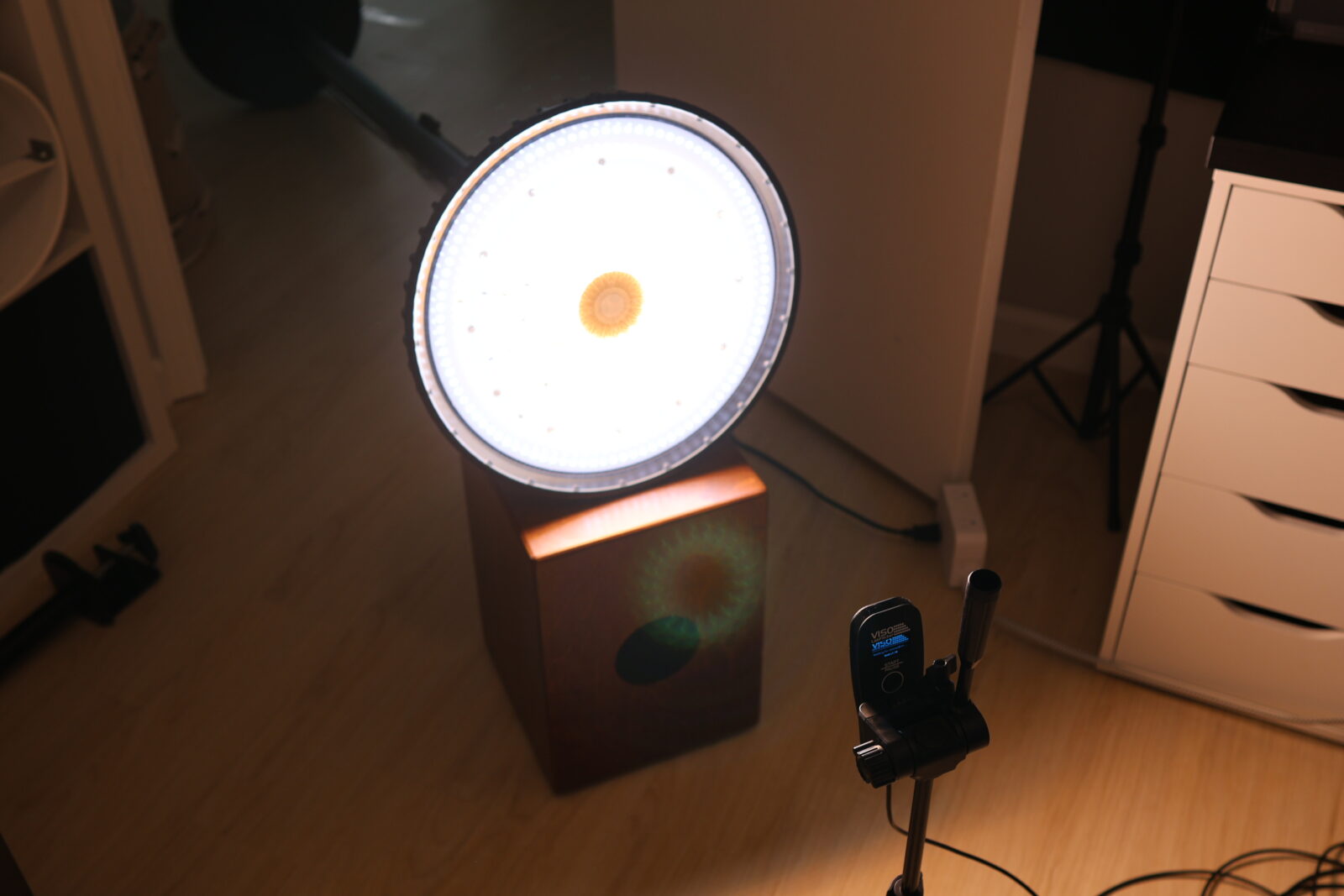
At full power, two feet from the source, I measured 48,650 lux and a melanopic EDI of 35,893. That’s a lamp doing what most people need an open window for.
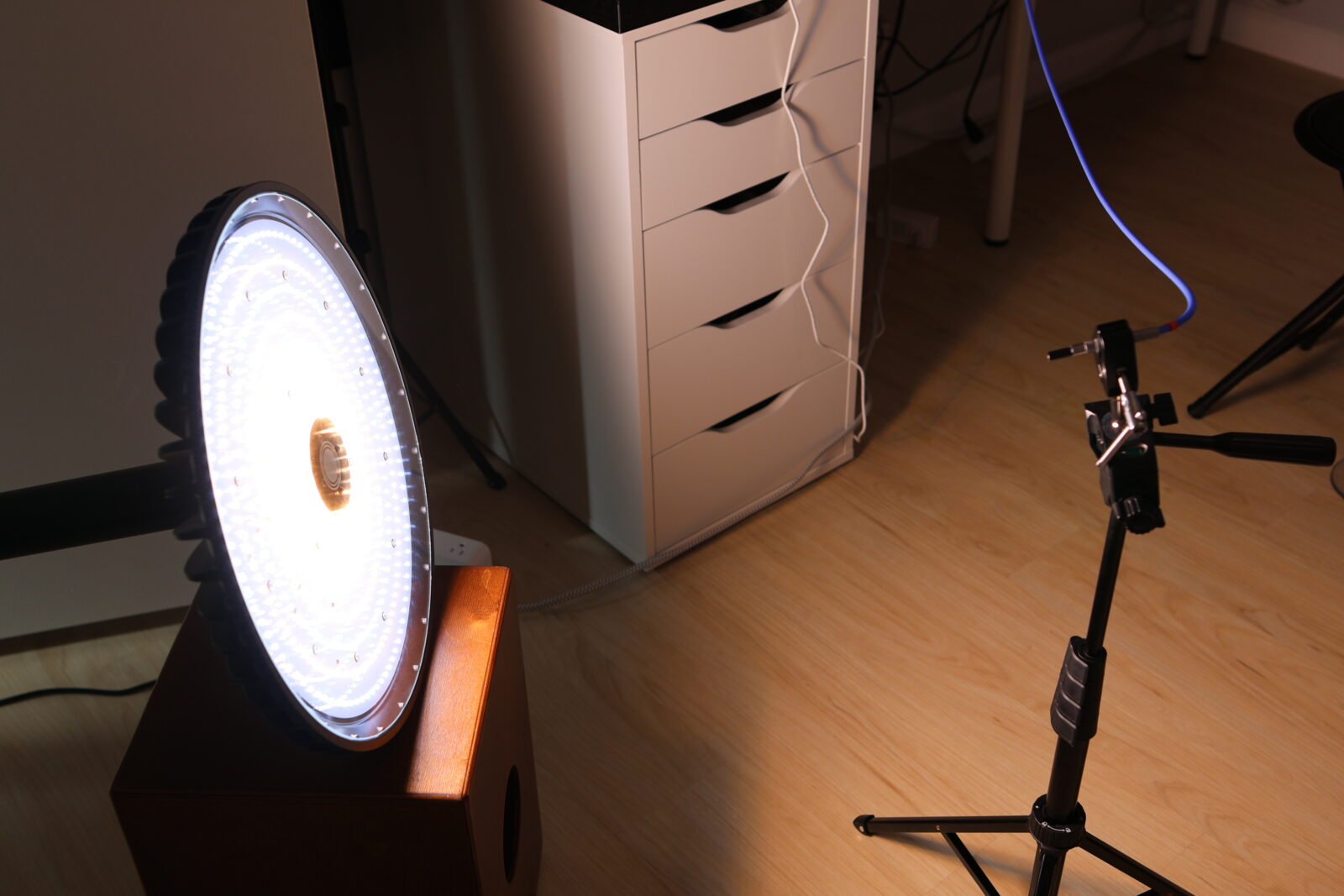
But two feet isn’t where you live. At standing eye level, in a normal room, full power still delivered 3,737 lux and 2,685 melanopic EDI. That comfortably clears most SAD lamps I’ve tested at their rated distance.
One quirk worth knowing: full brightness isn’t the 6500K “daylight” setting. Maximum output happens with the color dial in the middle, where both LED banks run flat out, and that lands around 4200K. It reads less like noon and more like a bright morning.
Spectrum chart. Cool setting 2 ft, 7047K, melanopic DER 1.00, 4% less body-clock light than daylight; Full power 2 ft, 4168K, melanopic DER 0.73, about the same body-clock light than daylight; Warm setting 2 ft, 2823K, melanopic DER 0.47, 4% less body-clock light than daylight.
See the numbers
Cool setting 2 ft
- Color temp
- 7047K
- Body-clock lightMelanopic DER: how much light this lamp gives the body clock for its brightness, compared with daylight at 1.00. Higher means more body-clock light per lux.
- 1.00×
- Vs. daylightBody-clock light compared with daylight of the same color temperature at the same brightness.
- 4% less
Full power 2 ft
- Color temp
- 4168K
- Body-clock lightMelanopic DER: how much light this lamp gives the body clock for its brightness, compared with daylight at 1.00. Higher means more body-clock light per lux.
- 0.73×
- Vs. daylightBody-clock light compared with daylight of the same color temperature at the same brightness.
- About the same
Warm setting 2 ft
- Color temp
- 2823K
- Body-clock lightMelanopic DER: how much light this lamp gives the body clock for its brightness, compared with daylight at 1.00. Higher means more body-clock light per lux.
- 0.47×
- Vs. daylightBody-clock light compared with daylight of the same color temperature at the same brightness.
- 4% less
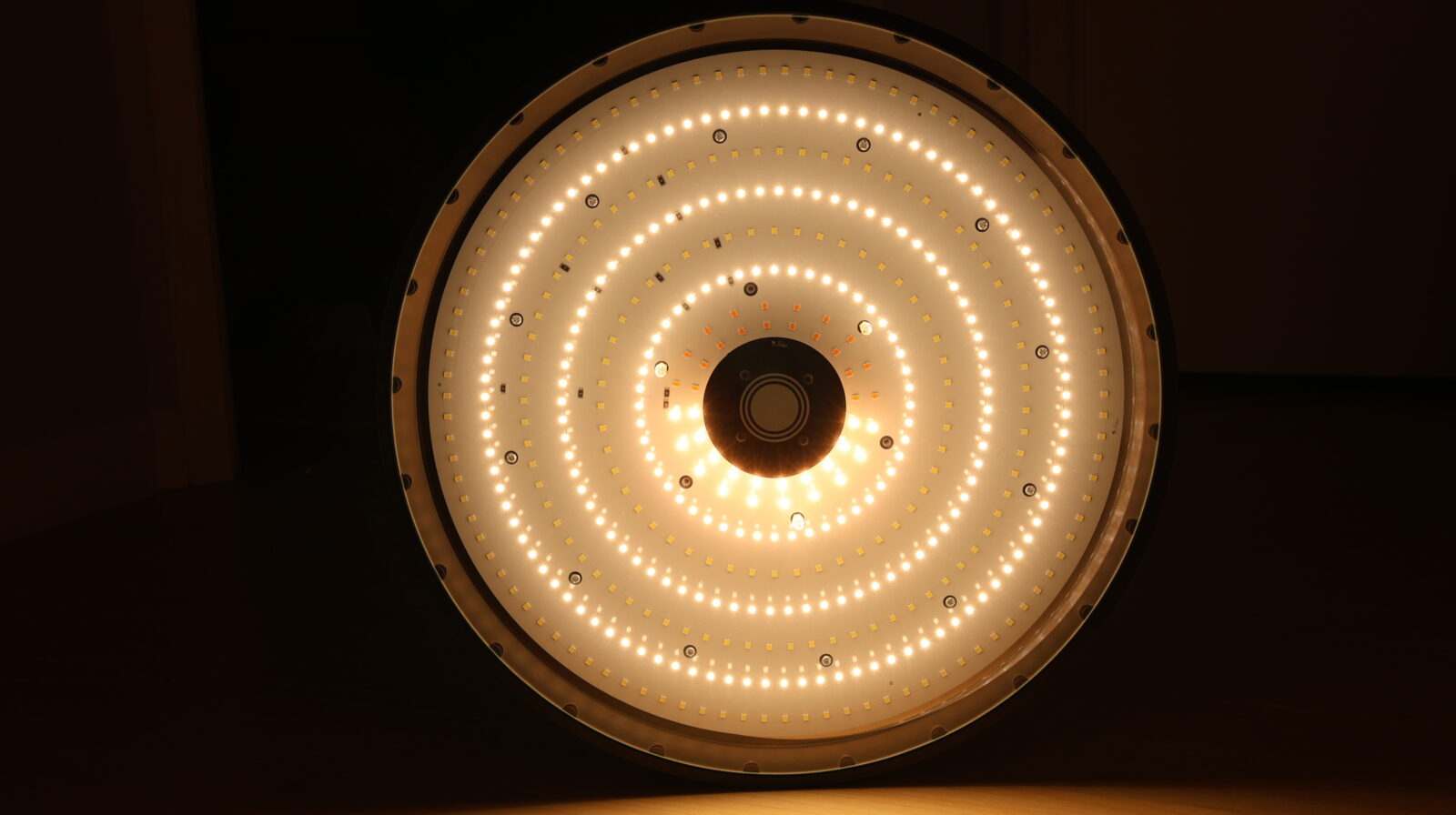
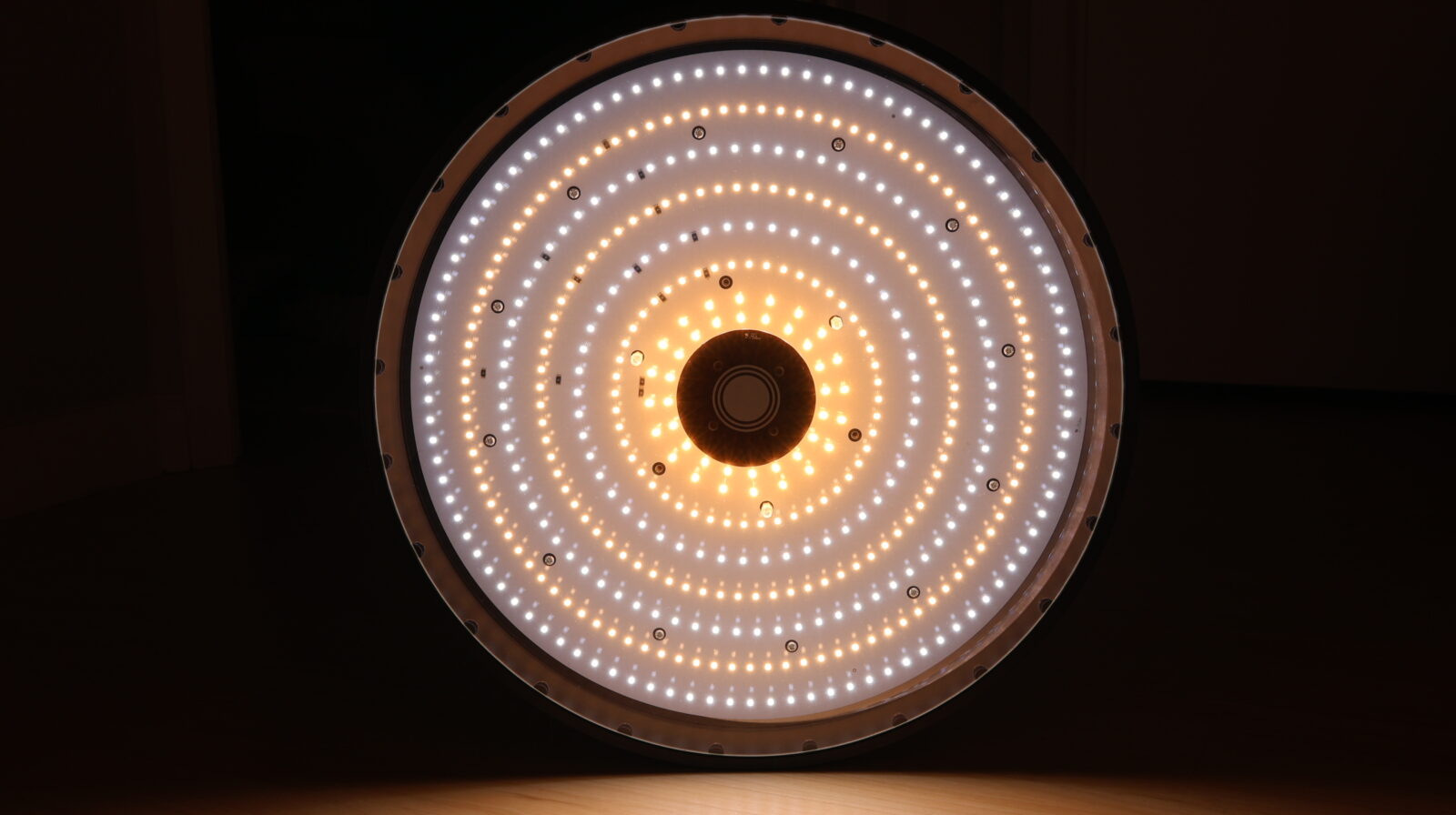
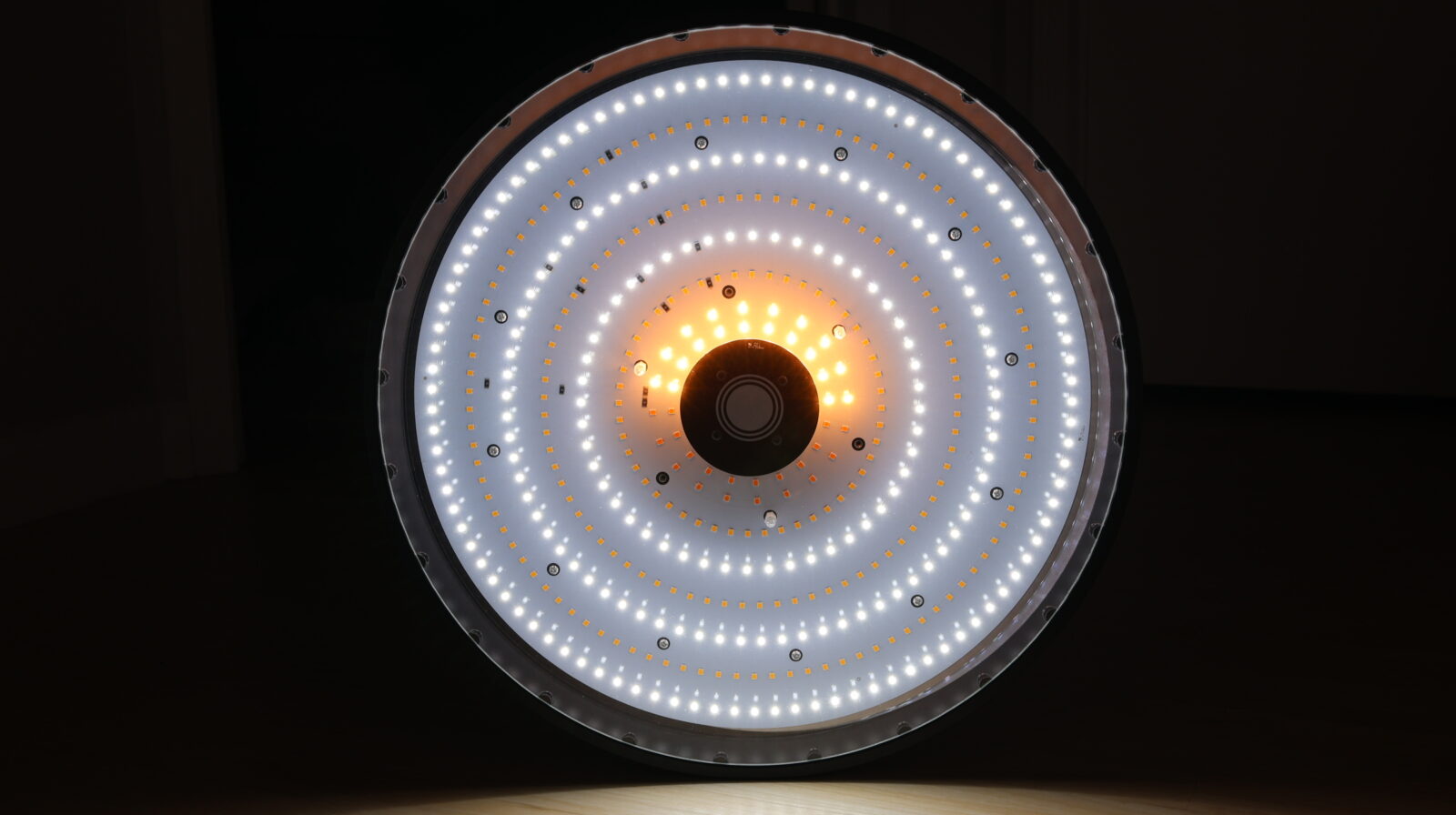
Is 60,000 lumens too much? For some people, yes, and they’ll just dial it down. I’m not one of them.
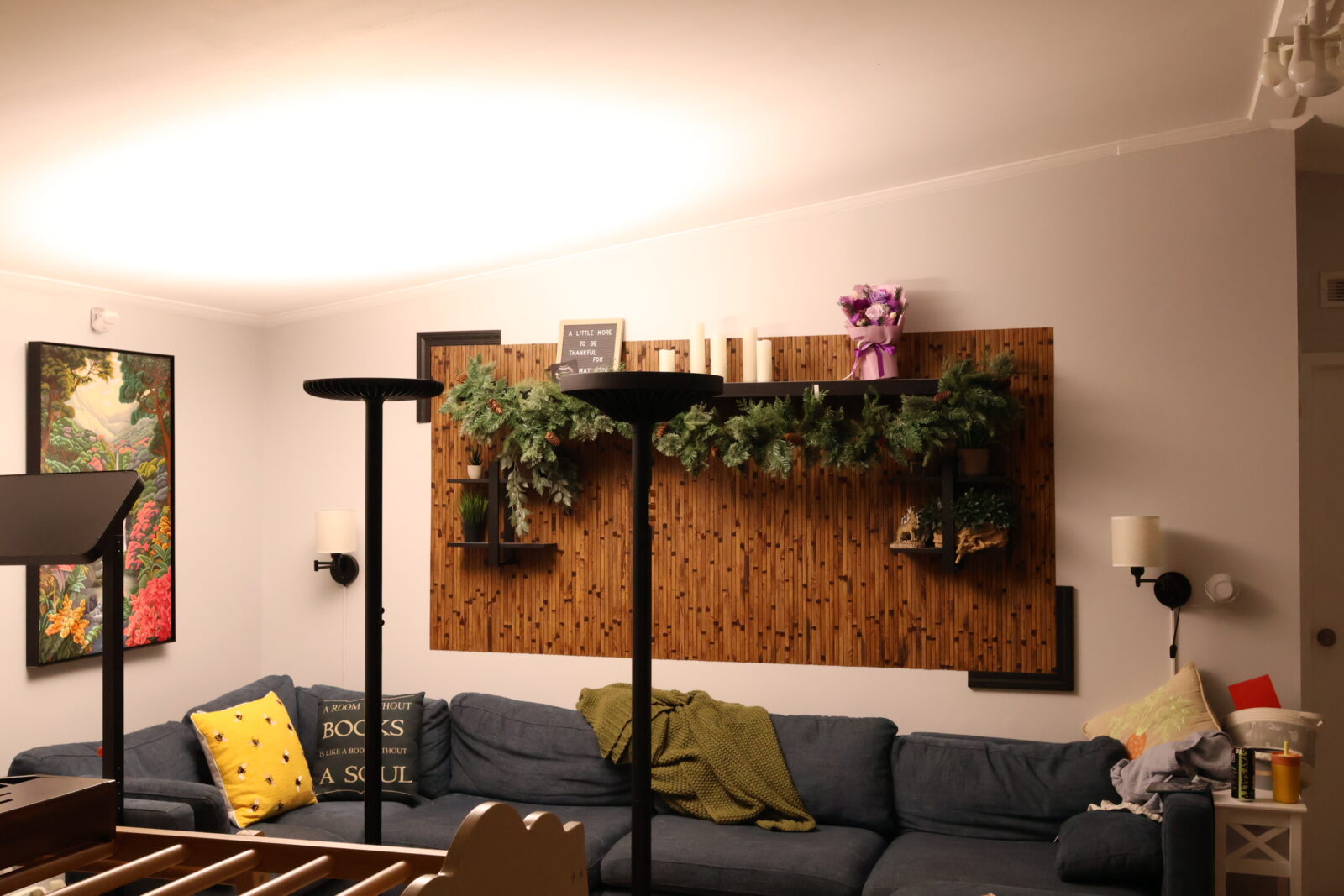
I like a room bright, and this is the first lamp that’s ever given me more than I asked for.
Does Brightness Cost Color?
Brightness and color accuracy aren’t the same thing, and this is where the Brighter shows its priorities. It claims “CRI 95+,” but that’s CRI Ra, the friendlier 8-sample average. On the stricter CRI Re I measured 93 to 94, and a high Ra is always easier to claim than a high Re.
The metric I trust most, TM-30 Rf, lands at ~91. That’s good, though not reference-grade. It slips at the warm end, where CRI Re drops to about 90 and deep-red rendering (R9) falls to around 50.
Spectrum chart. Brighter Lamp, cool setting 2 ft, 7047K, melanopic DER 1.00, 4% less body-clock light than daylight.
See the numbers
Brighter Lamp, cool setting 2 ft
- Color temp
- 7047K
- Body-clock lightMelanopic DER: how much light this lamp gives the body clock for its brightness, compared with daylight at 1.00. Higher means more body-clock light per lux.
- 1.00×
- Vs. daylightBody-clock light compared with daylight of the same color temperature at the same brightness.
- 4% less
Look at that cool-white spectrum. There’s a spike at 454nm, the blue LED pump, then a dip through the 480–500nm cyan region before it recovers.
That’s the classic “cyan gap” of a blue-pumped white LED. You won’t consciously see it, but it’s the kind of thing a spectrometer catches that a spec sheet won’t.
The Flicker Test
Most lamps that advertise “flicker-free” aren’t. They dim with high-frequency PWM and hope you don’t notice. So I test every light at full power and dimmed, because dimming is where flicker usually shows up.
The Brighter is the real deal. I measured 0.21% flicker at full power and 0.69% dimmed, essentially a flat line at both.
A flat line at the top means steady light; dips mean flicker.
Light output by time. Full brightness percent flicker 0.21%; Full brightness frequency Steady light; Full brightness ieee 1789 No observable effect; Dimmed percent flicker 0.69%; Dimmed frequency 59.2 Hz; Dimmed ieee 1789 Low risk.
See the numbers
Full brightness
- Percent flickerHow far the light dips from its brightest, as a share of the total. Under 1% is steady to the eye.
- 0.21%
- Frequency
- Steady light
- IEEE 1789The flicker safety guidance for lighting: how deep the flicker is, for its frequency.
- No observable effect
Dimmed
- Percent flickerHow far the light dips from its brightest, as a share of the total. Under 1% is steady to the eye.
- 0.69%
- Frequency
- 59.2 Hz
- IEEE 1789The flicker safety guidance for lighting: how deep the flicker is, for its frequency.
- Low risk
If you get headaches under bad office lighting, this is the number you came for. It’s one of the cleanest lights I’ve put on the meter, and it’s a big reason the light feels calm despite being so bright.
It Runs Hot (and There’s a Fan)
Here’s the one claim that didn’t survive testing. Brighter says the heatsink stays “cool enough to put your hands on for a couple of seconds” at max.
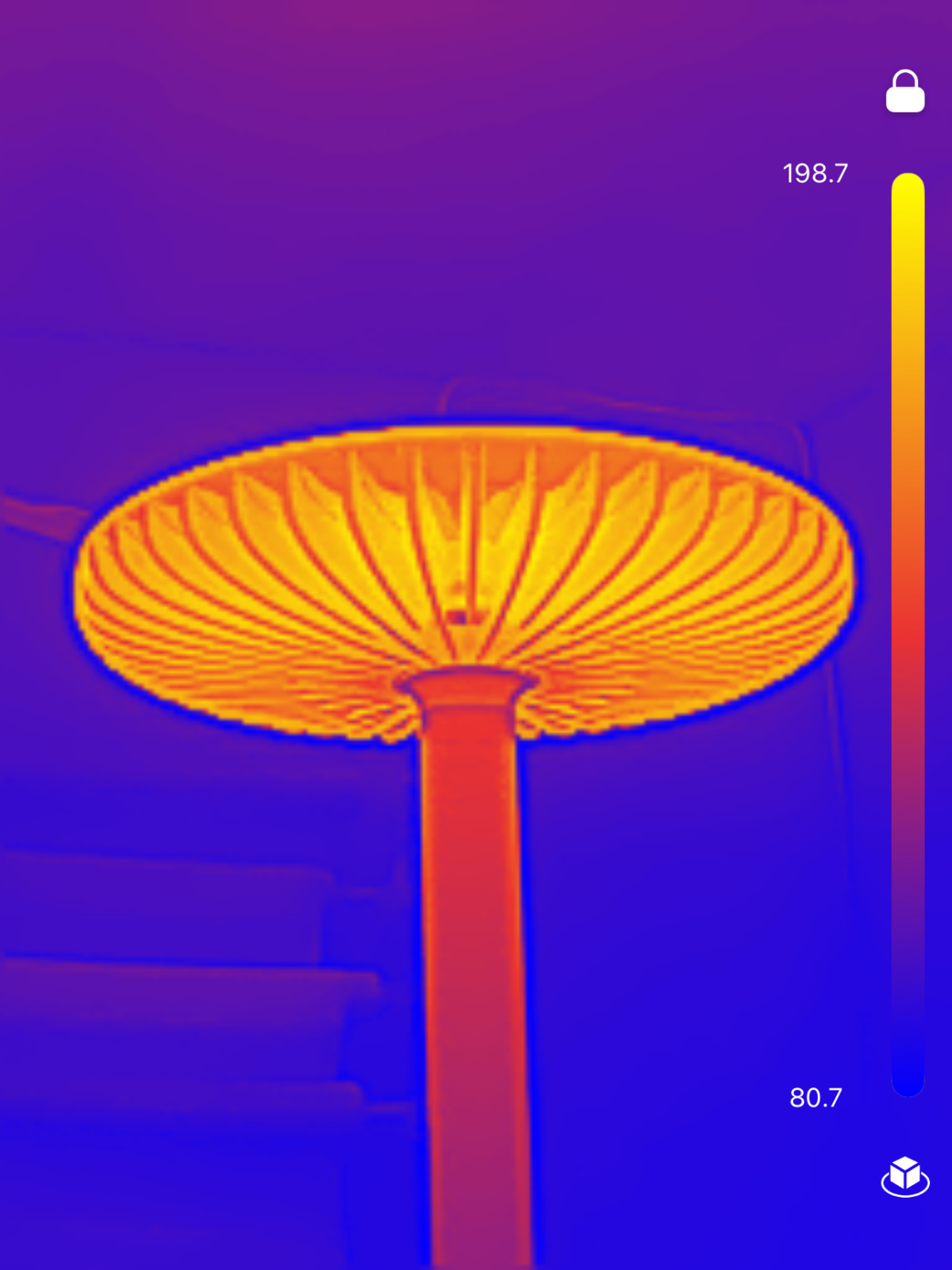
My IR camera read 198.7°F after an hour at full output. That’s hot. Could you tap it for a second? Maybe. Would I? No.
To be fair, dumping this much light means dumping a lot of heat, and the lamp handles it with a fan. It kicks on right away at high power. It isn’t loud, and under any normal room noise you won’t hear it, but the “touchable” line oversells it.
Controls & Smart Home
This is where the Brighter pulls ahead of most premium lamps: it’s a real smart-home device. Hold the power button for five seconds, it pulses white, and you pair it over Matter. Apple Home, Google Home, Alexa, SmartThings, Home Assistant, all of them.
There’s a Matter QR code on the back, too. Scan it and the lamp drops straight into any Matter-compatible smart home.
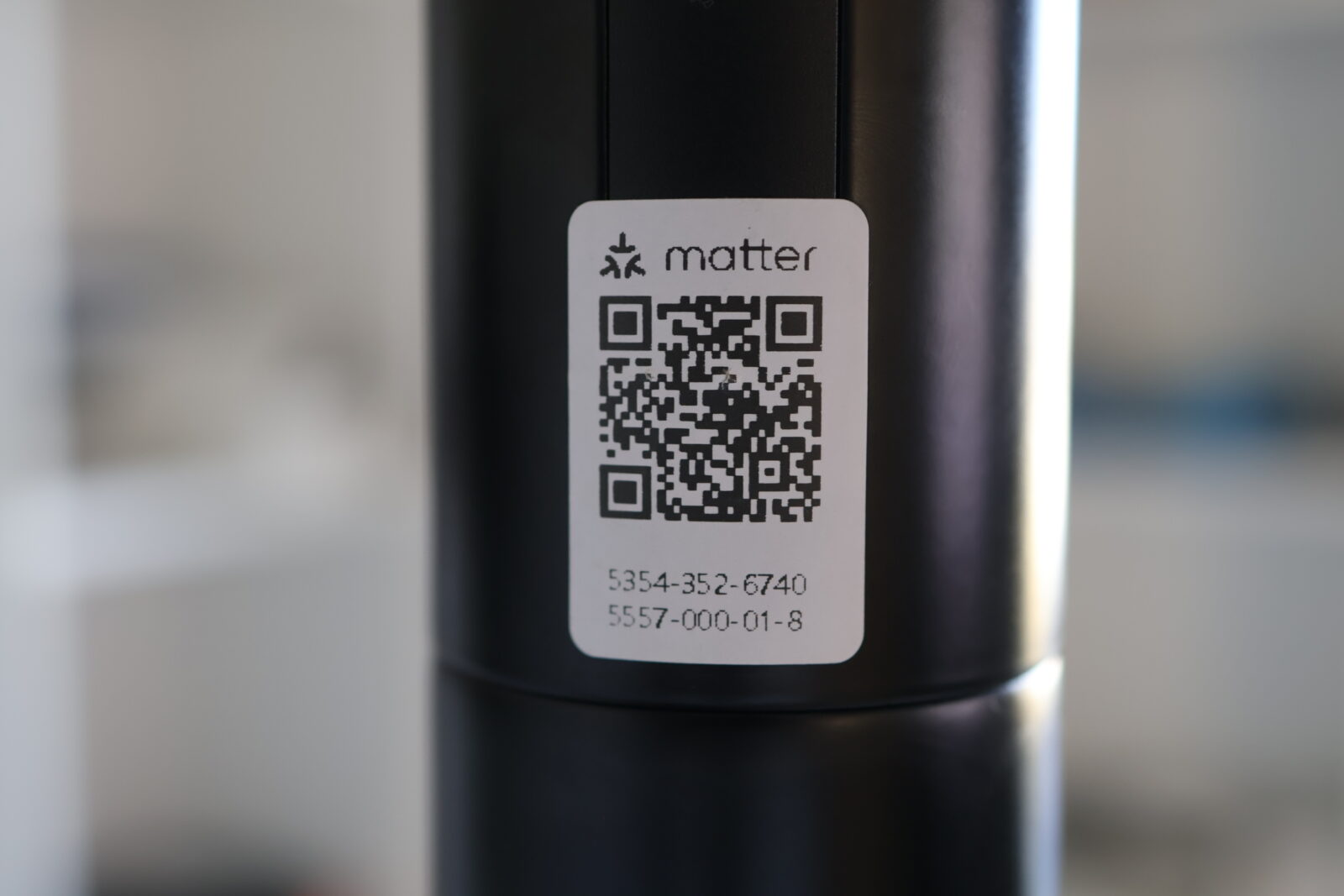
I run Apple Home, so I set adaptive lighting and let the color temperature track the time of day. Cool and bright in the morning, warm by evening, without touching a dial.
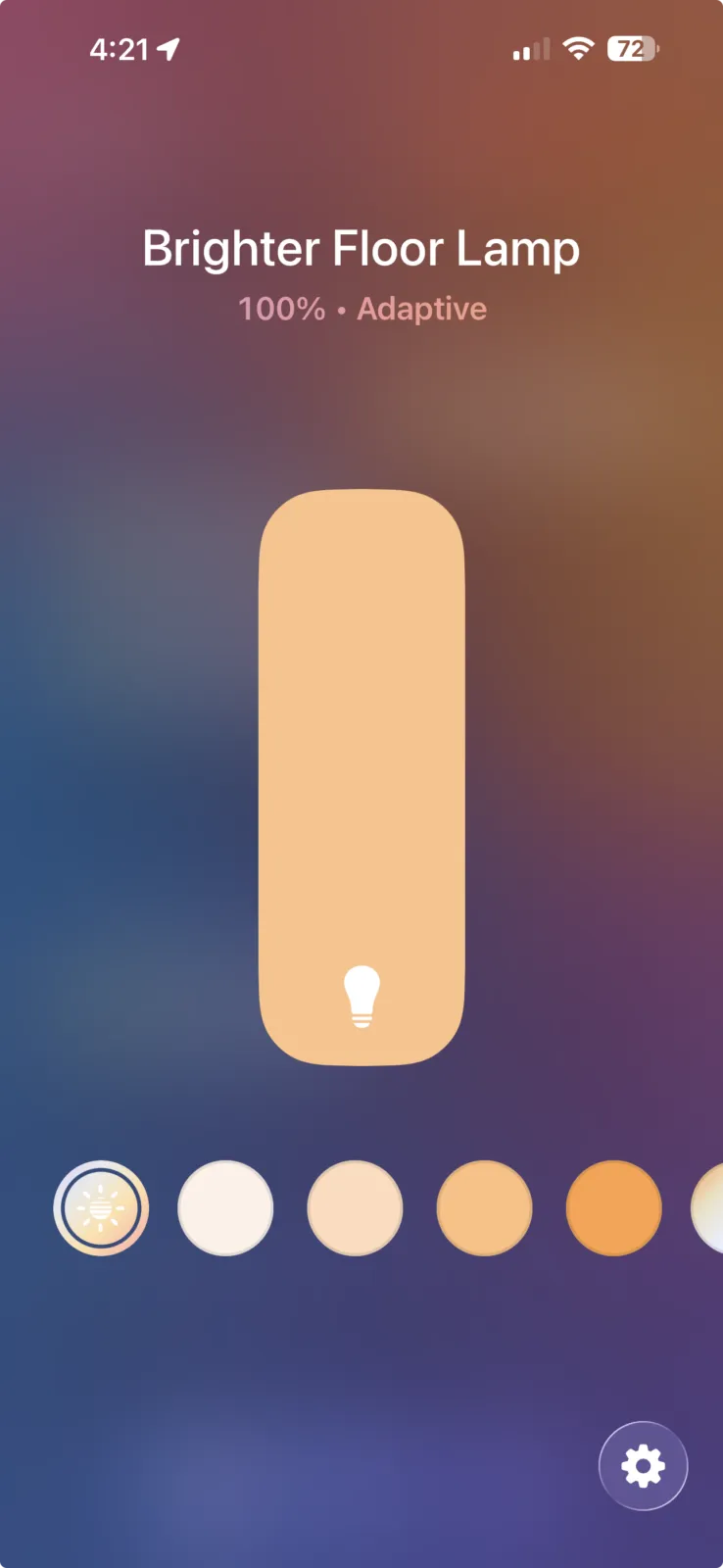
If you’re already in a smart-home ecosystem, that automation is the whole pitch, and it’s a good one.
The manual controls are the weak spot. There’s an on/off button and two knobs, and they’re smooth but laggy. Turn slowly and the light tracks. Turn quickly and it lags behind like it’s catching up.
It’s a small thing, and if you automate the lamp you’ll rarely touch them. Still, the knobs on the far pricier Chroma feel a generation better.
One note for the EMF-conscious: a smart lamp is a lamp with a radio in it. If you actively avoid that, a fully analog light is the trade-off you’d want instead.
Using It at Night
The Brighter tunes warm, but warm isn’t the same as night-safe. At its warmest I measured about 2800K. Even dimmed low, at eye level it still put out 222 lux and 95 melanopic EDI.
Spectrum chart. Brighter Lamp, warm setting 2 ft, 2823K, melanopic DER 0.47, 4% less body-clock light than daylight.
See the numbers
Brighter Lamp, warm setting 2 ft
- Color temp
- 2823K
- Body-clock lightMelanopic DER: how much light this lamp gives the body clock for its brightness, compared with daylight at 1.00. Higher means more body-clock light per lux.
- 0.47×
- Vs. daylightBody-clock light compared with daylight of the same color temperature at the same brightness.
- 4% less
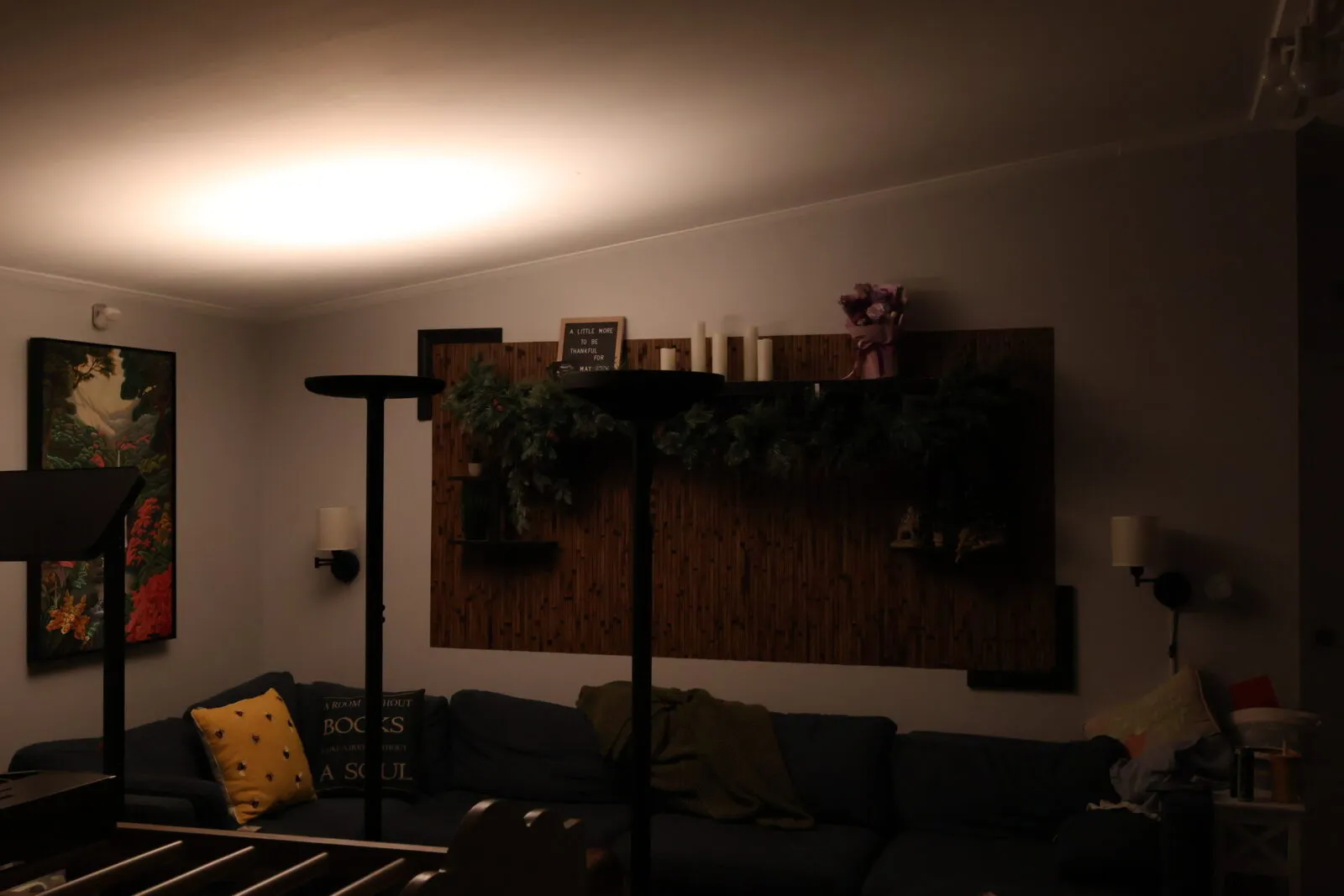
That’s fine a few feet away if you just want ambiance. It’s more light, and more blue in that light, than you want in the last hour before bed.
The lamp only dims a warm white. It can’t strip the melanopic content out the way a dedicated amber or red channel can. For genuine wind-down lighting, I’d reach for something built for it.
Setup, Build & Stability
Assembly took me under five minutes. Two wires feed up through the poles, the parts are labeled, and it’s straightforward.
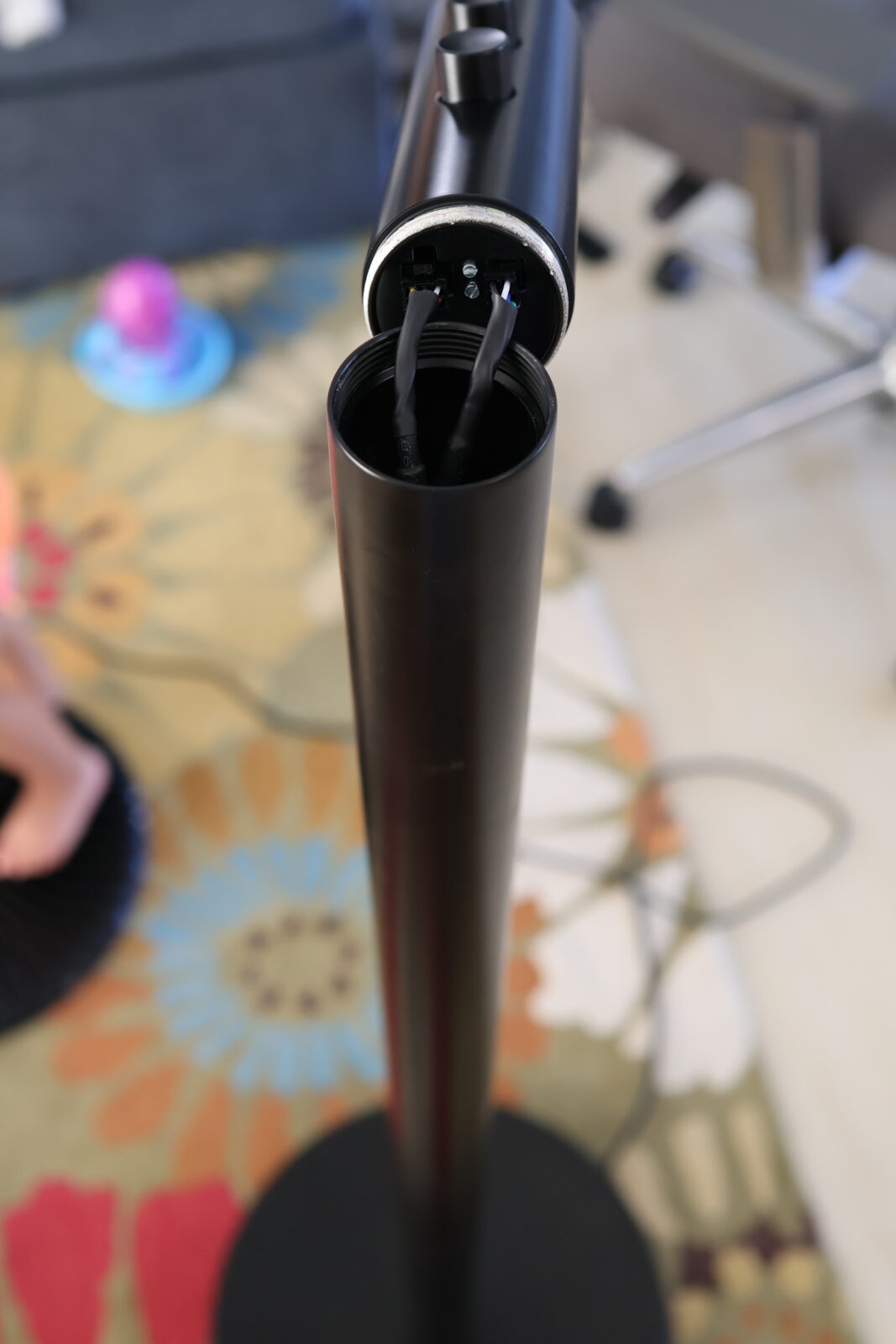
My one gripe: the labels are printed on clear stickers that are oddly hard to read, so peel and check before you commit to a tube.
At 50 pounds it’s substantial but far easier to live with than the 110-pound Chroma. The power cord is only about 70 inches, though, short enough that placement matters.
One caution on stability. The base is bottom-heavy but small, so you could knock this over, and with a heavy heatsink up top a fall could hurt someone or dent a floor. It’s not a daily worry, but worth a thought with kids or a big dog around.
How It Compares
Head-on, the Brighter is brighter than any SAD lamp. But you don’t use it head-on, you bounce it off the ceiling, and standing nearby that’s around 4,000 lux. That lands in the range of plenty of SAD lamps I’ve tested.
So this is about as close to a SAD-lamp replacement as an up-firing floor lamp gets. For the winter blues and a room full of bright, natural-feeling light, it’s a great fit. For a diagnosed circadian problem with a clinician telling you to hit a specific dose, I’d still point you to a dedicated light-therapy panel.
The other question everyone asks is how it stacks up against the Chroma Skylight. Short version: the Brighter wins on brightness, price, and smart automation, while the Skylight wins on color fidelity and true evening light. I put both on the same meters in the Brighter Lamp vs Chroma Skylight comparison.
Should You Buy It?
Buy the Brighter Lamp if you want the most daylight you can physically get into a room, you’re in a smart-home ecosystem, and you’ll park it somewhere you spend real time. For $1,199, the Brighter Lamp gives you roughly four times the brightness of a lamp that costs twice as much.
Skip it if your main goal is gentle evening light, if a hot-running lamp with a fan bothers you, or if you want something you’ll move around often.
Is “world’s brightest” real, or just marketing? I don’t know of a brighter consumer lamp, and I’ve measured a lot of them. The brightness isn’t a gimmick. Just know exactly what you’re buying it for.
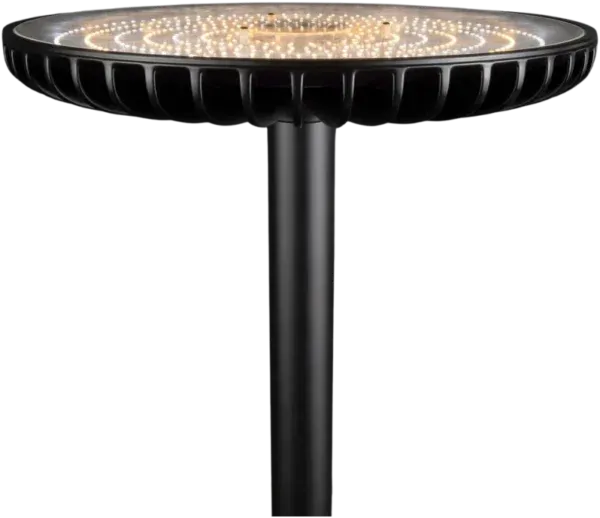
Brighter Lamp
The brightest home lamp I've measured (48,650 lux at 2 ft) and genuinely flicker-free, with smart-home tuning, for half the Skylight's price. It runs hot and the warm end isn't true night light, but for maximum daylight in a room nothing beats it.
Frequently Asked Questions
How bright is the Brighter Lamp?
I measured 48,650 lux at two feet at full power, and 3,737 lux at standing distance. That’s several times brighter than a typical SAD lamp.
Is the Brighter Lamp flicker-free?
Effectively yes. I measured 0.21% flicker at full power and 0.69% dimmed, among the cleanest results I’ve recorded.
Does it work with Apple Home?
Yes. It pairs over Matter with Apple Home, Google Home, Alexa, SmartThings, and Home Assistant, including adaptive lighting.
Is it good for SAD or winter blues?
As a room-flooding daylight lamp, it’s a strong option. For a diagnosed circadian disorder with a prescribed dose, a dedicated light-therapy panel is still the better tool.
Brighter Lamp vs Chroma Skylight, which should I buy?
Brighter for maximum brightness, price, and smart control. Skylight for color fidelity and evening light. Full breakdown in the versus comparison.