
Continuous Pulse Oximeter Database
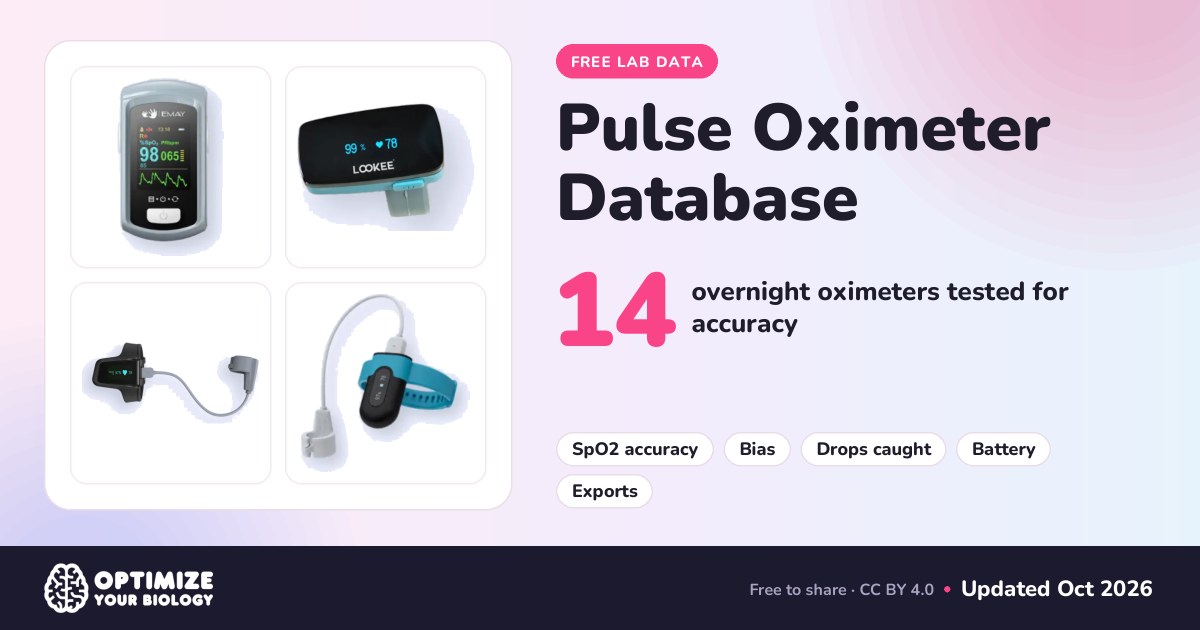
Continuous oximeter questions, answered with test data
Answered with the numbers in this database. They update as I test more products.
What is continuous pulse oximetry?
A pulse oximeter worn for hours, usually overnight, that logs blood oxygen (SpO2) and pulse at a fixed interval instead of giving one spot reading. The devices here log a reading every 1 to 13 seconds.
Can you wear a pulse oximeter all night?
Yes, that is what these are for. Ring and wrist designs are built to stay on all night, and rated battery life across the 18 devices with a figure runs from 10 to 100 hours.
Can a pulse oximeter detect sleep apnea?
It can flag oxygen drops that are worth discussing with a doctor, but it cannot diagnose sleep apnea; that takes a sleep study. I count how many 3% oxygen drops each device catches against a reference: the median device catches 65%. More in the best overnight pulse oximeters.
How accurate are home pulse oximeters?
It varies by device. I compare each one with a reference oximeter over the same nights. 11 of the 14 devices I accuracy-tested read within 1 percentage point of the reference on average; the rest read consistently high or low.
Which continuous pulse oximeters are FDA cleared?
3 of the 18 devices here are FDA cleared: Contec CMS50F, Wellue O2Ring-S, Wellue Checkme O2 Max. Use the clearance filter above to show only these.
Full test results: all 18 continuous pulse oximeters
Sorted by overall O2 score (out of 10). Bias, signal stability and ODI capture are measured against a Nonin 3150 reference worn on the same night. Last updated October 14, 2026.
- 14 of 18 oximeters were worn overnight next to a Nonin 3150 reference oximeter and compared second by second. The other 4 are listed with specs only.
- The highest overall O2 score is the EMAY EMO-90 at 9.7 out of 10.
- 11 of 14 tested oximeters read within 1% of the reference on average (bias).
- The EMAY EMO-90 caught the most 3% oxygen drops (95.8%); the EMAY SleepO2 caught the most 4% drops (100.0%).
Want my recommendations instead of raw data? Read the best overnight pulse oximeters. How I test: my testing standards.
| Oximeter | O2 score | Bias | Signal stability | ODI 3% caught | ODI 4% caught | Battery | Recording | Weight | Price |
|---|---|---|---|---|---|---|---|---|---|
| EMO-90EMAY · Fingertip | 9.7 | 0.0% | 99.8% | 95.8% | 88.4% | 18 h | 72 h | 40 g | $ |
| SleepO2EMAY · Fingertip + wrist unit | 9.7 | −0.1% | 99.0% | 84.1% | 100.0% | 10 h | 48 h | 36 g | $ |
| LOOKEE-SleepO2LOOKEE · Ring | 9.3 | −0.9% | 96.1% | 83.7% | 87.4% | 16 h | 10 h | 16 g | $$$ |
| Checkme O2 MaxWellue · Ring + wrist unit | 9.1 | +0.2% | 99.6% | 80.9% | 78.5% | 72 h | 40 h | 56 g | $$$$ |
| OxyUVibeat · Ring + wrist unit | 8.9 | +1.0% | 95.8% | 58.2% | 96.9% | 16 h | 40 h | 32 g | $$$$ |
| SleepUWellue · Ring + wrist unit | 8.8 | +1.9% | 70.1% | 91.0% | 94.4% | 16 h | 40 h | 31 g | $$$ |
| Ring-ProLOOKEE · Ring | 8.7 | −0.6% | 97.5% | 68.1% | 76.6% | 16 h | 40 h | 18 g | $$$$ |
| OxyLinkVibeat · Ring | 8.7 | +1.1% | 97.3% | 62.2% | 84.1% | 12 h | 40 h | 21 g | $$$ |
| OxyfitWearpulse · Fingertip | 8.7 | +0.9% | 98.9% | 58.5% | 77.5% | 14 h | 40 h | 30 g | $$ |
| Checkme 02 UltraWellue · Ring + wrist unit | 8.7 | +0.2% | 99.0% | 59.2% | 80.5% | 100 h | 48 h | 64 g | $$$$ |
| EMO-80EMAY · Fingertip | 8.2 | +2.5% | 58.9% | 95.0% | 87.3% | 40 h | 40 h | 50 g | $ |
| O2RingWellue · Ring | 8.2 | +0.7% | 99.1% | 48.9% | 64.1% | 14 h | 10 h | 15 g | $$$ |
| WearO2Vibeat · Ring | 8.1 | +0.7% | 99.4% | 37.6% | 67.3% | 16 h | 40 h | 20 g | $$ |
| O2Ring-SWellue · Ring | 8.1 | +1.0% | 98.2% | 43.3% | 68.1% | 24 h | 40 h | 16 g | $$$$ |
| Circul +Circul · Ring | Not tested | n/a | n/a | n/a | n/a | 15 h | n/a | n/a | $$$$ |
| CMS50FContec · Fingertip + wrist unit | Not tested | n/a | n/a | n/a | n/a | 24 h | 72 h | 60 g | $$$ |
| 50GHOLFENRY · Fingertip | Not tested | n/a | n/a | n/a | n/a | 15 h | n/a | 14 g | $ |
| WearpulseWearpulse · Fingertip | Not tested | n/a | n/a | n/a | n/a | 14 h | 40 h | 37 g | $ |
Free to reuse under CC BY 4.0. Please credit Optimize Your Biology with a link.