


That first half hour after a normal alarm goes off is the worst part of my day. Phone screaming, heart lurching, and then thirty minutes of slow, almost-hungover fog before I feel like a person again. Wake up after the room has already brightened and that fog mostly isn’t there.
So do sunrise alarm clocks work? Yes — mostly because they make waking up less groggy, which is a bigger deal than it sounds. The honest catch is that a lot of the marketing around them is oversold. The wake-up benefit is real and well-supported; the “resets your clock overnight” and “replaces your coffee” stuff is not.
- Sunrise alarms reliably make waking up easier and less groggy — that alone makes them worth it for most people.
- Strong clinical evidence for winter SAD; weaker, mixed evidence for cortisol and “performance.”
- The studies use ~250–300 lux at your eyes, so the lamp has to be close — within 18–24 inches.
- Phone “sunrise” apps don’t deliver enough light to count. Use a real lamp.
If you’re on the hunt, check out our best sunrise alarm clock list! →
Do they actually work?
Short version: yes, but not for everything the box promises.
Here’s the honest breakdown. The evidence is strong for two things: less subjective grogginess in the morning, and treating winter-pattern seasonal affective disorder. It gets weaker fast after that. Cortisol, objective performance on reaction-time tasks, cardiovascular benefits — all thin, small-sample, and mixed.
That gap is the whole point of this article. Most “do sunrise alarms work” pieces either parrot the manufacturer’s benefit list with zero grading, or bury you in a wall of studies. I’d rather tell you which claims I’d put money on and which I wouldn’t.
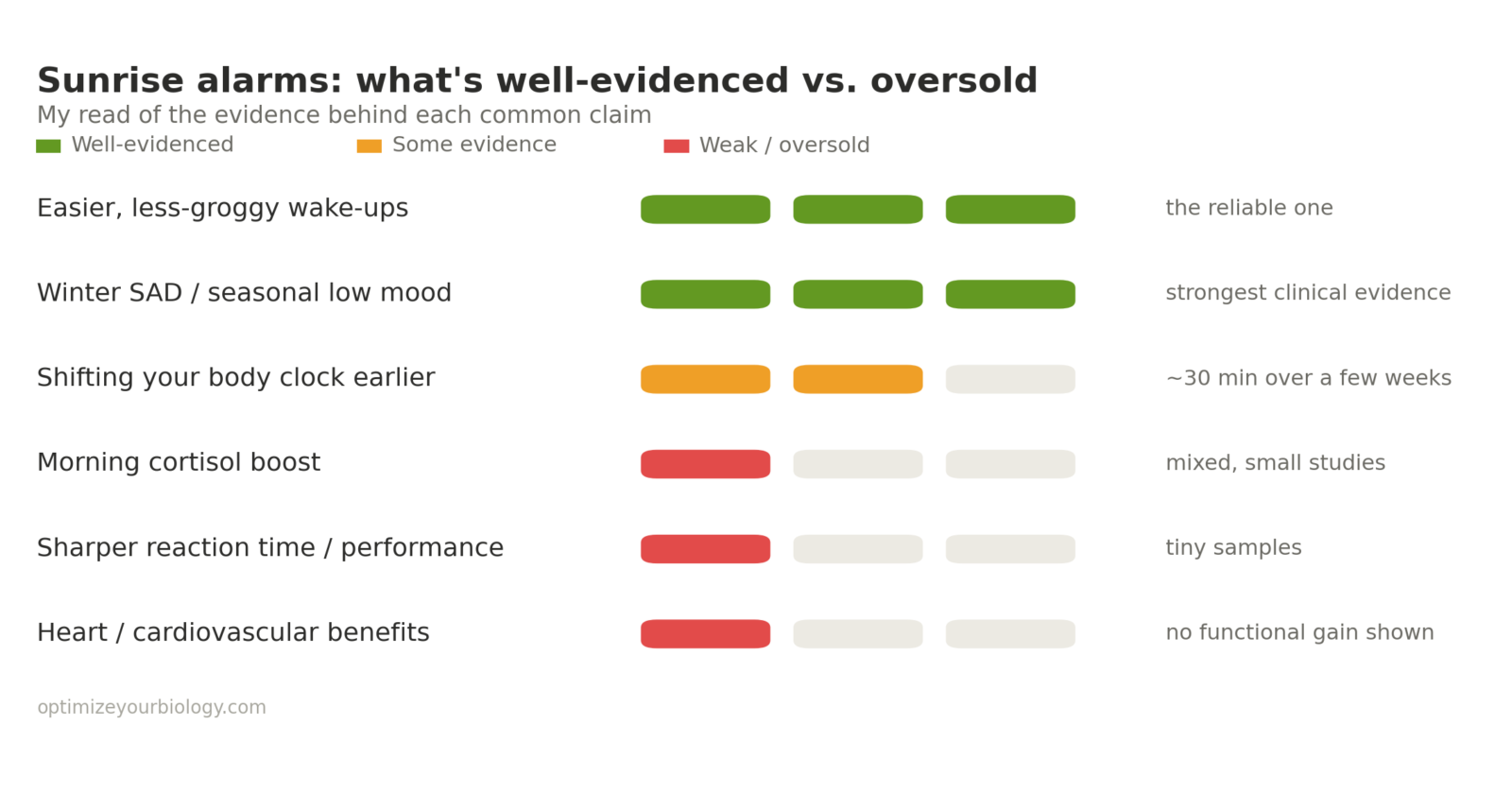
The strongest single finding is winter SAD, where dawn simulation performs at the level of a 10,000-lux light box — sometimes better. The most useful finding for most people is the grogginess one, because everybody wakes up and almost nobody has SAD. The rest is supporting cast.
Free · 95 pages
You're reading about one piece of this. The book is the whole day.
The Circadian Blueprint covers setting your body clock with light — the timing, the doses, and which products actually deliver them. Every number came off my own spectrometer.
What a sunrise alarm is actually good for
Lead with the one that’s real and universal: it makes getting up easier.
Easier, less-groggy wake-ups
This is the no-brainer. The single most replicated dawn-simulation finding is reduced subjective sleep inertia — that slow, foggy feeling in the first 30 minutes — and higher subjective alertness on waking.
In a 2010 crossover study in the Journal of Sleep Research [1], a 30-minute artificial dawn before the alarm cut subjective sleepiness and raised activation compared to just having the lights snap on at wake time. The proposed mechanism: more light sleep in the final 30 minutes before the alarm, plus a faster drop in skin temperature after rising. A small 2014 study [2] in habitually difficult wakers found the same direction — better perceived sleep quality, better alertness across the first 75 minutes awake.
Worth being straight about the ceiling here: these are mostly subjective gains. The objective performance numbers (reaction time, math tasks) are smaller and only really show up in people who are sleep-deprived or terrible morning wakers to begin with. As a feel-better-on-waking device, though, the effect is consistent and it’s held up for me every time I’ve used one.
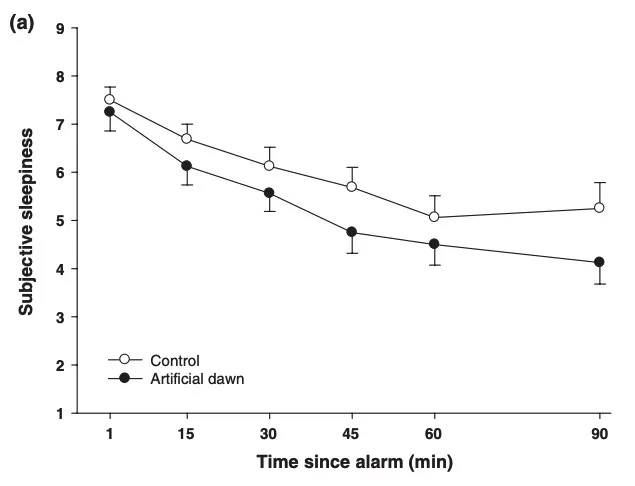
Subjective sleepiness on waking drops with a dawn ramp vs. control (Van de Werken 2010).
Nudging your body clock earlier
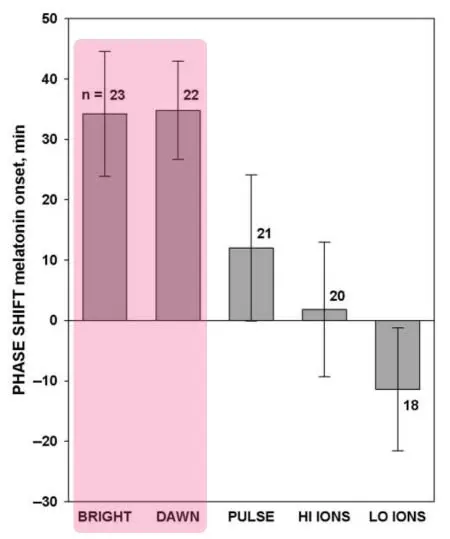
If you’re a night owl fighting an early start, a sunrise alarm can pull your clock earlier. A 3-week field trial from Terman & Terman (2010) [3] found a naturalistic ~90-minute dawn advanced DLMO by about 30 minutes — roughly equivalent to 30 minutes of 10,000-lux bright light therapy after waking.
That’s a real circadian effect, but notice the size: ~30 minutes over a few weeks, not a one-night reset.
Winter blues and SAD
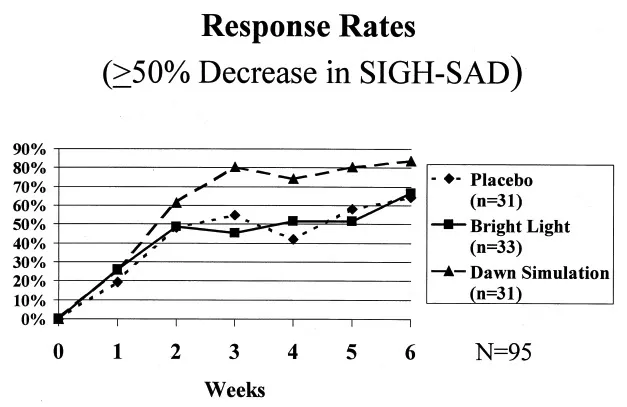
This is the best-established use, full stop. In a 2001 trial of 95 medication-free SAD patients [4], dawn simulation beat both a dim-light placebo and a 10,000-lux light box on remission and response. A 2005 meta-analysis [5] put the effect size for dawn simulation in SAD at 0.73 — clinically meaningful, and on par with bright-light therapy. The APA lists both as first-line.
If you deal with winter lows, a sunrise alarm may help here, and the evidence behind that is the strongest in this whole category. (Not a substitute for treatment if you’re struggling — talk to a clinician.)
How it actually works (the quick science)
Here’s the part most people find surprising: you experience the dawn through your closed eyelids, before you ever open your eyes.
Light through closed eyelids
Your eyelids aren’t blackout curtains. They pass a small slice of light through to the retina, and which light gets through is the interesting part. When researchers measured eyelid transmittance in 2011 [6], they found the lid blocks roughly 99% of visible light on average — but it blocks blue far more than it blocks warm orange and red.
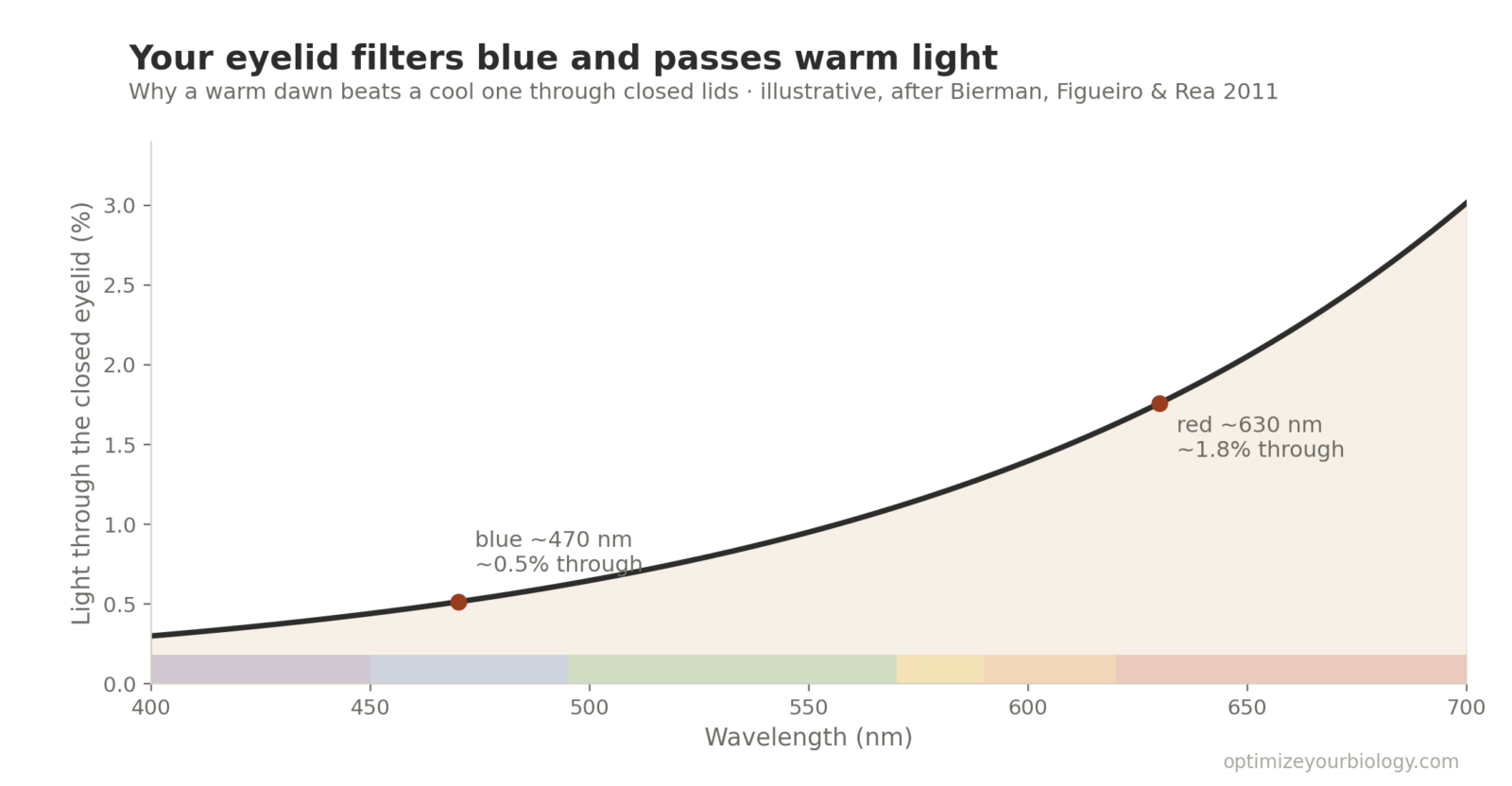
That single fact rewrites the “blue light is best” assumption for this specific case. Through a closed lid, a warm 2700K dawn delivers more usable signal to your circadian system than a cool blue one, because the blue gets filtered out before it reaches the cells that matter. The light still reaches the melanopsin-containing ipRGCs that drive your clock and your wake-up — just enough of it, in the right color, in the last stretch of sleep.
Why light beats a sound alarm
My own read on this — and I’ll flag it as my reasoning, not something the literature has nailed down — is that light wins because it isn’t jarring. You drift up through your sleep stages and the light tends to catch you when you’re already in a lighter stage, closer to a natural wake. A harsh sound yanks you out of wherever you happen to be.
There’s backing for the mechanics: the 2010 dawn study above found more wake and light sleep in the final 30 minutes before the alarm. So by the time the backup sound goes off, you’re already most of the way up. That’s the gentler, sleep-stage-synced waking I think does most of the work.
The cortisol question, honestly
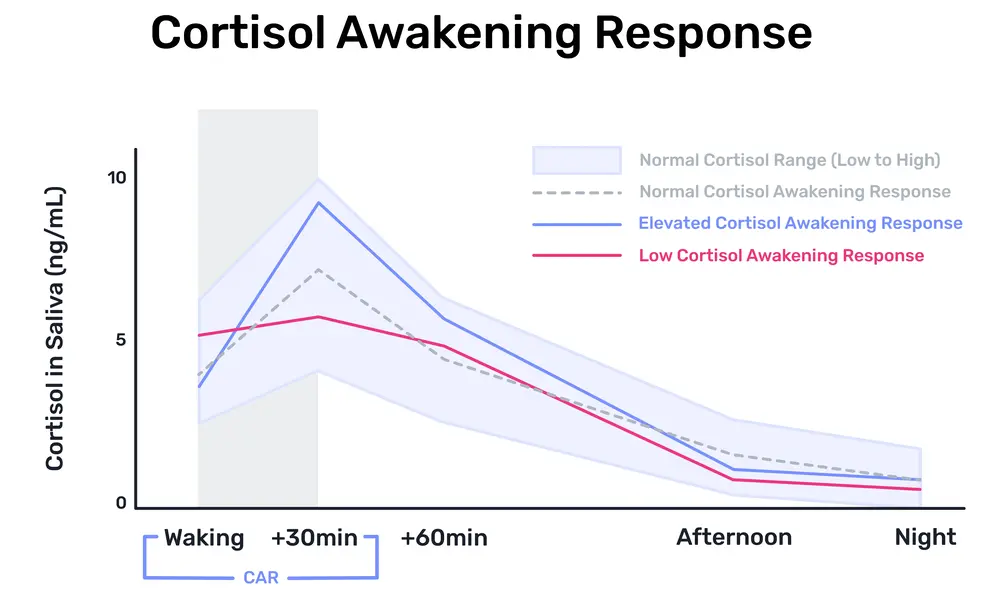
You’ll see a lot of confident claims that sunrise alarms boost your morning cortisol pulse. The evidence is honestly mixed. One small 2004 study [7] found a dawn ramp increased cortisol in the first 45 minutes after waking; other studies, including a controlled trial in older adults [8], found no effect at all.
I’m skeptical of leaning hard on cortisol, and I’d treat any product that builds its whole pitch around it with caution. It might be doing something. It’s just not the reason to buy one.
How to use one (and where to put it)
Here’s the number nobody else gives you: the studies that show a benefit use roughly 250–300 lux at your eyes, and most lamps can’t deliver that where you actually sleep.
How close, how bright
I measured this on the Lumie Bodyclock Shine 300, one of the lamps that actually does reach a research-grade dose — at the right distance.
| Distance from face | Lux @ max | vs. study target (250-300) |
|---|---|---|
| 18 in | 362 | above |
| 24 in | 220 | just under |
| 30 in | 150 | under |
| 36 in | 110 | well under |
Inverse-square law in action — push the lamp across the room and you’re getting a fraction of the dose.
The takeaway is blunt: aim for 18–24 inches from your face at full brightness. Park it on a far dresser and you’re running an underpowered version of the thing the studies tested.
This is also why a phone app doesn’t cut it. A dedicated lamp gives you 300-plus lux at 18 inches; a phone propped up and facing you is maybe ~50 lux, because the screen is small and dim next to a real lamp. A phone sunrise is probably better than nothing, but the science isn’t behind it.
How long a ramp
What actually wakes you is the light dose reaching your eyes, not the ramp length on its own. Once the light gets bright enough, early enough, you surface — so peak brightness is the main dial. Keep the peak lower and you stay under your personal wake-threshold longer; crank it and you’ll come up sooner.
That’s why ramp shape matters more than the raw number of minutes. A back-loaded ramp like the Shine 300’s sits under 3 lux for the first 15 minutes, then climbs hard at the end, so even a 60-minute setting keeps the real dose low until you’re close to wake time. I run at least 60 minutes for exactly that reason: it feels gradual without throwing light at me early.
If you’re a heavy sleeper who needs waking, go brighter. A higher peak means more dose, which is what it takes to clear a high wake-threshold, and lean hard on the backup alarm. Some people start with a shorter, punchier ramp while building the habit, then stretch it out once getting up gets easier. Sensitivity varies a lot between people, so treat brightness and duration as two dials to experiment with.
Output by time. Bodyclock Shine 300, lumie Shine 300 sunrise ramp (graph data #37557) ramp length 30 min.
See the numbers
Bodyclock Shine 300, lumie Shine 300 sunrise ramp (graph data #37557)
- Ramp length
- 30 min
The real ramp: barely anything for the first 15 minutes, then a hard climb in the final 10.
Placement workaround
If you roll over and face away, the light hitting your eyes drops off hard. One fix worth trying is an overhead light mounted close above the bed (not a high ceiling fixture across the room) on a sunrise schedule, so it reaches you whichever way you’re facing — I cover that setup in my smart light sunrise guide.
The downsides nobody mentions
The real problem with sunrise alarms isn’t whether they work — it’s waking up before you mean to.
The brighter the light gets, and the earlier it reaches that brightness, the more likely you surface ahead of schedule. For most people that’s fine or even pleasant. If you’re a light sleeper it can backfire, and if you have a job to get to, the fear of not waking is legitimate.
The fix is simple. Leave yourself runway (don’t schedule the sunrise to finish at the last possible minute) and set an audible backup alarm 10–30 minutes after the sunrise starts. It kills the oversleep anxiety and still lets you come up gently. This is the single best trick I know for living with one of these.
A few other honest caveats:
- You can wake a partner. Real issue if you share a room and they’re on a different schedule.
- Some people just get less out of it. Older adults (the aging lens filters more light), people near the equator (real dawn already does the job most of the year), and anyone who sleeps in a contact-fitting eye mask, which blocks the light entirely.
One more thing if the lamp just isn’t waking you: it might not be the lamp. Not waking to morning light is often a sign of weak circadian rhythmicity — your clock isn’t strongly entrained, so the signal doesn’t land hard enough to pull you up.
Two fixes. First, give it longer; a few weeks of consistent use lets your rhythm tighten up. Second, work the rest of your light diet, not just the wake-up:
- Morning sunlight within an hour of getting up.
- Bright light through the first half of the day.
- Dim, warm light in the evening.
- A cooler bedroom overnight.
I lay out the whole routine in my guide to resetting your circadian rhythm. The lamp lands best when the rest of your clock is already pulling the same way.
The backup-alarm trick — set an audible alarm 10–30 minutes after your sunrise begins. Best insurance against both oversleeping and wake-anxiety.
So, should you get one?
If you’re not waking up to light and you could be, it’s close to a no-brainer. Who wouldn’t want a less-groggy morning? The wake-up benefit is the real case; the circadian and SAD evidence is strong supporting material on top.
One caveat I’ll keep saying: a sunrise lamp is a bridge to real morning daylight, not a substitute for it. The best protocol is the lamp before wake, then actual sunlight within an hour of getting up. Outdoor light is orders of magnitude brighter than any lamp [9], and it’s still number one.
For specific picks, the Lumie Bodyclock Shine 300 is the unit I tested and a solid choice — bright, reaches the dose, not too expensive. The JALL is a reasonable budget option. I keep the actual head-to-head ranking in my best sunrise alarm clocks roundup rather than re-fighting it here.
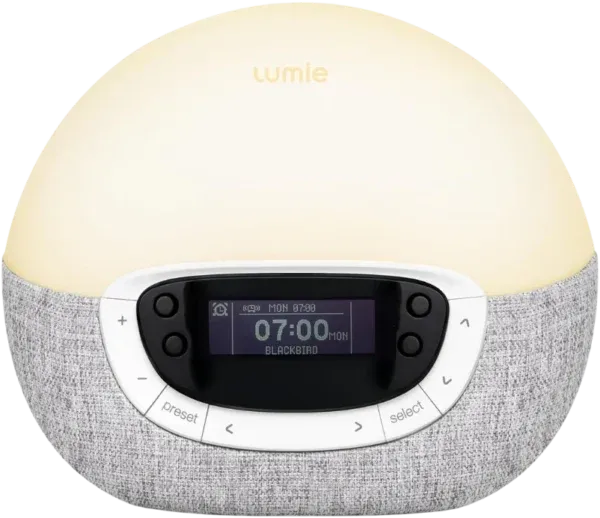
Lumie Bodyclock Shine 300
The unit I tested. Hits ~360 lux at 18 inches — into the study band — with a 15–90 min warm dawn. The one I'd start most people on.
Waking up to a sunrise is what we’re made for, so you should try to recreate that as best you can.
If you’re on the hunt, check out our best sunrise alarm clock list! →
Frequently Asked Questions
Are sunrise alarm clocks healthy / healthier than a normal alarm?
For most people, yes. A gradual light wake produces less of the jarring, sleep-inertia-heavy start that a sudden sound alarm does, and the morning-light exposure is mildly helpful for your body clock. There’s no real downside for healthy users beyond the practical ones (waking a partner, early waking).
Is it better to wake naturally than to an alarm at all?
Waking naturally at the end of a sleep cycle is ideal, but most people can’t because work doesn’t bend to their clock. A sunrise alarm is the closest practical stand-in — it eases you toward waking instead of interrupting deep sleep cold.
How long should I set the sunrise?
Start at 30 minutes; move to 60 or longer if you can. Longer, back-loaded ramps feel gentler and keep the light dose low until near wake time. It’s worth experimenting — sensitivity varies a lot between people.
Are sunrise alarm clocks worth it?
For the wake-up alone, for most people, yes — provided you get a lamp that actually reaches ~250–300 lux at 18–24 inches and you place it close. Skip the phone apps, and pair it with real daylight after you’re up.
References
- Van de Werken et al., “Effects of artificial dawn on sleep inertia, skin temperature, and the awakening cortisol response.” J Sleep Res 2010 https://doi.org/10.1111/j.1365-2869.2010.00828.x ↩
- Thompson et al., “Effects of dawn simulation on markers of sleep inertia and post-waking performance.” Eur J Appl Physiol 2014 https://doi.org/10.1007/s00421-014-2831-z ↩
- Terman & Terman, “Circadian rhythm phase advance with dawn simulation treatment for winter depression.” J Biol Rhythms 2010 https://doi.org/10.1177/0748730410374000 ↩
- Avery et al., “Dawn simulation and bright light in the treatment of SAD: a controlled study.” Biol Psychiatry 2001 https://doi.org/10.1016/S0006-3223(01)01200-8 ↩
- Golden et al., “The efficacy of light therapy in the treatment of mood disorders: a review and meta-analysis.” Am J Psychiatry 2005 https://doi.org/10.1176/appi.ajp.162.4.656 ↩
- Bierman, Figueiro & Rea, “Measuring and predicting eyelid spectral transmittance.” J Biomed Opt 2011 https://doi.org/10.1117/1.3593151 ↩
- Thorn et al., “The effect of dawn simulation on the cortisol response to awakening in healthy participants.” Psychoneuroendocrinology 2004 https://doi.org/10.1016/j.psyneuen.2003.08.005 ↩
- Zeitzer et al., “Effect of artificial dawn light on cardiovascular function, alertness, and balance in middle-aged and older adults.” SLEEP 2020 https://doi.org/10.1093/sleep/zsaa082 ↩
- Brown et al., “Recommendations for daytime, evening, and nighttime indoor light exposure.” PLOS Biology 2022 https://doi.org/10.1371/journal.pbio.3001571 ↩
Keep reading
 Circadian Rhythm
How to Set Up a Smart Light Sunrise Alarm: The Ultimate Guide
 Circadian Rhythm
20 Strategies to Reset Your Circadian Rhythm: Ultimate Guide
 Sleep Environment
Do Baby Monitors Prevent SIDS? An Honest, Evidence-Based Answer
 Full-Spectrum Lighting