

The Better than Sunshine lamp from Mitolux is one of the most exciting new vitamin D lamps to hit the market! Of course, as usual, we checked the UVB and infrared output with our lab-grade spectrometers, so you know exactly what you’re getting!
I also tested my vitamin D results, which were not what I expected… jump to those here.
Let’s jump right in!
The Overview
The Mito Lux is designed to mimic natural sunlight exposure, emitting infrared before and after UVB. While it offers a well-thought-out design with a proximity sensor for safety and multiple modes for different skin types, my month-long test only resulted in a modest 1.5 ng/mL increase in vitamin D.
It may still provide some benefit for those looking to supplement sun exposure, with the added perk of red/infrared light therapy. However, based on my experience, expectations for vitamin D production should be tempered until more testing is done.

Pros:
Cons:
🏷️ 10% off with link ⤵
The Mitolux Vitamin D Lamp
The Mitolux is a vitamin D lamp with a unique twist. Unlike traditional broadband fluorescent UV lamps, it utilizes 295nm narrowband UVB LEDs for a more precise and efficient effect. (in theory)
Free · 95 pages
You’re reading about one piece of this. The book is the whole day.
The Circadian Blueprint covers setting your body clock with light — the timing, the doses, and which products actually deliver them. Every number came off my own spectrometer.
Check your inbox to confirm. Plus a short note each month on what I’ve tested — unsubscribe anytime.
But that’s not all—it also mimics the Sun by incorporating healthy doses of red and infrared light before and after UVB exposure, improving its safety. This comes in the form of 590nm, 630nm, 830nm, and 850nm LEDs that can help prepare and heal your skin during a session.

This is a perfect pairing for anyone who wants to produce vitamin D without worrying about irradiating their skin with UVA or getting a tan.
The Mitolux feels like a quality product! It weighs 3 lbs, has an all-metal and glass body, and features an onboard fan to keep the electronics cool during use.

Using the Mitolux
To use the Mitolux, select a “mode” and press the power button.

Ten power levels are available depending on your skin type and tolerance to UVB light. There is also a red/infrared-only mode. A small proximity sensor on the front will beep and warn you when you get too close (13 inches) while using the UVB mode.
The back of the Mitolux includes a table with the recommended modes for each skin type.

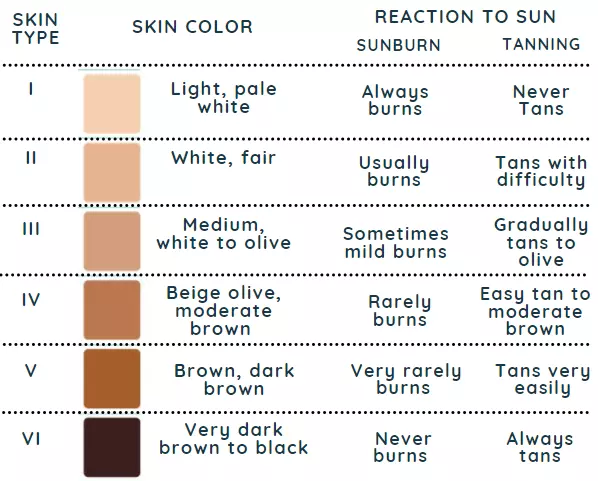
If you’re unfamiliar with skin types, here’s a chart:
To give you an idea of the area, this lamp lights up 15 inches away; it’s pretty decent!

Session Durations
So, how long are the UVB sessions?
P1: 3 min
P2: 4 min
P3: 5 min
P4: 7 min
P5: 8 min
P6: 9 min
P7: 10 min
P8: 12 min
P9: 13 min
P10: 15 min
Infrared runs the entire session. However, UV is only turned on in the middle of each session. Below is a graph of the emissions for each UV mode:
I’m not sure what’s going on with P5 here…
The Glasses
The Mitolux comes with two pairs of glasses that completely block UVB. The amber pair lets most of the infrared through, while the black pair cuts down on it quite a bit.

Here’s an example of what they block from the Mitolux:
Testing the Mitolux
Here is where I tested the actual spectral output using our spectrometer!

Spectral Output
Below is a nice colored graph of the Mitolux’s spectrum.

Just as advertised, you can see that 295nm UVB diodes are present here. We also see those amber/red and infrared diodes.
Here’s an average from 15 inches away:
It doesn’t look like a lot of UV light, does it? Let’s look a little closer at that, though…
UV Output
Believe it or not, the Mitolux has a maximum light intensity similar to the Sperti lamp. However, unlike the Sperti, it only puts out UVB.
According to this 2017 study, diodes between 290 and 300nm seem the most effective at producing vitamin D in human skin. Since the Mitolux is primarily this type of UV without all the extra UVA, I can see this being “safer” than the Sperti. More bang for your buck, let’s say.
Again, this is theory for me, because I didn’t get a huge increase.
Infrared Output
Selecting H on the Mitolux turns on the infrared-only mode, which runs for 10 minutes. Mitolux recommends using this mode at a distance of 6-12 inches.
Here’s a close-up of the spectrum of just the infrared portion at 6 inches:
Here is a chart showing the total irradiance in mW/cm2 from 1-12 inches:
This is a decent output and should be enough light to be effective anywhere in this range.
Flicker Testing
I was curious about any flicker, so I tested this as well.

There’s a small amount of high-frequency flicker here, but not much.
EMF Testing
I detected no magnetic fields from this Devi e however there are significant electrical fields within the area of use <15 inches, if that concerns you.
I measured around 60-70 V/m at 15 inches
Vitamin D Testing
Finally, let’s talk about my test results… they’re not good.
Mitolux recommends using the lamp for 6 weeks before testing, but I only did 30 days because I wanted to directly compare the results to my DIY test.
However, I did use the lamp almost every day, while Mitolux recommends every other day, so maybe that makes up for it!
I’m a skin. type 3, so I followed their schedule for that, here is my exact schedule (I missed a few days)
Unfortunately, my vitamin D levels only went up 1.5ng/mL over that 30-day period, here are my test results:

This is in stark contrast to the results I got from my DIY vitamin D lamp, in which I increased my levels by 16.2ng/mL over a 30-day period.
Either narrowband UVB doesn’t work as well as broadband UVB/UVA, or it doesn’t work very well for me, not sure
Overall Thoughts
I think this is a cool product. I love the attempt to make a more “natural” and safer vitamin D lamp by mimicking the solar cycle of infrared and UVB.
The build quality and programming are very well done! I’m just disappointed it didn’t seem to work for me 😔
I’d love to see if anyone else has done testing with this and what your results were!
MitoLux Vitamin D Lamp

Pros:
Cons:
🏷️ 10% off with link ⤵
-
Sperti Vitamin D Lamp Review: Does It Actually Work?
We tested the Sperti Vitamin D Lamp with a UV spectrometer. See the UVB output, clinical study results, and how much it increases Vitamin D levels.
7 minutes
hello, searching for answers on the internet i can see peple have raised their D3 in blood with Sperti but nowhere is Mitolux results. are you planning on using it and having blood tests before and after. will it actually work though
I’m planning to do testing this winter yes! However, I’m quite positive it will work. The radiation spectrum and power are just about all you need to know and they are well within the vitamin D action spectrum.
I am so excited I just found your reviews as I was researching and comparing the Sperti to the Mitolux for my husband who suffers from Psoriasis and Psoriatic Arthritis. We have a red light panel which we originally purchased for mitochondrial stimulation and inflammation reduction, but we think the UVA/B benefits on Vit D production as well as SAD symptoms (and all the effects that the shorter days of winter produce) would be a great addition for wintertime, when his condition significantly worsens every year. Do you think the Sperti (or your homemade version) would be better since it DOES emit more UVA than the Mitolux? I know some look for less UVA in order to reduce possible skin damage, but in my limited research it seems that for those with skin Psoriasis this may be part of what is actually beneficial.
Also, Sperti makes a Psoriasis lamp. Could you shed some light on this for me? (No pun intended haha). In my very limited layman’s research I am having trouble deciphering if this is actually different from their other lamp in its light spectrum output or if it is basically the same bulbs with the added benefit of using insurance to pay for it. (Ie. Red tape.) It does also seem smaller and I’m thinking this may be for the purpose of targeting specific psoriasis patches, however in my husband’s experience, full body sunshine is one of the only things that actually improves his patches as well as the arthritic component of his psoriasis.
Thank you so much for any thoughts you have on this!
Hi Christin! I have to admit I’m not super knowledgable on UV wavelengths and their effects on skin conditions like psoriasis. However UVA does seem to act as an endorphin modulator of sorts, this seems to be why a lot of people like tanning in the winter. So that could be one advantage of the Sperti or DIY panel over something like the MitoLux if “skin damage” doesn’t concern you.
As for the Sperti psoriasis lamp, good question! I’ve been meaning to buy their other lamps to test the actual output because yeah, there’s really no way to know what they mean without a spectral graph or actual measurements. I think it’s likely higher in UVB as this is typically whats used for psoriasis medically and smaller for targeted use as you’ve noted.
Has your husband ever tried a tanning bed to see if that helps his condition?
Hi Derek — love your site! Based on your articles, I’ve incorporated BioLights and more amber and red evening lighting around the house for the family. So thank you for reminding me on the importance of all this stuff.
I’ve also begun collecting all the parts to “simulate” (approximate) the sun in our home offices based on your “Sun” article: UVB reptile lamp, IR lamp. I also began using the small red/NIR panel on my desktop while I work and doing some mid-day UVB sessions on my previously dust-collecting Sperti. 🙂
All of this is to say that I’m trying to really engineer the best environment I can for our long, cold, sunless winters and have a few Qs…
Questions:
1. How does this Mitolux setup compare to having the above elements pinned to the wall in an office setting? I.E. Can I expect to generate some level of Vitamin D w/ the reptile 5% UVB lamp?
2. Or is it still important to get focused time close to a UVB lamp such as the Mitolux or Sperti?
3. Why is it OK to have the reptile UVB lamp up w/o goggles on in the background, but the Mitolux or Sperti require brief sessions w/ goggles?
Thank you so much!
Hi Tony! Wow good on ya! Hmmm let me see…
1. It’s hard to make a direct comparison without knowing the exact specification and distances involved. I don’t know that a 5% bulb placed several feet away has the strength required for significant amounts of vitamin D creation in the skin. The main reason I have this in my office is simply to replicate Sunlight from a visual standpoint. John Ott was a big fan of UVA and thought it had unknown health benefits and there’s quite a bit of it in Sunlight so I thought having some bouncing around the room made sense from a naturalistic perspective.
2. I’d say some time near a device emitting strong levels of UVB makes sense if you’re looking to maintain or improve D levels. There’s a chance you could create a set up that emits just the right amount for prolonged exposure but it might require testing equipment to verify the output and or experimentation with burning lol (which might be better to avoid)
3. Well, with my setup the amount of UV hitting my eyes might be akin to sitting under a tree n a partly cloudy day. With these devices you’re looking at more like noonday middle of the summer sun on a cloudless day, great for vitamin D, not so great for your retina. You could probably get away with eyes closed? But I haven’t gone any through the eyelids measurement yet! haha
Thanks for this review!
Did you test the EMF readings for the Mitolux lamp?
Good question! I forgot 😅 I will do that and update the article!
Thanks! I’ll be very interested in the update.
was the emf update ever posted.
Hi Christina! Sorry I just added those. No magnetic fields but there are electrical fields as can be expected as it is not grounded. I measured around 60-70 V/m at 15 inches
Hi Derek, do you know if there’s a lamp with both UVA and UVB but dedicated for eyes so in lower dose than those lamps for skin – basically a SAD lamp? It seems there are also health benefits from UVA and UVB getting in our eyes, so it would be interesting to see if anyone produced such lamp.
I’m not aware of one. I also subscribe to this notion though. My solution is that I have a 4 foot 6% UVB Arcadia bulb in the upper back corner of my office that shines down on me while I work.
Figure it does a good job of introducing low levels of UV into the office without being dangerous in any way.
Hi again,
Your tests suggest that the peak UVB wavelength is 298nm rather than 295nm as the company reports. Have I understood that correctly?
A 2017 study I saw found that 293nm produced vitamin D more efficiently than 298nm and 295nm, but all outperformed 301nm and sun exposure for efficiency. (298nm seemed to outperform 295nm too.)
I would guess that this is relevant if you want to take on less radiation for skin health and appearance but receive the vitamin D benefits of UVB exposure.
That’s not usual at all. There are natural variations and deviations in both diode production and spectrometer calibration, so some difference is normal and expected.
But yes, even if the peak is slightly off from 295 there will still be a ton of energy to either side of it.
Hey Derek, have you tested any LED reptile lights to see how it compares to this? I already have a Mito Red light and was thinking about just adding some LED reptile lights for UVA/UVB.
I’ve been meaning to do this I just haven’t yet! I’m not aware of any that come close to the amount of UVB LEDs the Mitolux has but I’m curious to test some.
Hi Derek, thanks for the article. What do you think about the amount of UV-C light that is emitted? Shouldn’t that be too carcinogenic to the skin as it doesn’t naturally reach the earth’s surface?
I wonder if the risk outweighs the benefit and if instead it would be better to have less “vitamin D potency” at >300nm UV-B and avoid UV-C completely.
Thanks for answering!
Hi Marcel! UV-C is almost always defined as under 280nm and the Mitolux doesn’t emit anything under about 283nm or so.
So I think we’re in the clear!
Hi Does it come with a uk plug ?
Does the price include all uk taxes and duties ?
How long does delivery to the uk take ?
Thank you.
Hey there! It is compatible with UK voltage, however mine did not come with a UK adapter, so you may need to purchase one.
As for the shipping specifics to the UK, I’m afraid I don’t know :/ You’d have better luck emailing MitoLux directly about that!
Much appreciated
Thank you.
Hi again,
Interested to see your test results for vitamin D levels. I’d be interest to know if your testosterone levels change too.
Kind regards,
Paul
They’ll be up soon! Dang, that would have been a good idea! I’ll keep that in mind for future tests.
May I trouble you for one more question? What was the condition of your skin after the 30 days of treatment? I read that UVB can also cause skin aging. Did you notice a change? Was there any erythema? And did you tan? (UVA, I hear, causes visible tan but UVB creates melanin for UVA to oxidised – inevitably you’ll still get some UVA from normal living even if not from the lamp.)
No noticeable erythema or tanning on my end!
Good to know. Thanks!
Hi Derek,
I think I know why it wasn’t very effective for you. I recently started using the “dminder” vitamin d phone app, and noticed there’s an option for logging time with the Sperti lamp. It indicates around 2100 IU of vitamin d for a 5 minute session (i’m skin type 2/3). I’ve been using this metric as a baseline and using basic percentages of UV output from your graphs to gauge vitamin d output from various lights. For instance, my single agromax 2 ft lamp, is around 40% more powerful than the Sperti. So my sun session with my lamp is roughly 3 minutes (5 minute standard Sperti session * .60). I figure this should give me the 2100 IU. I do this twice a day to get around 4200 IU.
Anyway, based off my calculations, because the Mitolux is slightly less powerful than the Sperti and you are spending a little extra time compared to a standard Sperti 5 minute session, you are getting around the same 2100 IU per day as the Sperti.
The dminder app also shows how much IU per day to get a certain level vitamin D. 2100 IU appears to be around 25-30. This might explain why you showed almost no change. You might need to double the session to get to 4000+ IU.
Hey Eric! Nice work!
It really looks like the recommended times and/or total UVB output on the Mitolux just isn’t sufficient for adequate vitamin D production. Even though in theory it’s using “better” peak wavelengths, the total output and recommended treatment times just obviously weren’t enough to make a difference for me. So yes increasing the treatment times to say the upper end of their recs might fix it, then you’re looking at 15 minutes per day… maybe I’ll try it again next year doing that haha
I love how thorough your review was with all the different tests. Consider me a new follower!
I’d definitely be interested in another test to see if you can get Vitamin D up next time around. Would also be interested in testosterone if you do the test again, as another comment mentioned.
Hey Alex, testosterone will definitely be in the next round of tests I do!
Hi, I’m wondering about the Vita D testing, the standard test, I believe is for stored vita d, which then needs to be converted into the active form, which is not routinely tested for. I’m wondering if it would have changed, but in that case, you would have had to test the vita d active form for a baseline before starting the test. It is not an easy access test.
I’ve thought about getting a bit more granular with the testing, but this was simply to show that production is occurring.
I’m loving all this content! (Somehow found you via Weston Price). Many years ago before Vitamin D was even a thing I spoke with a pioneer, Dr John Cannell, who advised me to tan daily (as naked as possible) and use a tanning bed on rainy days. After several months of that I was surprised to find that my Vitamin D levels had hardly budged. At that point Dr Cannell also advised me not to shower hours before or after tanning and to be careful with any cosmetics or lotions. I don’t know if that changed the numbers but it made sense. I have been told perhaps I just have “old skin” but I wonder if I really just have dry skin. At any rate I just bought the Sperti and I hope it gets me through the winter. Thank you!
Hi Lori! So glad you found us, we’re big fans of Weston A Price here as well 🙂
I have heard of the skin washing thing before, not sure if there’s any science to it however.
Either way best of luck on your health journey!
Hi Derek:
I recently obtained the Mitolux and had a few questions/concerns.
According to their user manual, I’m a skin type 2 (maybe 2.5). In terms of finding my “exposure sweet spot”, on day one I started with their UVB 2 setting and had no erythema (even mild). Same on day 2 at UVB 3 setting and on days 4 and 5 at UVB 4 and 5 settings. Raises a red flag for me in terms of efficacy based on total lack of any reddening, even mild.
For a number of years I used a narrow range UVB device (SolR) that used 2 Phillips narrow band TL 100W01-FS72 bulbs which very effectively increased my vitamin D level. That device did cause some mild erythema which helped me determine the length of my sessions. I should note that per SolR’s instructions, the treatments were a lot closer than 15 inches, perhaps 6 – 12 and lasted 4 (starting) to around 8 or so minutes.
In terms of studies using UVB LEDs (vs traditional tubes) bulbs on humans, I only found one online that actually showed a fairly significant reduction in vitamin d levels which was very surprising. ( only had a few subjects however).
Any thoughts or recommendations? Do you think longer sessions would be more effective?
Thanks!
Bob
Hey Bob, kinda hard to argue with your experience… I had almost no increase on my Vitmain D tests using the Mitolux, and as you noted the studies using narrowband UVB LEDs don’t seem that impressive from what I’ve seen. I think we need more good clinical trials of this technology before we rely on it fully over more prover methods.
Hi Derek,
It would be a good experiment to test the mitolux for at least 3 months and maybe with higher levels. Would you want to try it?
That’s quite a long test time! I will consider it.
I think I figured out why your vitamin D levels might not increase compared to Sperti or DIY lamp.
Although Mitolux have very similar peak energy outputs per cm2, at the 15 inch level it has far less total UVB radiation compared to Sperti.
Also the specterometer looks at from a very limited surface area (1-2cm) while you’ve exposed to a much bigger body surface. It might be the case that Mitolux’s total radiated area and total energy might not be enough compared to Sperti.
Finally max output doesn’t mean it will be continuous energy delivery throughout the session. LED’s loses efficiency with heat and probably after a couple of minutes Mitolux loses significant energy output through its LED’s.
My conclusion is, probably you need far higher doses (longer sessions) of Mitolux compared to Sperti to have the same amount of UVB.
It would be interesting if you can test this as well, increase the total session durations and see anything changes in 3-4 weeks.
I did measure output over the entire session, LED degradation doesn’t appear to occur at this time intervals. But I agree, something about it didn’t seem to work.
Based on the graph I’ve calculated that Mitolux has 23mw/cm2 vs sperti 19mw/cm2 effective Vitamin D radience (based on this research https://www.nature.com/articles/s41598-017-11362-2 on efficiency of vitamin D production per each nm wavelength, most of the output of Sperti is wasted as won’t help on Vit. D production)
However Mitolux’s main problem is total treatment area which is limited to 330cm2 vs Sperti’s 1500cm2. Therefore per session Mitolux produces 7500iu vs Sperti produces 28500iu.
The advantage of Mitolux is that you can avoid UVA and burning and much more efficient per cm2 area. However, as the device is smaller you’ll need to do 4x body area to have the same amount of vitamin D generation.
Also Mitolux spends some time to radiate redlight, therefore a 5 minutes session of Mitolux won’t give 5 mins of UVB compared to Sperti’s full 5 mins of UVB.
I think your results reflect this and you should extend your session with Mitolux up to 4-5x the same time spent as Sperti to have the same amount of UVB radiated to the overall surface area.
Would be really interesting to check if this is the case by testing this protocol.
That’s the problem with a lot of these theoretical math based calculations though. You’re claim that Sperti produces 28,500 IU is way off from what their own study shows, which I think was around 5000 IU.
I think the main issue I had is that I followed Mitolux’ own recommendations. So IF narrowband UVB can work, the recommended dosing is clearly way off the mark.
I think in order to see a sizeable outcome of ng/ml blood vit D levels with Mitolux you need 4x the amount of time spent compared what company suggests. 5 mins only in P3 with 3-4 mins of it only UVB won’t give enough radiation with 330cm2/sec body area.
And you’re right 28.500 is too high and it should be around 3-4k IU (I didn’t account for conversion efficiency). But the ratio of 1/4 for Mitolux vs Sperti still applies.
In order to get the same amount of Vitamin D, for every minute of Sperti lamp exposure you’ll need 4 mins of Mitolux.
It would be interesting to test this theory. I’ve already started doing 4x of the suggested program in Mitolux (and I have skin type 3) and I don’t see any effect of burning. Looks like the minimum effective dose for Mitolux is much higher compared to other UV lamps.
That is a shame, I think the theory and marketing behind narrowband UVB LEDs is that we should be able to get a bigger dose in less time, but perhaps that doesn’t seem to be the case… we need more studies!
I found your lack of results from this product fascinating, so I asked the AI to hypothesize as to WHY. Here is what it said … The reason a bulb strictly targeting the 297–300 nm range produced lower blood levels of Vitamin D3 comes down to a chemical phenomenon known as photo-equilibration.
While 297–300 nm is technically the peak wavelength for initiating Vitamin D production, isolating it removes the natural “brakes and balances” provided by a wider solar spectrum. The Over-Irradiation Trap:
When 7-dehydrocholesterol (7-DHC) in the skin absorbs UVB, it turns into previtamin D3. However, previtamin D3 is highly sensitive to the exact same 297–300 nm wavelengths. [1]
If a bulb continuously blasts this narrow range without any other wavelengths present, a fast photo-equilibrium is reached. The narrow, intense energy starts instantly degrading the newly formed previtamin D3, converting it into inert, inactive photoproducts like lumisterol and tachysterol before your body heat can naturally transition it into final Vitamin D3. [1] Why a Broader UVA-B Spectrum Works Better:
In short, a single isolated “perfect” wavelength triggers immediate degradation of its own product. A broader spectrum mimics natural sunlight, allowing multiple wavelengths to continually recycle byproducts back into active Vitamin D3. [1, 2]
Thanks for the insight James! This all checks out. It’s a super interesting topic I’ve been meaning to dive deeper on but have yet to find the time. As far as I can recall narrowband UVB vitamin D production is theoretical mostly with very little clinical evidence. I’d love to see someone else actual show some results from devices like this.
Ever since the scamdemic, some people suddenly have all the time in the world, and others, like you and I, have very little of it. It is a testament to your hard work that your time is in such high demand. The AI is great for people like us, but I do not completely trust it, and am still checking the citations it provided. But the conclusion it drew makes complete sense. Here in Toronto I need a December/January solution. Perhaps I will build a light saber out of a Agromax Pure UV T5 bulb, and run around naked in a Star Wars-themed room, with mirrored walls and ceiling to amplify the UVB. I can market being chased naked in the room by me as a safe, fun way for women to to boost both their Vitamin D3 and mood. If you are interested in co-authoring a paper on the subject, let me know.
LOL I admire your creativity! Standing in front of a vitamin d lamp can get kind of monotonous and boring, adding some vest to the activity is certain to improve adherence.
Now as for AI and all that, couldn’t agree more, we’re using it a lot, very useful, just have to make sure it’s not making things up! I’ve been using Scite and PupMed connections in Claude which has been very helpful for scientific inquiries but as always you still need to double check claims.