

People cross-shop these two constantly, and the Chroma Skylight vs Brighter Lamp question usually comes down to one decision. They’re both premium, full-spectrum daylight floor lamps built to bring real light into a room, so I put both on the same spectrometer and flicker meter to compare them — and they turned out to be built for very different jobs.
Skylight vs Brighter
The pick: Two great lamps, two different buyers. The Brighter Lamp ($1,199) is the everyday default: far brighter, smart-home tunable, half the price. The Chroma Skylight ($2,400) is worth the premium if you want the healthier sunlight-grade white and dedicated amber and red channels for protecting your evenings.
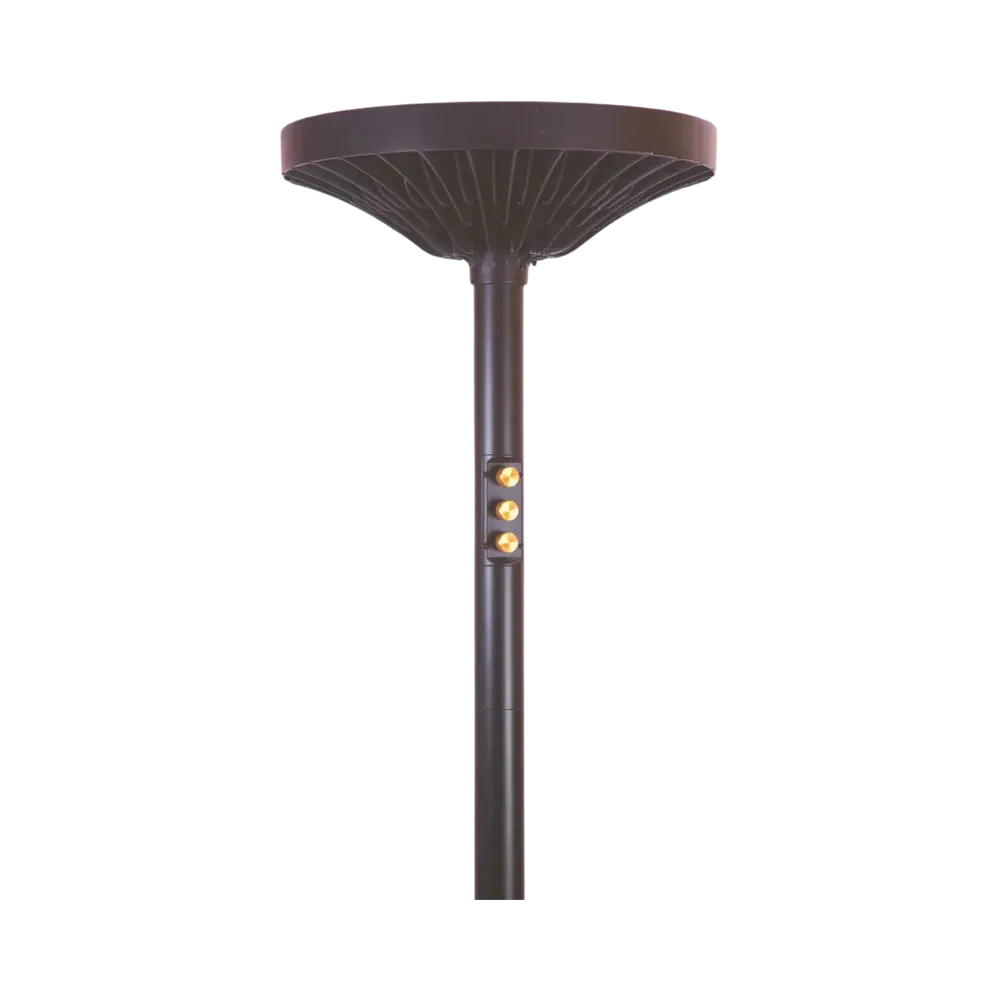
chroma
Skylight
Best white, real evening mode.
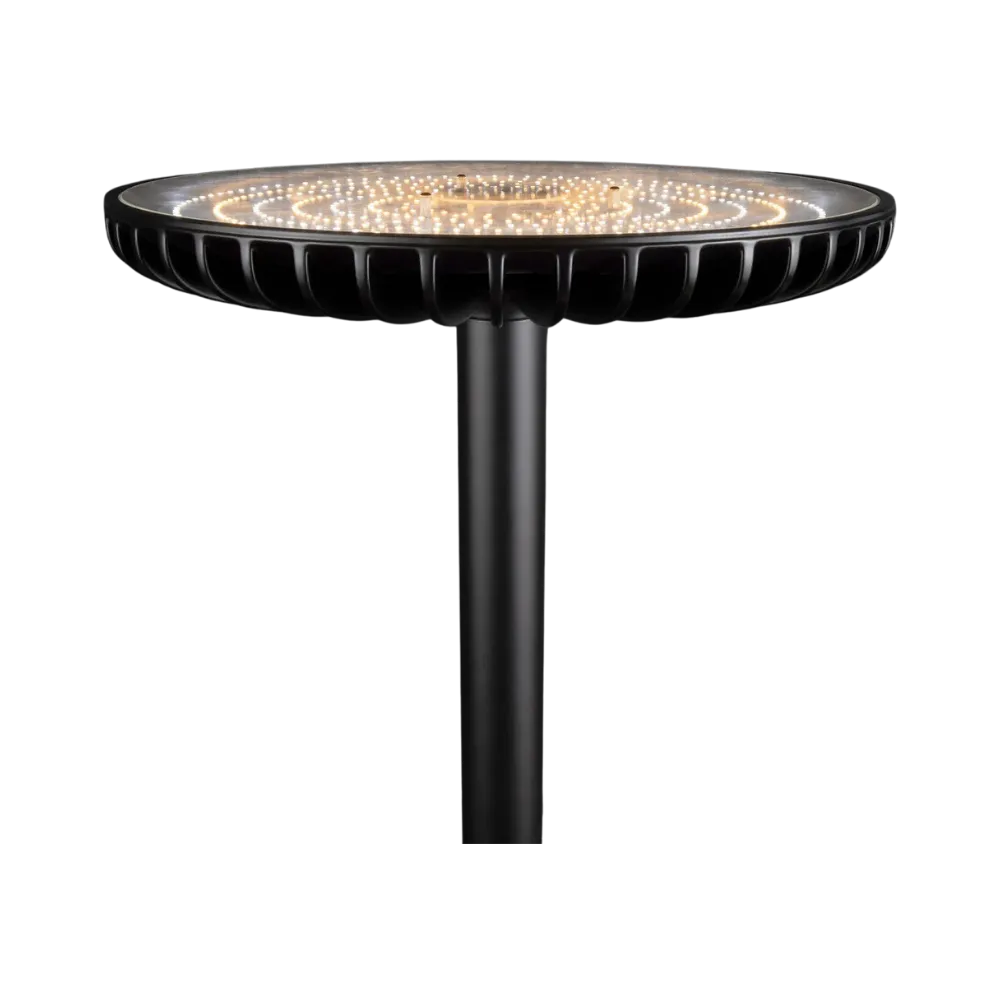
brighter
Brighter Lamp
Brightest, smartest, best value.
The Comparison, at a Glance
|
Chroma Skylight |
Brighter lamp |
|
|---|---|---|
|
Price |
$2,400 |
$1,199 |
|
Brightness @ 2ft |
10,322 lux (white) |
48,650 lux |
|
Standing Melanopic EDI |
675-701 |
2,685 |
|
CRI Re (white) |
97.4 |
94.1 |
|
TM-30 Rf |
97 |
91 |
|
Cyan gap |
None (peaks 494 nm) |
Present (~490 nm dip) |
|
Flicker (full/dimmed) |
0.41% / 4.27% |
0.21% / 0.69% |
|
Evening channels |
Amber + red (dedicated) |
None (warm white only) |
|
Smart control |
None (analog) |
Matter (multi-ecosystem) |
|
Weight |
110 lb |
50 lb |
|
Power cord |
16 ft |
5.8 ft |
|
Heat / cooling |
183.5°F, silent/fanless |
~199°F, fan |
|
Stability |
Essentially untippable |
Can be knocked over |
|
Where to buy |
That table is the whole decision in one grid. The rest of this is the why behind each row, and which rows should actually decide it for you.
They’re closer in purpose than in execution. Both are bright, ceiling-bouncing circadian room lights, not face-on SAD lamps. But once you put them on the meters, they pull apart fast.
What Actually Separates Them
Three things really matter here. The Brighter is dramatically brighter and costs half as much. The Chroma has a healthier, more sunlight-like white and a true evening mode the Brighter simply doesn’t have. Almost everything else is close.
Free · 95 pages
You’re reading about one piece of this. The book is the whole day.
The Circadian Blueprint covers setting your body clock with light — the timing, the doses, and which products actually deliver them. Every number came off my own spectrometer.
Check your inbox to confirm. Plus a short note each month on what I’ve tested — unsubscribe anytime.
Brightness and Daytime Dose
This one isn’t close. At two feet, the Brighter measured 48,650 lux at full power against the Chroma white channel’s 10,322 lux. That’s roughly 4.7 times brighter from the same distance.
The gap holds where you actually stand, though it narrows. At standing eye level the Brighter delivers about 2,685 melanopic EDI to the Chroma white’s 675 — roughly 4× on the circadian metric, versus nearly 5× on raw lux.
That narrowing is the spectrum talking. The Chroma’s white carries more melanopic signal per lux, so it closes some of the gap on the number that actually drives your body clock. The Brighter still wins outright, but lux alone oversells how far ahead it is.
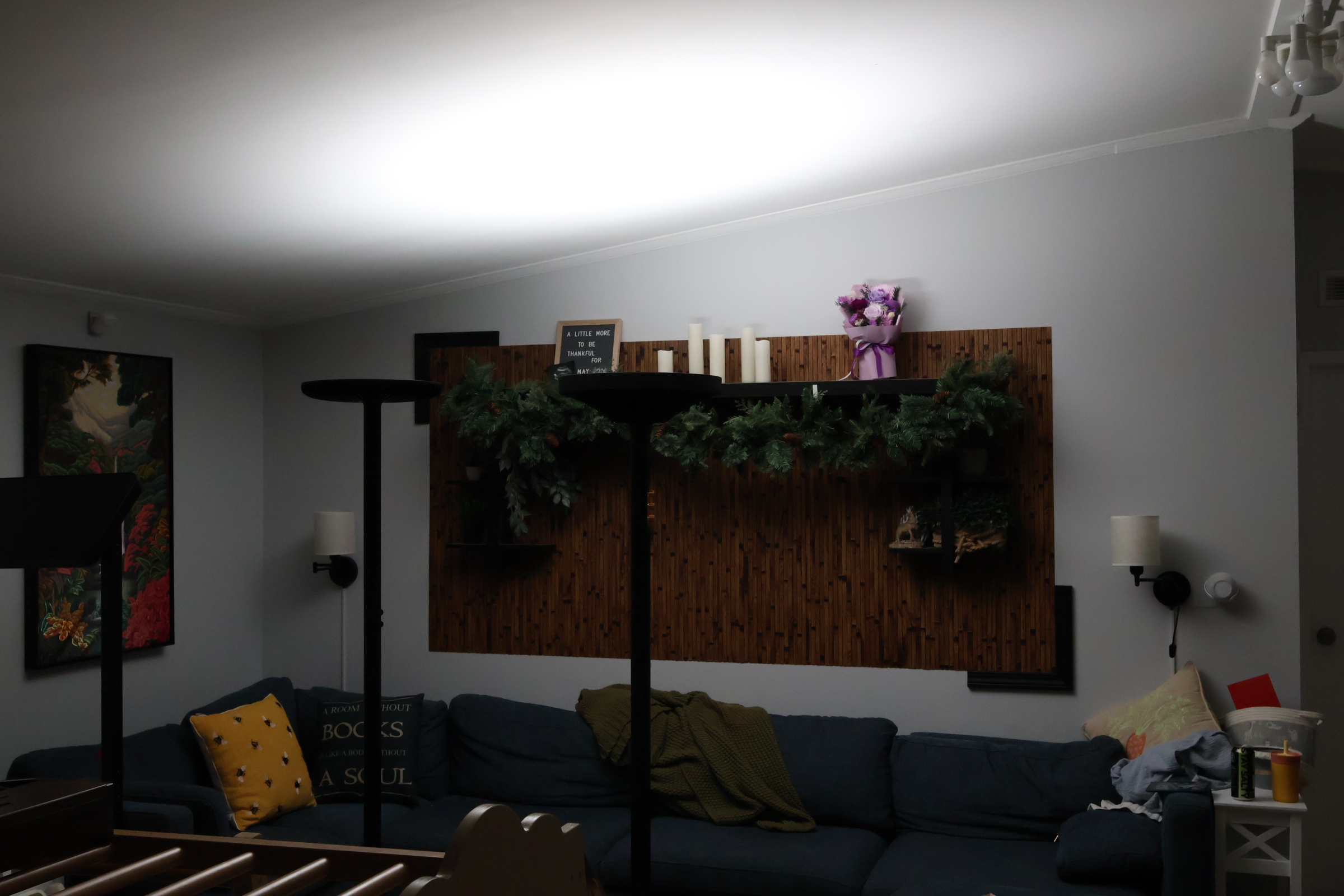
Two caveats keep this honest. The Brighter’s maximum output happens mid-dial, around 4200K, not at its coolest 6500K setting. And the Chroma’s white alone reads modest at standing distance, which is why I usually ran all three of its channels for a brighter room.
If your goal is to flood a space with daylight, the Brighter Lamp wins decisively. It’s the brightest home lamp I’ve measured.
Color Quality: Which White Is Healthier
The point of an indoor daytime light is to mimic sunlight. That’s the whole idea behind using one. And on that measure, the Chroma’s white is clearly the better light.
Two things make it more sunlight-like, and both come off the spectrometer. First, there’s no cyan gap. Most white LEDs dip in the 480–500nm cyan region, but the Chroma’s white actually peaks at 494nm, filling the turquoise band instead of leaving a hole in it.
The Brighter does the opposite. Its cool white spikes at 454nm from the blue LED pump, then dips to a trough around 490nm before the phosphor recovers. That’s the classic cyan notch, and you can see it plainly in its own spectrum below.
Second, the Chroma is simply higher fidelity. I measured TM-30 Rf 97 and CRI Re 97.4 on its white, versus Rf 91 and Re 94 on the Brighter. A higher, smoother fidelity score means the spectrum is more complete, which is exactly what “closer to sunlight” means in practice.
That healthier white has a downstream payoff too. Better fidelity means skin tones, food, and artwork all look right under it, the way they do by a window.
One house note on the numbers: the Brighter’s advertised “CRI 95+” is the friendlier Ra average. On the stricter CRI Re that I use, both lamps come down, but the Chroma holds at about 97.
Evening and Night: The Real Dividing Line
If color is where the Chroma pulls ahead, evening is where it wins something the Brighter can’t match at all. The Chroma has dedicated amber and red channels. The amber measures 1631K with a melanopic ratio of just 0.14, and the red is effectively non-melanopic at 0.03.
The Brighter has no dedicated evening channel. It only dims a warm white, and even at its warmest and dimmest that white still measures about 95 melanopic EDI at eye level, because warm white still carries blue. So this isn’t “one runs a little warmer.” It’s a capability the Brighter doesn’t have.
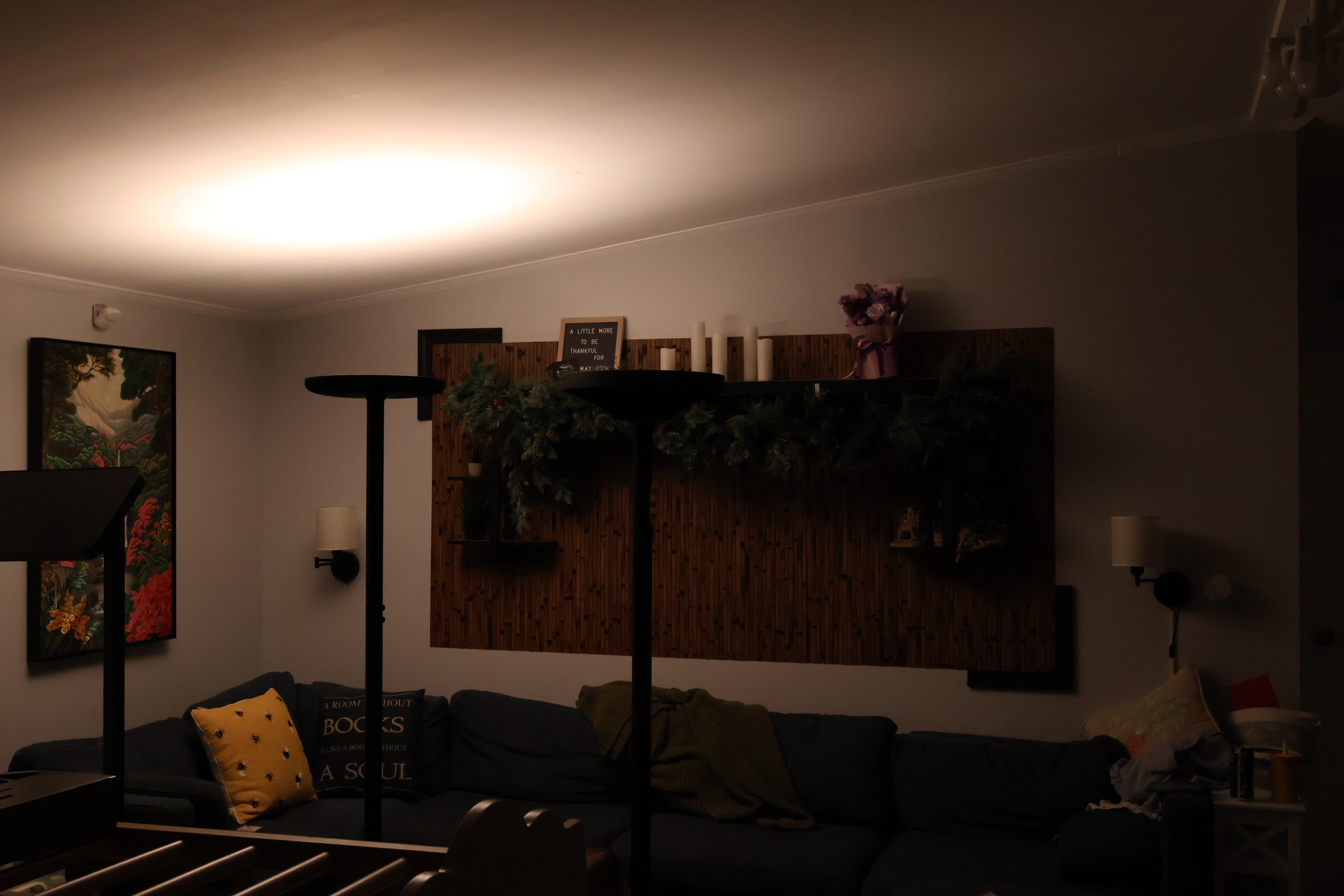
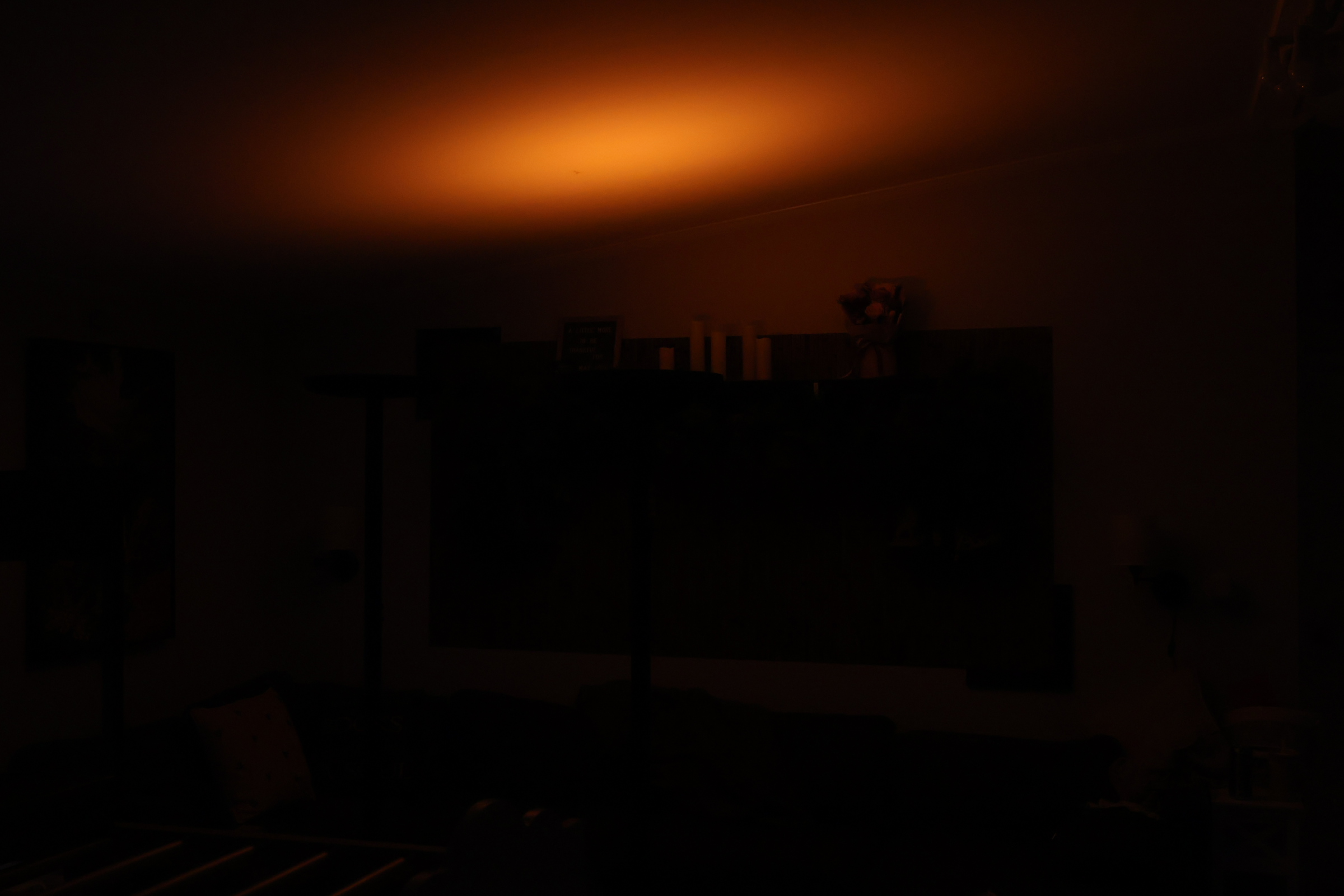
The clearest example of what that buys you came unplanned. We had a home birth, and the midwives arrived around 3 a.m. to a dark house.
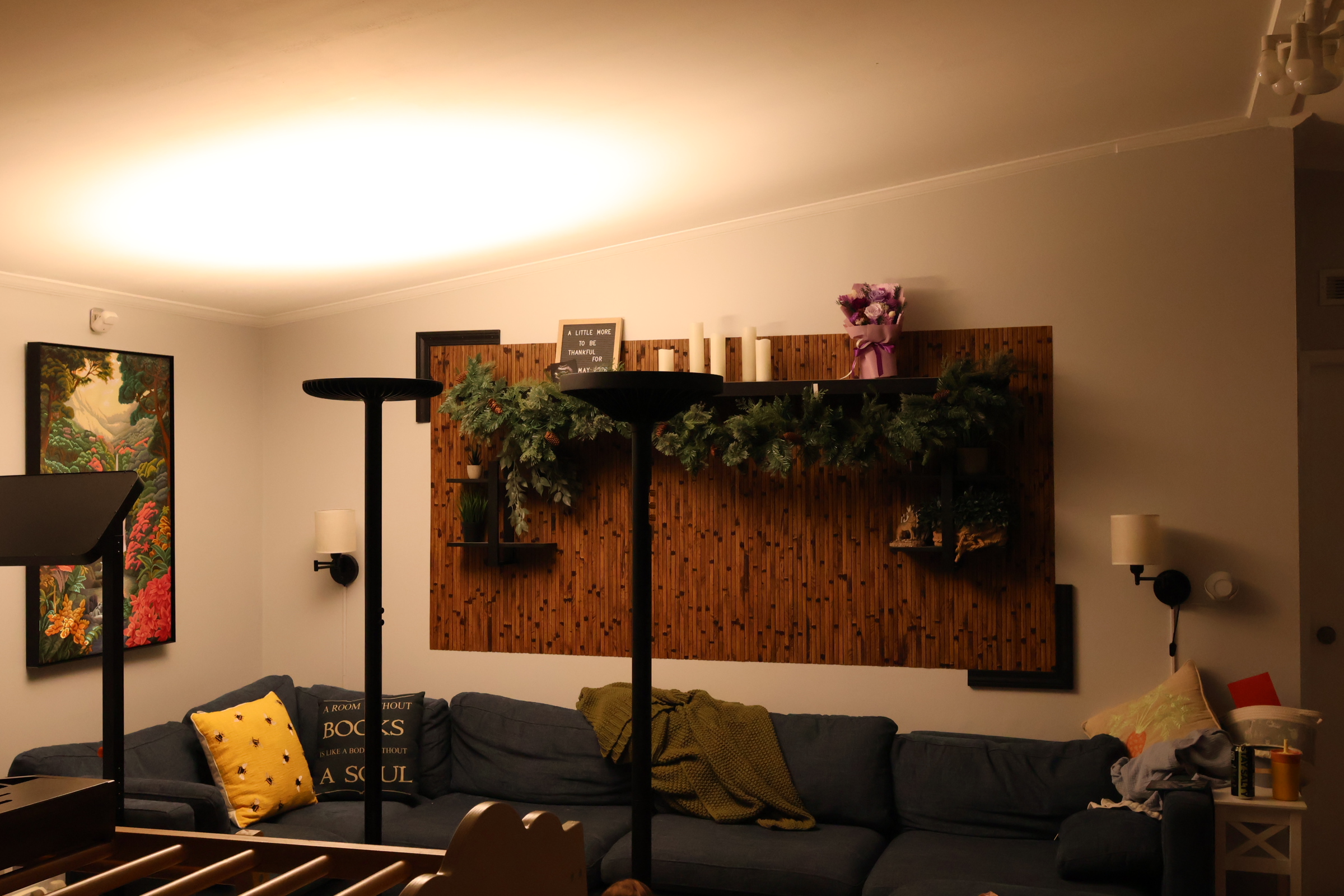
Instead of blasting everyone with overhead lights, I ran the Chroma’s amber and red channels and lit the whole living room in a warm, dim glow. Bright enough to work by, without hammering anyone with alerting light in the middle of the night.
For protecting your evenings, the Chroma Skylight is in a different category.
Flicker
This is close to a tie, and both pass easily. At full power the Brighter measured 0.21% flicker and the Chroma 0.41%, both effectively flicker-free with no PWM.
The one difference shows up when you dim. The Brighter stays cleaner at 0.69%, while the Chroma rises to 4.27% as a high-frequency ripple at 3.3kHz. That’s still very low, still nowhere near the low-frequency PWM that causes problems, so I’d call it a tie with a tiny edge to the Brighter when dimmed.
Put all four readings on the IEEE 1789 flicker-risk chart and the story gets simple. Every one of them lands in the no-risk zone, nowhere near the frequency-and-modulation limits where flicker starts to matter.
If you’re flicker-sensitive and get headaches under bad office lighting, both are safe choices here. Neither drops into the low-frequency range that actually triggers symptoms, so this isn’t a category where either lamp should worry you.
Smart Control
The Brighter is a real smart-home device. It pairs over Matter and works with Apple Home, Home Assistant, Alexa, and Google Home, including Apple’s adaptive lighting that shifts color temperature through the day on its own.
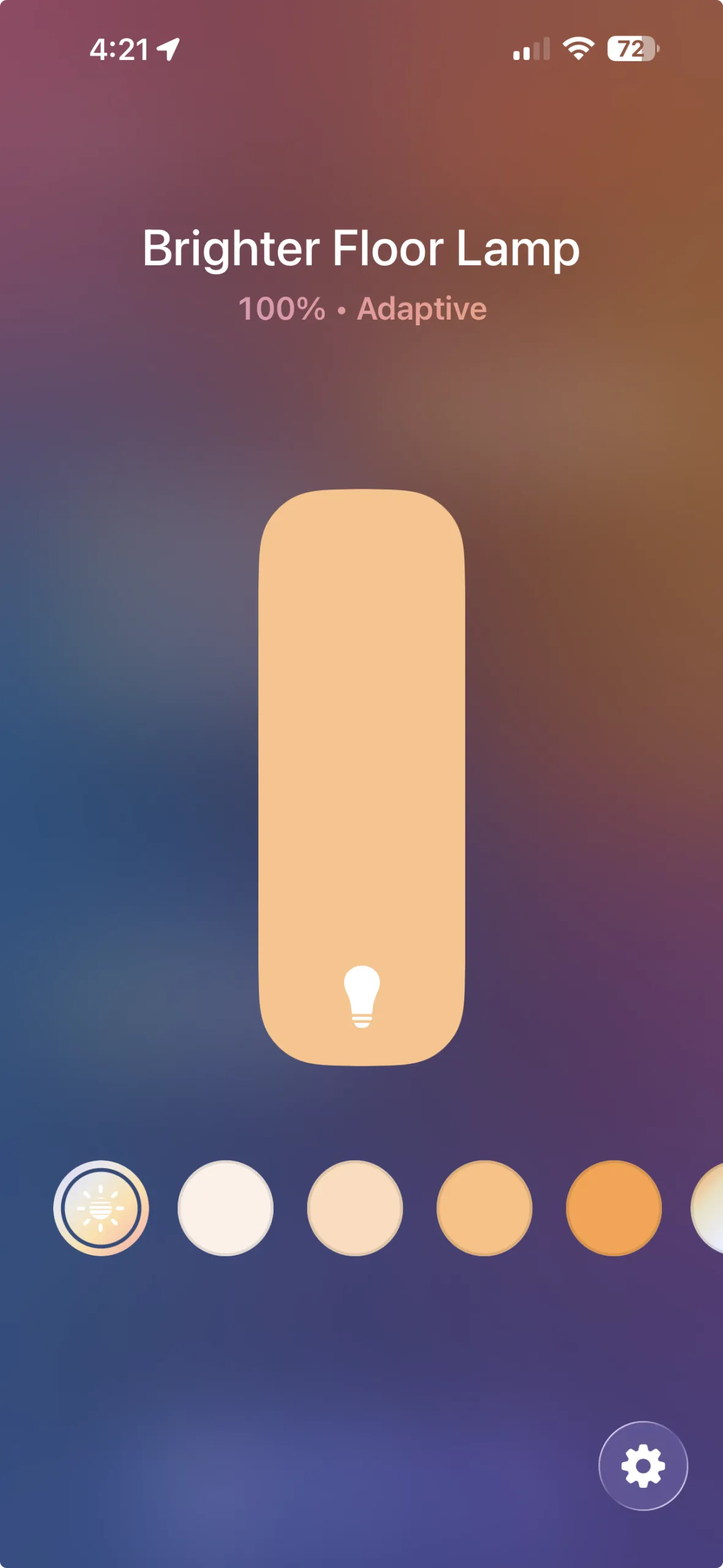
The Chroma is fully analog. Three knobs, no app, and you re-dial it each session.
For most people the Brighter’s automation is a clear advantage. But if you actively minimize wireless signals in your home, the Chroma’s radio-free design is the one you’d want instead.
Build, Safety, and Heat
The Chroma is a tank. At 110 pounds with a huge base, it’s essentially impossible to tip over, which genuinely matters with kids or a dog around.
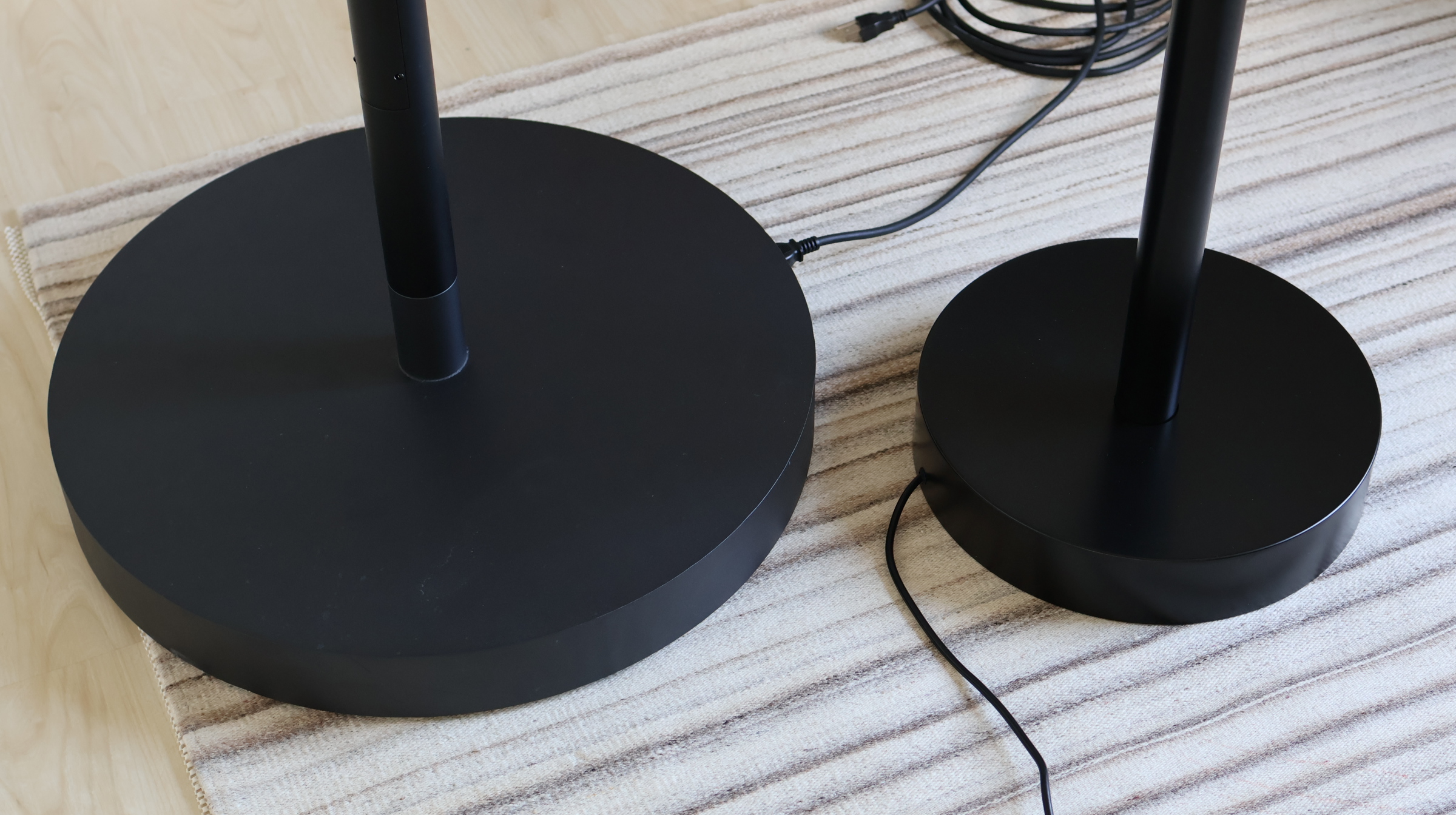
It also runs silent and fanless at 183.5°F and has a generous 16-foot cord. The trade-off is that it’s a two-person assembly you won’t be relocating on a whim.
The Brighter is far easier to live with day to day. It’s 50 pounds, assembles in under five minutes, and I can move it myself.
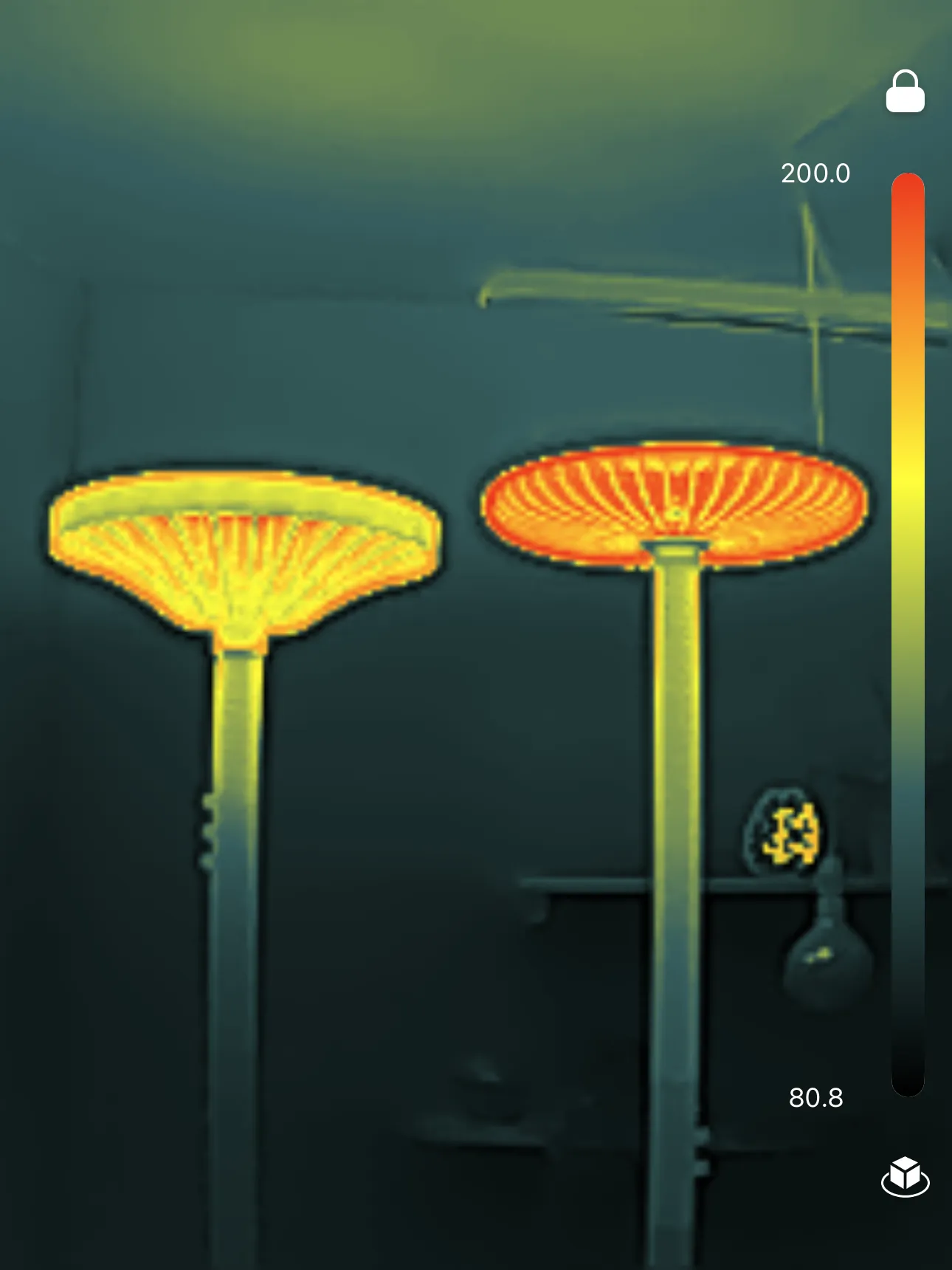
But it’s more tippable, its head runs hotter at about 199°F, and it uses a fan that kicks in at high power. The fan isn’t loud, though you’ll hear it in a quiet room, and the Chroma won’t make a sound.
Price and Value
The Brighter is $1,199. The Chroma is $2,400. That’s the number a lot of this comes down to.
You’re getting roughly four times the brightness from the lamp that costs half as much. The Chroma’s premium doesn’t buy lumens.
It buys the healthier sunlight-grade white, the dedicated evening channels, and the untippable build. Whether that’s worth double is entirely about which of those things you actually need.
Who Should Buy Which
Buy the Brighter Lamp if
You want the most daylight you can get into a room, you’re in a smart-home ecosystem and want adaptive lighting, or the price gap matters to you. It’s the better everyday value for a bright, tunable circadian lamp. Just don’t put a 199°F head where a toddler can grab it.
Buy the Chroma Skylight if
You want the healthiest, most sunlight-like white money buys, or you specifically want a real evening mode that lights a room without wrecking your sleep. It’s also the pick if you have kids or dogs and need something untippable, if you want a silent fanless lamp, and if the $2,400 is comfortable.
Neither one is a face-on SAD lamp, for the record. Both are ambient room lights. If a desk-style light-therapy device is what you’re really after, the Chroma Sky Portal is the closer fit, and my best SAD lamps guide covers the face-on options.
Final Verdict
These lamps don’t really compete so much as split the field. The Brighter Lamp is the everyday default: brighter, smarter, and half the price. It’s the right call for most people who just want a bright, tunable circadian lamp.
The Chroma Skylight is the one to buy if the healthier sunlight-like white and a true evening mode are the reason you’re shopping in the first place.
brighter
Brighter Lamp
The brightest home lamp I’ve measured (48,650 lux at 2 ft), smart-home tunable, and half the Skylight’s price. The everyday-value pick for a bright circadian lamp.
chroma
Skylight
The healthiest white I’ve measured in a home lamp (Rf 97, no cyan gap) with dedicated amber and red evening channels. The pick for sunlight-grade color and protected evenings.
Frequently Asked Questions
Common questions about the Chroma Skylight and Brighter lamp
-
Tuo Circadian Smart Bulb Review: Better Than a SAD Lamp?
Does the Tuo bulb work? We tested the flicker and spectral output of this circadian light to see if it’s more effective than a traditional SAD lamp.
10 minutes -
The Brighter Lamp Review: I Put the “World’s Brightest” Lamp on My Meters
The world’s brightest floor lamp, on paper. I put it on my meters: 48,650 lux at two feet, effectively flicker-free at every setting, and one heat claim that didn’t survive testing.
11 minutes -
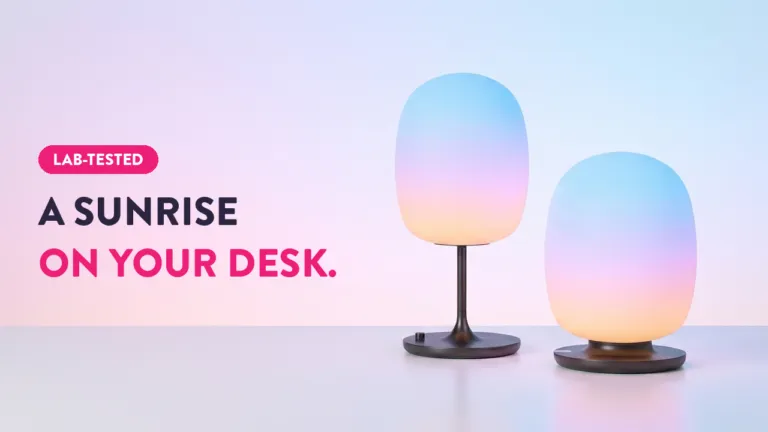
SkyView 2 Lamp Review: Beautiful But Is It Effective?
We analyzed the SkyView 2’s 24-hour cycle. See the spectral graphs, flicker data, and why it’s the most comfortable SAD lamp we’ve tested.
10 minutes
Really wonder if skylight on full amber+red mode produces lumens to call the room well-lit, say, for reading? Or is it’s amber+red channels on brightest settings are not even reaching Brighter’s lowest setting in terms of lumens?
Hey Phil, I’d so it’s definitely bright enough for reading, it’s not dim by any means, just not a bright as the Brighter. The Skylight is brighter than the Brighter on it’s lowest settings for sure.