
Welcome! I just spent the last two months accuracy testing all of the most popular pulse oximeters for overnight monitoring and the EMAY SleepO2 results were shocking!
To measure accuracy, we benchmarked this “wellness” oximeter against an FDA-cleared, $1,500 hospital-grade reference device for three nights. In this review, I’ll break down the testing method, results, and the key features—plus design and comfort—that make this overnight monitor a hidden gem!
The Overview
If you don’t care about a flashy app or the highest comfort, but you just want the honest overnight oxygen data, the EMAY SleepO2 is one of the most accurate I have tested! In my testing, it scored 96.5/100 on my overall accuracy score — meaning it tracked oxygen drops and trends unusually well compared to a $1500 hospital-grade reference.
The EMAY SleepO2 is the “Toyota Camry” of pulse oximeters: Boring, reliable, and
unexpectedly accurate.
Pros:
Cons:
🏷️ TH31F230YT3W for 20% off
What the EMAY SleepO2 Is (and What It’s Not)
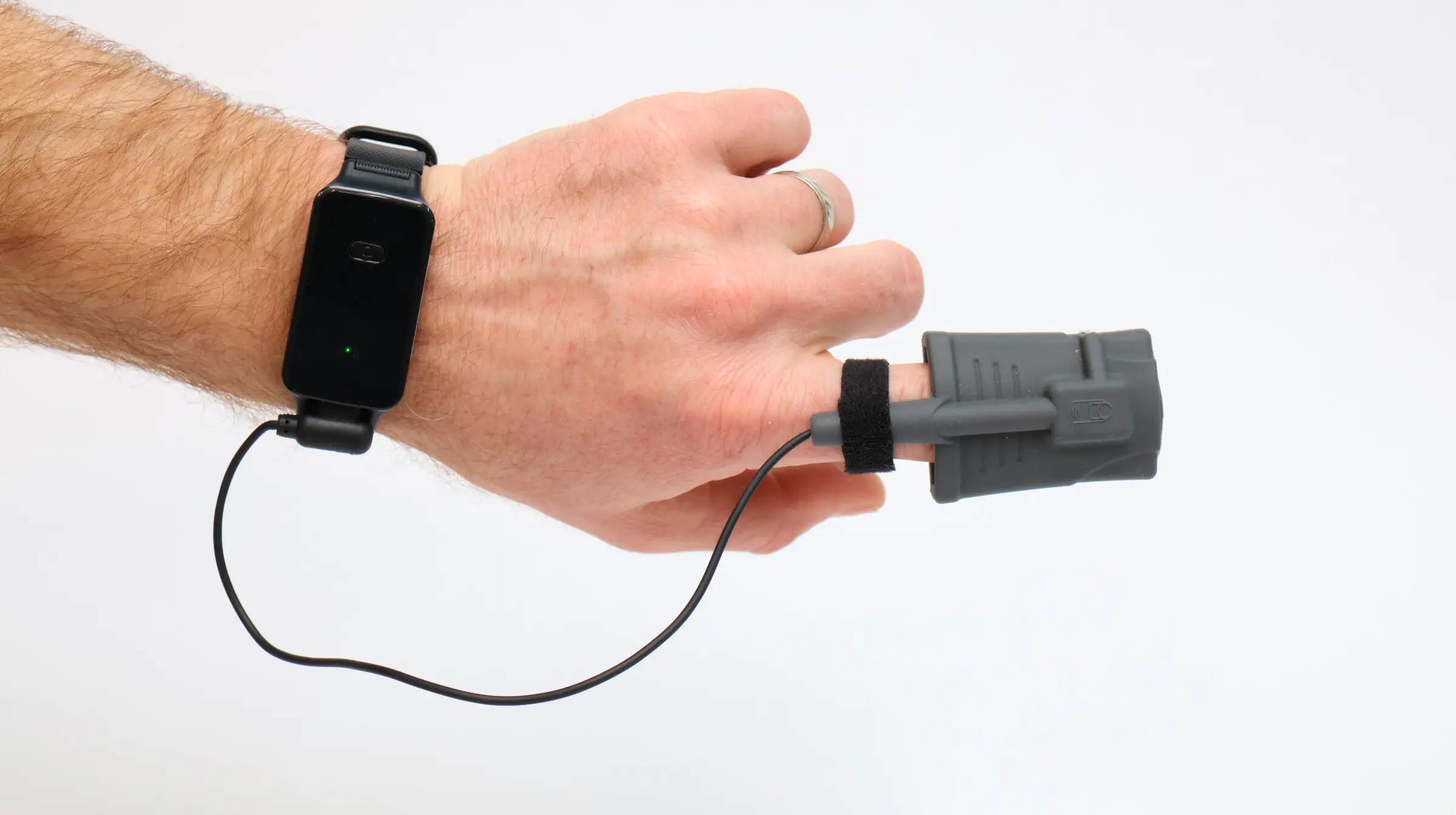
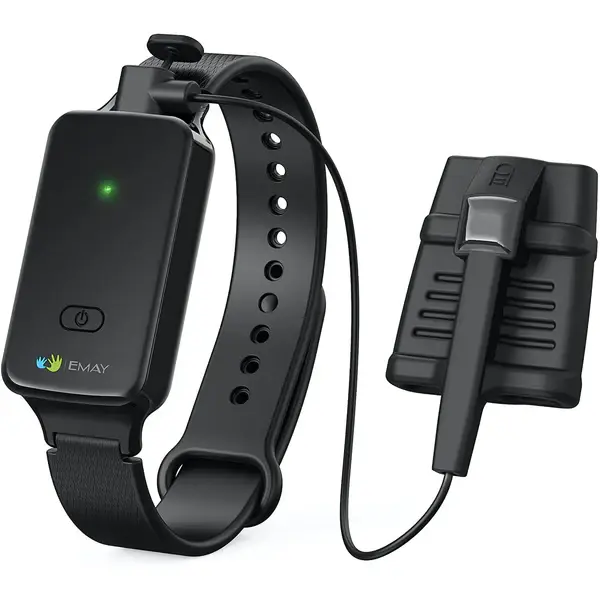
The EMAY SleepO2 is designed for overnight tracking of SpO₂ and heart rate—not spot-checking. That’s why there’s no screen on the device.
It stores data onboard (listed as 48 hours built-in memory) and then you download it later via Bluetooth in the EMAY app. EMAY also states the device is intended for reference only and not for medical use/diagnosis. That is what we were here to test!
How We Tested
Test Protocol (Simple Version)
- Each device was worn for three consecutive nights
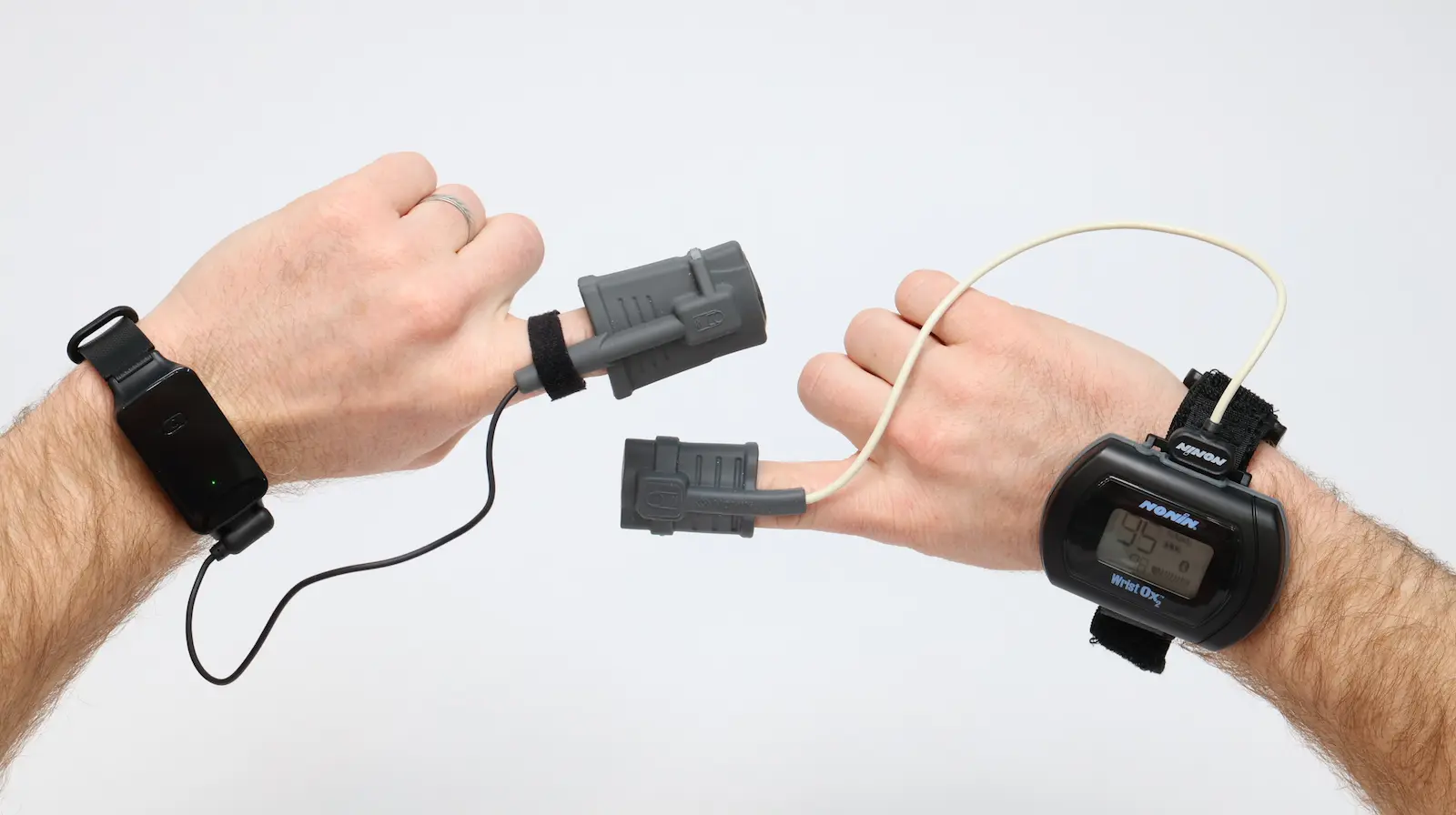
- The reference device was worn on one hand, and the test device on the other
- Each morning, I exported the raw data files from both devices
- A custom Python script cleaned, aligned, and compared the data second-by-second
- All metrics were averaged across 3 nights to reduce randomness
EMAY SleepO2 Accuracy Results (3-Night Average)
- The EMAY SleepO2 was one of the most accurate devices I tested overall
- It tracked desaturation event frequency (ODI) especially well
- It showed high signal stability, meaning it tracked the Nonin ±2 points all night
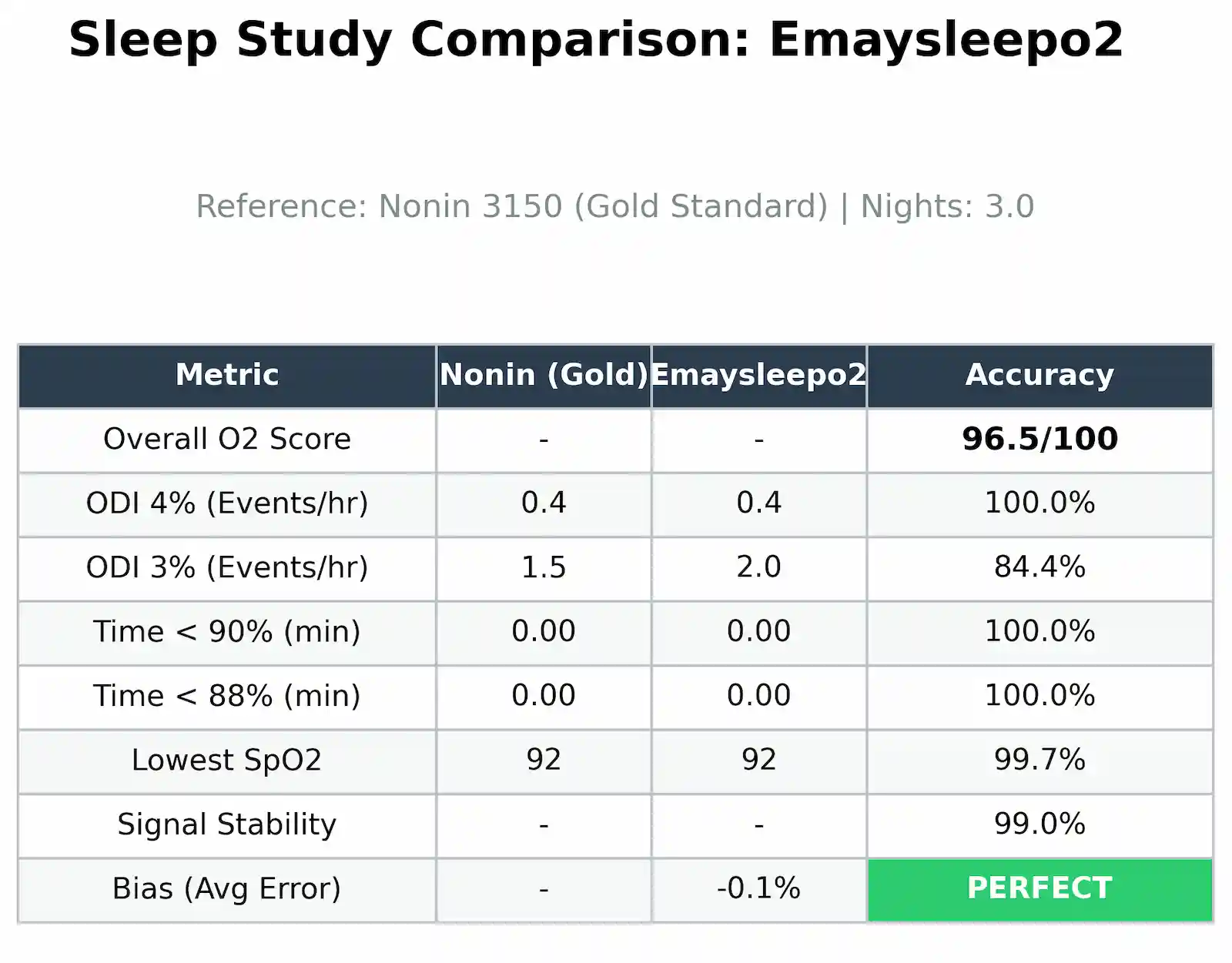
Chart Definitions
- ODI (3% & 4%): The “Oxygen Desaturation Index” counts how many times your oxygen drops per hour. 3% is a mild dip; 4% is severe. The 3% is a more sensitive metric.
- Time <90%: A timer counting every second you spent below 90% oxygen.
- Time <88%: A timer counting every second you spent below 88% oxygen.
- Lowest SPO2 (Nadir): The absolute lowest oxygen point of the night. We checked if the device caught this “rock bottom” moment or smoothed it over.
- Bias: Shows the device’s “personality.” Positive (+) bias means it overestimates oxygen (optimist); Negative (-) means it underestimates it (pessimist).
- Signal Stability: Measures how often the device stays within ±2% of the medical reference. High stability means it rarely loses its “lock” on your data.
- Overall O2 Score: A 0–100 final grade. It heavily weights ODI and Stability to determine if the device is safe for medical tracking.
The Overall O2 Score is calculated by the following weights: 40%: ODI Accuracy (3% and 4% combined) 30%: Signal Stability (FDA-style ±2% agreement) 20%: Nadir Accuracy 10%: T90 Accuracy.
What the Results Mean (Plain English)
Here’s what matters: the EMAY SleepO2 doesn’t just produce a pretty, stable-looking line. In my testing it behaved like a device that’s trying to capture real physiology, including short, sharp oxygen drops.
That’s important because brief drops are often the exact thing you care about when you’re:
- screening for possible sleep apnea
- troubleshooting CPAP leaks or position changes
- trying to understand why you wake up exhausted
If you want a device that tends to “tell the truth” when oxygen dips—rather than smoothing those dips away—the EMAY SleepO2 is a strong pick in its price range.
Many pulse oximeters can be lazy while tracking your oxygen levels at night, meaning they smooth over dips. As you can see from the chart below, the EMAY SleepO2 is not the lazy student, but the anxious Honor Student. When the internal algorithm notices your oxygen dropping it reacts fast, and some times a little too fast, but can be a good thing.
Deviation From Nonin
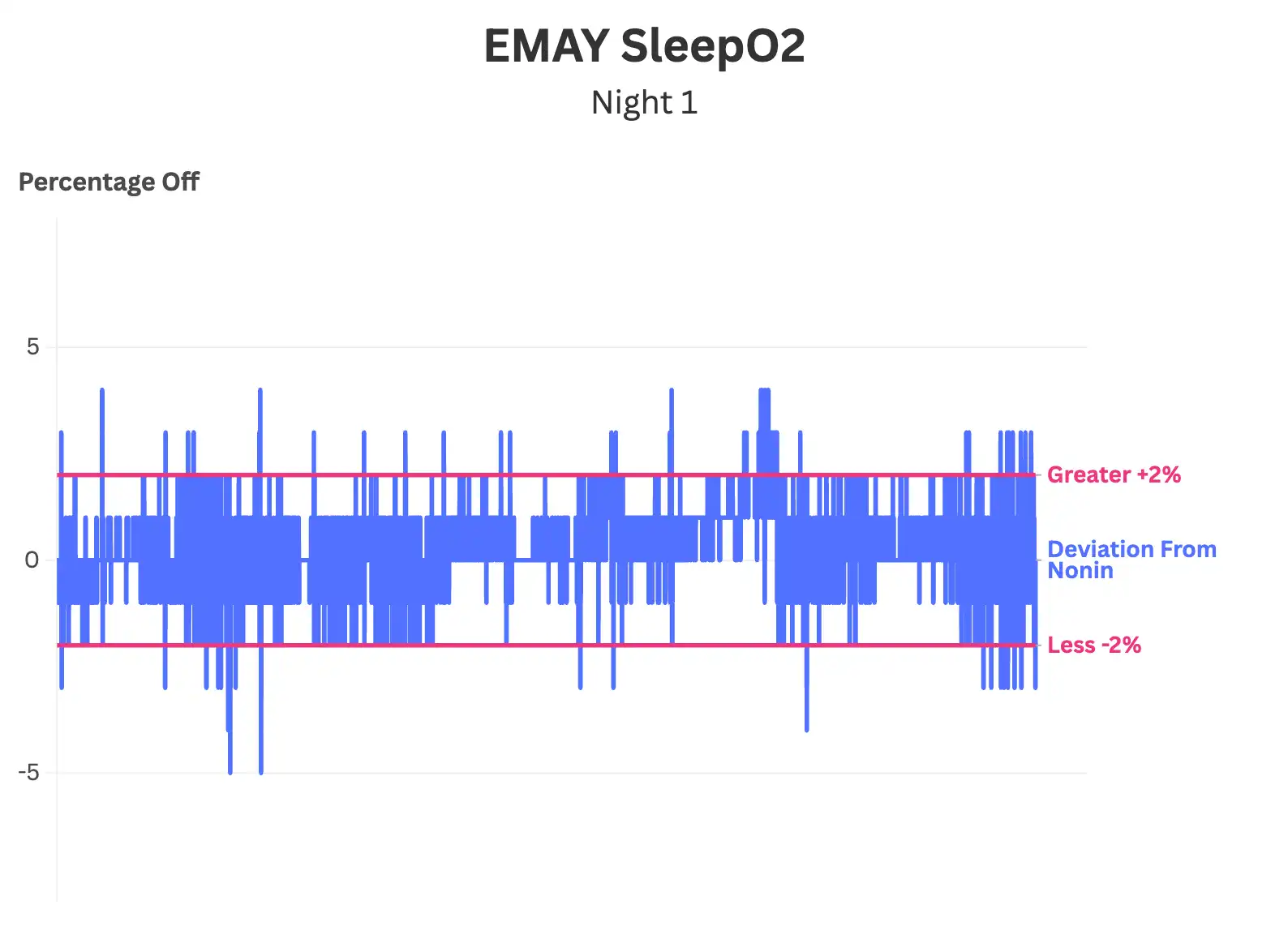
Chart shows why it scored 99% on Signal Stability 😀 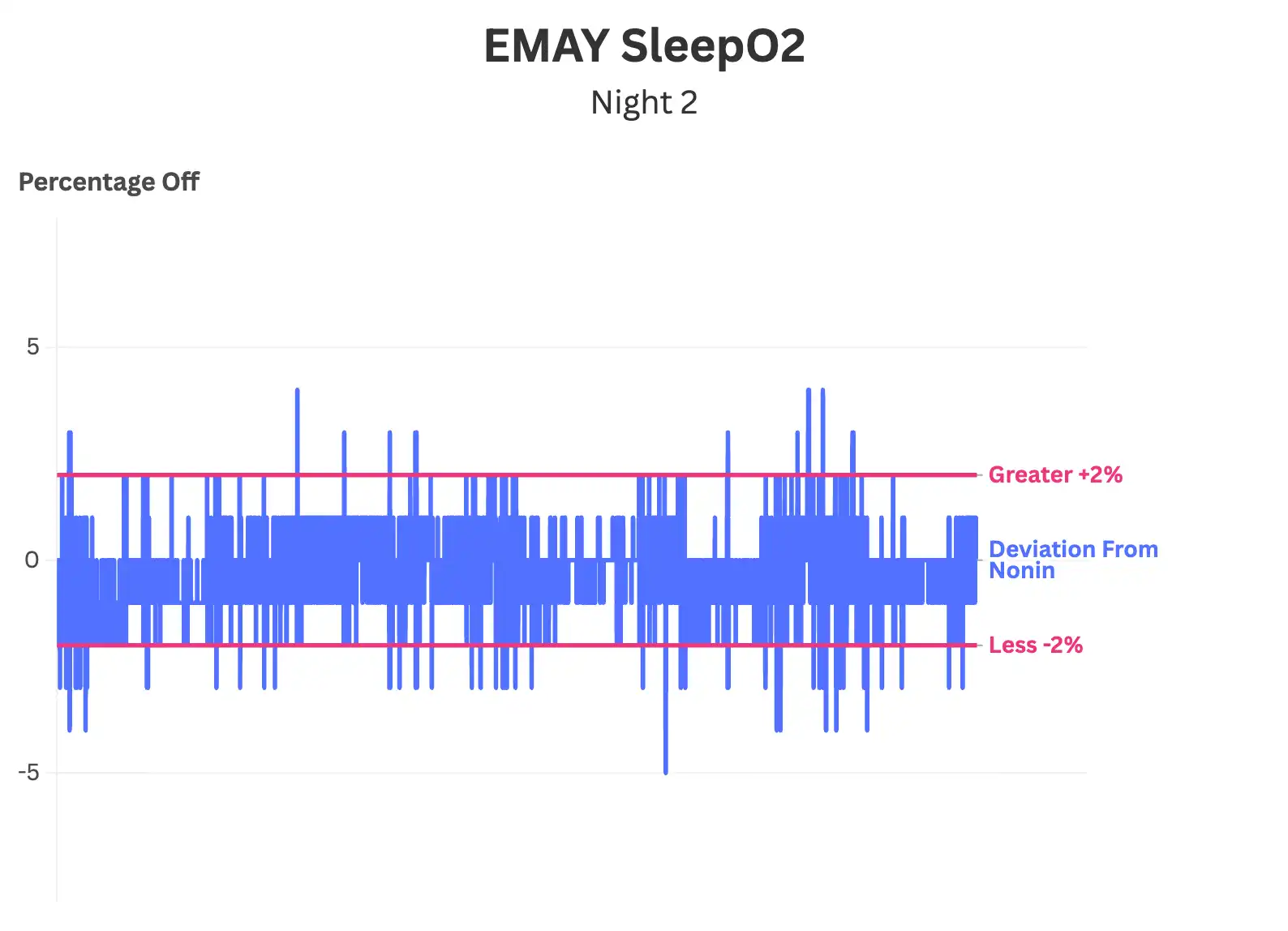
Chart shows why it scored 99% on Signal Stability 😀 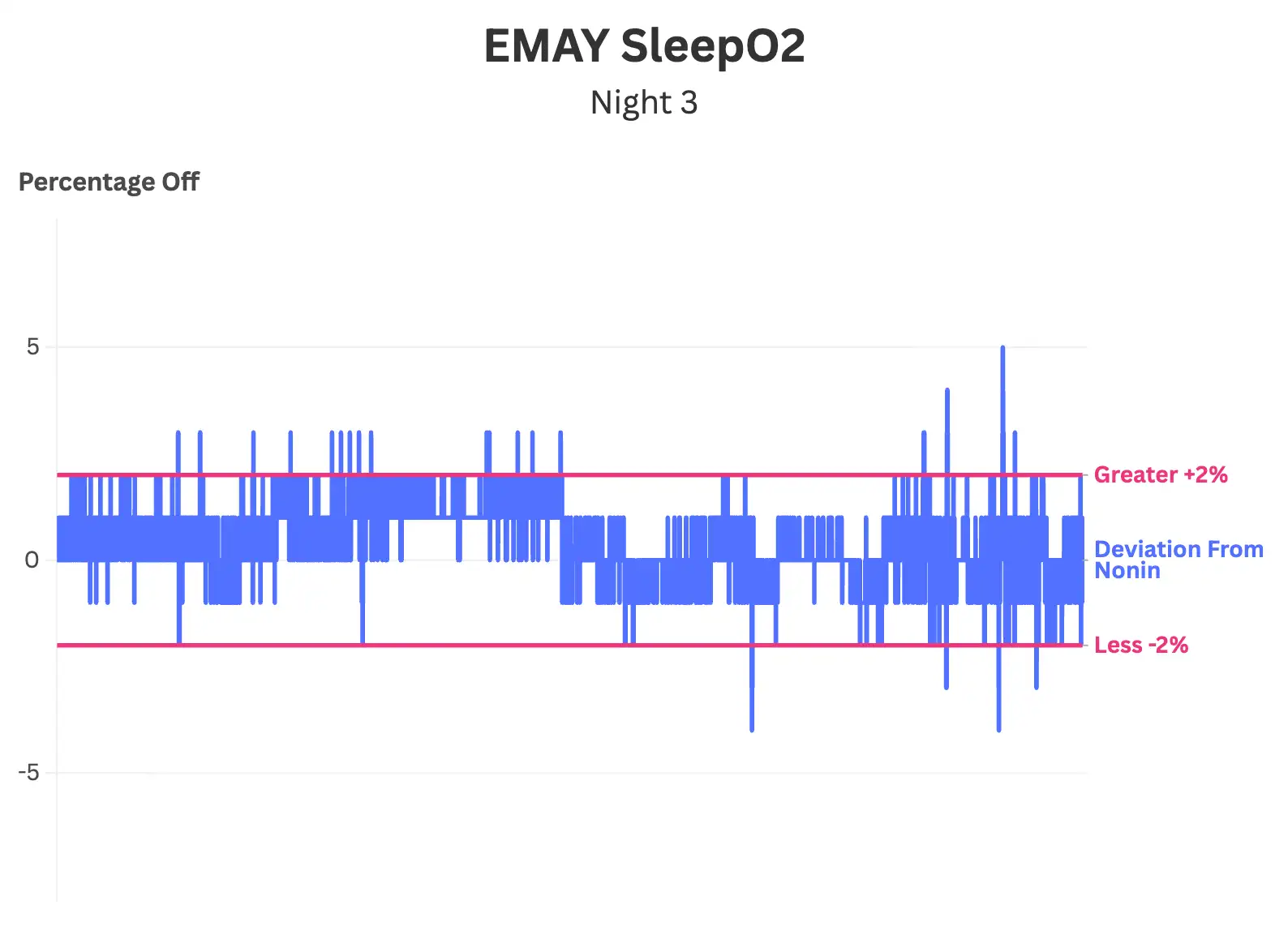
Chart shows why it scored 99% on Signal Stability 😀
How to Read this Chart
Think of the Blue Line as the device’s “Report Card.”
- The Center Line (0): This is a perfect score. The device matched the medical equipment exactly.
- The Pink Lines (+2 /-2): These are the “Guard Rails”. As long as the blue line stays between them, the EMAY SleepO2 is considered perfect alignment with the $1500 device.
- The Takeaway: Notice how the blue line spends almost the entire night safely inside the tracks. This is what reliability looks like.
Deviation Calculation
- The “Zero-Blindspot” Formula: We calculate the deviation for every single second of sleep using this formula:
- Deviation = SpO₂ (Reference) – SpO₂ (EMAY)
- The “Safety Guard Rails” (ISO 80601-2-61): You will see the pink limit lines at ±2%. These aren’t arbitrary; they represent the International Standard (ARMS) for clinical pulse oximetry.
- Why this matters: If the device’s line stays between these rails, it is agreeing with the hospital equipment.
- Bias Direction (The “Life Saving” Metric):
- Optimistic Bias (Negative Score): The line dips DOWN. This is dangerous because the device is reporting higher oxygen levels than you actually have, potentially masking a problem.
- Pessimistic Bias (Positive Score): The line trends UP. This is safer because the device is slightly under-reading, ensuring you are alerted to drops early.
- The “Fair Start” Protocol: To be 100% fair to the hardware, we surgically trim the first 5 minutes of every recording. This removes “warm-up” noise and ensures we only grade the device once it has stabilized on your finger.
EMAY SleepO2 Design and Build
For a long time, I thought EMAY was just a budget brand trying to compete with the big guys. I was wrong. My research of FDA filings and FCC certifications discovered a secret; EMAY SleepO2 is actually manufactured by Viatom Technology, the same giant behind the high-end Wellue devices.
While it shares a pedigree with Wellue and the others, the EMAY SleepO2 likely achieves superior accuracy through a precision-engineered synergy of optimized LED placement, a high-frequency sampling rate, and a refined form factor that minimizes the data noise other sensors miss. Let’s dive into it!
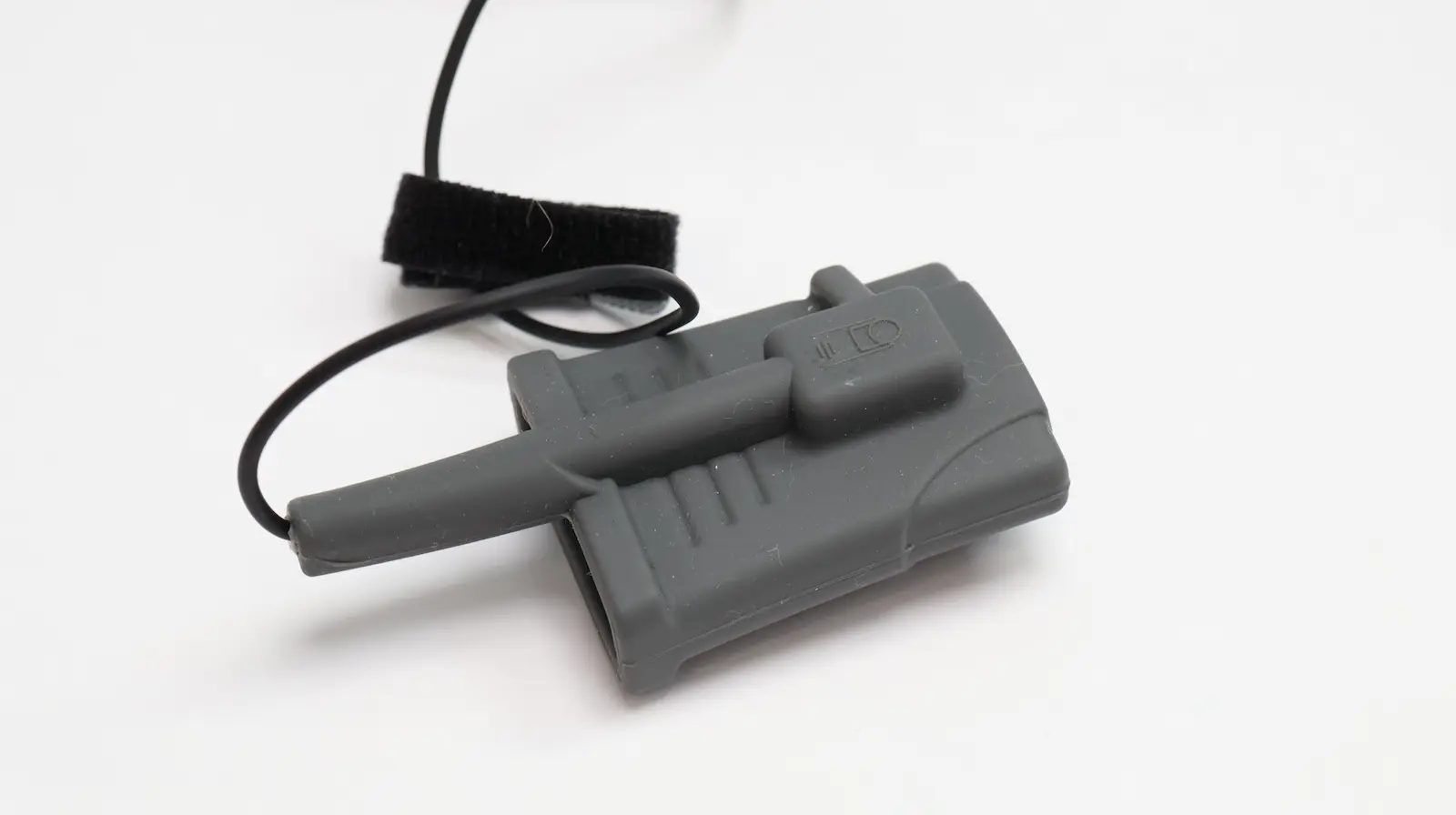
The duckbill probe is very similar to the Nonin 3150, but the EMAY version is wider at the base. Its softer rubber doesn’t pinch, and despite my concerns, accuracy was still strong. It also includes a soft felt band to keep the sensor from shifting side-to-side, which I appreciated for its simple, effective design.
Important: the velcro finger strap is necessary to keep the probe on your finger at night.
First Impressions (Unboxing + Hardware)
Build quality is simple but thoughtful: the band felt high quality and soft, locks easily, and held well all night.
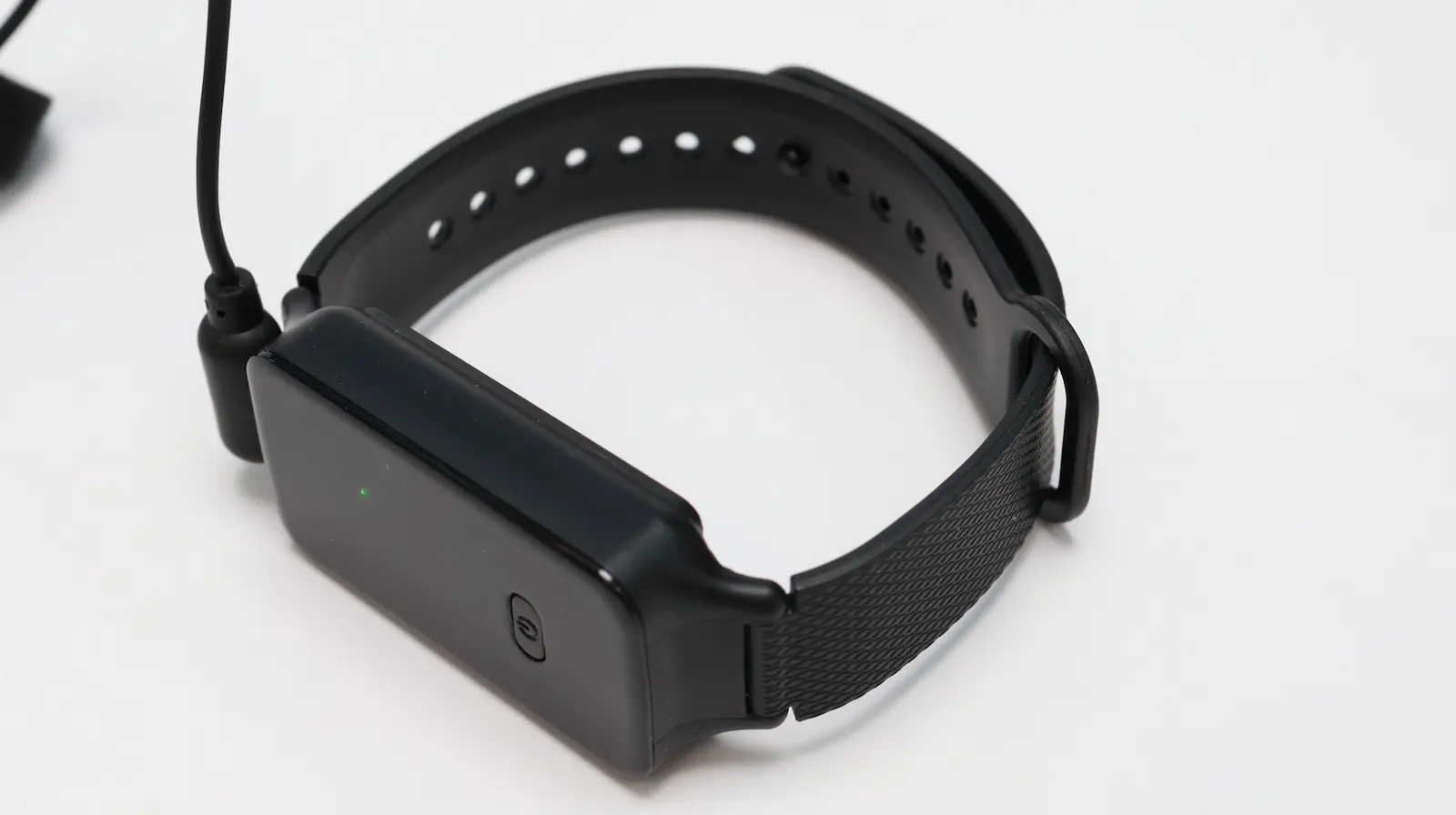
The power port is a mini USB cable, which comes with the device.
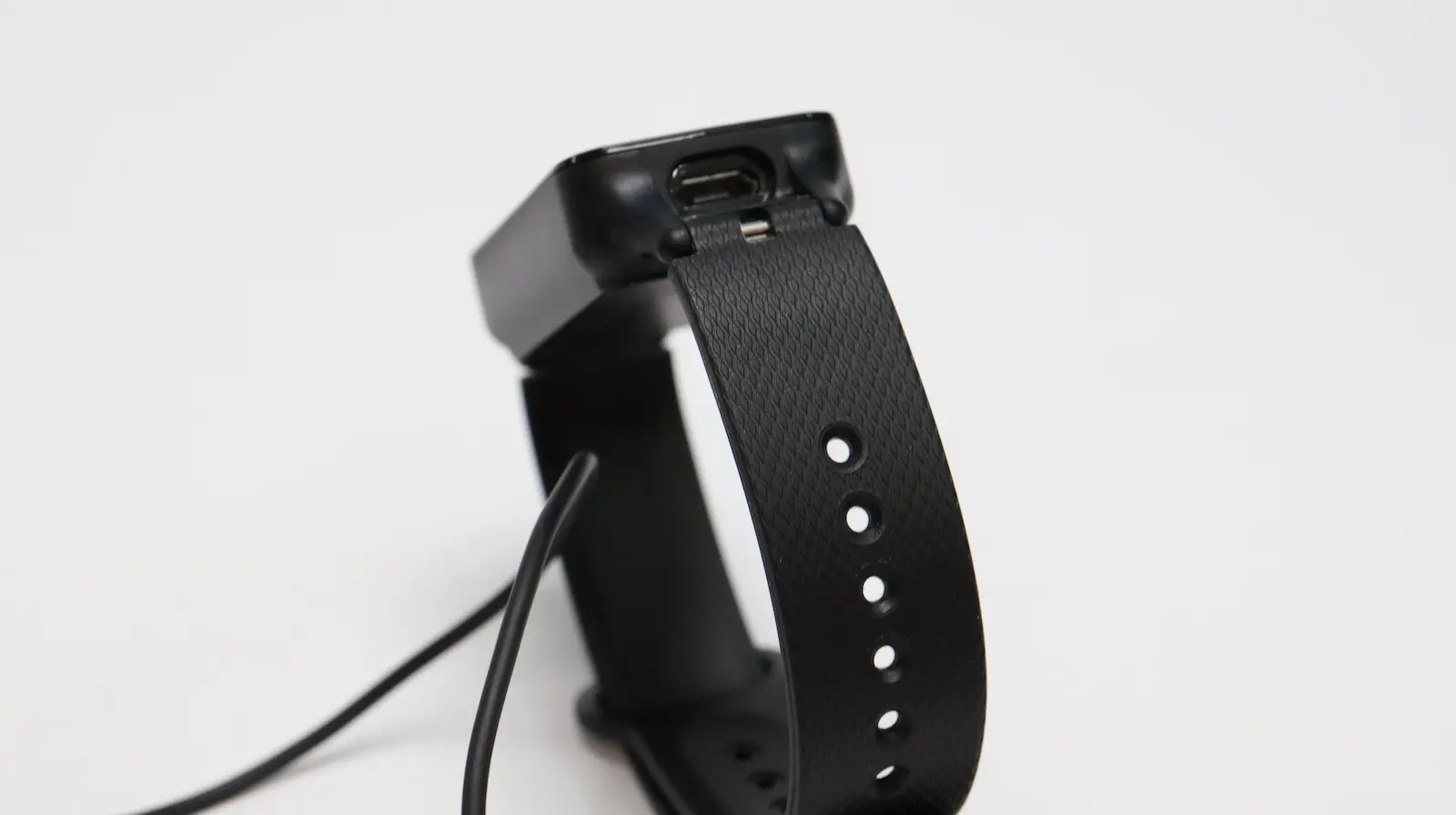
No Screen Design
EMAY explicitly notes there’s no display on the face because it’s not meant for spot checks—if you want real-time readings, you use the app. I enjoyed this feature, since I am testing overnight pulse oximeters for sleep, and having a blue LED screen lighting up the room is not my vibe.
Overnight Comfort and Wearability (“Pillow Test”)
Comfort Rating: 6/10⭐
Did it stay on? Yes—across three nights the sensor stayed on my finger and did not fall off. It shifted side-to-side sometimes but the velcro strap did a great job at keeping it in place.
The finger position is a bit more straight and split-like. For this reason is why I dropped the rating slightly. Overall, it was comfortable to wear overnight for all three nights.
This device does not have a SpO₂ or HR alarm with set thresholds.
EMAY SleepO2 App Experience
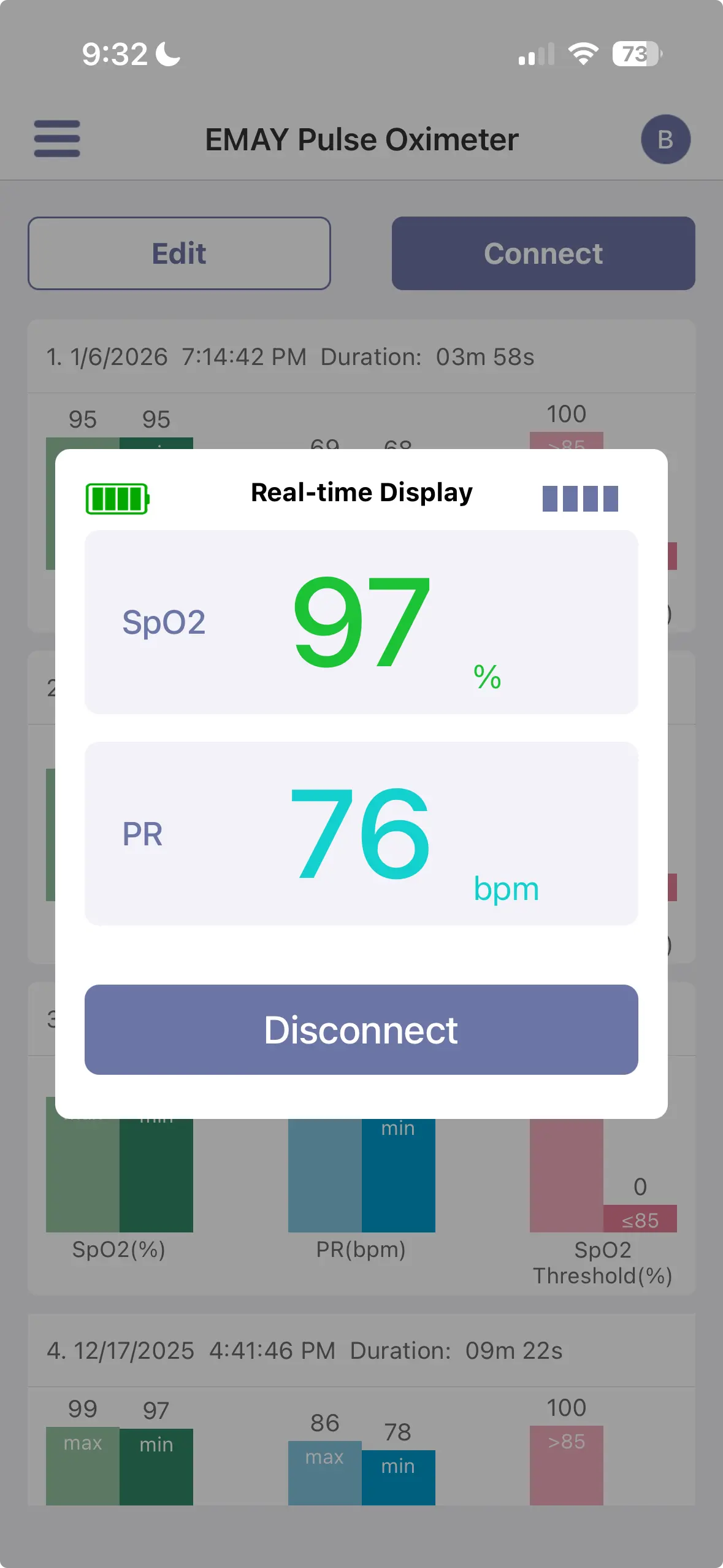
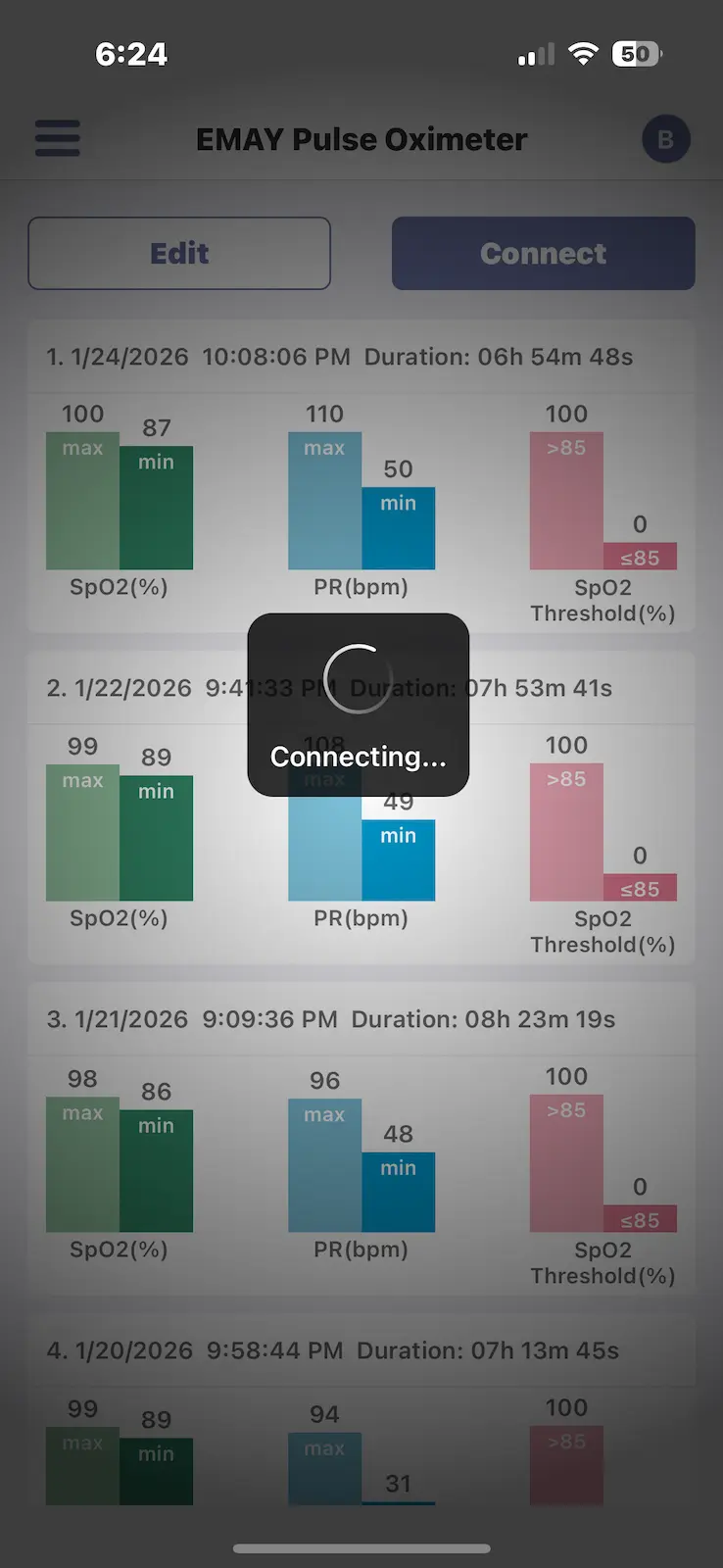
The app is modern looking, and intuitive to use. Pairing and syncing was fast: power on the device, tap Connect, and it downloads the night’s data immediately. This works exceptionally well!
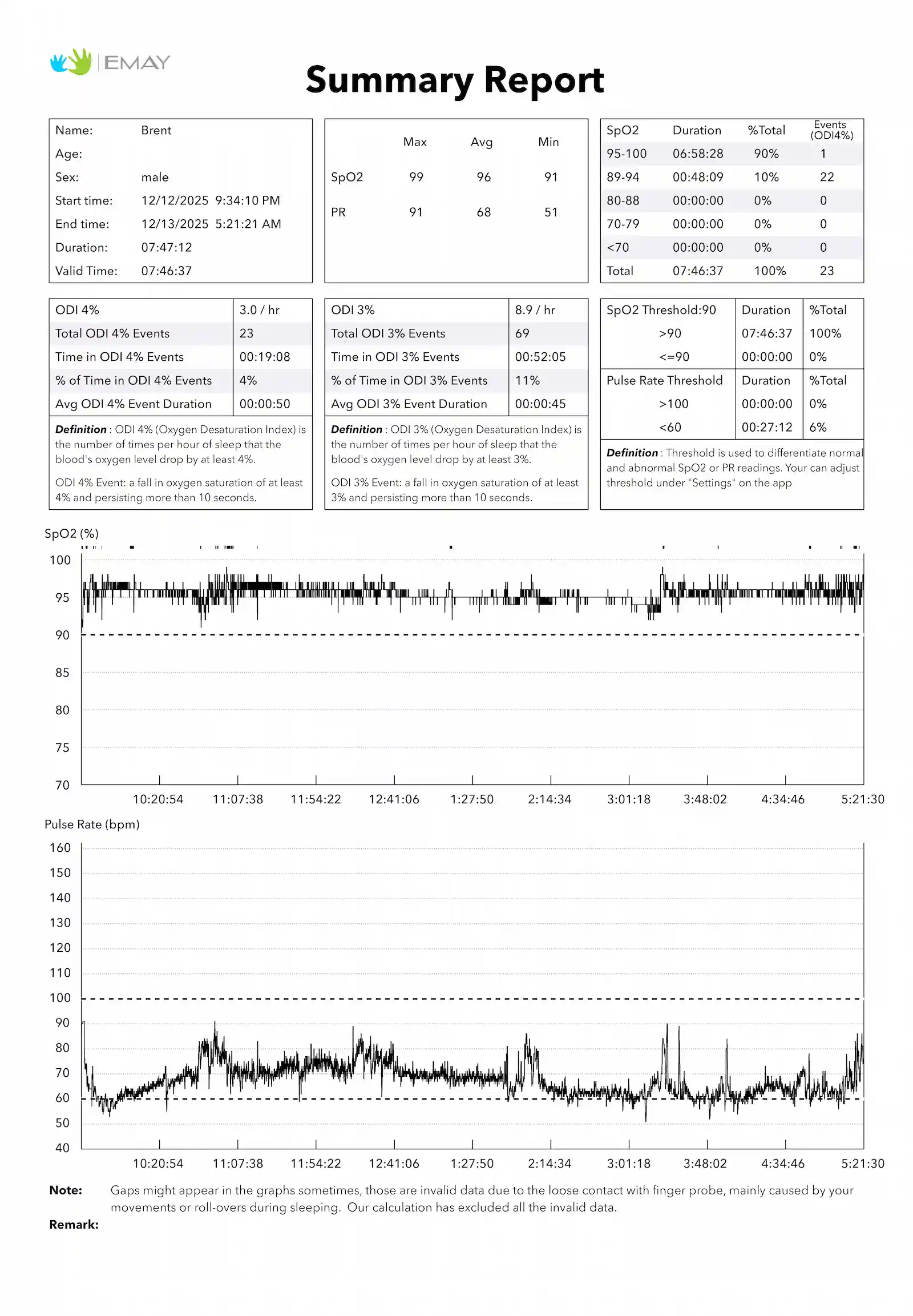
Data Export (CSV + PDF Done Right)
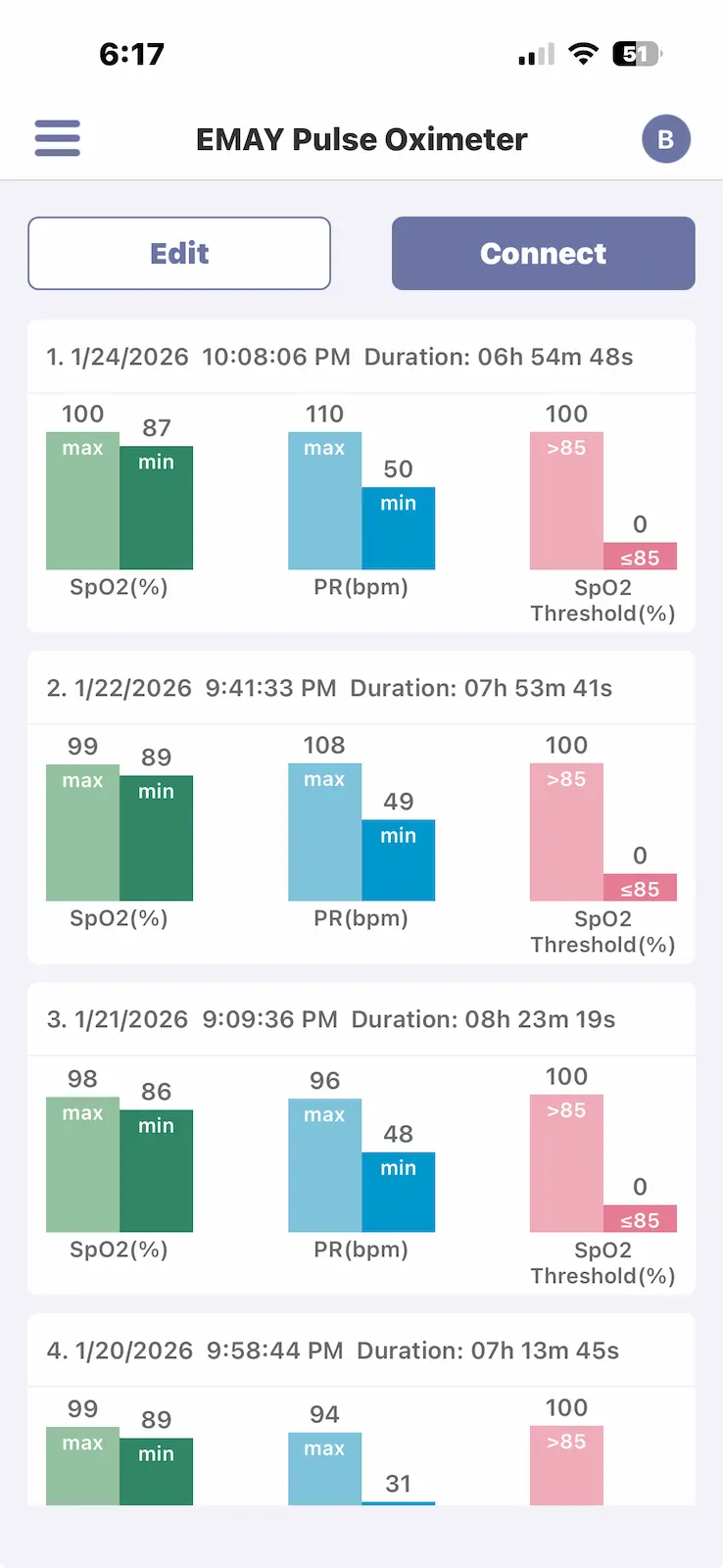
From all my testing, EMAY produced the best quality sleep study report I found. I was very impressed with the layout, metrics, education, coupled with clean CSV for the raw data.
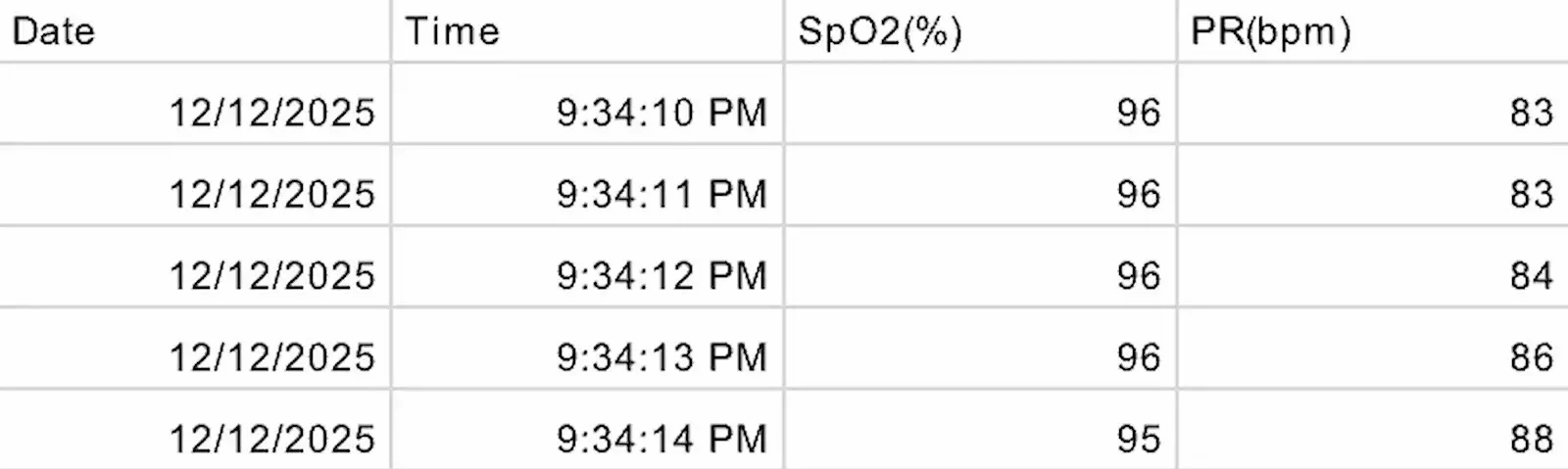
The CSV file that you get access to in the app is in a nice clean format. It provides second-to-second data of exactly what happened while you were sleeping.
Should You Buy The EMAY SleepO2?
After testing this device and sleeping with it for 24 hours, this would be a great device for you if you:
- Suspected sleep apnea (you care about Oxygen Desaturation Index and dips below 90%)
- You have a CPAP (you care about short, sharp desats from leaks in the mask and changes in pressure)
- You are a Biohacker who want exports and trend clarity to optimize your sleep
Overall Thoughts
Overall, the EMAY SleepO2 surprised me in the best way. It’s not the prettiest device, but it is sleek, lightweight, and accurate; it’s not trying to win awards for comfort or app “wow” factor—but when it comes to doing the one job that matters (capturing your real overnight oxygen trends and dips), it will show up like a champ!
Don’t be fooled by the shared DNA with Wellue—my months of rigorous testing show that EMAY’s refined form factor and precision sampling outpace the competition, giving you the honest data and clean exports of a high-end clinical device at a fraction of the cost.
EMAY SleepO2
Pros:
Cons:
-

Science of Sunrise Alarms: Do They Actually Work?
Does a sunrise alarm actually help? We analyze the studies on dawn simulation for winter depression (SAD) and circadian alignment. See the science inside.
11 minutes -
Philips SmartSleep Review: HF3500 vs. HF3520 vs. HF3650
Confused by the SmartSleep models? We tested all three. Compare lux, flicker, and alarm features to find the right Philips sunrise alarm for you.
7 minutes -
How to Blackout Your Bedroom: The Ultimate Guide
Waking up too early? Learn how to pitch-black your room using magnetic strips, blackout shades, and hidden tricks to stop light leaks.
4 minutes