

Review Summary
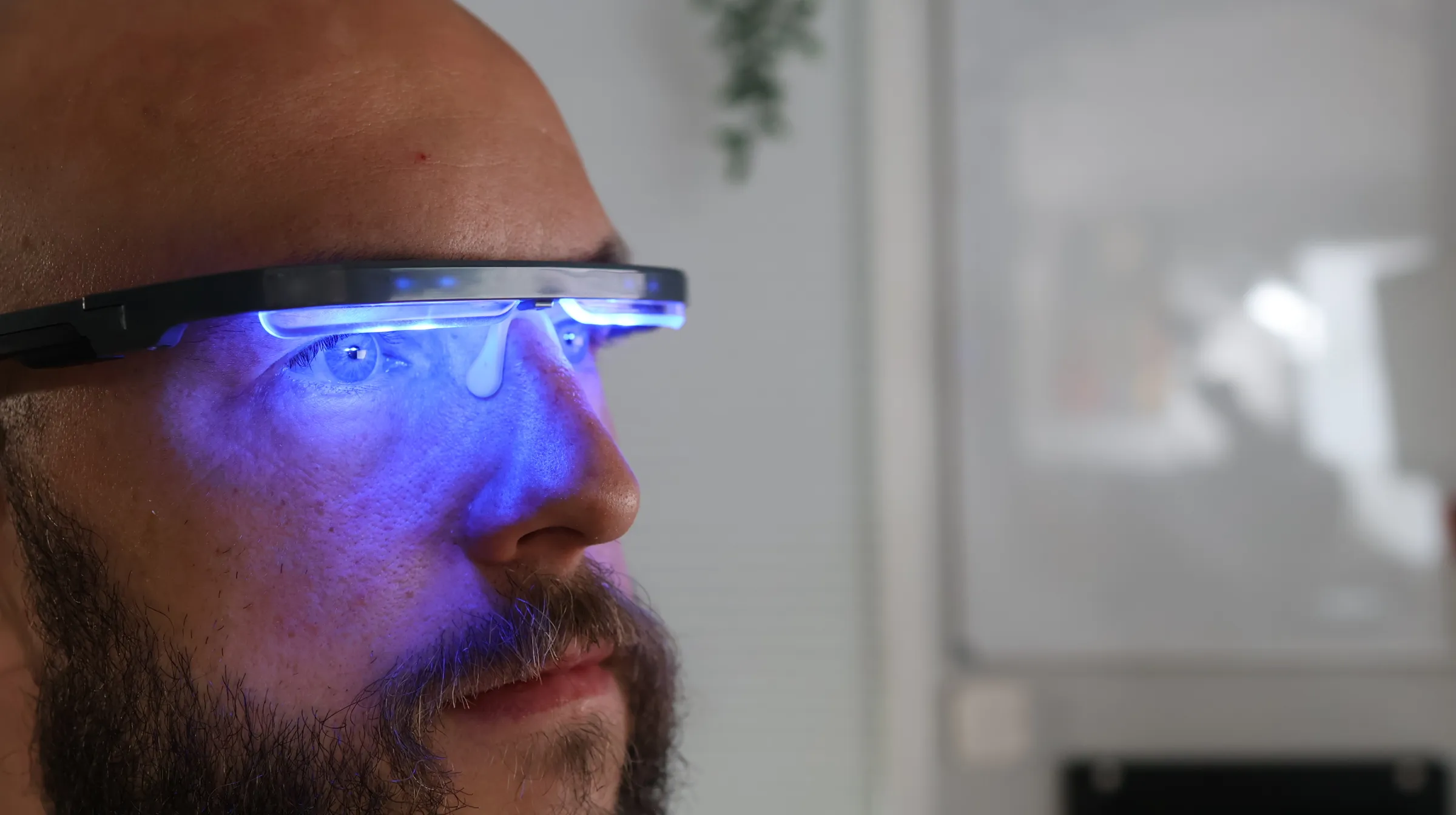
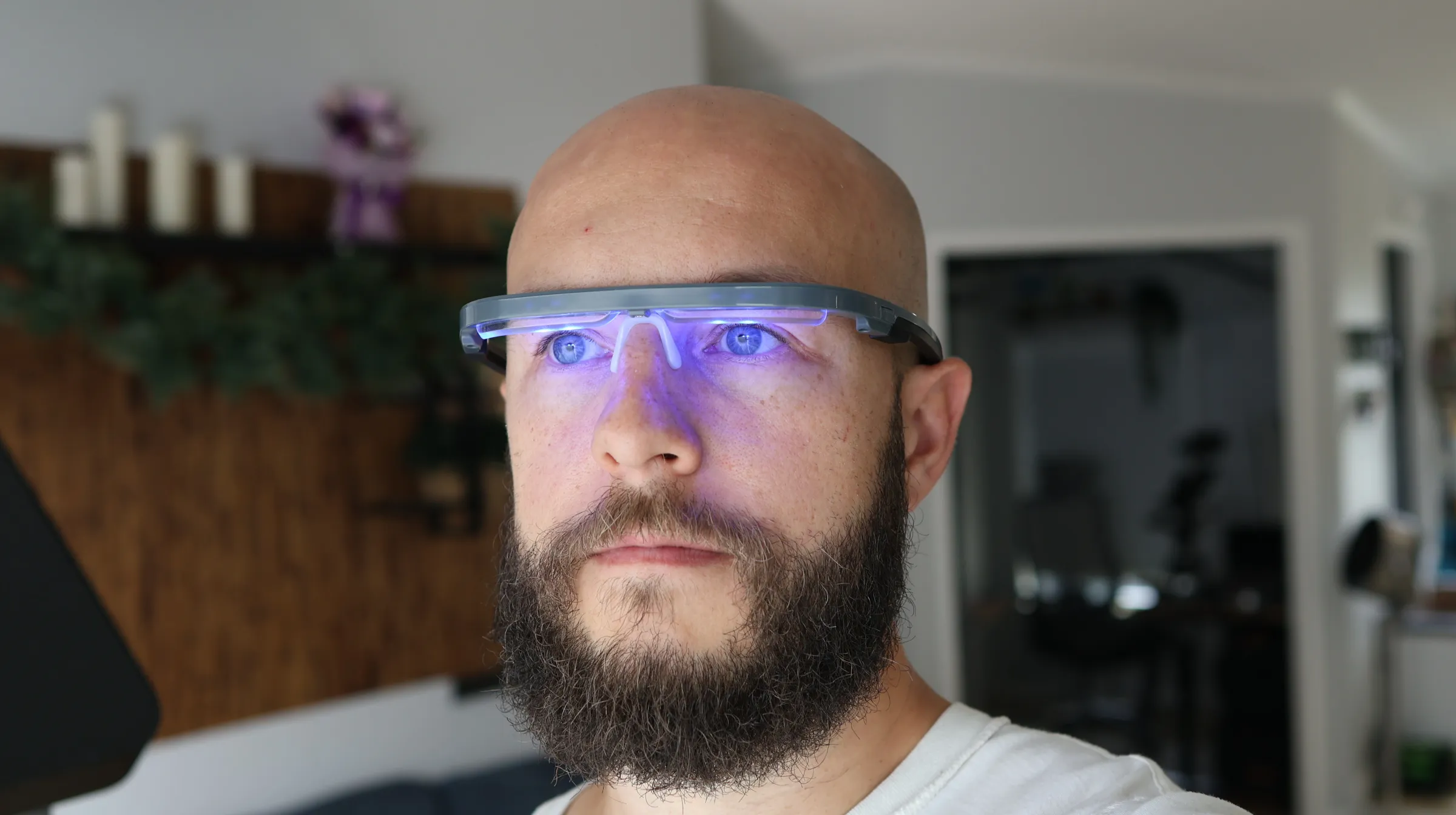
The AYO+ is the pair of light therapy glasses I actually keep using. It’s light, comfortable, easy to see out of, and delivered about 1,000 lux melanopic EDI on high at my eye.
It also comes with the best free app in the category. Buy it for the blue light and the portability. The red light is a nice extra, not red light therapy.
Pros
Cons
I’ve owned several pairs of AYO glasses over the last few years, and the AYO+ is the one that lives in my travel bag. I wanted to know how much light it really puts into your eye, so I measured it on a spectrometer headform built from a scan of my own head.
It holds up. If you want to see how it ranks against the rest, my best light therapy glasses guide has the full field.
AYO+ Specs at a Glance
These are the numbers people ask about most. Anything marked “measured” came off my own bench or scale.
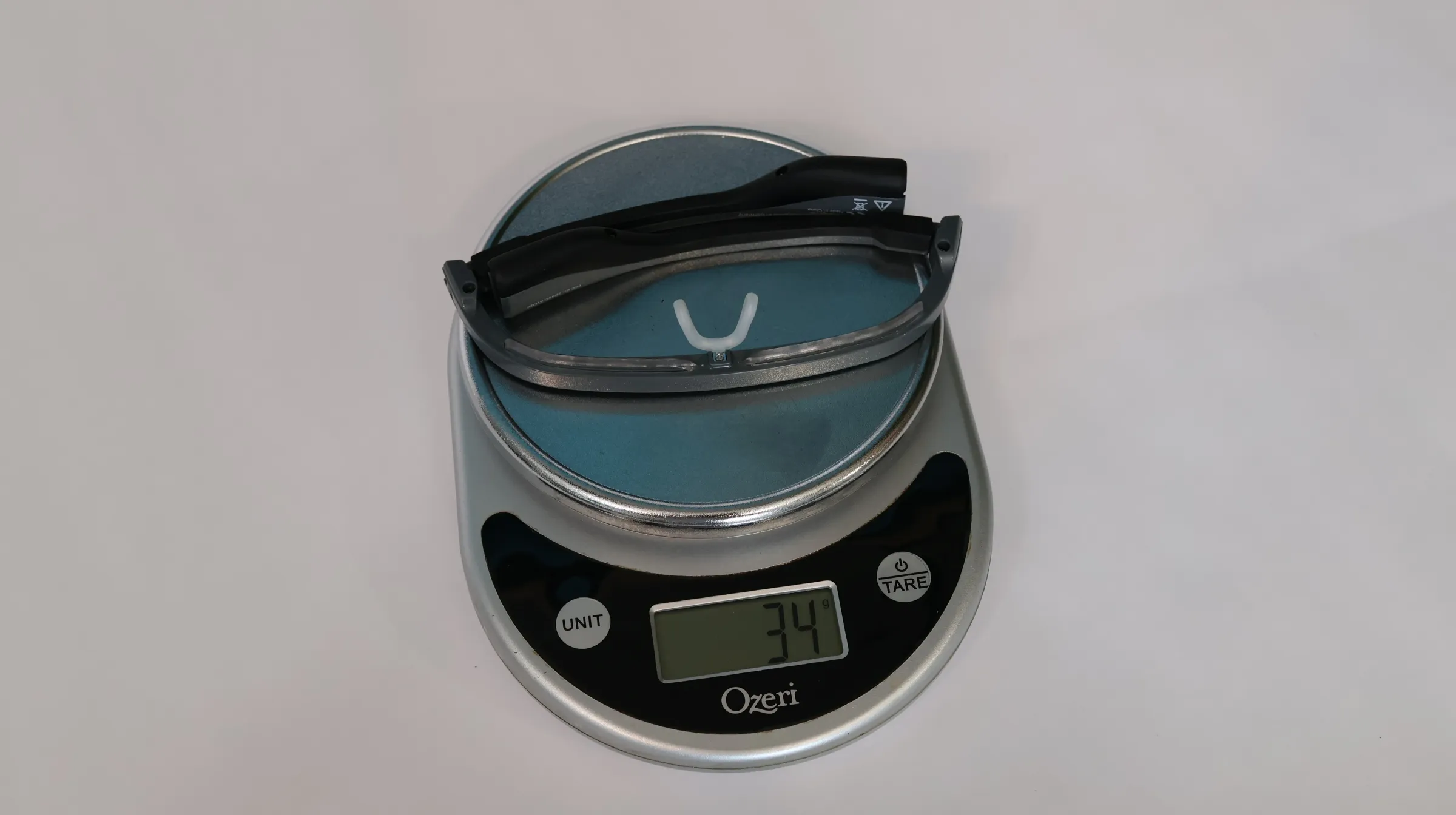
- Weight: 34g measured (AYO says 31g)
- Blue light: 463nm peak measured (AYO says 470nm)
- Melanopic EDI at my eye: 511 / 717 / 1,011 lux at low / medium / high
- Red light: 675nm peak measured (AYO says 670nm)
- Intensity: 10 to 100% in the app, with presets at 50 / 70 / 100%
- Session length: 5 to 90 minutes
- Controls: none. It turns on when you open the arms
- App: free, no subscription
- Battery: about 9 sessions, roughly a week of daily use (AYO says up to 10 days)
- Charging: USB-C, about 90 minutes to full
- Integrations: Apple Health
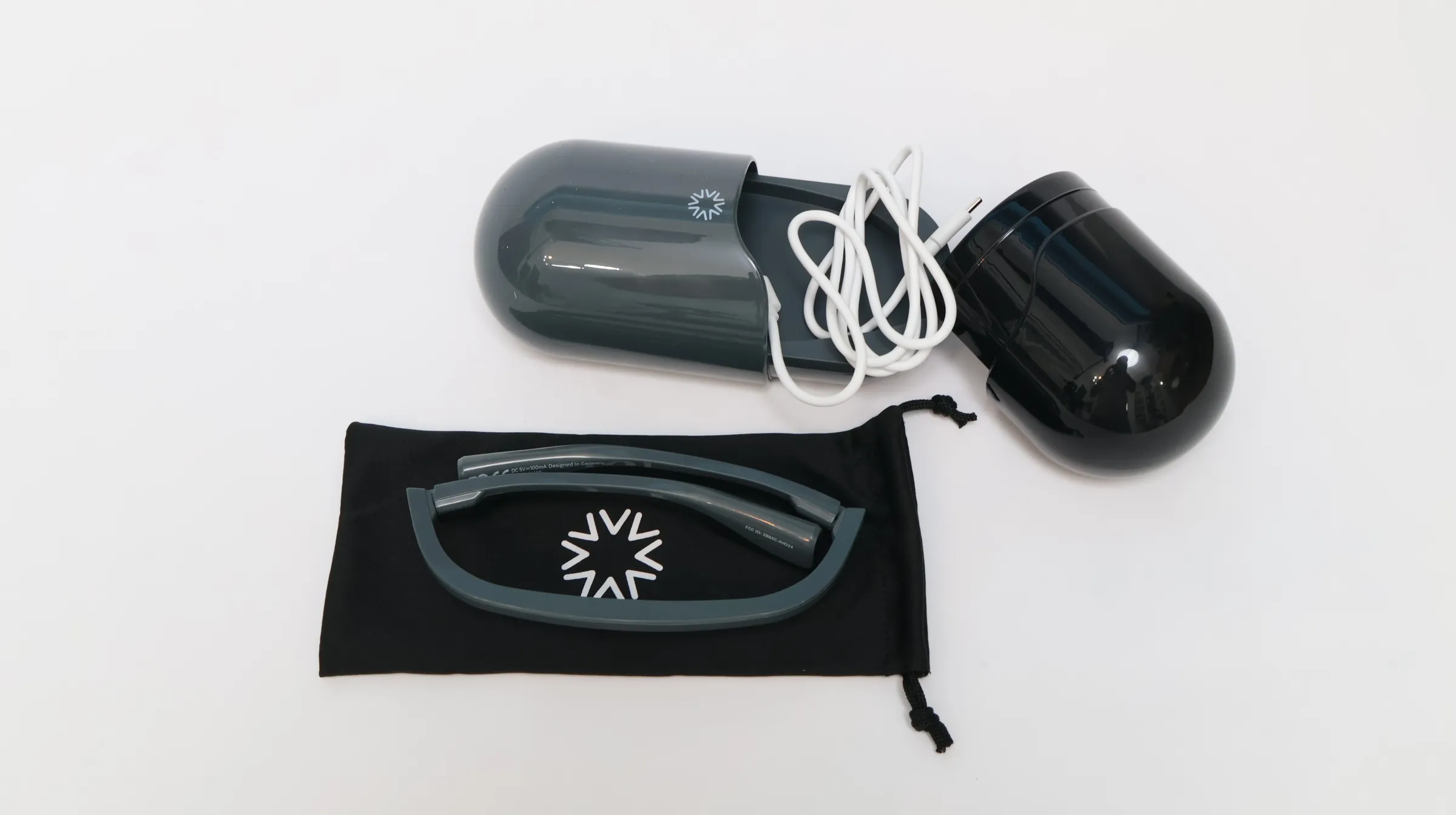
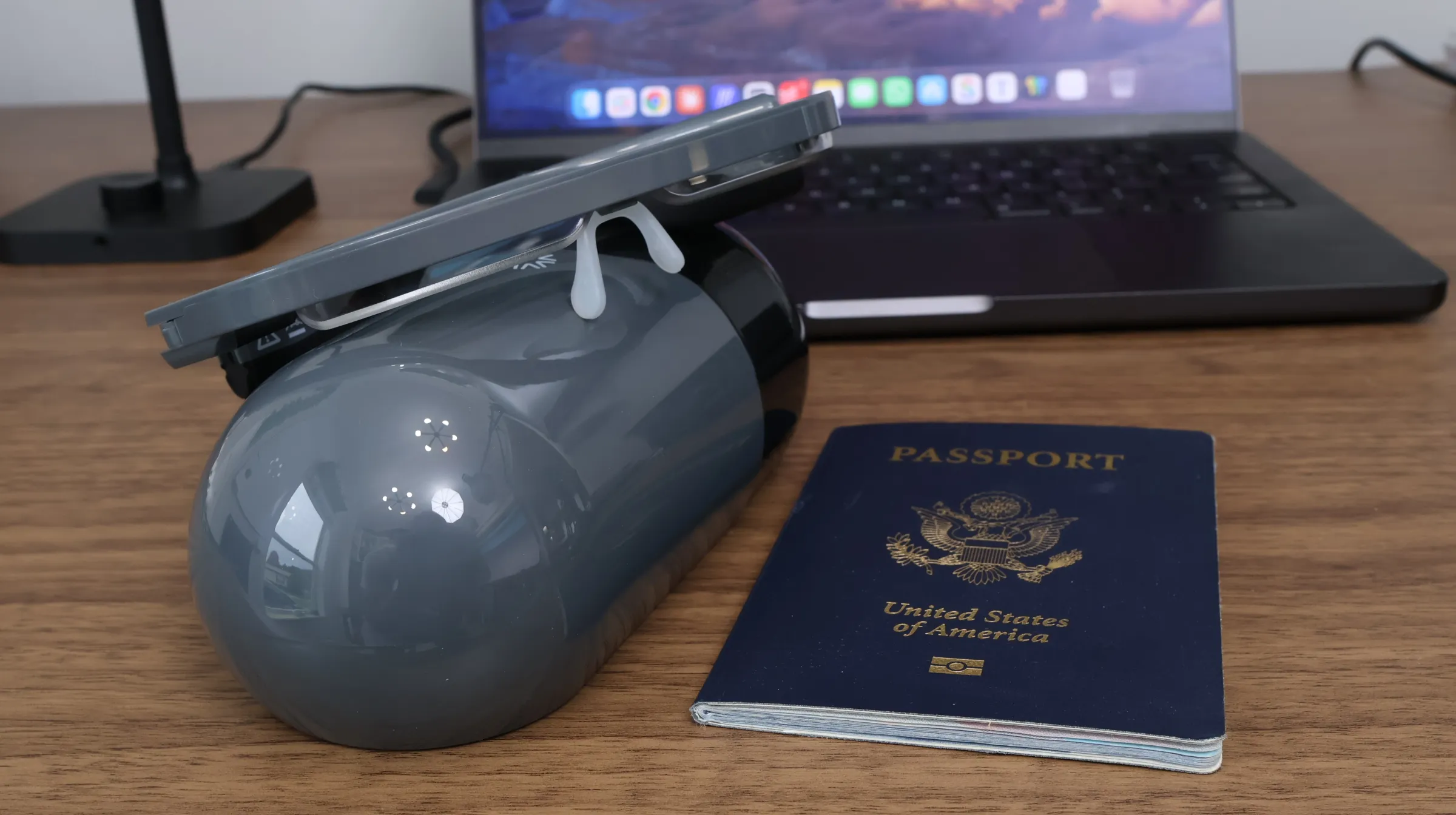
- In the box: glasses, hard travel case, soft pouch, USB-C cable
- Price: $299 (White/Blue), $319 (Carbon Black), FSA/HSA eligible
- Warranty: 60-day money-back guarantee, 1-year warranty (2 years in the EU)
What It’s Like to Wear Every Day
I have a wide head. Most glasses-style gadgets leave me with a sore spot above the ears within 20 minutes.
Free · 95 pages
You’re reading about one piece of this. The book is the whole day.
The Circadian Blueprint covers setting your body clock with light — the timing, the doses, and which products actually deliver them. Every number came off my own spectrometer.
Check your inbox to confirm. Plus a short note each month on what I’ve tested — unsubscribe anytime.
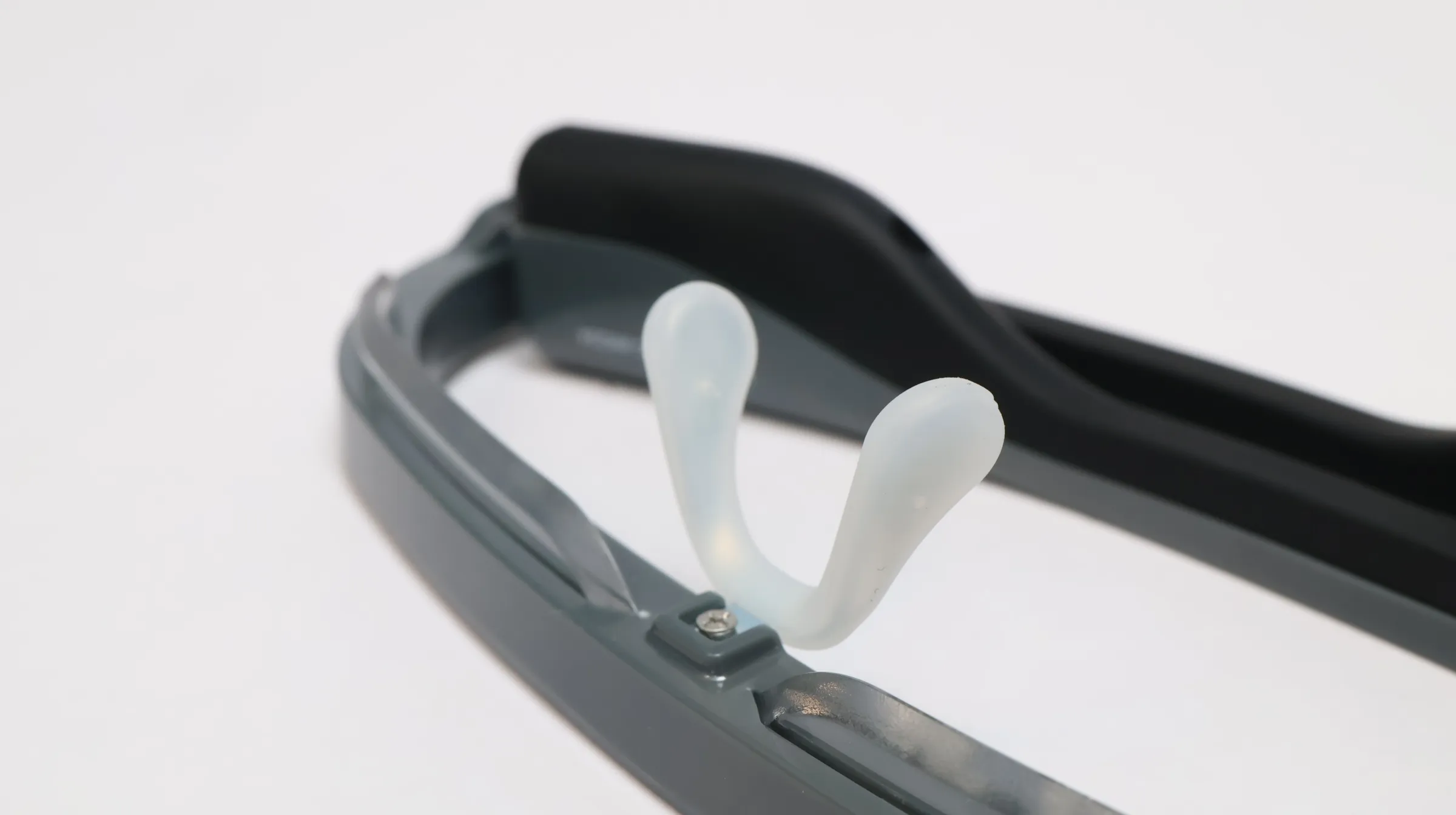
The AYO+ doesn’t. I’ve worn it for 30-minute sessions for years with no temple pressure, and the adjustable nose piece lets it sit where it’s comfortable instead of where the frame wants it.
Can you see through them?
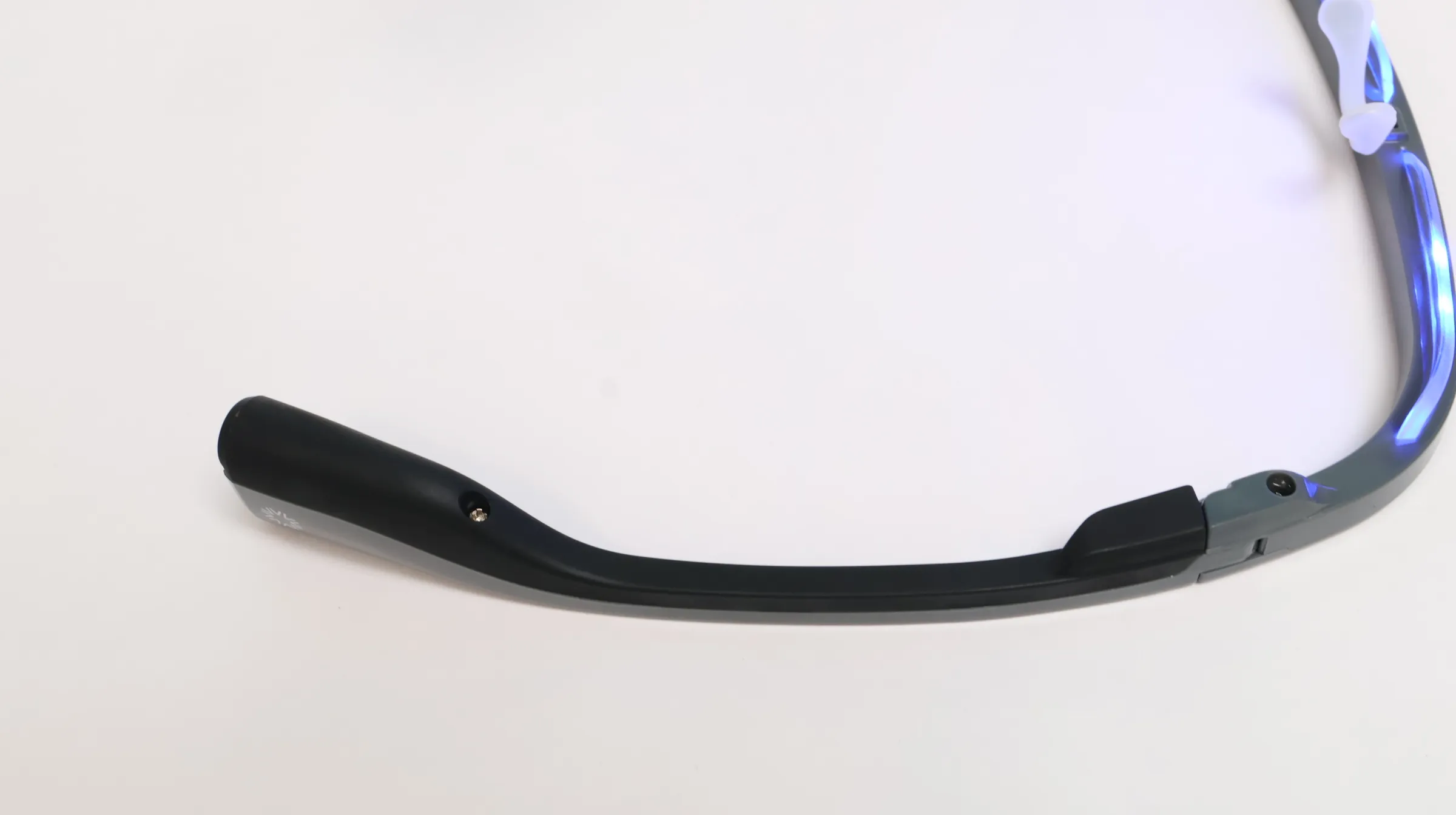
Yes, and this is the AYO+’s real advantage for me. It’s the easiest light therapy glasses I’ve worn to see out of.
Narrowband blue is less glaring than the white light some glasses use, and less distracting than the turquoise-green of others. I work at a laptop, read and make coffee in them without thinking about it.
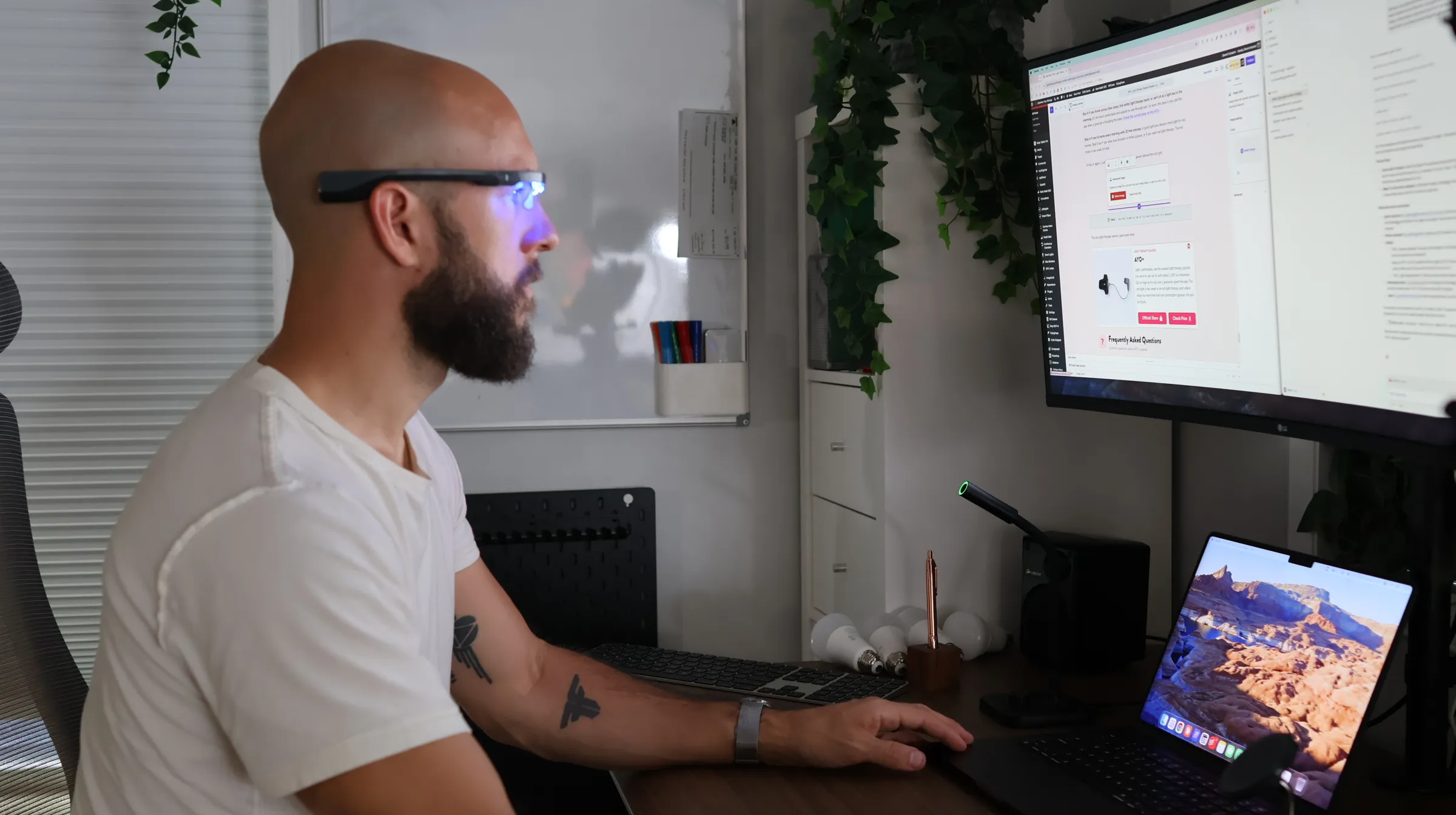
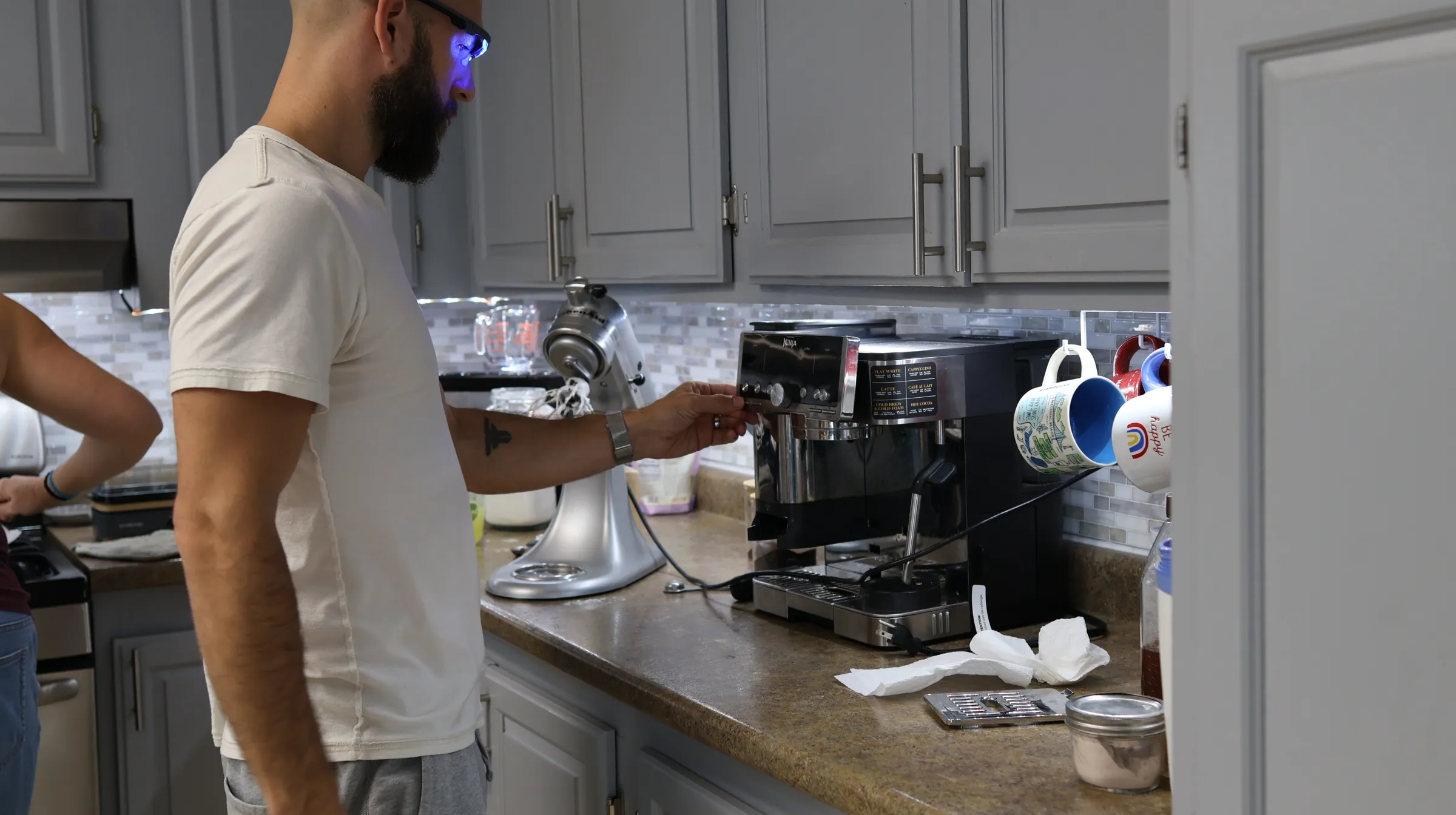
There is one situation where they struggle: a very dark room before sunrise. With the light shining at your eyes, your night vision is gone, so turn a lamp on first. That’s true of every pair of light therapy glasses I’ve tried.
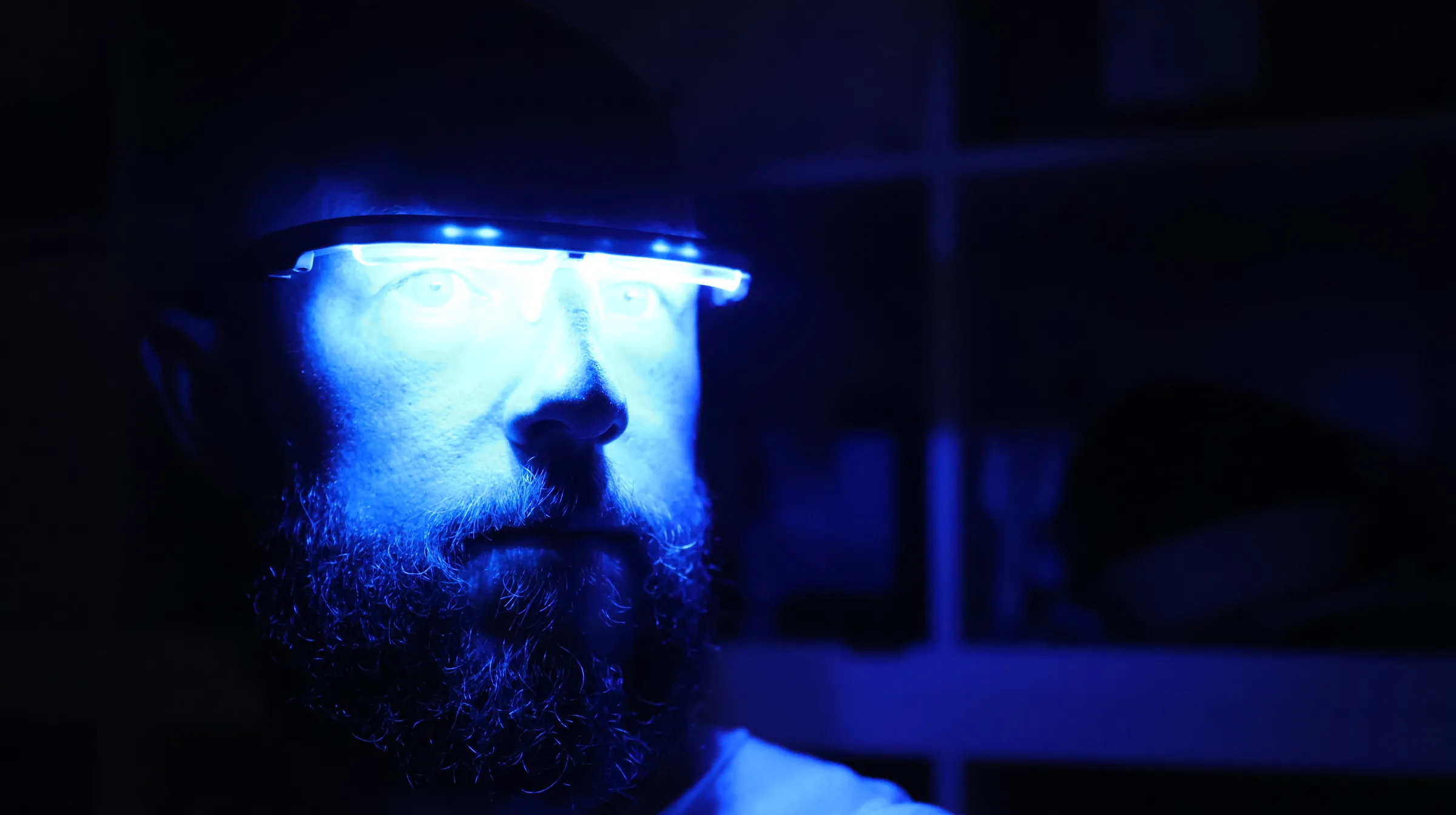
Don’t drive in them. If you want light therapy on your commute, the Luminette Drive is built for that job.
Build quality and the two colors
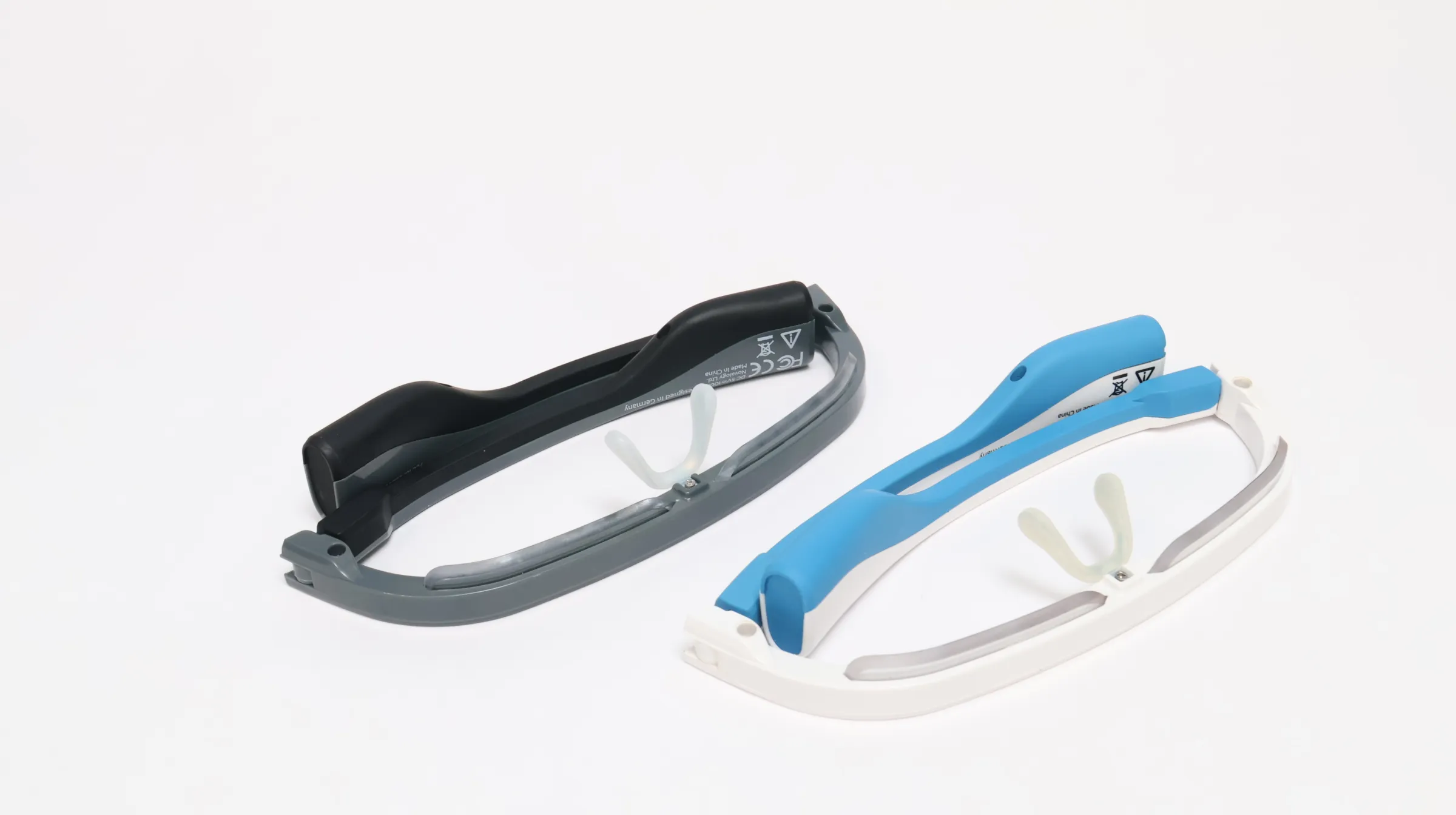
I’ve had multiple pairs over a few years and haven’t broken one. I’ve seen people online say theirs snapped. I can’t tell you why, but opening the arms gently seems like cheap insurance.
The Carbon Black costs $20 more than the White/Blue. I like the look of it better, but that’s the only difference.
Can you wear AYO+ over glasses?
It fits over most frames, but it sits higher and farther from your eye, and the light has to pass through your lens. That costs you a lot.
On my headform, wearing the AYO+ over a pair of completely clear glasses cut melanopic EDI from 1,011 to 418 lux. That’s a 59% drop, and clear lenses are the best case.
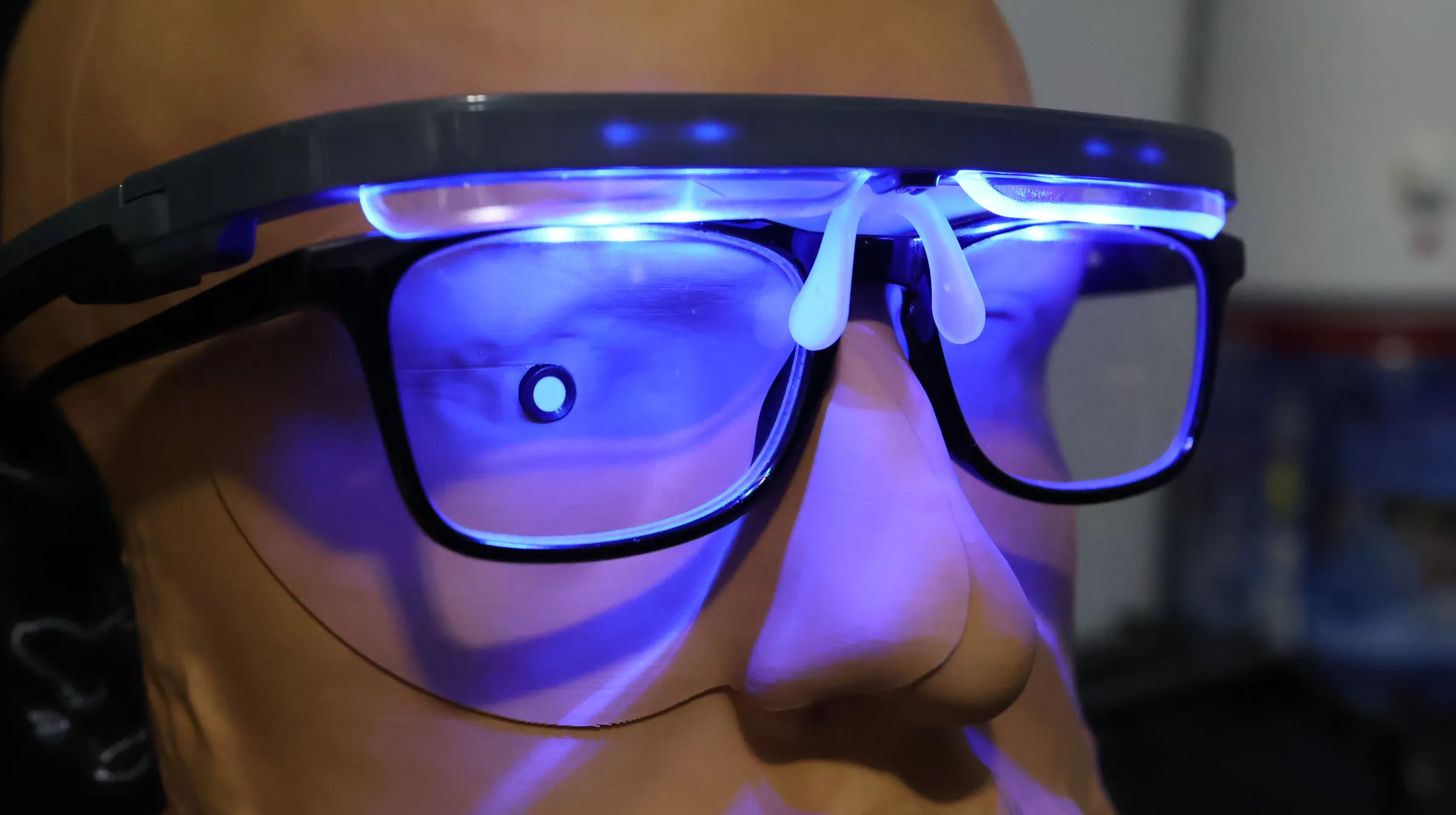
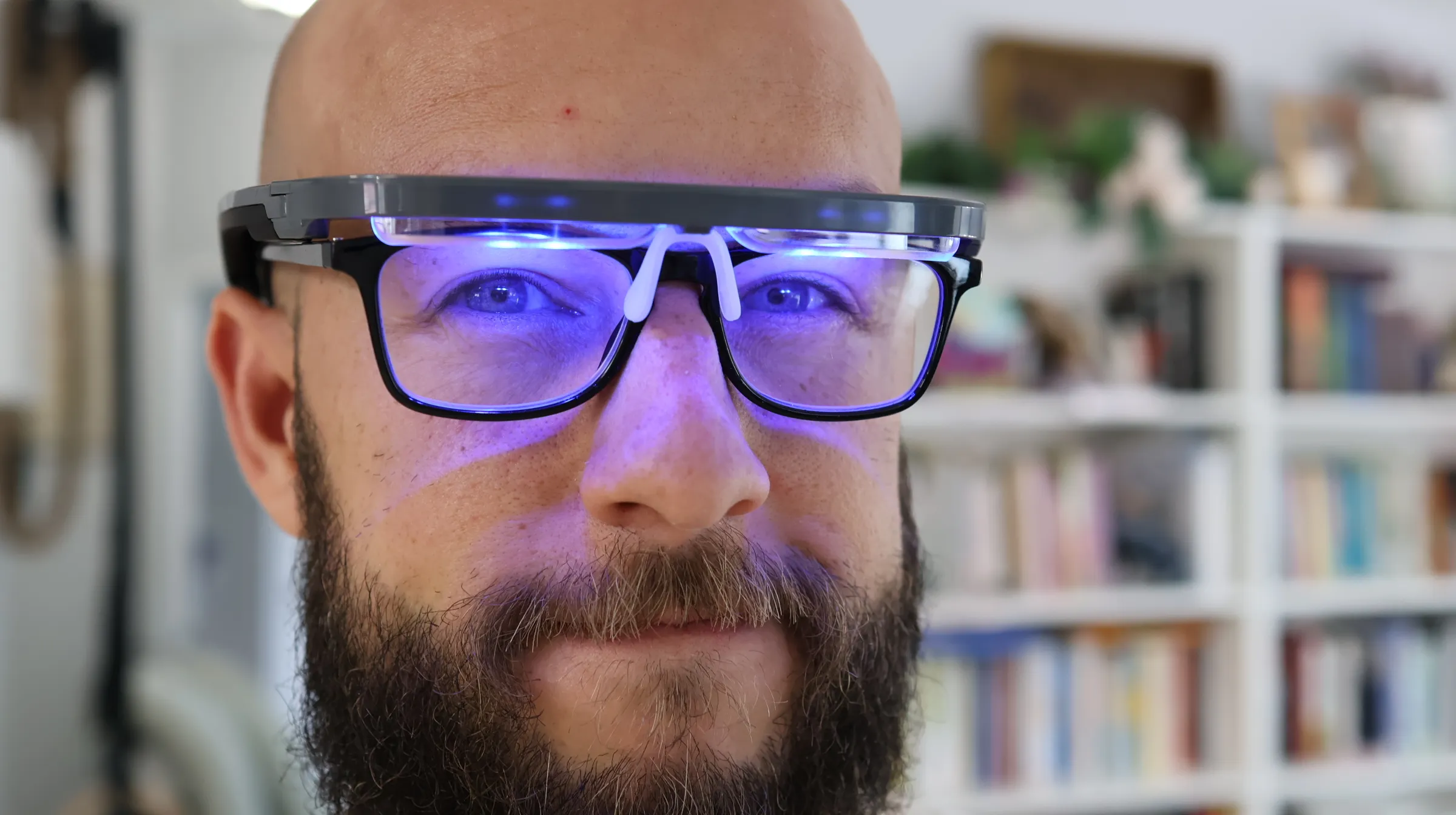
Never wear them over blue blockers or tinted lenses. The AYO+ puts nearly all its light right where those lenses block it, so you’d be cancelling the session out.
How Much Light Actually Reaches Your Eye
Measured with a plain lux meter, the AYO+ on high reads 113 lux. That number is almost meaningless for these glasses.
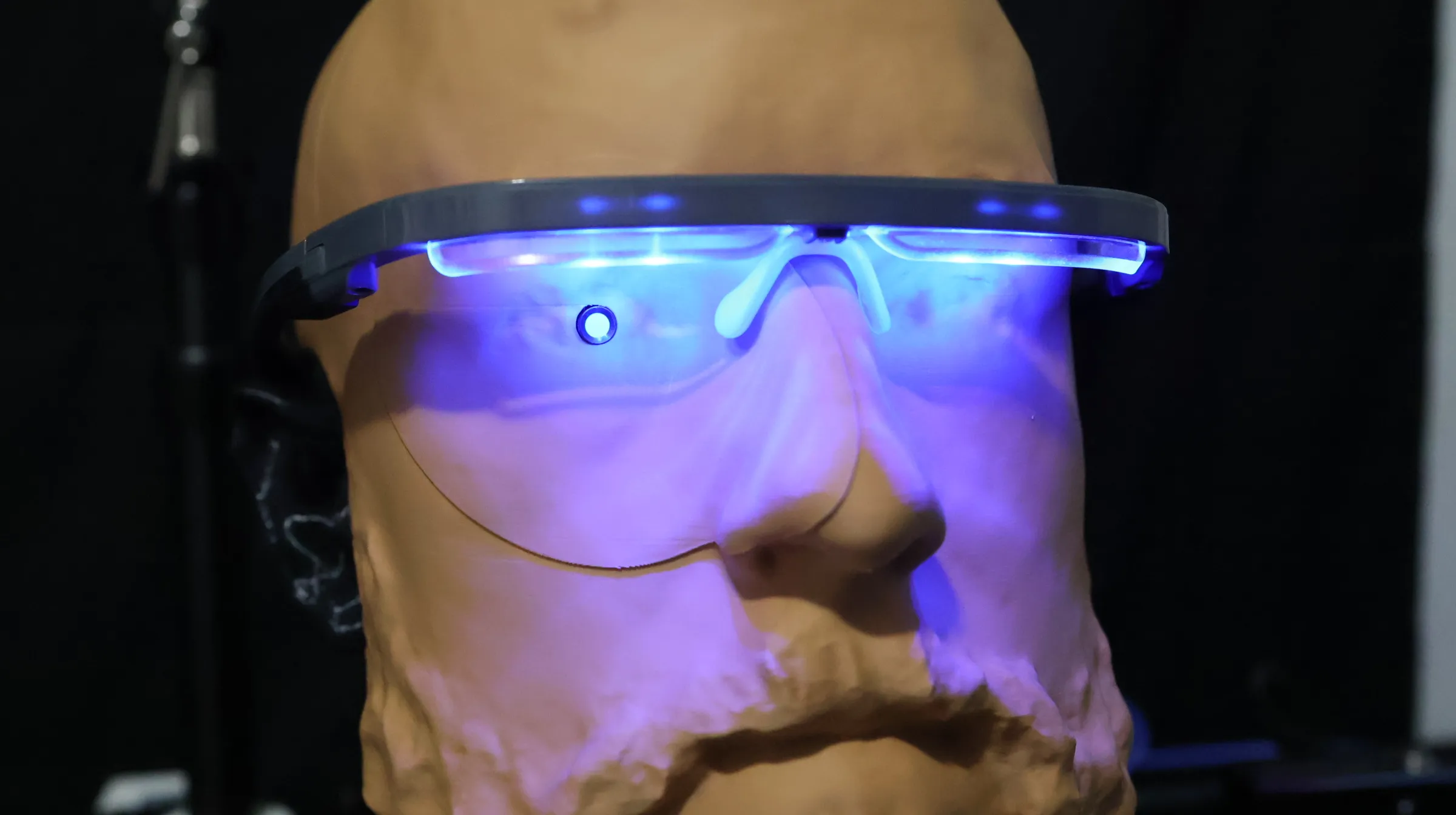
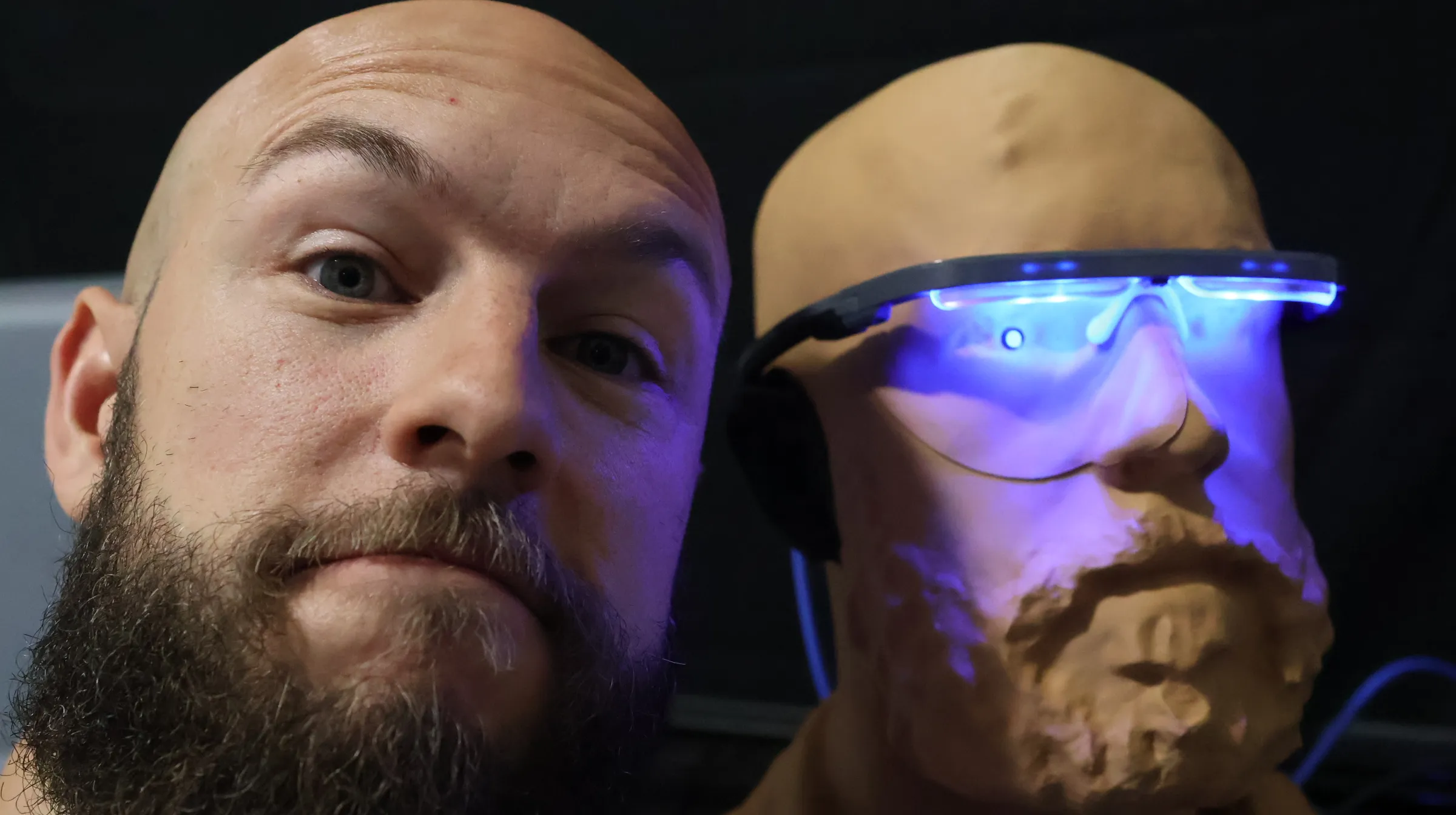
To get the real dose, I put the AYO+ on a headform that’s a 3D print of my own head, with a calibrated spectrometer sitting where my eye would be. That tells you what reaches the eye, not what leaves the LED.
Why lux undersells it
The AYO+ emits narrowband blue light peaking at 463nm. The lux scale is built around how bright light looks to you, and your eyes barely register 463nm as bright.
Your circadian system is a different story. Melanopsin, the photopigment that sets your body clock, is most sensitive right around 480nm. That’s why melanopic EDI, the metric that tracks it, comes out about 9x higher than lux on the AYO+.
A single narrow peak at 463nm. Almost no visible “brightness”, plenty of circadian signal.
Melanopic EDI by setting
Here’s what I measured at each preset:
- Low (50%): 511 lux melanopic EDI · 56 lux · 88 µW/cm²
- Medium (70%): 717 lux melanopic EDI · 79 lux · 123 µW/cm²
- High (100%): 1,011 lux melanopic EDI · 113 lux · 173 µW/cm²
Even the low setting clears the 250 lux daytime minimum by a wide margin.
For context, a 2022 expert consensus recommends at least 250 lux melanopic EDI at the eye during the day.[1] The AYO+ clears that on its lowest preset.
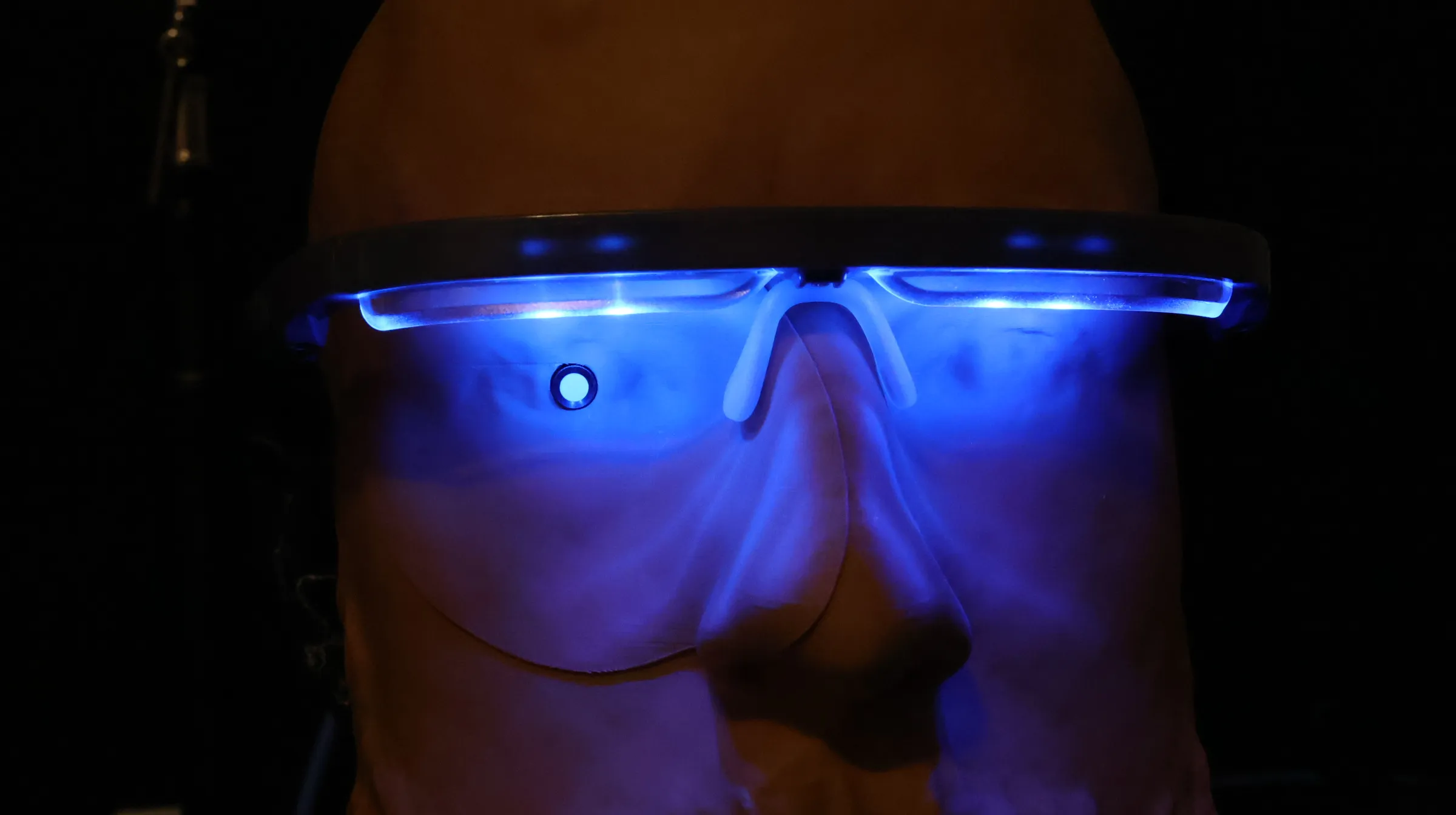 Low
Low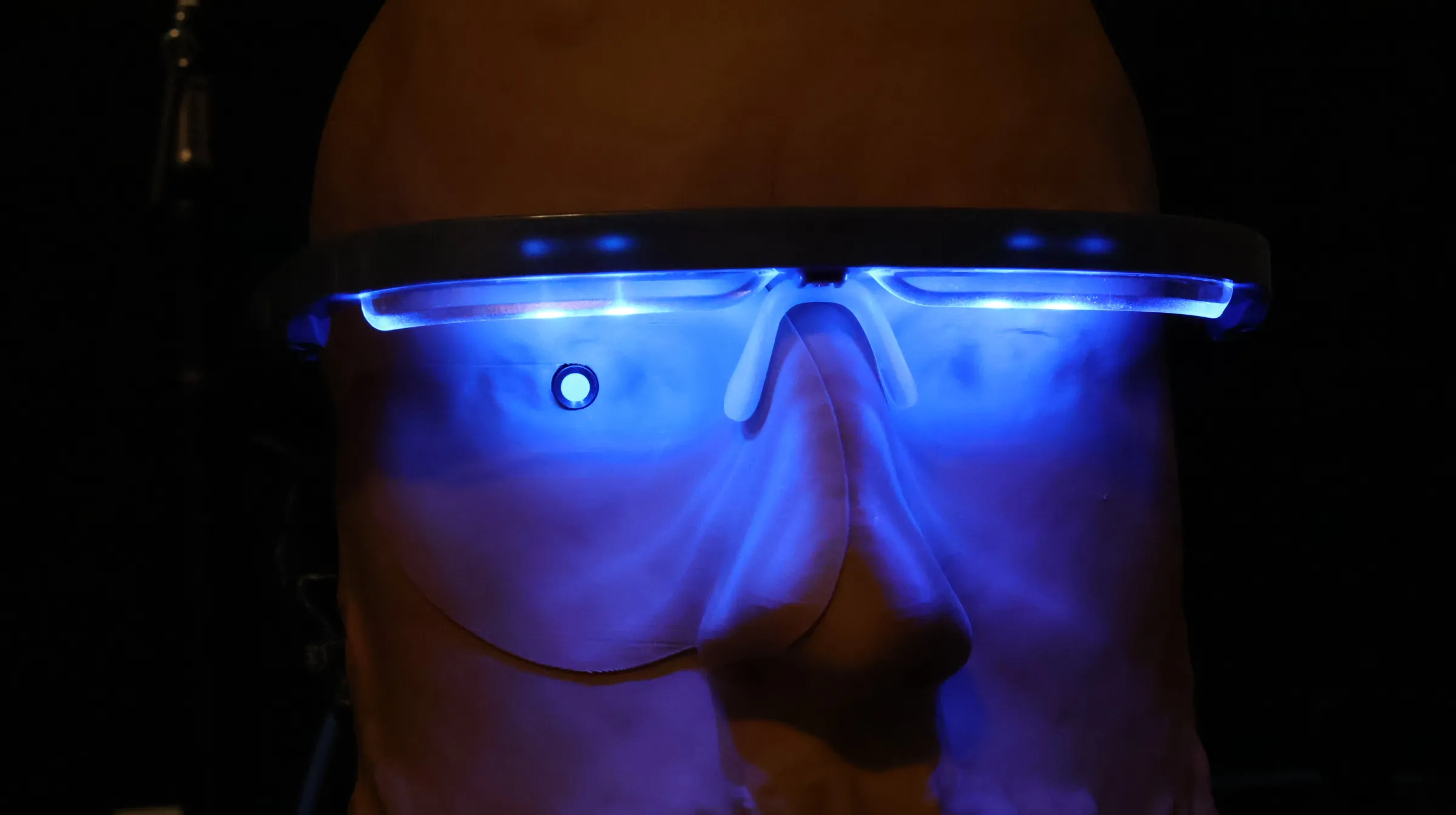 Medium
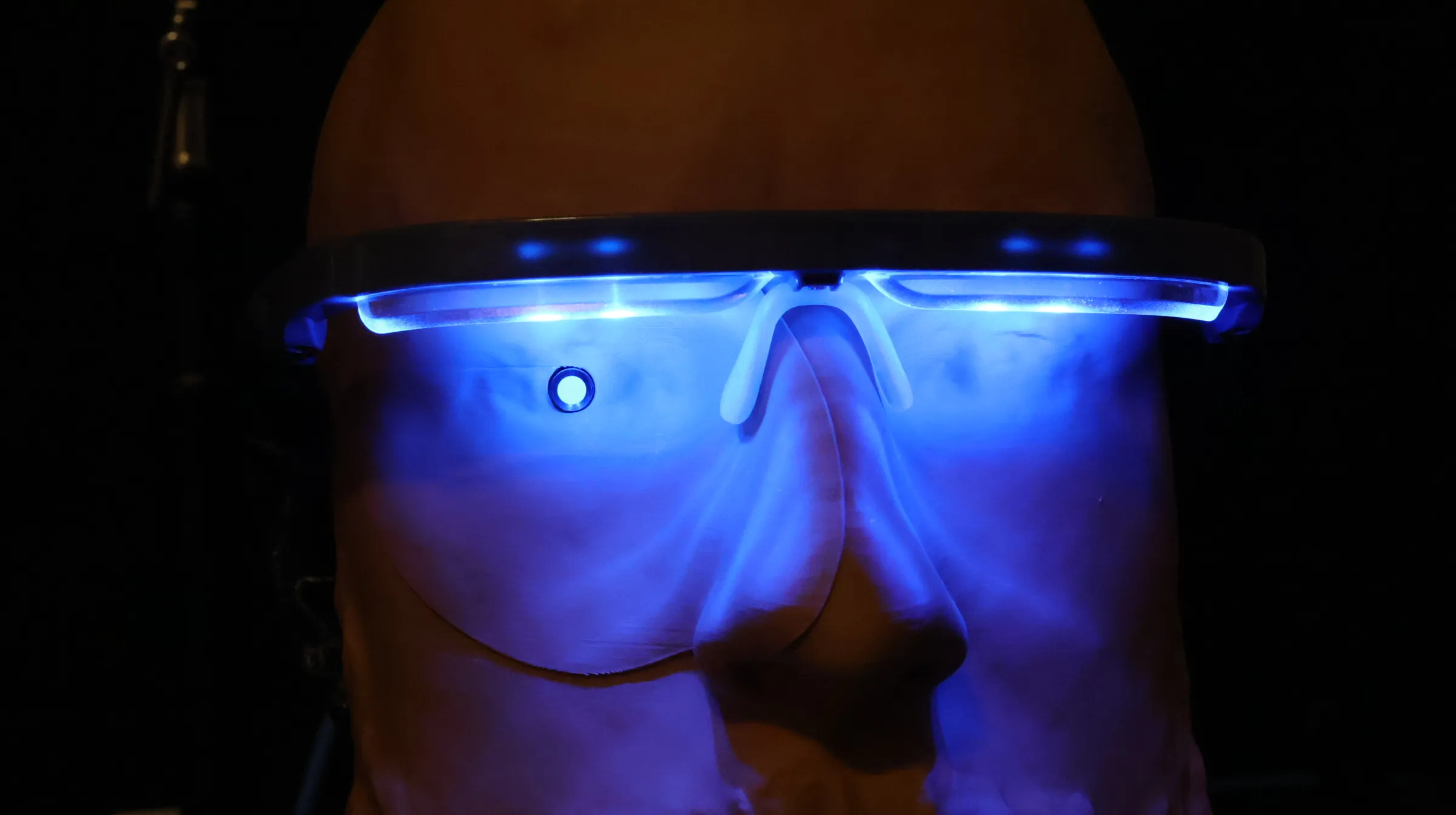 High
High
Your face isn’t my face
Every at-eye number here comes from one face: mine. Your nose bridge and how deep your eyes sit change how much of the beam lands in your pupil, so your dose could be higher or lower.
AYO’s app lists 1,400 m-EDI at 100%. I measured 1,011 on my rig. That gap is what different faces and measurement setups produce. It doesn’t mean either number is wrong.
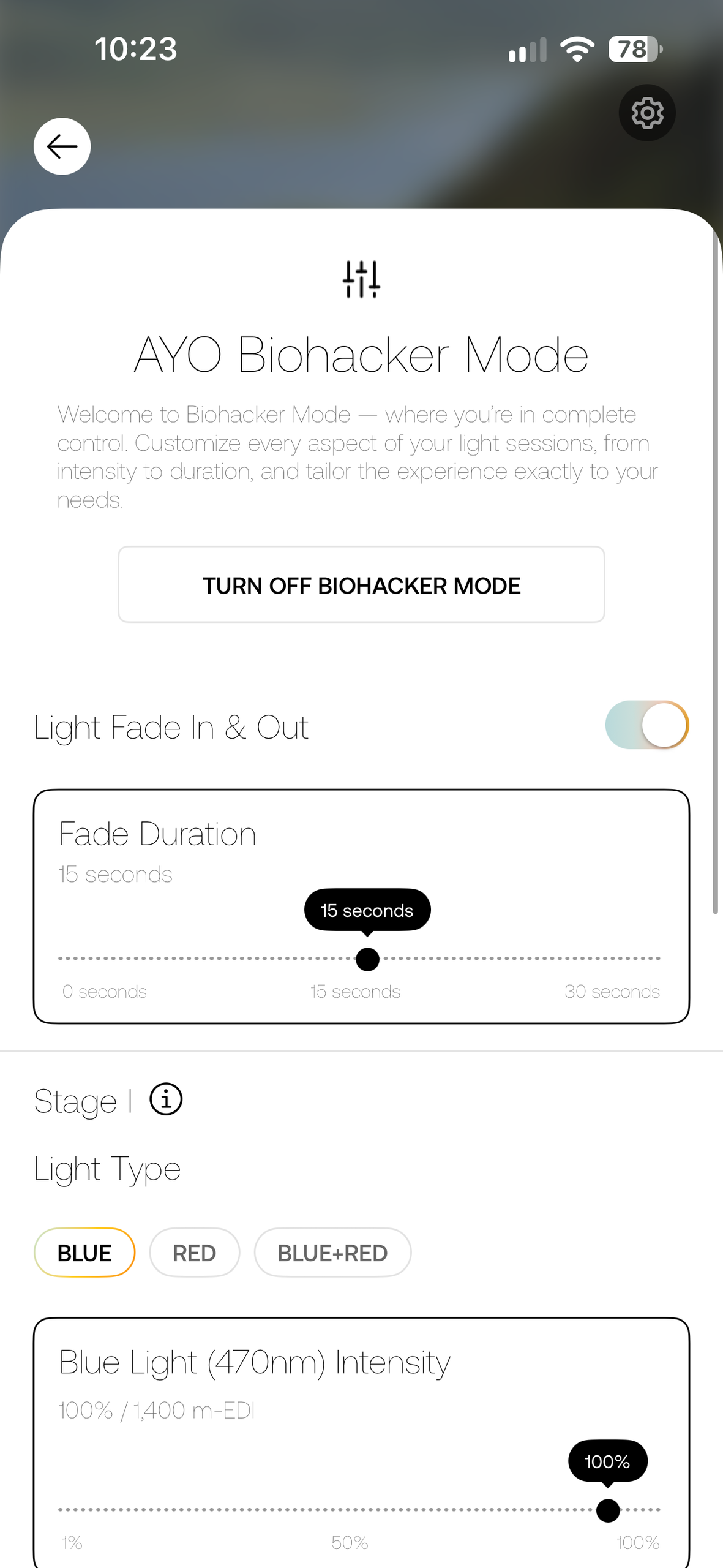
Is AYO as strong as a 10,000 lux light box?
AYO compares its output to a 10,000 lux light box. I wouldn’t lean on that comparison in either direction.
A typical white 10,000 lux box delivers more melanopic light than the AYO+. But lux-to-lux comparisons don’t hold for narrowband light, and the AYO+ works at close range while you walk around, which a light box can’t.
If you’re home every morning with 20 free minutes, a light box is the better value. The best SAD lamps I’ve tested are here.
Flicker
The AYO+ dims with PWM at 2,000 Hz. At full power the modulation is only 3%, but it climbs as you dim: 33% at 70% and 55% at 50%.
Nearly flat at full power, heavily modulated at half. Both at 2,000 Hz.
At 2,000 Hz, all three settings sit inside the IEEE 1789 no-risk zone, so this isn’t a health concern. If you’re flicker-sensitive, run it at 100% and shorten the session instead of dimming.
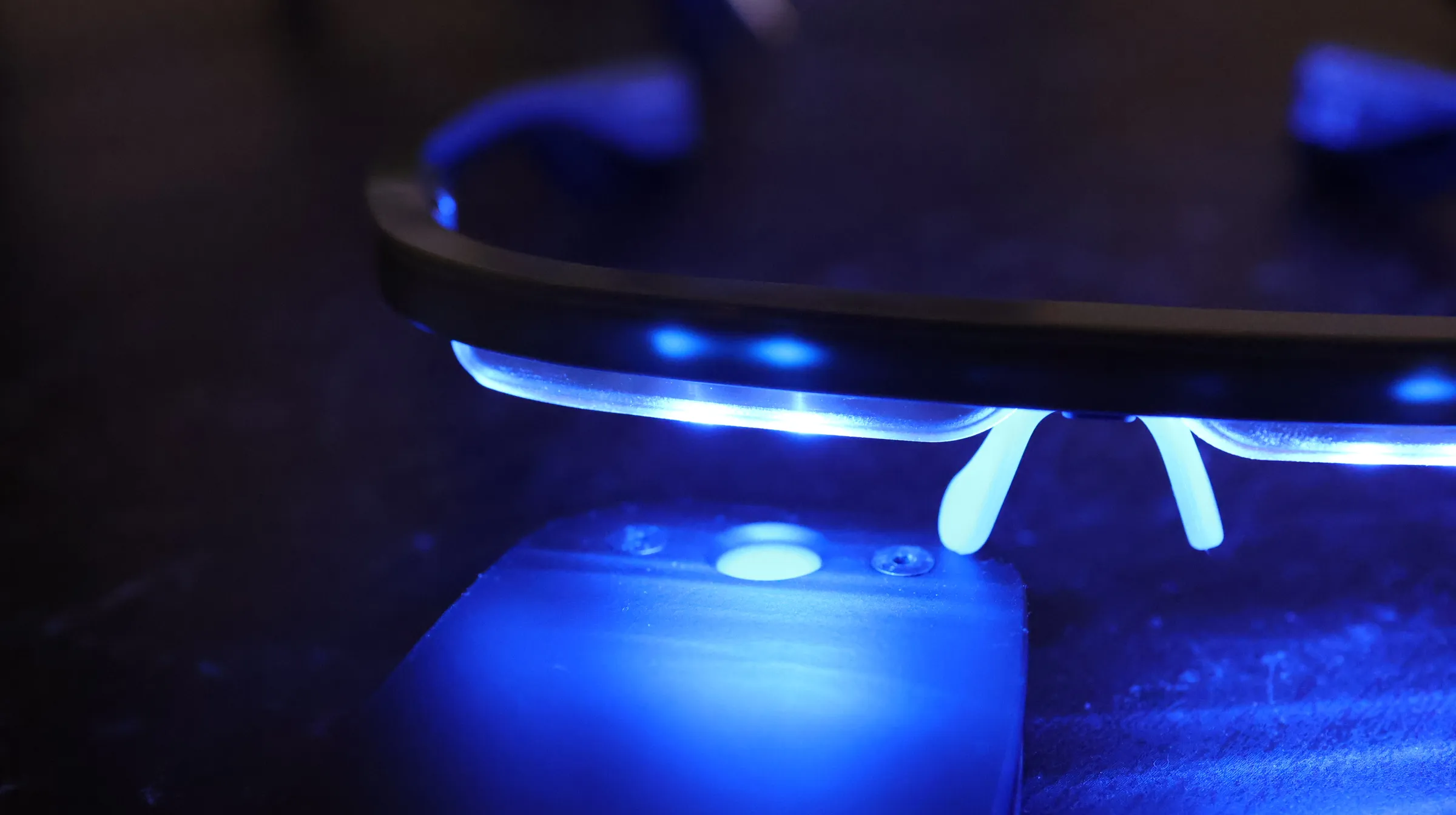
The AYO App (and Why There’s No Button)
There isn’t a single button on the AYO+. You open the arms, it turns on and runs a default session.
That’s enough if you just want light. Everything else, from brightness to session length to red light, lives in the free AYO app. There’s no subscription, and nothing is paywalled.
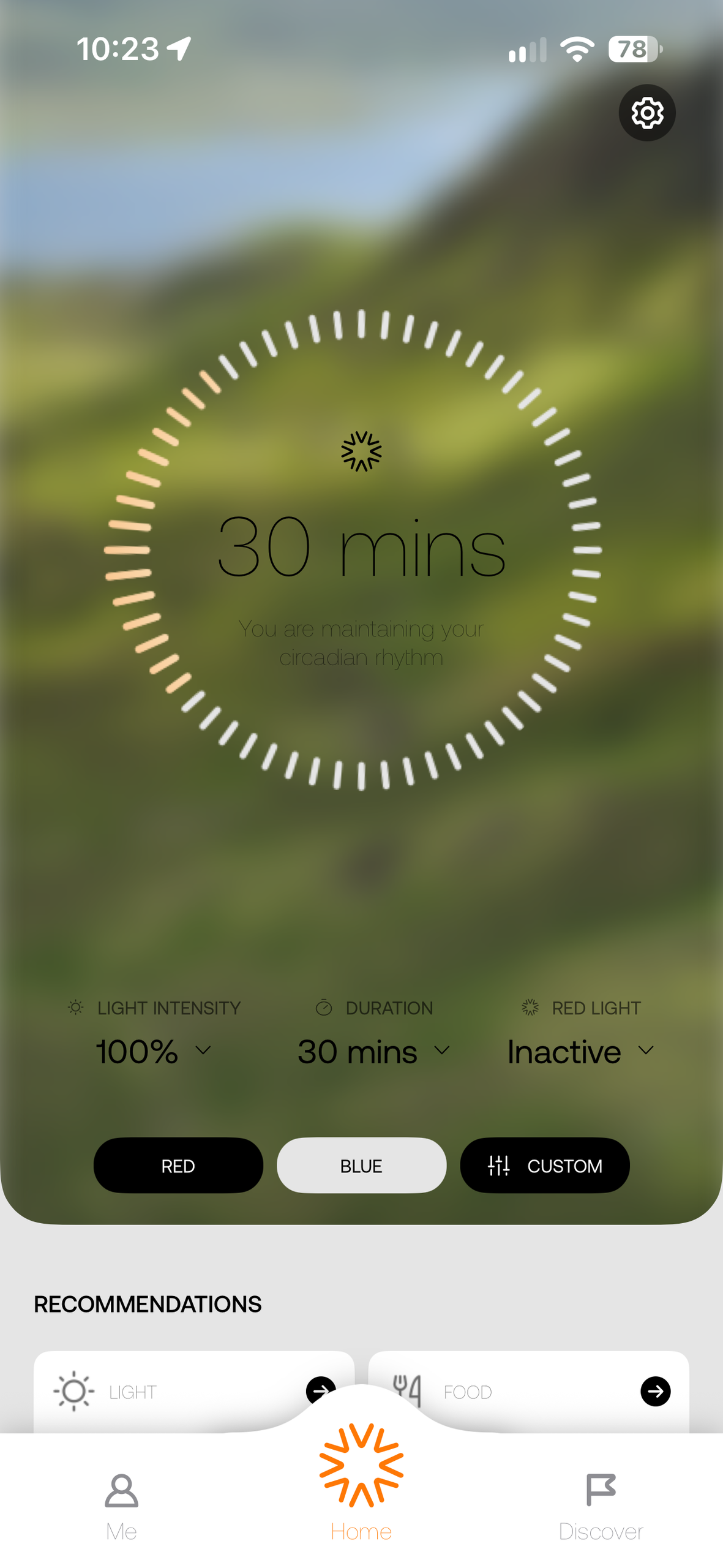
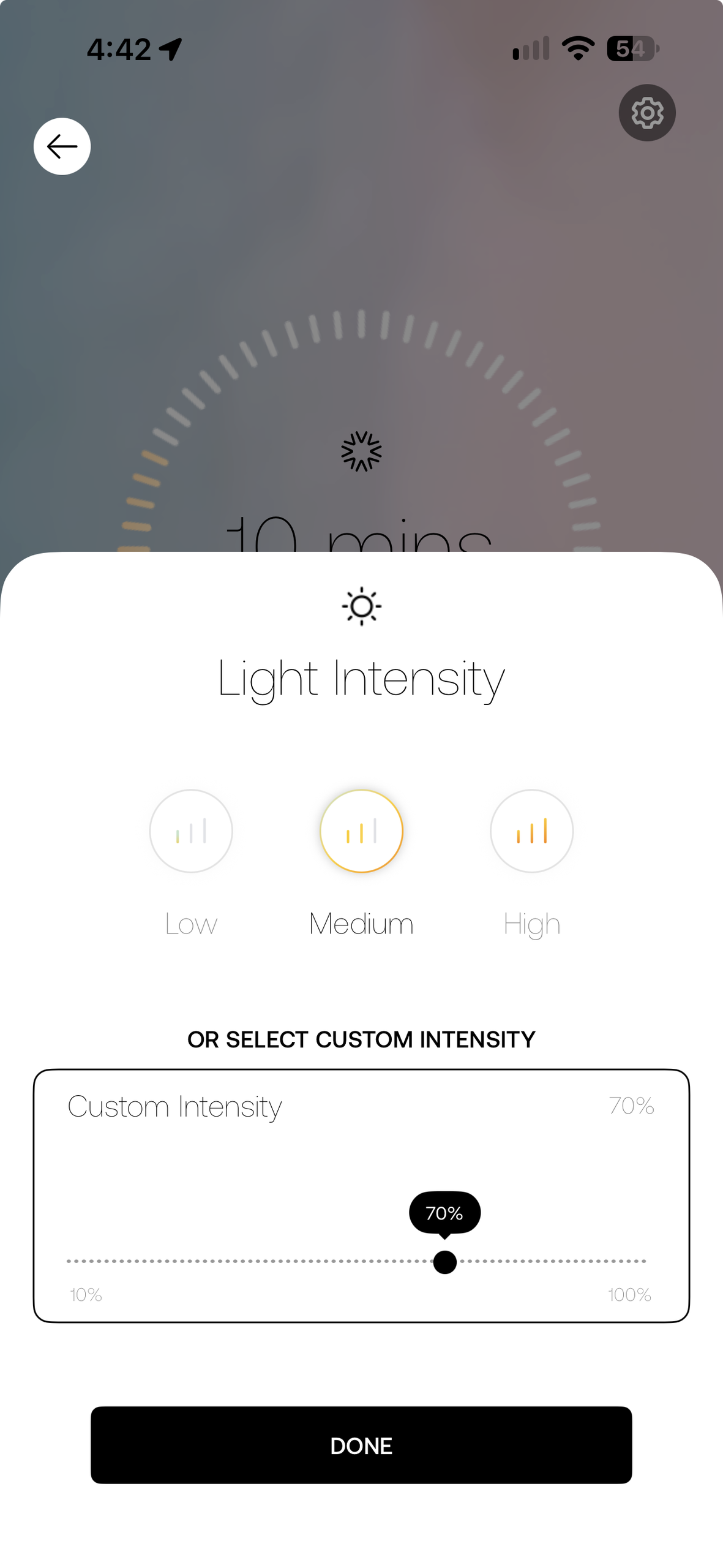
From the home screen you set intensity (10 to 100%), duration (5 to 90 minutes) and whether red light is on. Pairing has never given me trouble, and the app shows the battery level, which is how I know when to charge before a trip.
The circadian plan
Below the controls, the app builds a daily plan around your wake time: when to get light, when to eat, when to stop caffeine. It pulls sleep data from Apple Health if you connect it. I didn’t see a Google Fit option.
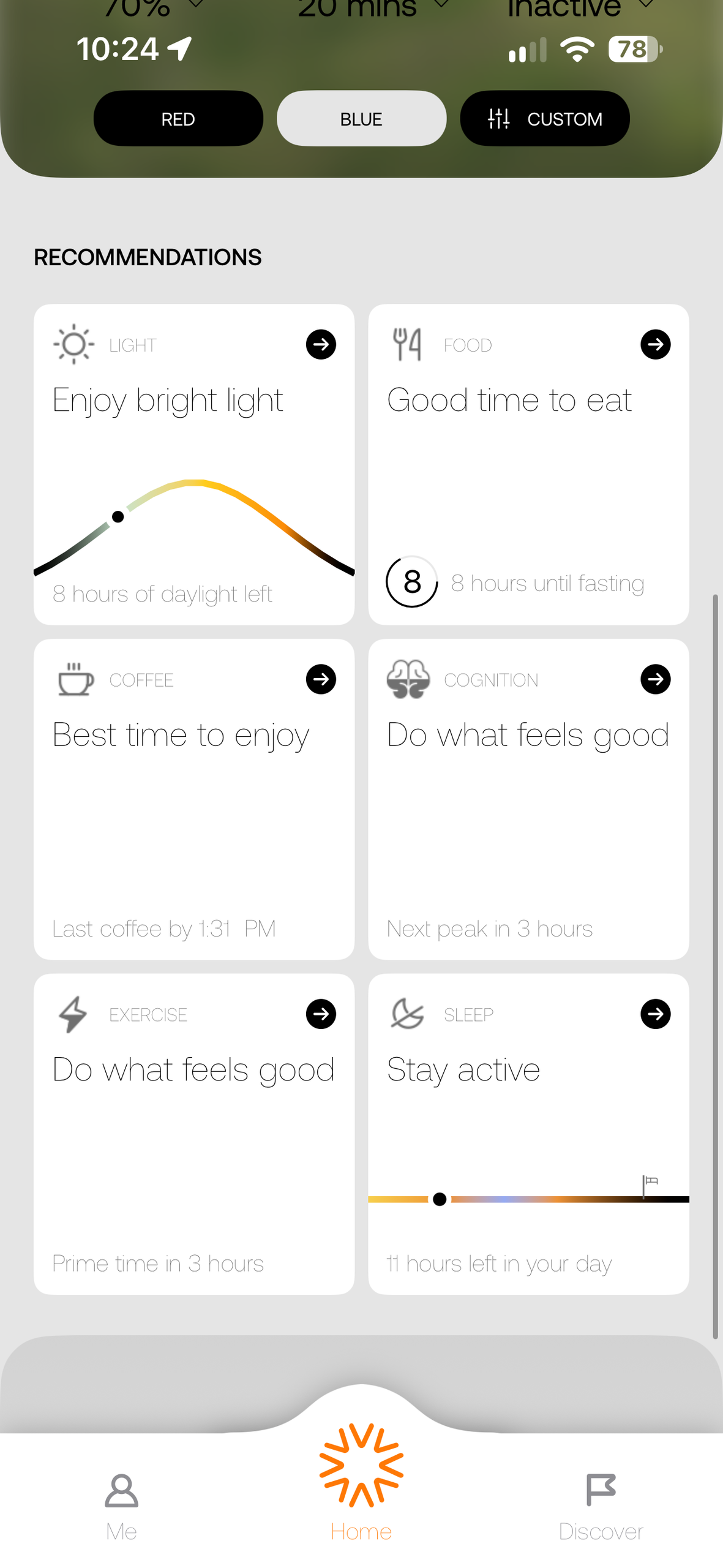
If you already know your circadian timing cold, you won’t need it. If you’re still learning, this is a genuinely good coach, and it’s free with the glasses.
Habit reminders and Discover
The “fine-tune” section turns goals into reminders: sleep, winter blues, energy and metabolism. Pick one and the app schedules nudges like a morning session or an evening wind-down.
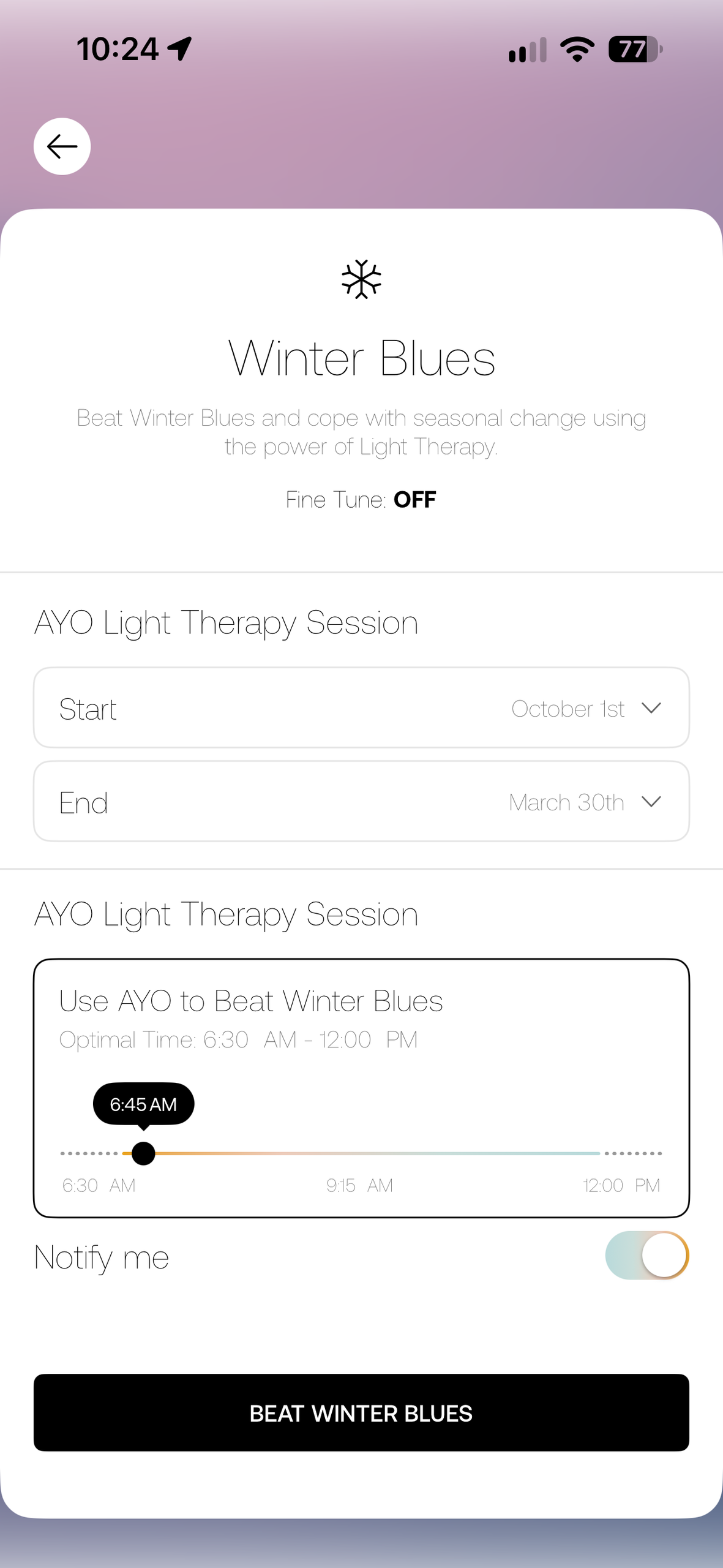
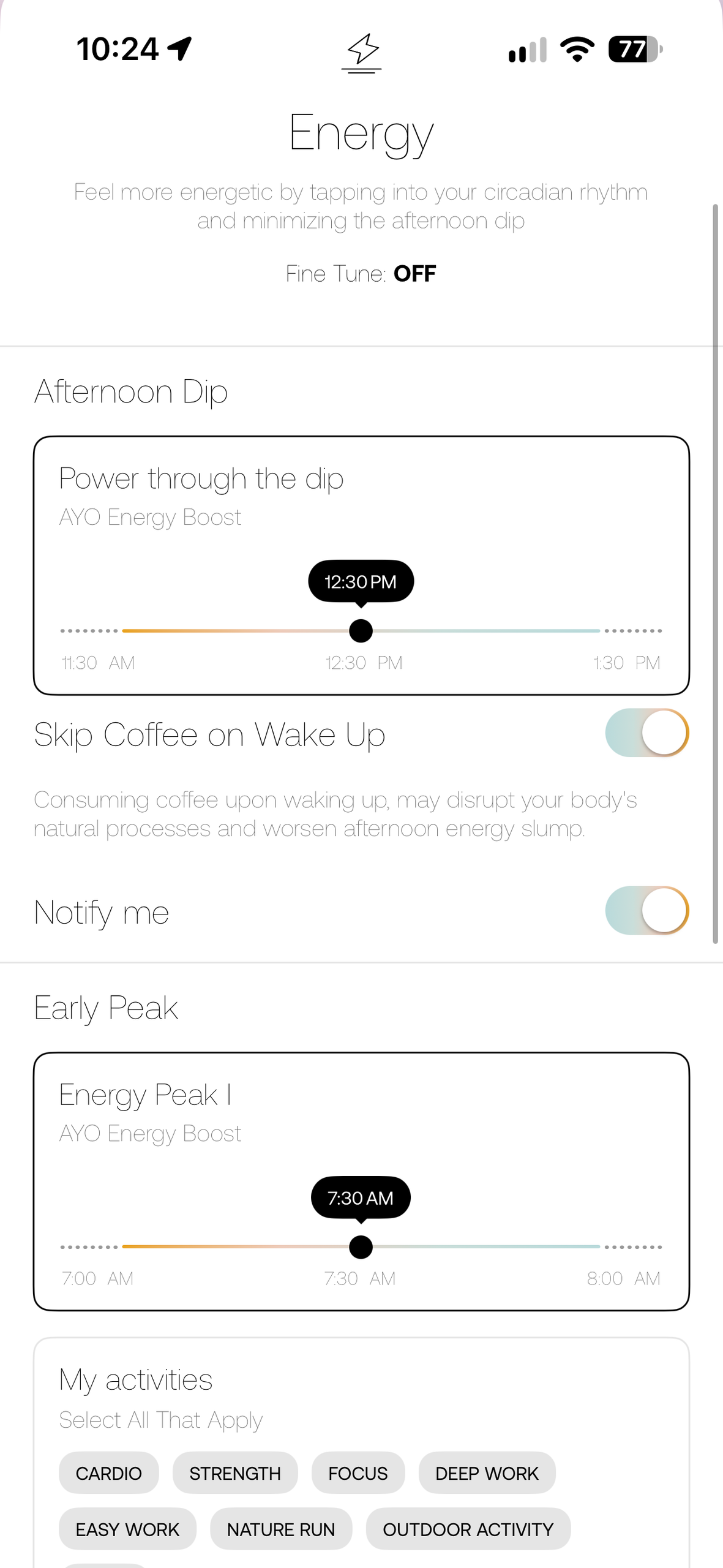
It’s a habit builder more than a program, and I think that’s the right call. Consistency is what makes light therapy work, and most people need the nudge.
Red Light and Biohacker Mode
AYO calls its red light phase “focused on ocular health.” That phrase comes from real research, so I measured it against the studies it points to.
First, what the modes do.
Red light
Red light can run on its own or as a short phase after a blue session. I measured it at 675nm.
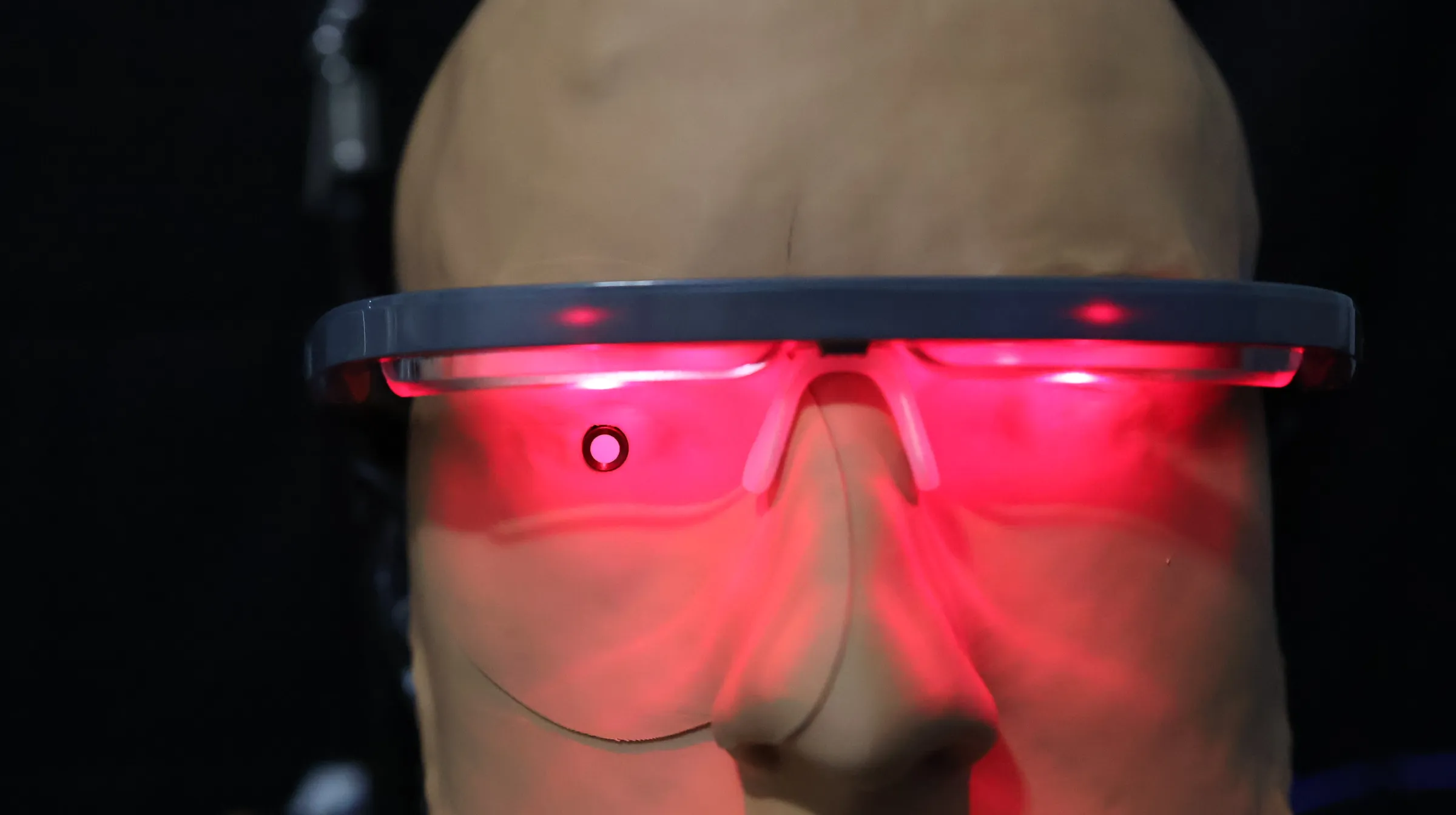
A narrow peak at 675nm with essentially no melanopic content.
It has almost zero effect on your circadian system: 0.3 lux melanopic EDI on high. That makes it a fine evening option, since it won’t push your body clock later.
Biohacker mode
Biohacker mode (the Custom button on the home screen) lets you build your own session in up to three stages. Each stage gets its own light type (blue, red or both), intensity and duration, and you can add a fade in and out of up to 30 seconds.
On trips, I usually run blue and red together at full power. Blue plus red measured 988 lux melanopic EDI, about the same as blue alone, since the red adds brightness but no circadian signal.
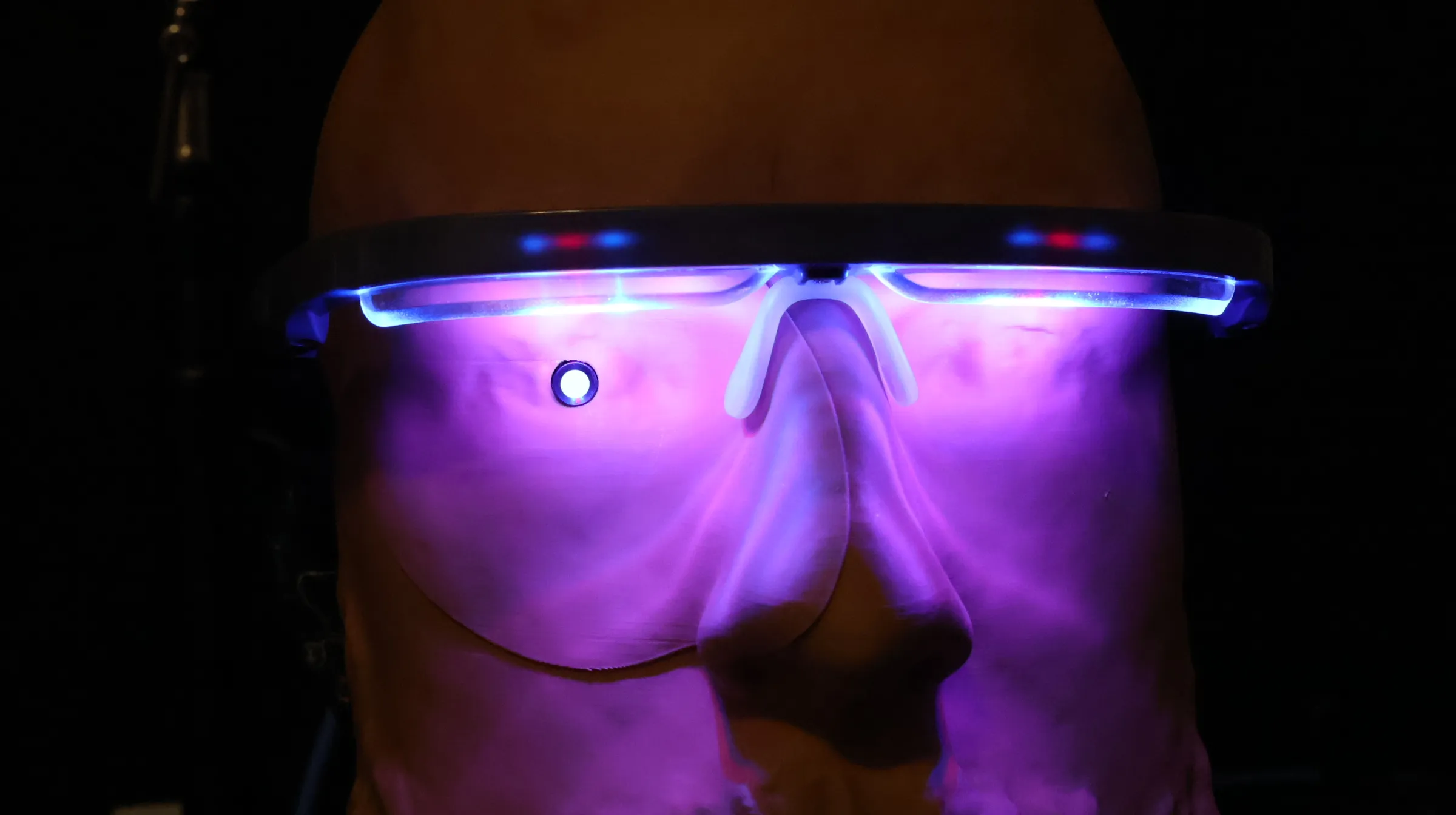
Here’s what that looks like on my spectrometer for those curious:
How strong is the red light?
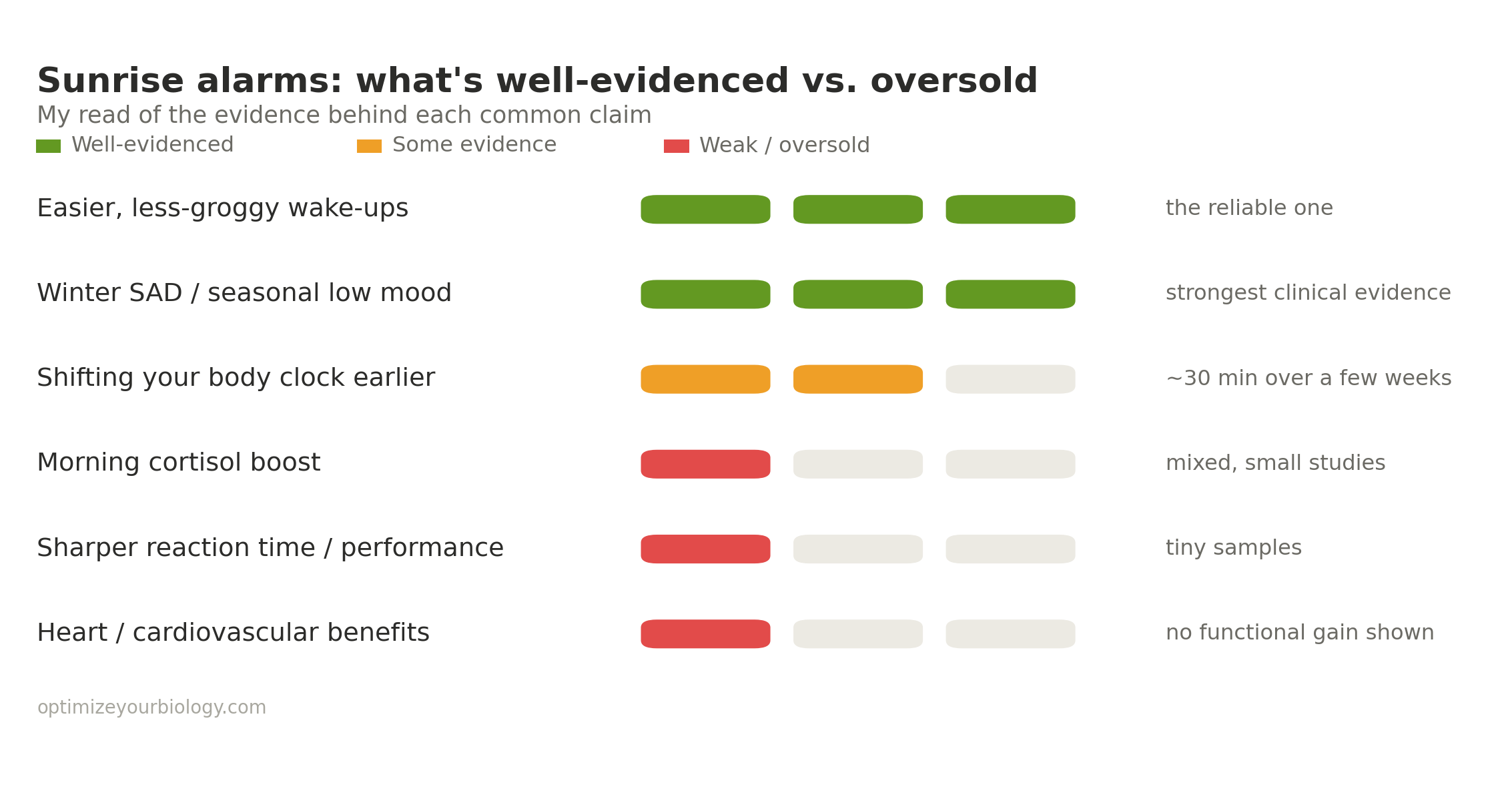
The studies behind “ocular health” come from a University College London group. In one, a single 3-minute morning exposure to 670nm light at about 8 mW/cm² improved color contrast sensitivity in people aged 37 to 70 for about a week.[2] An earlier study used about 40 mW/cm².[3]
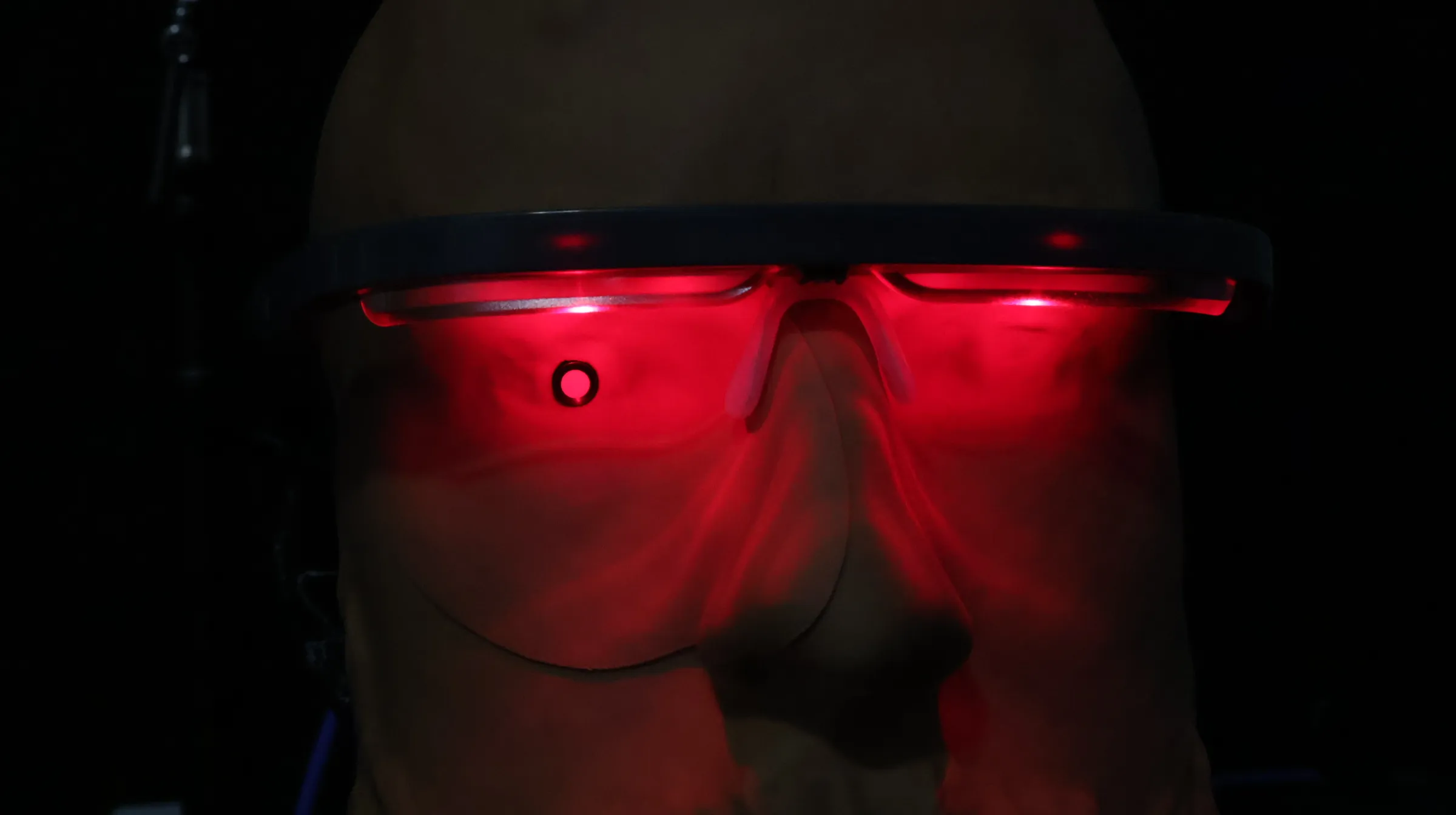
On high, the AYO+ red delivered 0.071 mW/cm² at my eye (380 to 780nm). That’s about 110x below the lower study dose.
AYO+ red on high versus the doses used in the 670nm eye studies. The AYO+ bar is barely visible at this scale.
So the AYO+ red light isn’t built to replicate those results, and I wouldn’t buy it expecting red light therapy. I like having it, and it does feel pleasant after a blue session. But I’d love to see a much stronger red mode in the next version.
How I Actually Use It: Travel and Jet Lag
At home, I don’t use the AYO+ much. I have bright lights and a routine, and that covers my mornings.
On the road it’s different. The AYO+ lives in my carry-on, and it’s the first thing I put on in a hotel room the morning after a flight. Friends have borrowed my spare pair for their own trips.
My routine is simple: full power, blue plus red, about 30 minutes right after waking at the destination. For me it makes waking up easier and helps me get onto local time faster.
It beats a light box for travel on every practical point. It’s 34 grams, charges over USB-C, and lasts about a week between charges. If you cross time zones often, my circadian rhythm guide covers how to time the light on each end of a trip.
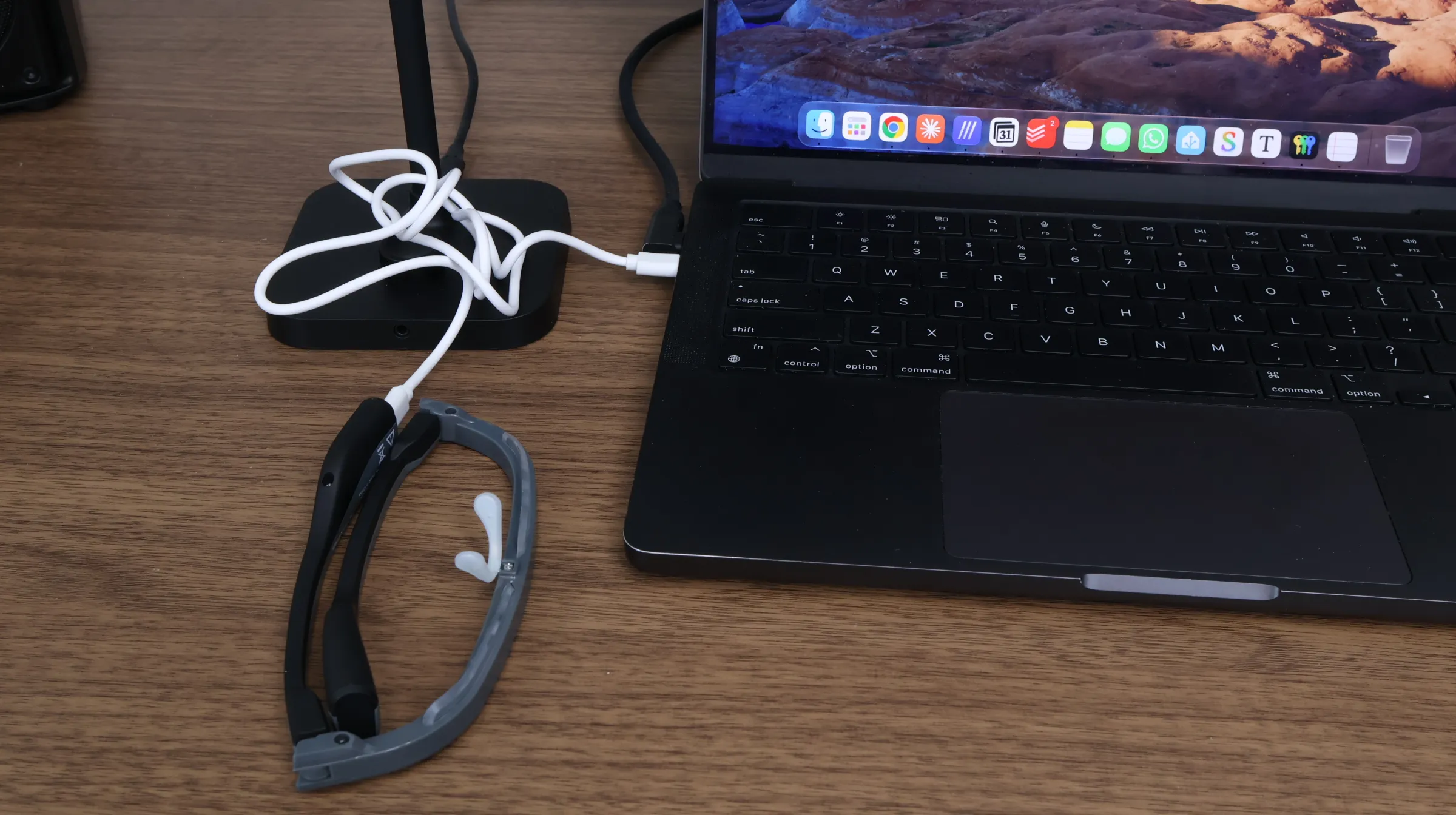
For frequent travelers, this is the easiest recommendation in the category. Get the AYO+ here.
What the Research Says About AYO
AYO says its glasses have been used in more than 30 clinical trials. I went looking and found five studies that used AYO hardware and published results. Here’s what they show, strongest first.
The workplace study (2026)
The newest and largest is a 2026 paper in the Journal of Applied Psychology. 182 full-time employees wore AYO glasses for 30 minutes after waking for one work week at 100% intensity and one week at 1%, in random order.[4]
Participants couldn’t tell the two settings apart, which makes the 1% week a real control. The study dose was 150 µW/cm², close to the 173 µW/cm² I measured on high.
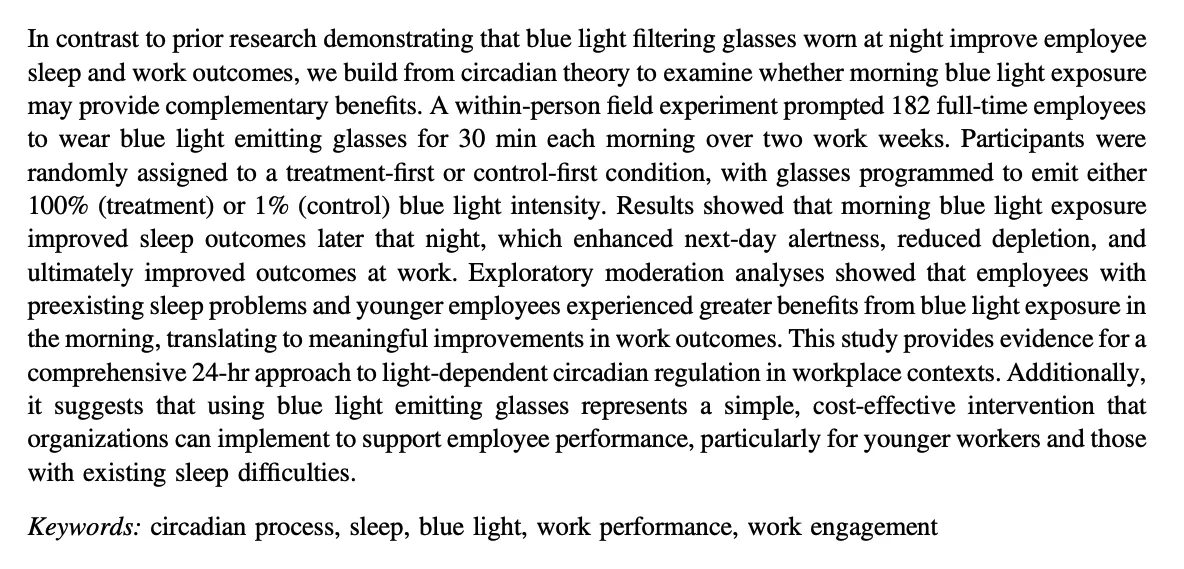
On days after full-strength light, people reported about 11 more minutes of sleep and slightly better sleep quality. That fed into more alertness and less mental fatigue the next day, and better engagement at work. People who already had sleep problems benefited the most.
Two caveats: sleep and work outcomes were self-reported, and AYO donated half the glasses (the researchers bought the rest).
The submarine study (2024)
The U.S. Navy tested AYO glasses on submariners at sea, one of the most light-starved jobs there is. Crew wore AYO for about 40 minutes after waking and blue blockers for about 2 hours before sleep, for up to two weeks.[5]
Compared with crew using nothing, they had better modeled performance (87% vs 83%) and faster modeled circadian adjustment. Sleep efficiency and total sleep trended better but didn’t reach significance. There was no placebo group, and the glasses were paired with blue blockers, so you can’t credit the AYO alone.
The sleep-stage study (2025)
A University of Arizona team compared blue AYO glasses with a red-light placebo version in 36 military service members, two weeks each, with sleep tracked every night by an at-home EEG headband.[6]
Morning blue light cut time in the lightest sleep stages, increased the share of REM sleep, and got people into REM faster. Total sleep time didn’t change. This is a conference abstract, so treat it as early results.
The studies used roughly what the AYO+ delivers on high.
The trials that found little
Two smaller trials in clinical groups were less impressive. In women recovering from breast cancer surgery, four weeks of AYO light didn’t improve the main cognition score over a dim version, though participants reported fewer cognitive complaints.[7]
In adults with fatigue, bright and dim AYO glasses lowered fatigue by about the same amount, which points to expectation doing some of the work.[8]
Here’s the scorecard:
- Workplace (182 employees, dim-light control): better sleep, alertness and work engagement
- Navy submariners (42, no placebo): better modeled performance and circadian adjustment
- Military sleep study (36, red-light placebo): more REM, less light sleep
- Breast cancer recovery (117, dim control): main outcome null
- Fatigue (60, dim control): bright no better than dim
It’s real, independent research, but it’s five studies, not 30.
AYO+ vs AYOlite: What Changed
AYOlite was AYO’s cheaper, blue-only model. AYO doesn’t sell it anymore, and the Amazon US listing shows as unavailable, though a few European retailers still list leftover stock.
Here’s how the two compare. The AYOlite details come from retailer listings and owner reports, since I didn’t test one.
- Light: AYOlite is blue only (470nm). AYO+ adds red light and blue plus red.
- App: owners report the AYO app doesn’t work with the AYOlite. AYO+ has the full app, including Biohacker mode.
- Session length: AYOlite runs a fixed 20 minutes. AYO+ runs 5 to 90.
- Intensity: AYOlite has no adjustment. AYO+ goes from 10 to 100%.
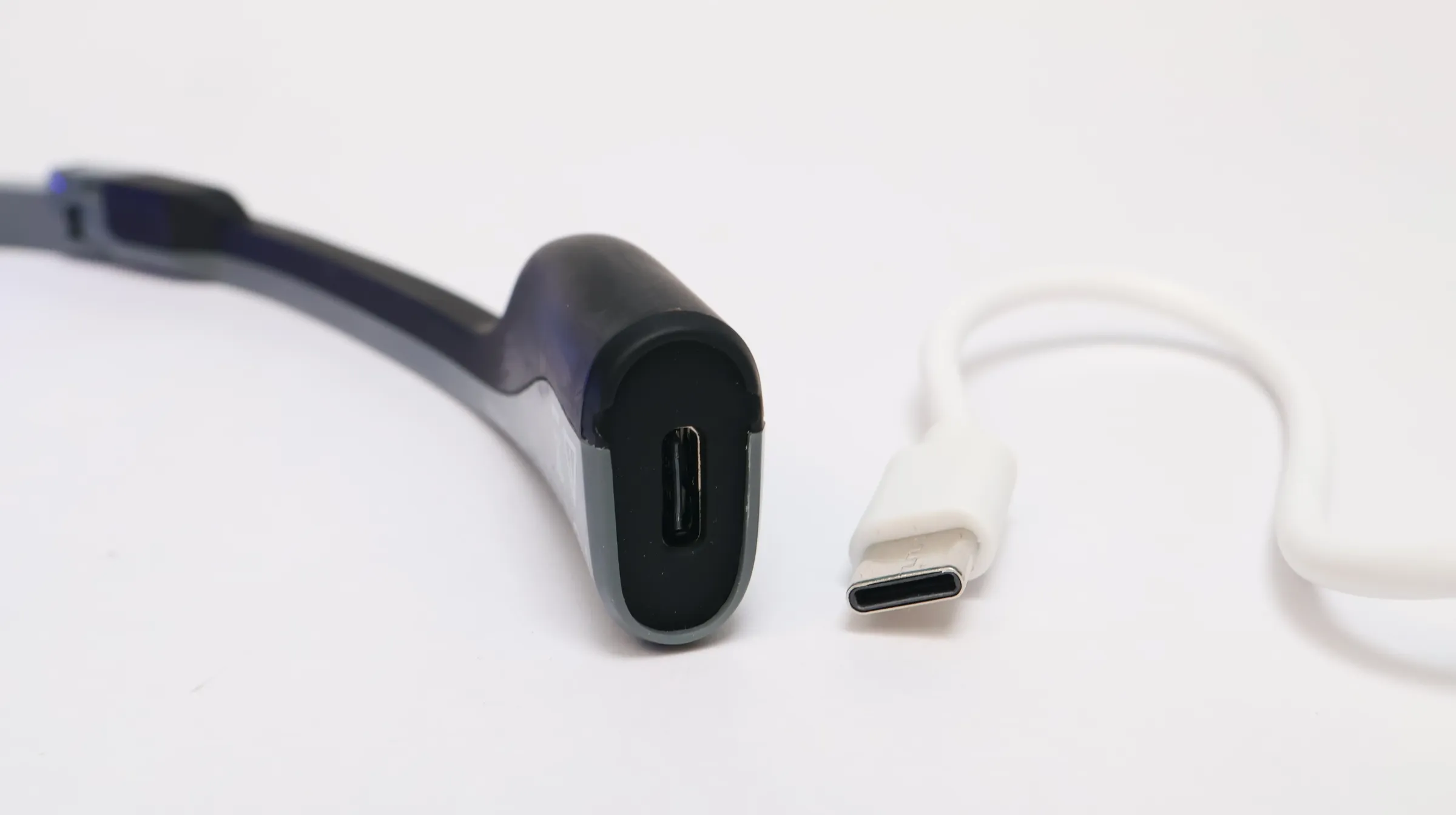
- Charging: owners describe a magnetic charger on the AYOlite. AYO+ uses USB-C.
- Weight: AYOlite is listed at 35g. AYO+ measured 34g.
- Price: the AYOlite sold for about $100 less than the full AYO.
If you find an AYOlite on clearance, it’ll deliver blue light, but you give up the app, the adjustable sessions and the red light. For most people, the AYO+ is worth the difference.
Should You Buy the AYO+?
Buy it if you travel across time zones, find white light therapy harsh, or can’t sit at a light box in the morning. It’s the most comfortable and easiest-to-see-through pair I’ve worn, the dose is real, and the app does a good job of building the habit. Check the current price on the AYO+.
Skip it if you’re home every morning with 20 free minutes. A good light box delivers more light for less money. Skip it too if you wear blue blockers or tinted glasses, or if you want red light therapy. The red mode is too weak for that.
I’d buy it again. I just hope the next version puts real power behind the red light.
Light therapy glasses
AYO+
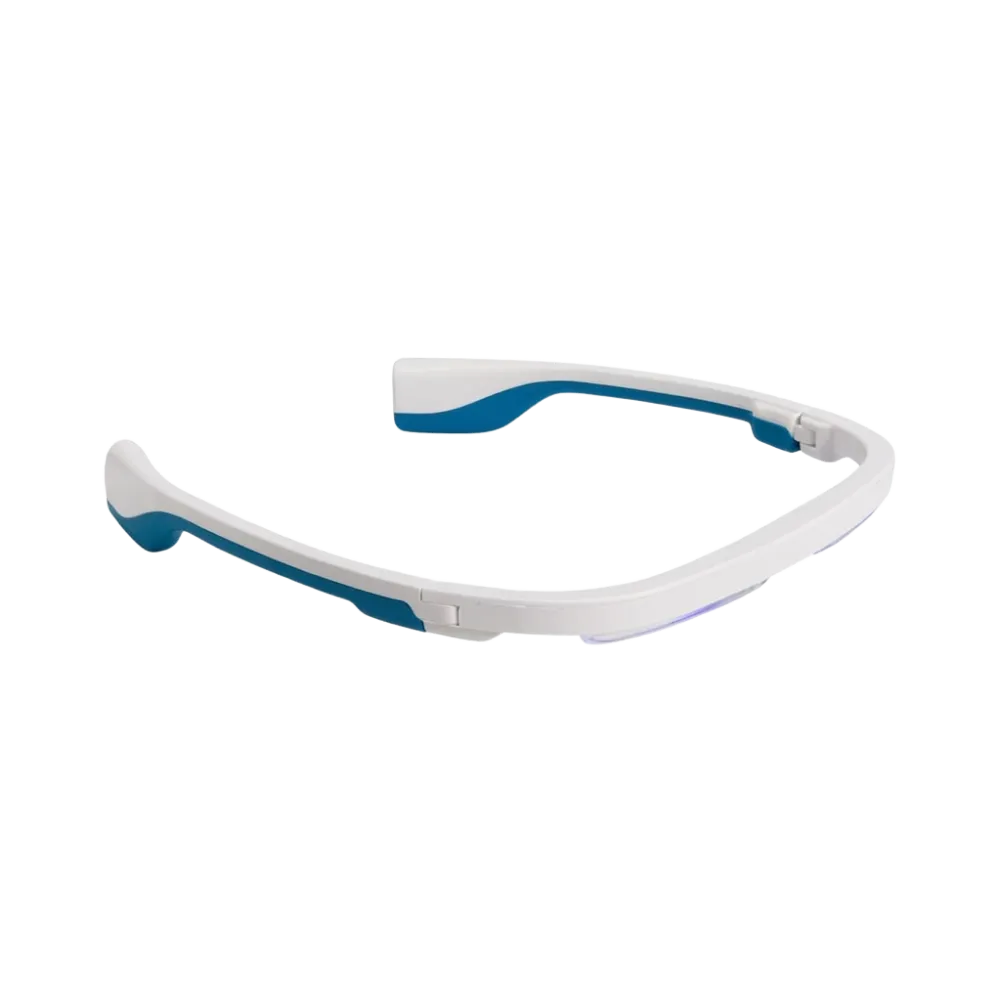
Light, comfortable, and the easiest light therapy glasses I’ve worn to see out of, with about 1,000 lux melanopic EDI on high at my eye and a genuinely good free app. The red light is too weak to be red light therapy, and output drops by more than half over prescription glasses. My pick for travel.
Frequently Asked Questions
Common questions about AYO+ glasses
References
- Brown TM, Brainard GC, Cajochen C, et al. Recommendations for daytime, evening, and nighttime indoor light exposure to best support physiology, sleep, and wakefulness in healthy adults. PLoS Biology 2022;20(3):e3001571 https://doi.org/10.1371/journal.pbio.3001571 ↩
- Shinhmar H, Hogg C, Neveu M, Jeffery G. Weeklong improved colour contrasts sensitivity after single 670 nm exposures associated with enhanced mitochondrial function. Scientific Reports 2021;11:22872 https://doi.org/10.1038/s41598-021-02311-1 ↩
- Shinhmar H, Grewal M, Sivaprasad S, et al. Optically improved mitochondrial function redeems aged human visual decline. The Journals of Gerontology: Series A 2020;75(9):e49-e52 https://doi.org/10.1093/gerona/glaa155 ↩
- Keeler KR, Barnes CM, Huang Y, Gunia BC, Moy JH. Rise and shine: Morning blue light exposure, sleep, and work. Journal of Applied Psychology 2026. Advance online publication https://doi.org/10.1037/apl0001418 ↩
- Chabal S, Moslener E, Markwald RR, Chinoy ED. Personal light treatment devices: a countermeasure to improve sleep, fatigue, and circadian misalignment in an operational setting. Sleep Advances 2024;6(1):zpae097 https://doi.org/10.1093/sleepadvances/zpae097 ↩
- Killgore WDS, Franca G, Elali L, et al. 0887 Daily morning blue light exposure affects polysomnographic sleep in a real-world setting. Sleep 2025;48(Suppl 1):A385 https://doi.org/10.1093/sleep/zsaf090.0887 ↩
- Aspelund SG, Halldorsdottir T, Agustsson G, et al. The effects of light therapy on cognitive function and stress in women with breast cancer before systemic treatment. Cancer Medicine 2025;14(22):e71412 https://doi.org/10.1002/cam4.71412 ↩
- Butler M, D’Angelo S, Ahn H, et al. A series of personalized virtual light therapy interventions for fatigue: feasibility randomized crossover trial for N-of-1 treatment. JMIR Formative Research 2023;7:e45510 https://doi.org/10.2196/45510 ↩
-
Re-Timer 2 Glasses Review: Ugly But Effective?
We tested the Re-Timer 2 glasses. See the 501nm green light spectrum, comfort analysis, and why we think the AYO+ is the better travel choice.
7 minutes -
Best Light Therapy Glasses Review: Lab Tested (2026)
We tested AYO+, Luminette 3, & Re-Timer. See the spectral data, circadian light output, and why blue light glasses might beat bright white ones.
10 minutes -
Propeaq 3 Review: Lab Tested, and It Misses Its Own Light Claim
The Propeaq 3 looks like normal glasses and doubles as an evening blue blocker. On my headform it delivered 157 lux melanopic EDI, well short of its 250 claim.
9 minutes
Awesome review! Thanks for breaking out the spectrophotometer. Could you test the AYO glasses for bluetooth radiation like you did with the Luminette 3? It would be nice to know which glasses are radiating the head the most.
Thanks Di!
So this current version of the AYO actually doesn’t have Bluetooth, so the answer is zero radiation!
Superb information! Appreciate you sharing your wisdom and expertise and outstanding reviews! Keep it up please as it is beneficial to all the world!
I’m glad you’ve found it helpful Gayle 🙂
Hi! Derek. By any chance have you tested the Bluetooth radiation emitted from the AYO+ glasses since they are Bluetooth unlike the originals? Thanks for your time, help and response.
I have! They emit a very short pulse when settings are first changed in the app but other than that I couldn’t detect any.
Thank you Derek! Appreciate your help!
Hi! Derek
Sorry to bother you again but another quick question. Is the red light emitted with AYO+ glasses in the last 2 minutes of the session actually red in color like you would see in red light therapy or is it an invisible wavelength? Thank you for your help and response!
It’s a visible red at around 630nm! I think I’ll have to add a photo of it in this article so folks can see 🙂
Thank you! Hmm. I just got the AYO+ thanks to your recommendations and I have the toggle switch to on for red light in the app and I didn’t see a red light before the end of my 20 minute session. 😔
Interesting… I’d try rebooting the app, and maybe reconnecting the headset. If that doesn’t work I’d try reaching out to AYO, I’m not quite sure why it wouldn’t work :/
So sorry for the delayed response. Thanks for your input. I did turn my iPhone off and on again and then the red light worked with my next session and I am really liking it and the glasses as a whole are amazing the energy I am getting along with uplifting mood is awesome!
Can’t thank you enough for your generosity in sharing your knowledge and reviews because of them, I purchased the AYO +. 😊
Oh excellent! I’m glad it’s working 🙂 You’re very welcome Gayle! We have a lot of cool new content planned in the future so stay tuned 😀
Hi Derek, Thank you for your thorough reviews of the major light therapy glasses. I was curious if you tested the AYO light therapy glasses for EM radiation like you did with the Luminette 3s using your GQ EMF 390. As it seems both glasses actually have bluetooth capability. I know little about EM radiation and don’t have a good frame of reference. Being able to compare the EM measurements of the AYO glasses against the Luminettes would be helpful in deciding which route to go.
I was digging around and I actually found that the Luminette website has this short statement in their Q/A section:
“The Luminette is equipped with a bluetooth transmitter. Is it dangerous for health?
Bluetooth is switched off when the Luminette is switched off. During treatment, Bluetooth emits an Advertisement message every 100ms. This message is used to announce the presence of the Luminette to a nearby Smartphone. Regarding the sensitivity, you should know that this very short message lasts less than 400µs, so that the emission does not take place in fact only 0.4% of the time. In addition, we are talking here about Bluetooth Low Energy and our transmitter has an output power of 1mW, to compare with traditional Bluetooth equipment (such as a wireless headset) which often emit 10X louder (10mW) or WiFi which transmits at 100mW.”
Yes I did! The new AYO+ emit very briefly while changing settings in the app. I didn’t detect any emissions during use. The Luminette 3 on the other do in fact emit nonstop during use. So in my view the AYO+ are the safer option with regards to EMF.
Dear Derek & Malissa..
Hope both of you are well..
Thank you for your brilliant channel/website/support,, I wish I found you both some years ago,, I have now used two different light boxes,, first was old school,, second l.e.d. hoping that it would not be to bright or give me eye/headache but not so,, after contacting s.a.d associations and no reply your information is what I was looking for,, it looks like now it’s best I purchase AYO+ glasses now I’ve read your report nearly making another mistake looking at the options being to bright for my eyes,, I hope your viewers can read this polite warning to try out some way before buying if possible,, I’ve wasted lots of money,, I shall also looking at blue light blocking glasses next in your review because I am having a very time in the mornings/winters,, I thank you both,,Regards John..
Hi John! Thank you for the kind words, and I’m glad you found us as well! 🙂
The AYO+ are indeed probably the best option for effective light without the brightness usually found in most other light therapy devices. I hope those work out for you!
Hi! Thanks for all the great info! The myluminette sight compares their luminette3 model with the ayo+ and mention things like angle of incidence and light diffusion technology being better. Are those largely negligible variables or is that something that matters and to look out for?
I looked around and didn’t find this on their website so I’m unsure as to the exact claims they’re making, but…
IPRGCs or the cells primarily responsible for circadian entrainment are mostly located on the lower hemisphere of the eye, so light coming from above is usually best suited to hitting these. From this perspective the AYO makes more sense, however the Luminette also projects light fairly angularly.
Overall, the angle incidence between the two is probably negligible, and without any head to head studies it’s all just conjecture.
Thanks for sharing! I realise it was a post on their blog. I’m not sure if links are ok to share, but this is what I came across: https://myluminette.com/en-ca/blogs/article/ayo-vs-luminette
Links are fine, thanks for sharing Ash!
Hi. On the AYO site there is an option to buy the AYO with no app, or the AYO with an app membership. I read somewhere that in order to change the light intensity level or session duration you need the app.
Does this mean the standalone option to buy the AYO without the app membership leaves it stuck on default settings, unable to even change the light intensity level without purchasing the app membership? That seems crazy, so maybe I’m misinterpreting.
However, if that is true, do you know what light intensity level(Low/Medium/high) setting the AYO is set to by default without changing it with the app? I’m hoping it’s at least on the ‘High’ light intensity setting by default if you buy the option with no app. It would be annoying if it was stuck on a lower setting and I had to purchase an app membership just to increase it to ‘High’ and get the most out of the device.
Hey J,
So I’m not 100% sure what it defaults to… I did speak to AYO recently about some stuff and they said they we’re planning on only selling a version with lifetime app access, so I think anyone who buys without would eventually get access to the app?
Overall I agree, my one gripe with AYO is the unknown way the app membership works, it really does just need to be a package deal and from what I heard that’s the plan.
They are pretty responsive to emails so I’d shoot them an email with your questions and you should be able to get a response!
Thank you for this review, especially the comparisons using Circadian Light and Circadian Stimulus. I have no idea why the companies themselves don’t show these stats (as far as I could see).
You’re welcome Hugh! I imagine many simply don’t want to be held to any standard, it’s harder that way.
The study that you cited for red light is 8 mW/cm², not 8 µW/cm². You are off by a factor of 1000, so you can’t confidently state that AYO glasses help with eyesight.
Good catch Zoe! Thanks for making that correction, the model I have has been updated as well, this needs to be re-written, working on it!