
DEREK10% off
My verdict
Dreamegg Sunrise 1
A good-looking, app-free clock at a fair price, with a dim sunrise you can’t turn up. Buy it for the looks and the white noise if you wake easily. Skip it if you need light to get you out of bed.
- Pro: Looks the part next to a Hatch for less than half the price
- Pro: No app, no Wi-Fi, no account: dials and buttons on the clock
- Pro: The red nightlight is about as gentle on your body clock as light gets
- Pro: Effectively flicker-free at full brightness (0.08%)
- Pro: Sunrise lengths from 5 to 60 minutes, and it keeps time through a power cut
- Con: 62.6 lux at 18 inches, 16th of the 18 sunrise clocks I’ve measured
- Con: The sunrise has no brightness control at all
- Con: Every alarm sound starts at full volume and never builds
- Con: 13 of the 30 sounds are white-noise versions of the other 17
- Con: Snooze and alarm-off sit side by side and feel almost the same
See the lab results
Max 18 in · measured Jul 17, 2026
- 12m-EDI
- Melanopic EDI
- 63lux
- Brightness
- 1974K
- Color temp
- None
- Flicker
Spectrum
Spectrum chart. Dreamegg Sunrise 1, 1974K, melanopic DER 0.18.
Flicker, full brightness
Chart by time. Dreamegg Sunrise 1.
Most people shopping for a Dreamegg sunrise alarm clock found it the same way: they saw a Hatch Restore, liked the look, and went hunting for one that costs less.
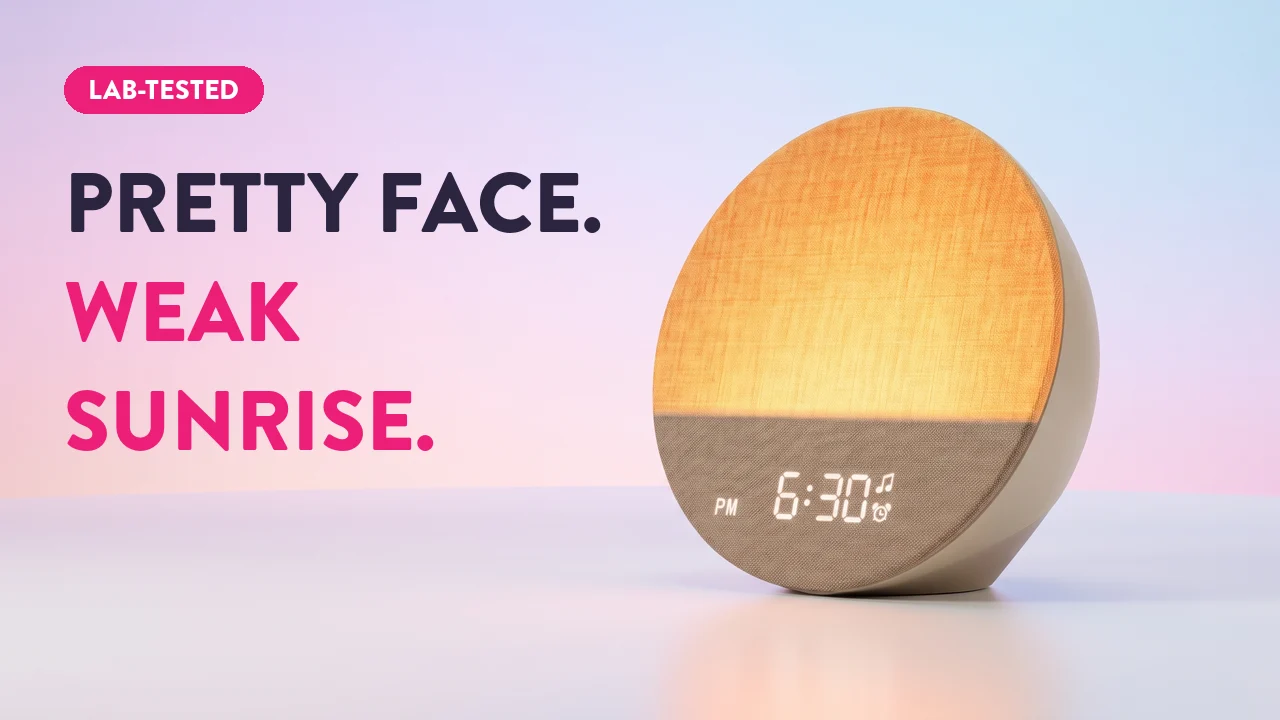
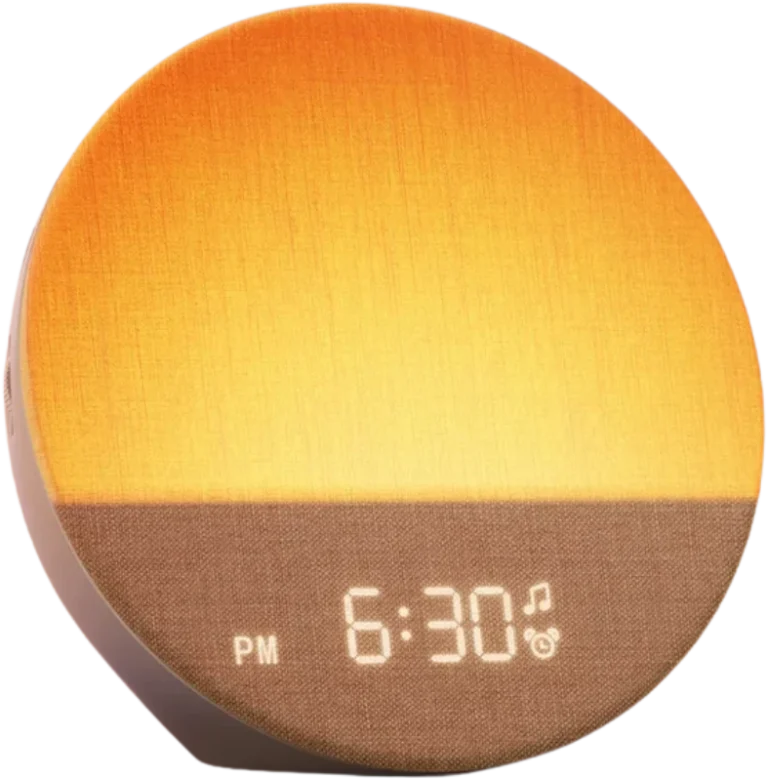
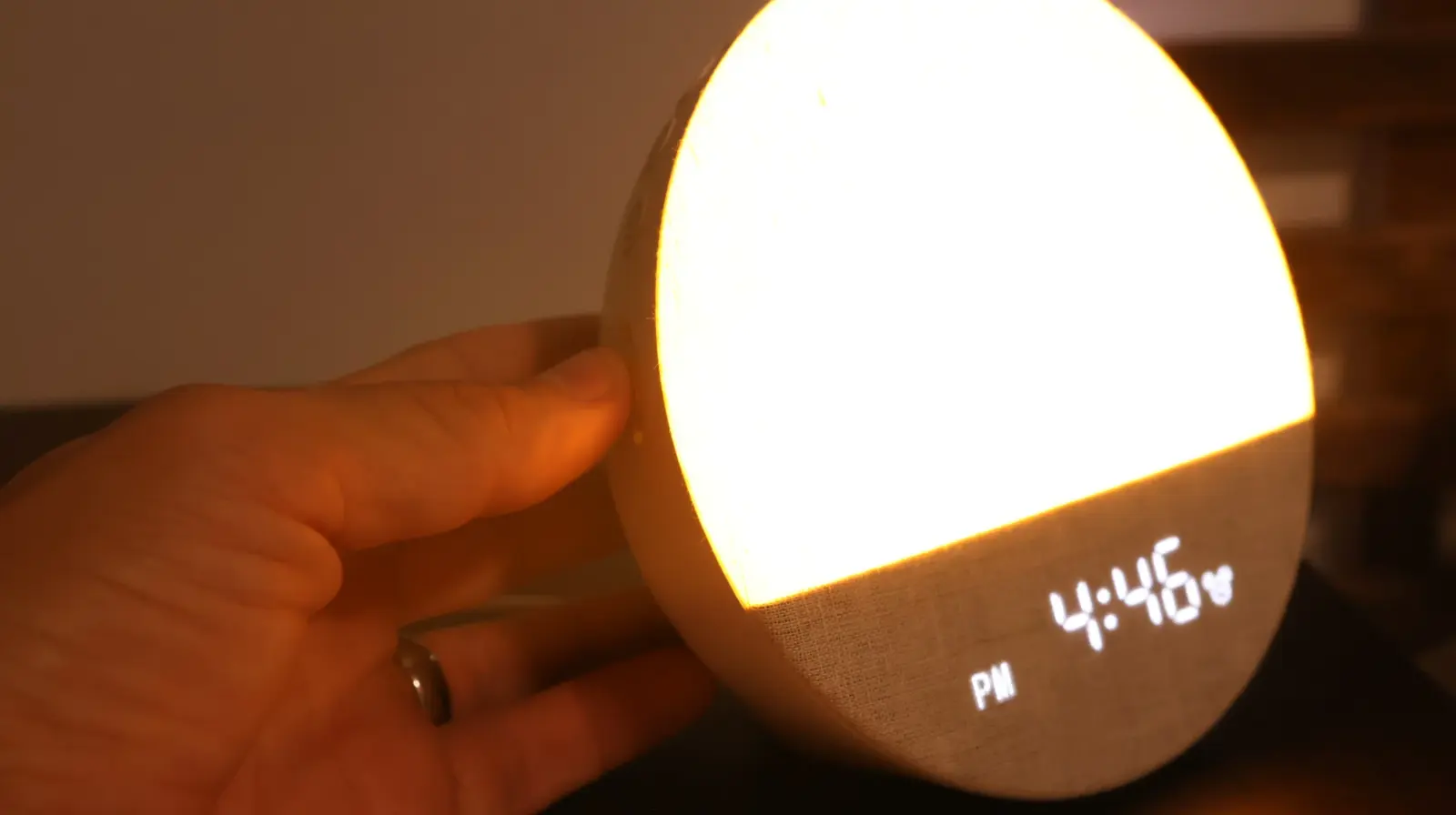
The Dreamegg Sunrise 1 is that clock. Fabric front, soft glow, a sunrise, a sound machine, about $65. From across the room it passes.
I put it on the same bench as the Hatch, and it doesn’t pass there. If you’d rather see the whole field ranked by brightness, my best sunrise alarm clocks guide has every clock I’ve measured.
Nobody else has put this one in front of an instrument. Not the reviews, and not Dreamegg either.
Free · 95 pages
You're reading about one piece of this. The book is the whole day.
The Circadian Blueprint covers setting your body clock with light — the timing, the doses, and which products actually deliver them. Every number came off my own spectrometer.
What It Is (and Which Dreamegg This Is)
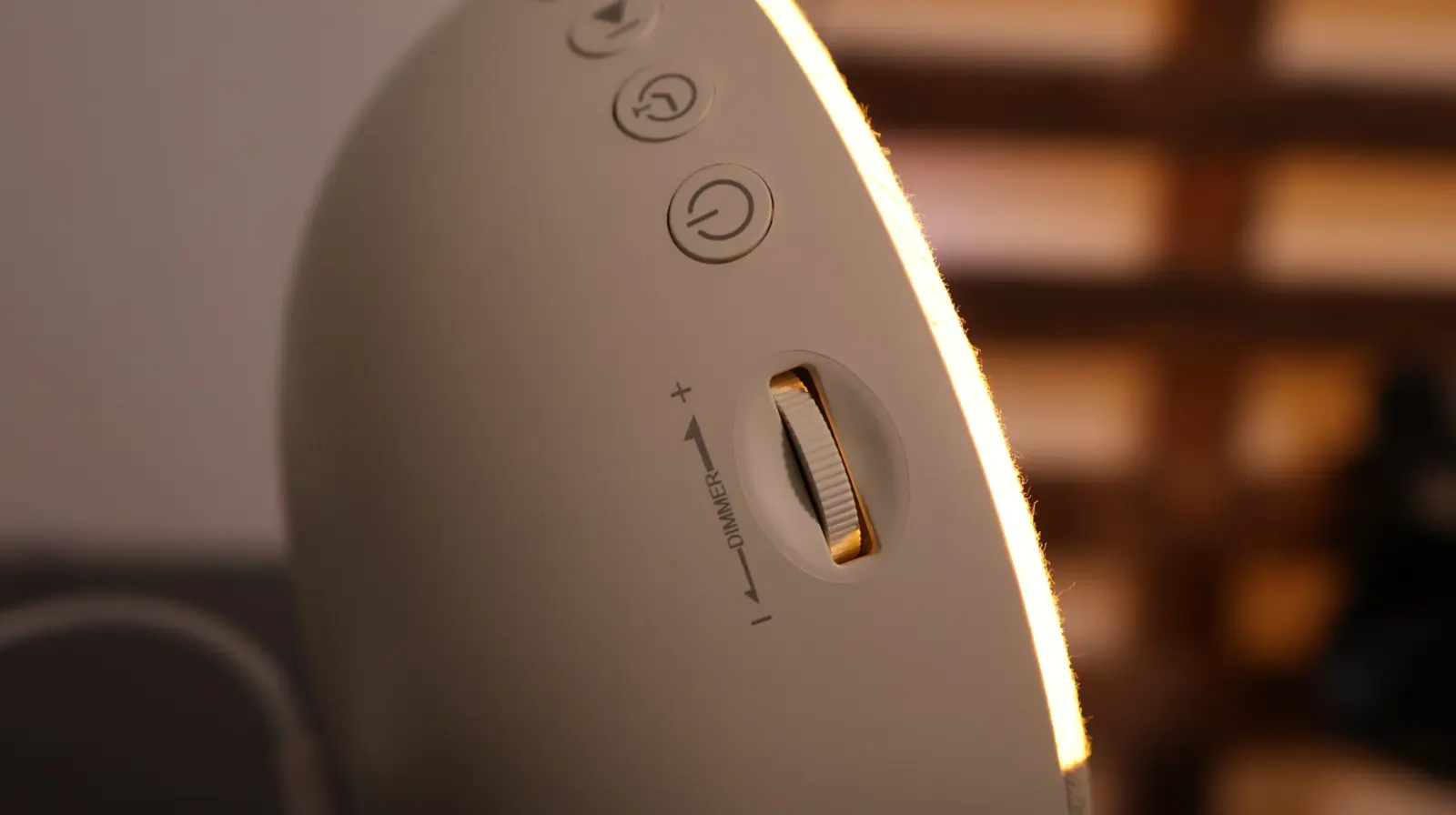
For about $65 you get a clock, a sunrise, a nightlight with nine colors, and 30 sounds, all run from buttons and two dials on the clock itself.
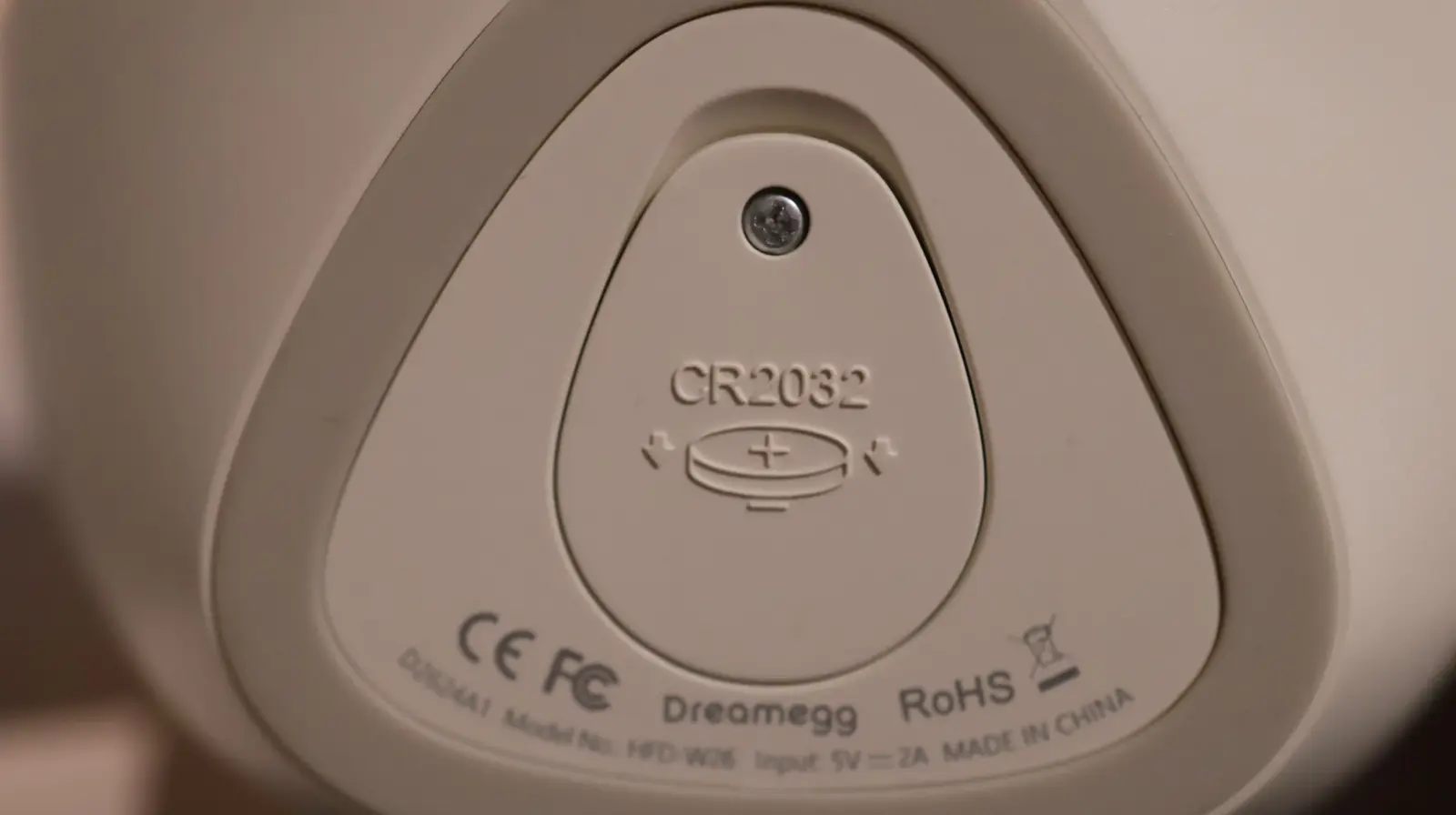
There’s no app, no Wi-Fi and no account. It plugs into a DC adapter on a 60-inch cord, draws 5.5 watts at full brightness, and a coin cell in the base keeps the time if the power drops.
The name trips people up, because Dreamegg sells four sunrise clocks:
- Sunrise 1: this one. No app, no Wi-Fi.
- Sunrise 1+: adds app control and a sunset mode.
- Sunrise Beam: the cheaper “essential” model.
- Sunrise Art: the “design edition.”
At least one review site has a Sunrise 1+ review sitting at a Sunrise 1 address, so check which one you’re reading about.
If you want the science of why a sunrise clock should work at all, I cover that in do sunrise alarm clocks work. This review is about whether this one does.
How I Tested
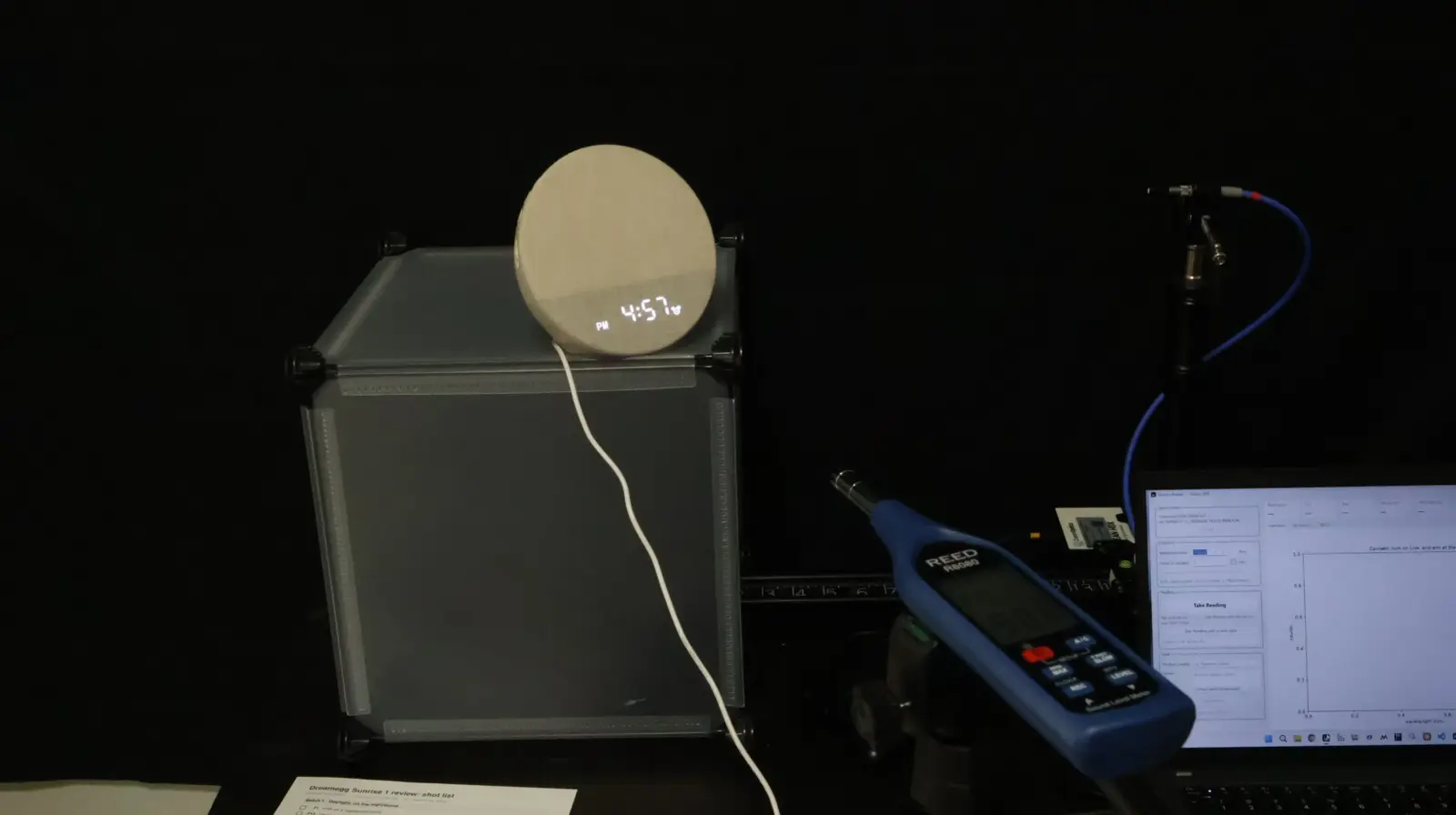
Every brightness number in this review was taken at 18 inches, roughly nightstand to pillow.
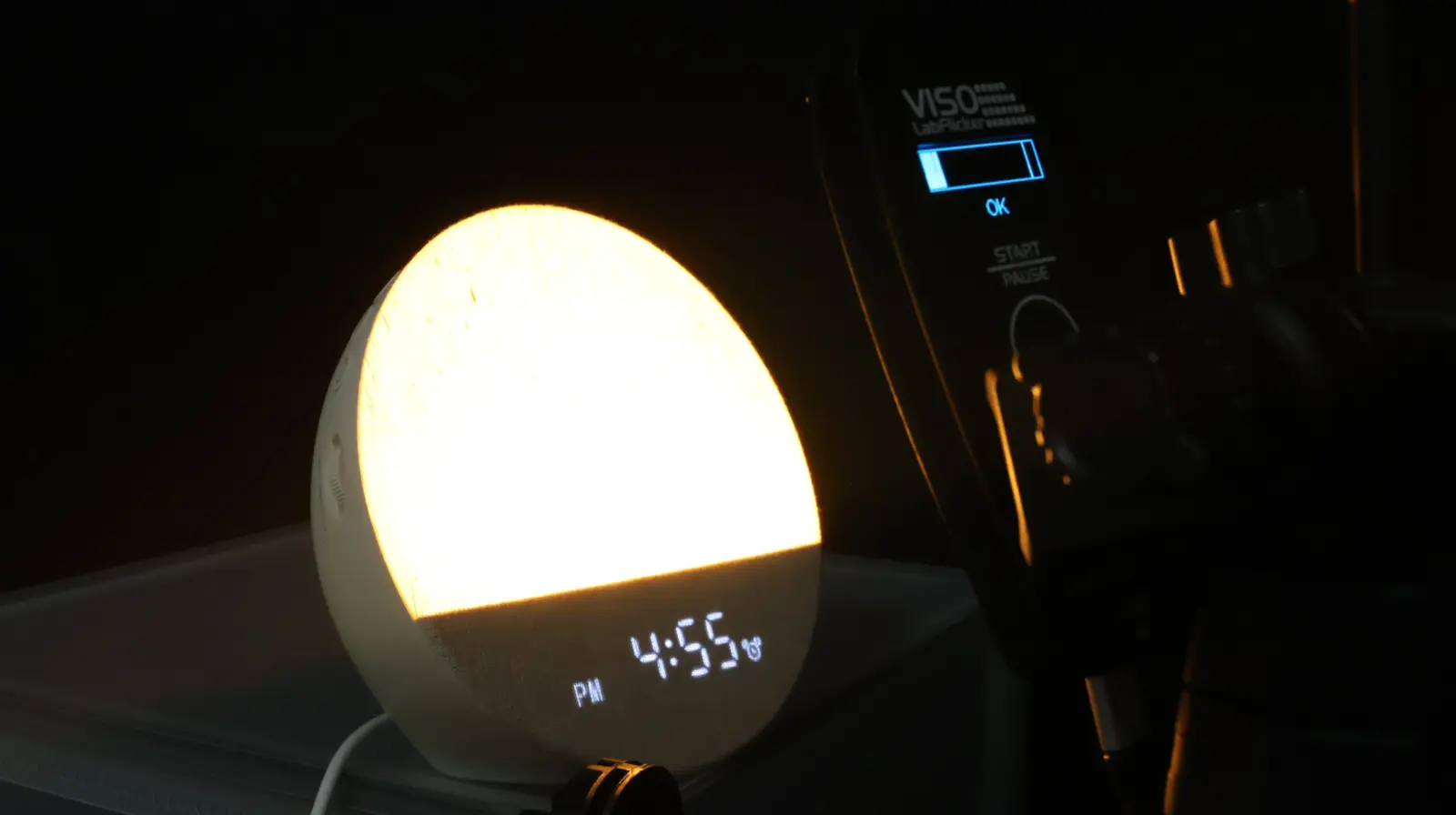
The sunrise at full went in front of an Ocean HDX-XR spectrometer with a cosine corrector. That gives brightness, color temperature, color rendering and the melanopic numbers.
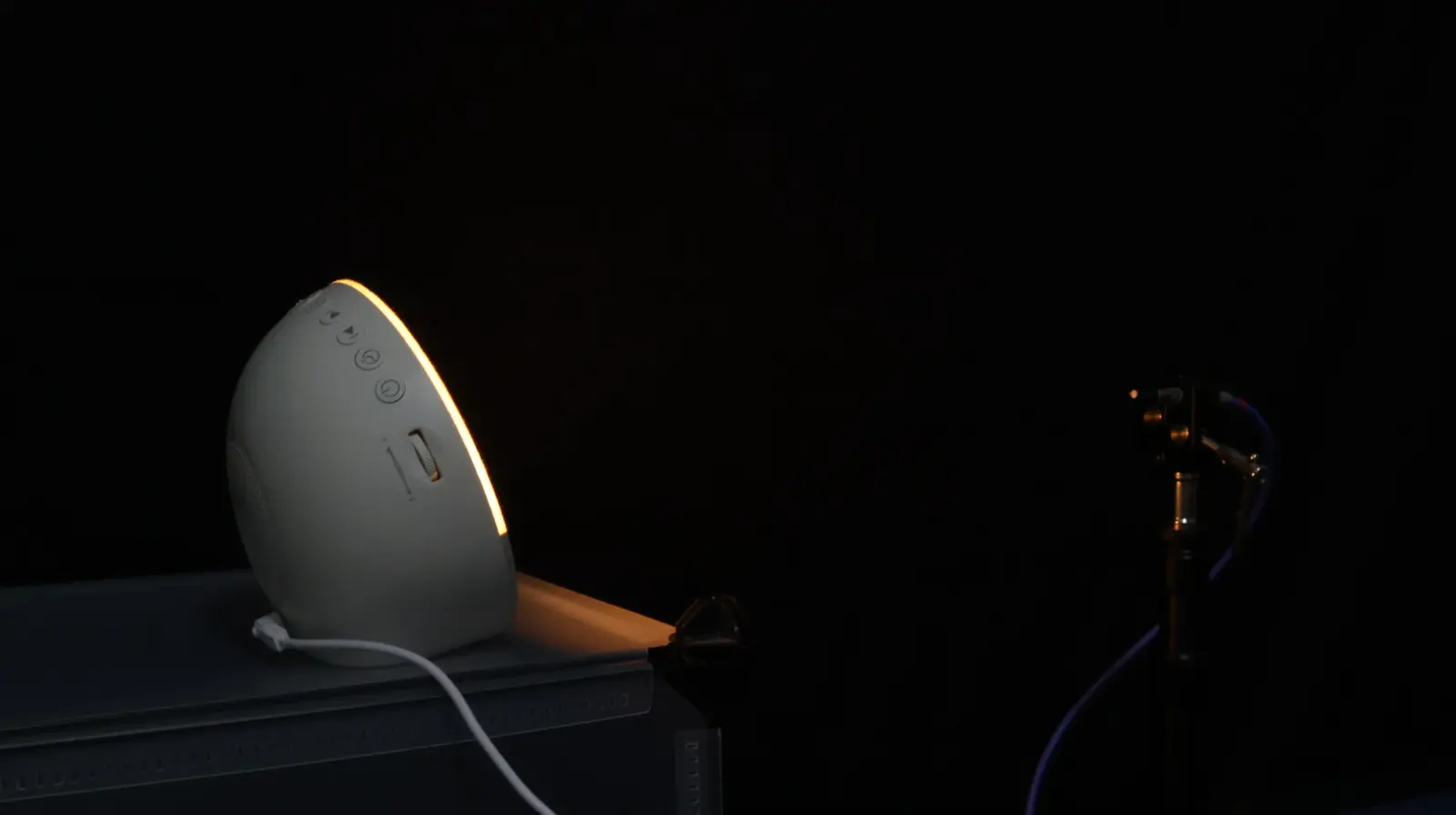
The full 30-minute sunrise went into an integrating sphere on a second spectrometer, logging the whole ramp from first glow to full.
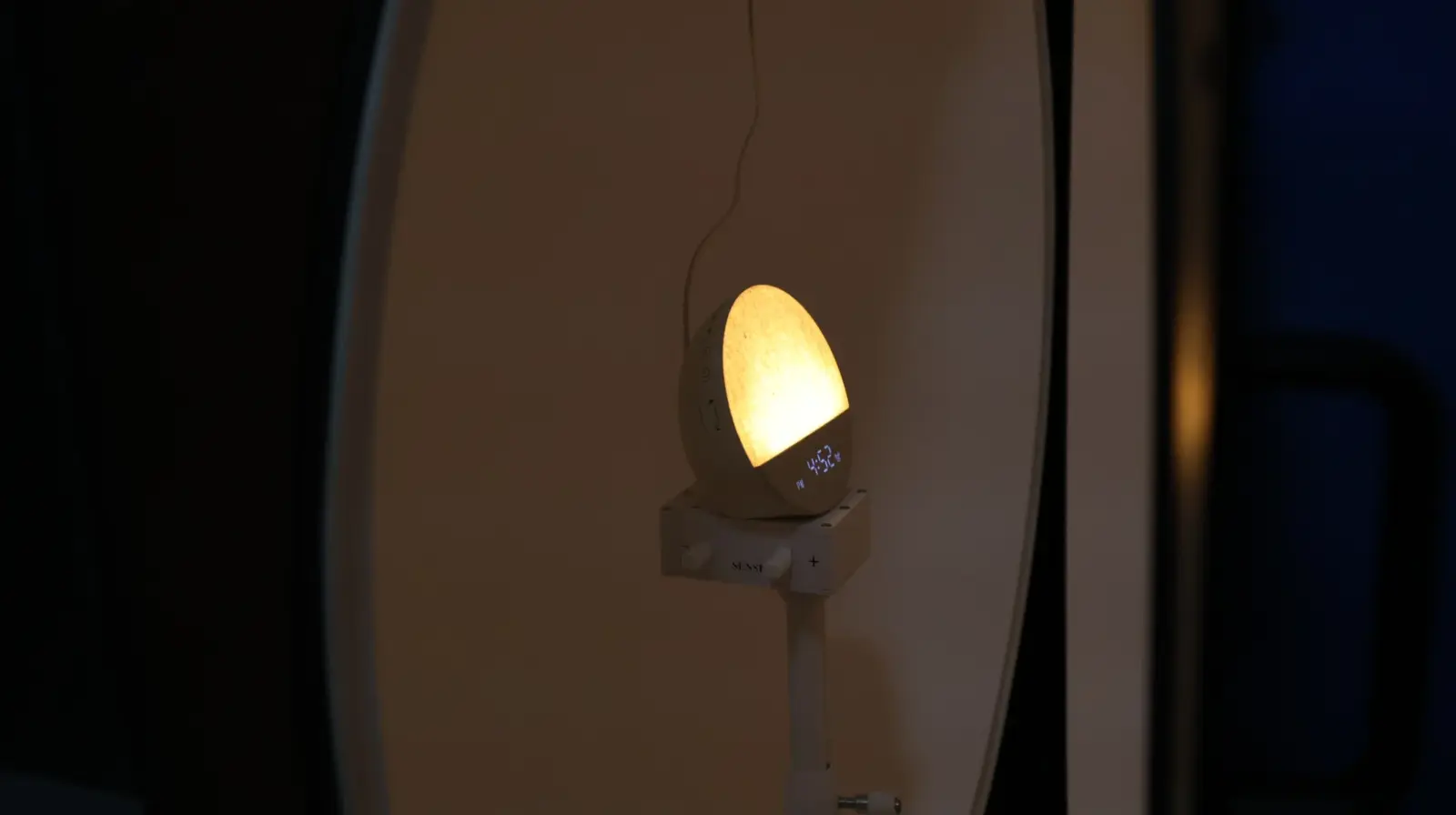
I also measured four nightlight colors for their spectrum, ran a Viso LabFlicker meter at full and with the nightlight dimmed, and put a dB meter at 18 inches with the volume maxed across 20 of the sounds.
The nightlight readings were taken up close to get a clean spectrum. They tell you what color the light is, not how bright it is.
The Light, Measured
The Sunrise 1 peaks at 62.6 lux at 18 inches. Out of the 18 sunrise clocks I’ve measured, it comes 16th.
62.6 lux, against 282.6 for the Hatch Restore 3 and 274.3 for a $30 JALL. Three of the 18 readings were taken on a newer spectrometer; for plain brightness the two instruments agree closely.
A roughly $30 JALL puts out 4.4 times as much light at the same distance. The Hatch Restore 3 puts out 4.5 times as much.
Here’s the part I didn’t expect: the sunrise has no brightness control. The dials dim the nightlight and the clock face. Nothing dims or boosts the sunrise, so 62.6 lux isn’t the top setting. It’s the only setting.
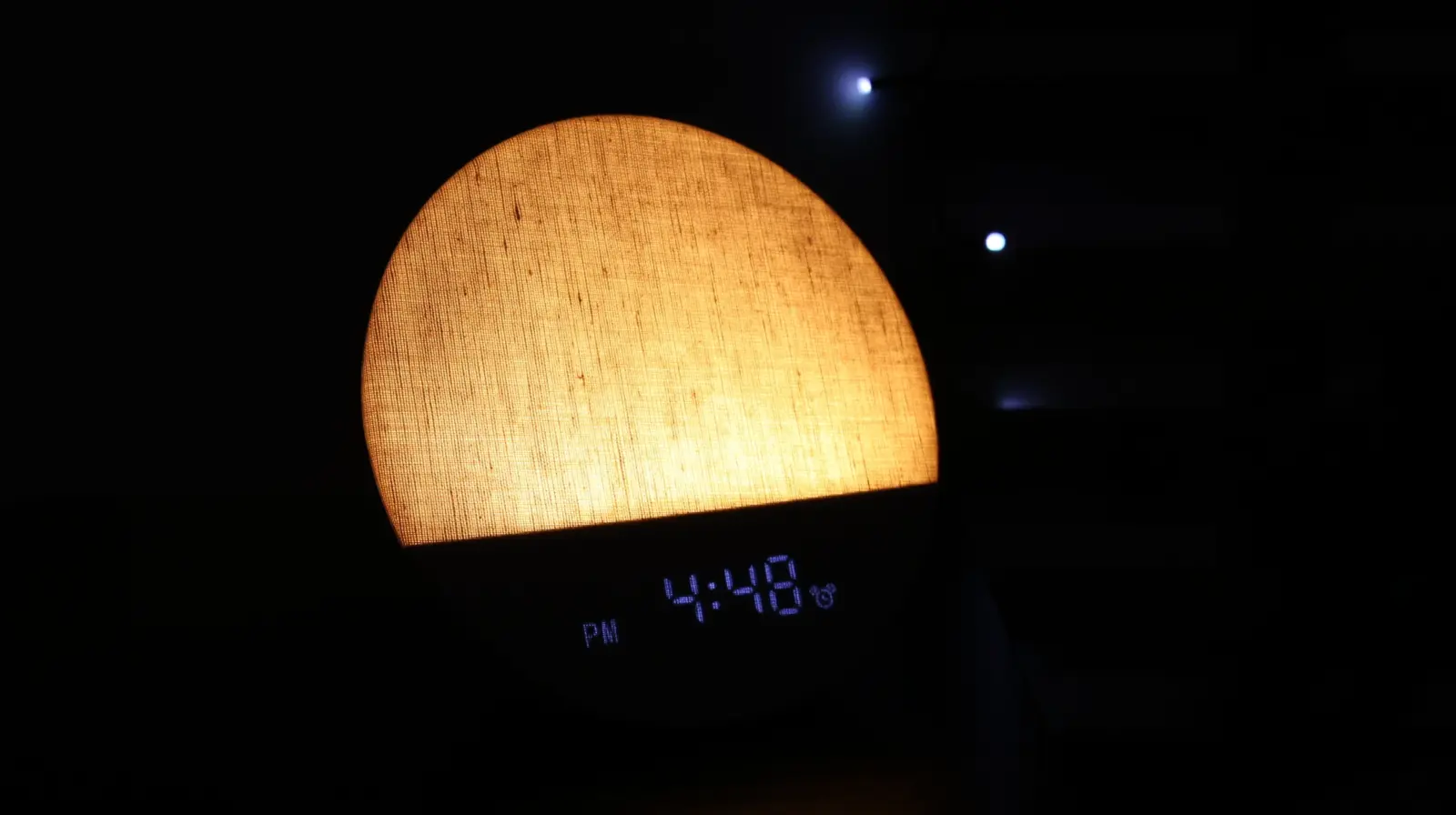
The light itself is a deep warm amber: 1974K, with a TM-30 fidelity (Rf) of 83.5 and a CRI of 74.6 on the stricter Re scale (80.6 on the Ra number most spec sheets quote). Reds hold up reasonably well for the price, with an R9 of 26.
Its melanopic ratio (mel-DER) is 0.19. That number tells you how strongly a light hits the melanopsin cells that set your body clock, per unit of visible brightness, against daylight at 1.0. Warm amber is low by nature, which is fine for a gentle light and less useful for a wake-up one.
Spectrum chart. Sunrise 1, max 18 in, 1974K, melanopic DER 0.18, 36% less body-clock light than daylight.
See the numbers
Sunrise 1, max 18 in
- Color temp
- 1974K
- Body-clock lightMelanopic DER: how much light this lamp gives the body clock for its brightness, compared with daylight at 1.00. Higher means more body-clock light per lux.
- 0.18×
- Vs. daylightBody-clock light compared with daylight of the same color temperature at the same brightness.
- 36% less
A red-heavy spectrum with a small blue bump. Plenty of warmth, very little of the blue-cyan that wakes the body clock.
Dreamegg says the sunrise builds “into full, bright daylight.” Daylight runs around 5000K to 6500K and reaches thousands of lux. This is 1974K and 62.6 lux.
The Sunrise Itself
The ramp is the most orderly one I’ve recorded. It climbs in a straight line at about 3.3% of full output per minute and reaches full at around 29 minutes on the 30-minute setting.
Output by time. Sunrise 1 ramp length 30 min.
See the numbers
Sunrise 1
- Ramp length
- 30 min
A clean straight line up, then it holds at full.
No steps, no late surge. At the start it’s already at about 3% of full, so there’s a faint glow from the first minute rather than a stretch of darkness.
Once it reaches full, it stays on. One reviewer wrote that the light “turns off very quickly right at the end.” On my unit it didn’t, and the ramp data shows it holding steady past the 30-minute mark.
You can set the sunrise to 5, 10, 15, 20, 30, 45 or 60 minutes. Reviews online disagree about this, from “30 or 60 only” to “20 minutes,” so here’s the full list.
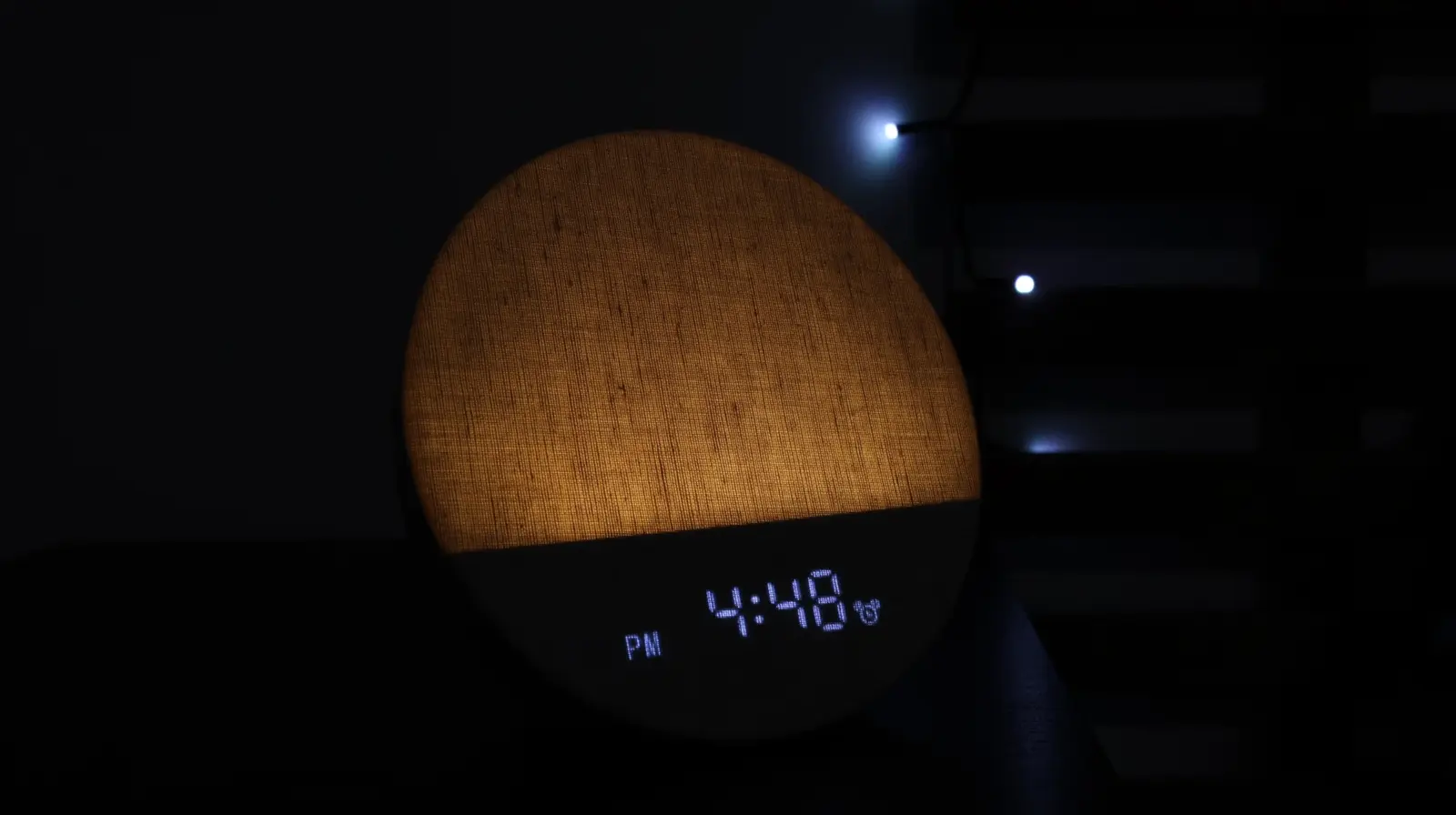
The color doesn’t change as it brightens. It moves by about 20K from the first reading to the last, so this is one warm color getting brighter, not an amber-to-white sweep.
That isn’t a flaw to me. A real sunrise starts warm, and this is warm the whole way. It just means the only thing changing is the brightness.
Does It Wake You Up?
It didn’t wake me. I like a much brighter lamp, and 62.6 lux doesn’t get me out of bed.
The number the dawn-simulation research keeps coming back to is 250 lux. Avery’s 2001 trial ramped to 250 lux and outperformed a 10,000-lux light box.[1] The Sunrise 1 delivers about a quarter of that at 18 inches.
It clears the lower bar and sits well short of the usual one.
But 250 is a yardstick, not a minimum. The one study that compared intensities head to head found 50 lux eased morning grogginess about as well as 250.[2] The Sunrise 1 clears that.
So I won’t call it too dim to work. If you wake easily, or you’re already surfacing around your alarm time, this is enough light to nudge you. If you sleep through most things, it won’t be.
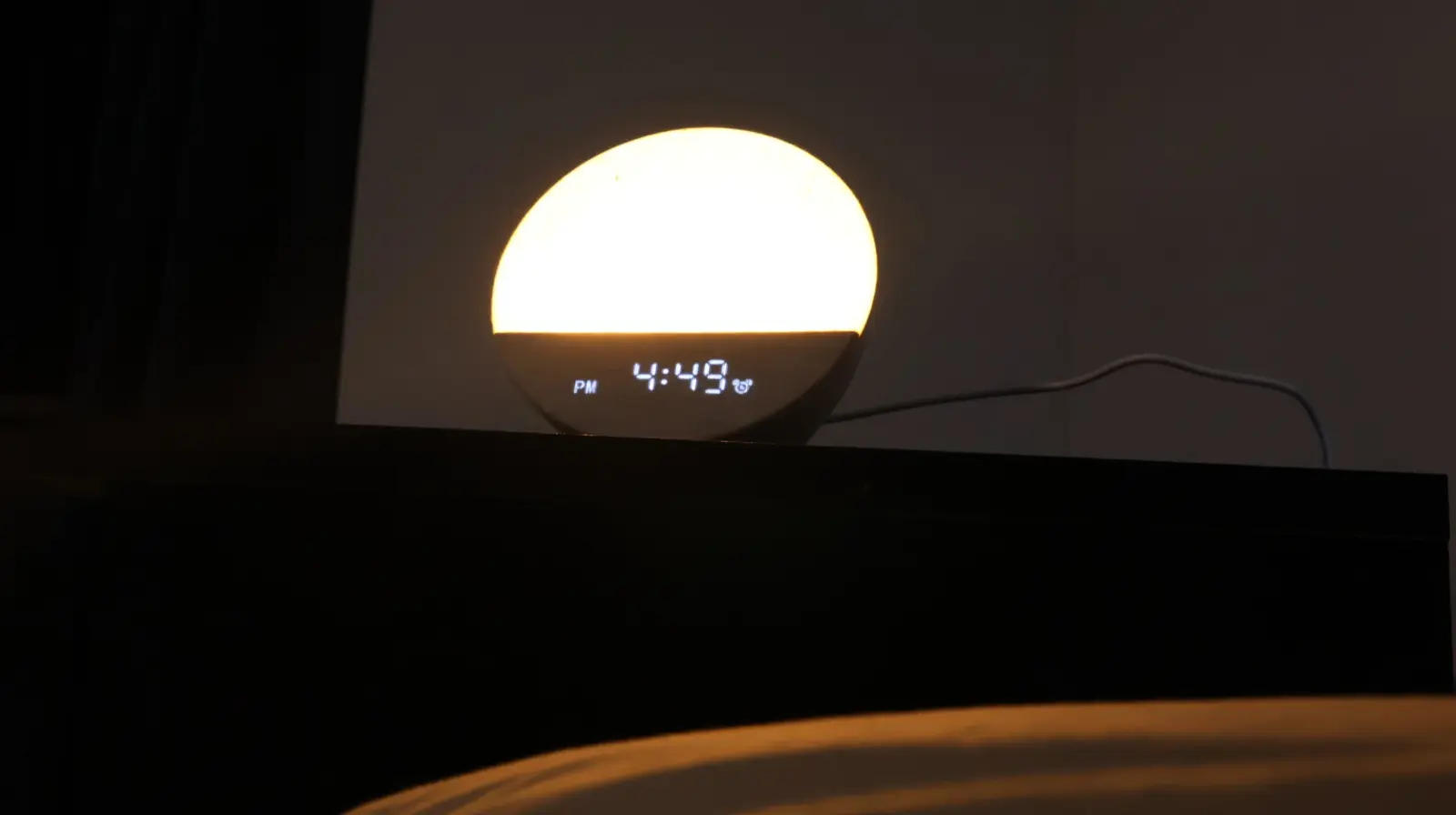
If you don’t know which kind of sleeper you are, assume you need more light. A dim sunrise clock that doesn’t work just becomes a clock.
The Nightlight: Use Red
If you use the nightlight at night, use the red. That’s the short version.
I measured four of the nine colors. Here’s how hard each one hits your body clock per unit of brightness (mel-DER, lower is gentler):
- Red: 0.004
- Warm white: 0.19
- White: 0.41
- Amber: 0.44
Red barely registers. Amber, surprisingly, scores the highest of the four.
Red is a single red LED at 630 nm with almost nothing on the melanopic curve. Warm white is the same light as the sunrise and a fine second choice.
Amber is the odd one. It looks like the warmest color, but it’s made by mixing a red LED with a green one, and that green sits right where the body clock is sensitive.
Spectrum chart. Nightlight red, melanopic DER 0.00; Nightlight amber, 1669K, melanopic DER 0.44, 112% more body-clock light than daylight; Nightlight warm white, 1974K, melanopic DER 0.19, 33% less body-clock light than daylight; Nightlight white, 2746K, melanopic DER 0.40, 14% less body-clock light than daylight.
See the numbers
Nightlight red
- Color tempColor temperature only describes white light. This light is too colored to have one.
- Colored light
- Body-clock lightMelanopic DER: how much light this lamp gives the body clock for its brightness, compared with daylight at 1.00. Higher means more body-clock light per lux.
- 0.00×
Nightlight amber
- Color temp
- 1669K
- Body-clock lightMelanopic DER: how much light this lamp gives the body clock for its brightness, compared with daylight at 1.00. Higher means more body-clock light per lux.
- 0.44×
- Vs. daylightBody-clock light compared with daylight of the same color temperature at the same brightness.
- 112% more
Nightlight warm white
- Color temp
- 1974K
- Body-clock lightMelanopic DER: how much light this lamp gives the body clock for its brightness, compared with daylight at 1.00. Higher means more body-clock light per lux.
- 0.19×
- Vs. daylightBody-clock light compared with daylight of the same color temperature at the same brightness.
- 33% less
Nightlight white
- Color temp
- 2746K
- Body-clock lightMelanopic DER: how much light this lamp gives the body clock for its brightness, compared with daylight at 1.00. Higher means more body-clock light per lux.
- 0.40×
- Vs. daylightBody-clock light compared with daylight of the same color temperature at the same brightness.
- 14% less
The amber’s second peak at 518 nm is green. You see orange; your body clock sees the green.
Keep this in proportion. These are ratios, not doses, and at nightlight brightness none of these colors is going to keep you awake. Red just gives your body clock the least to react to.
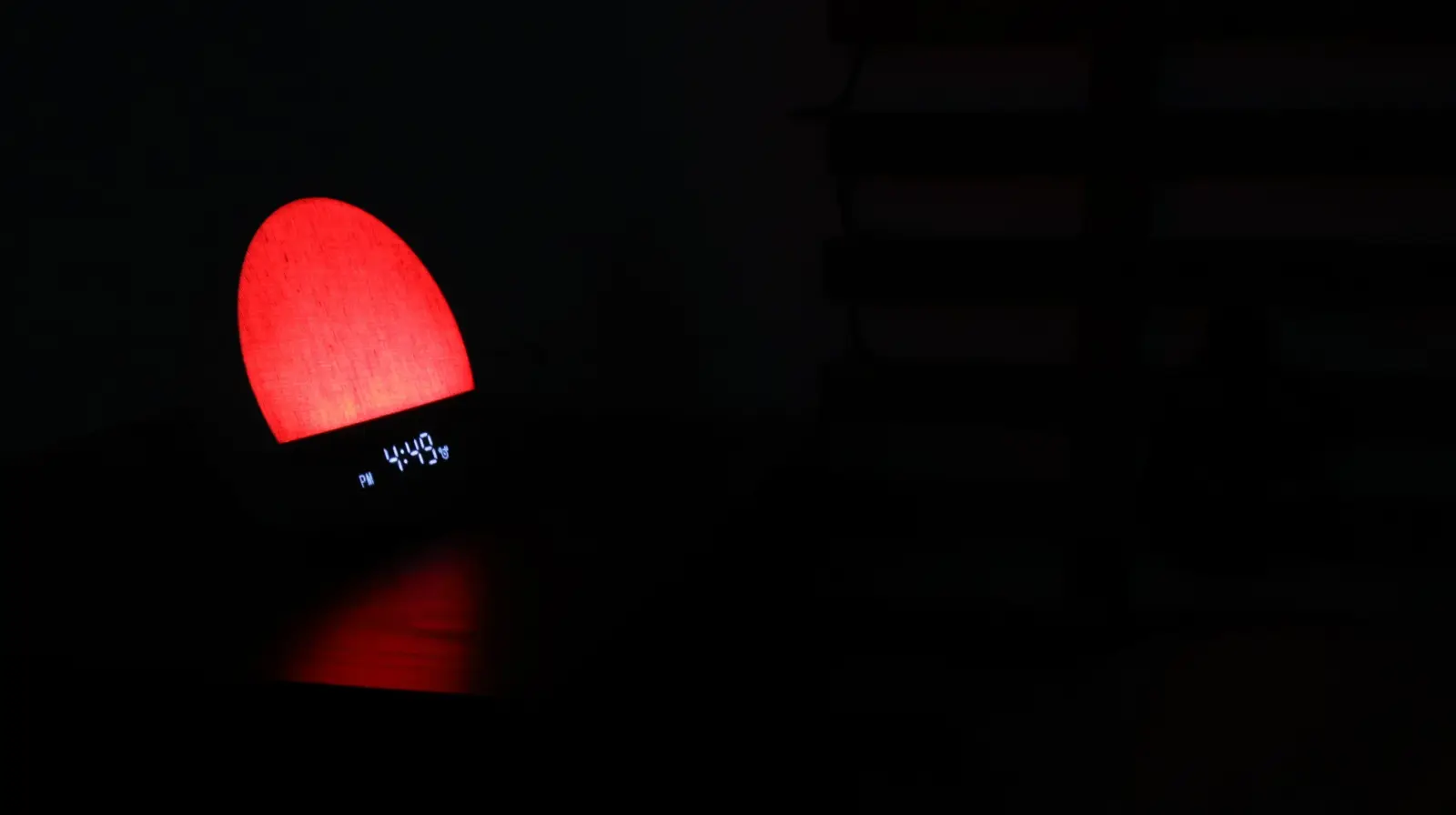
The nightlight is also nice to live with. It remembers your color: press and hold the light button to turn it off, press it again and it comes back on red, without cycling through all nine. If a nightlight is the main thing you want, the Casper Glow is built around that job.
The Sound
The loudness surprised me. At full volume and 18 inches, the loudest sound peaked at 86.8 dB.
What it won’t do is build. I measured 20 of the sounds, and none of them grows as it plays: the last quarter of each is within 1 dB of the first. Every alarm starts at full volume from its first second.
Sound level by time. Dreamegg Sunrise 1 loudest 79.6 dB(A); Dreamegg Sunrise 1 average 67.8 dB(A); Rise Centered loudest 77.7 dB(A); Rise Centered average 60 dB(A).
See the numbers
Dreamegg Sunrise 1
- Loudest
- 79.6 dB(A)
- Average
- 67.8 dB(A)
Rise Centered
- Loudest
- 77.7 dB(A)
- Average
- 60 dB(A)
The Dreamegg (its cave-music sound here) is at full volume from the first second. The Rise Centered climbs from 45 to about 63 dB over 100 seconds.
I don’t use sound alarms unless I have to. When I do, I’d much rather wake to one that starts quiet and builds. That gives you a chance to come up gently before it gets loud.
The sound you pick ends up being your volume setting. At the same volume, the 20 I measured averaged anywhere from 55.8 dB (storm) to 74.8 dB (rain), a big enough gap that switching sounds changes how loud it is.
The noise-type sounds hold steady. The nature and music ones swing a lot: birds ranged from 56 to 87 dB in a single run.
Dreamegg lists 29 sounds. My unit has 30, and from track 18 onward they’re the earlier sounds with white noise laid over them. You can barely hear the birds or rain underneath, and they sound nearly identical to each other.
So it’s closer to 17 sounds plus padding. Six of them can be set as the alarm.
The speaker is small, so it’s tinny and there’s no real bass. That’s normal for a clock. As a sleep sound machine it’s fine if you only want one device on the nightstand, but a dedicated sound machine sounds better.
Living With It
Day to day, most of it is easy. One pair of buttons is not.
The buttons
Setting it up is simple once you’ve skimmed the manual. Hold the alarm button, use plus and minus to change the value, and tap the alarm button to move to the next setting.
The side dials and the large nightlight button are easy to find in the dark. The rest are hard to tell apart by feel.
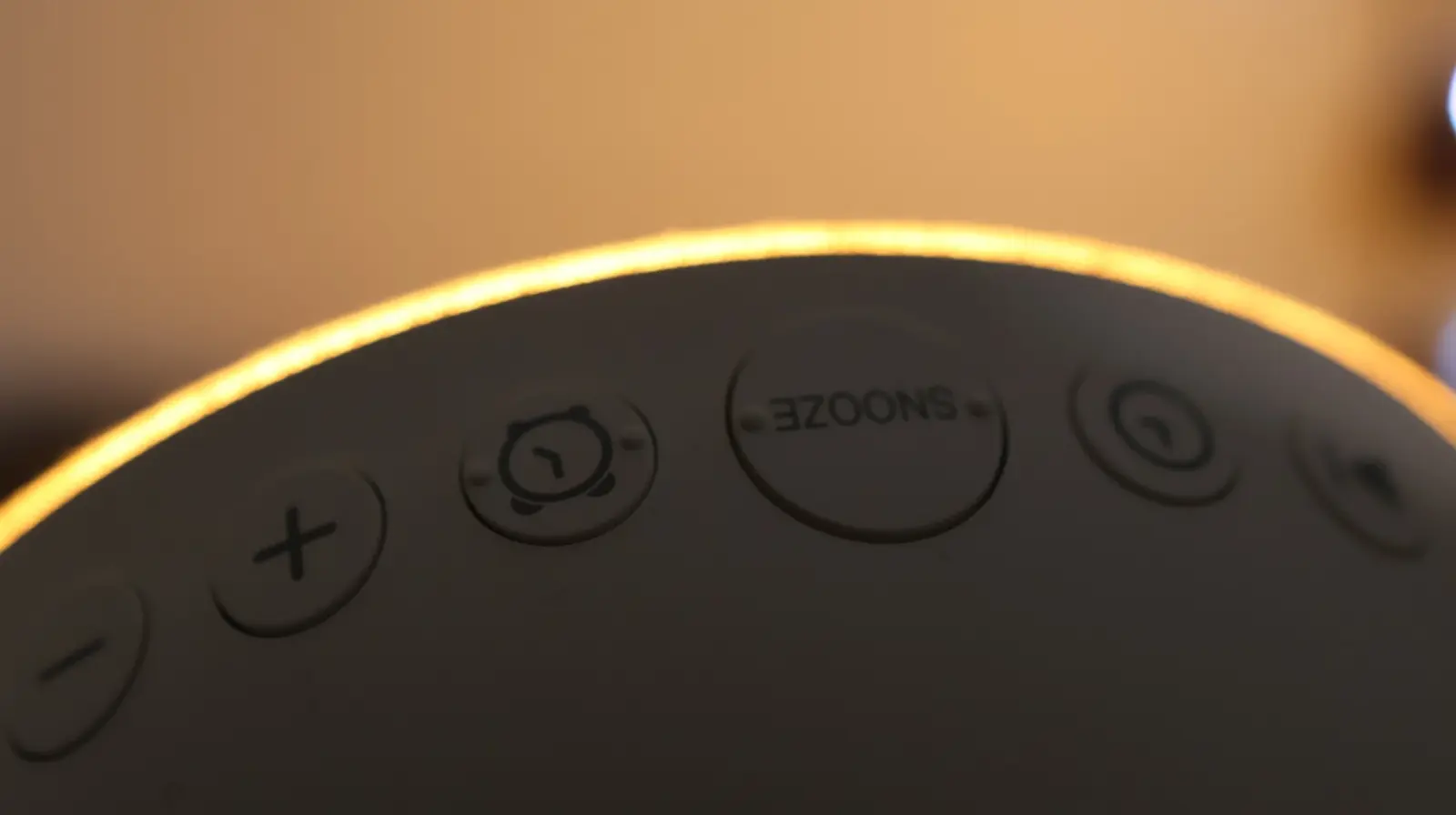
The problem is at the top. Snooze and alarm-off sit right next to each other and both have two raised bumps. Alarm-off is only slightly smaller, so it’s easy to hit the wrong one half asleep.
Tom’s Guide gave it 5 out of 5 for ease of use. I’d give it a 3 or a 4.
Snooze
Snooze lasts 9 minutes and turns off both the light and the sound. I’d rather it silenced the sound and left the light on, since the light is the part that’s supposed to be waking you.
The display
The clock face dims smoothly on its dial and goes fully dark, so it won’t keep you up.
Timer and power
The sleep timer runs from 5 to 180 minutes. Dreamegg’s own product page says 15 to 90, which is wrong on my unit.
A coin cell in the base keeps the time through a power cut, so you won’t wake up to a blinking clock.
Flicker
At full brightness it measured 0.08% flicker, which is effectively steady light and well inside IEEE 1789’s no-observable-effect zone.
Dimmed, the nightlight is mostly steady too, with a ripple of about 0.3%. Every so often it drops for a fraction of a millisecond, by up to about 9%, and those brief dips push the meter’s headline number to 4.9%.
A flat line at the top means steady light; dips mean flicker.
Light output by time. Full brightness percent flicker 0.08%; Full brightness frequency Steady light; Full brightness ieee 1789 No observable effect; Dimmed percent flicker 4.91%; Dimmed frequency 488 Hz; Dimmed ieee 1789 No observable effect.
See the numbers
Full brightness
- Percent flickerHow far the light dips from its brightest, as a share of the total. Under 1% is steady to the eye.
- 0.08%
- Frequency
- Steady light
- IEEE 1789The flicker safety guidance for lighting: how deep the flicker is, for its frequency.
- No observable effect
Dimmed
- Percent flickerHow far the light dips from its brightest, as a share of the total. Under 1% is steady to the eye.
- 4.91%
- Frequency
- 488 Hz
- IEEE 1789The flicker safety guidance for lighting: how deep the flicker is, for its frequency.
- No observable effect
Flat at full. Dimmed, a steady line with the occasional sharp, very brief dip.
The flicker index, which weighs how much of the time the light is actually dipping, is 0.0001 or less in both states. That’s about as low as it gets. I wouldn’t worry about it on a nightlight, but dimmed is the one place this clock isn’t perfectly clean.
Dreamegg Sunrise 1 vs Hatch Restore 3
Tom’s Guide put these two head to head and wrote that “the light simulations offered by both clocks are on par.” I measured both at the same 18 inches.
The Hatch Restore 3 hit 282.6 lux. The Sunrise 1 hit 62.6.
Same bench, same 18 inches. “On par” it isn’t.
They can look similar by eye, and a dim room makes any glow seem bright. On the meter it’s not close.
Most people comparing these two are trying to get away from the Hatch subscription. That’s the part worth clearing up: the subscription isn’t what separates them.
Without Hatch+, the Restore 3 still does its sunrise alarm, custom bedtime routines and 40 sleep sounds, according to Hatch’s own free-versus-paid breakdown. The $4.99 a month (or $49.99 a year) buys a bigger library of sounds, lights and wind-down audio, none of which the Sunrise 1 has in any form.
So the real trade is about $105 and a phone app. For that you get 4.5 times the light, a better speaker, and (in my testing) a snooze that silences the sound but keeps the light on.
The Sunrise 1 wins on price, and on having real dials. When I tested the Restore 3, it needed its app just to change the brightness; the Dreamegg does it with a knob on the side.
I used to think the Dreamegg’s nightlight beat the Hatch’s, which I found too bright and too white when I tested it. That was a while ago and Hatch may have changed it, so I’m not counting it.
If you’ve been going back and forth, my Hatch Restore review covers the app, the routines and whether Hatch+ is worth it.
Who Should Buy It
Buy it if you like the look, you wake fairly easily to light, you want white noise and a clock in one device without an app or an account, and your budget is around $65.
Skip it if you need a bright light to get you up, or you’re only buying it to avoid Hatch’s subscription. The Hatch works fine without one.
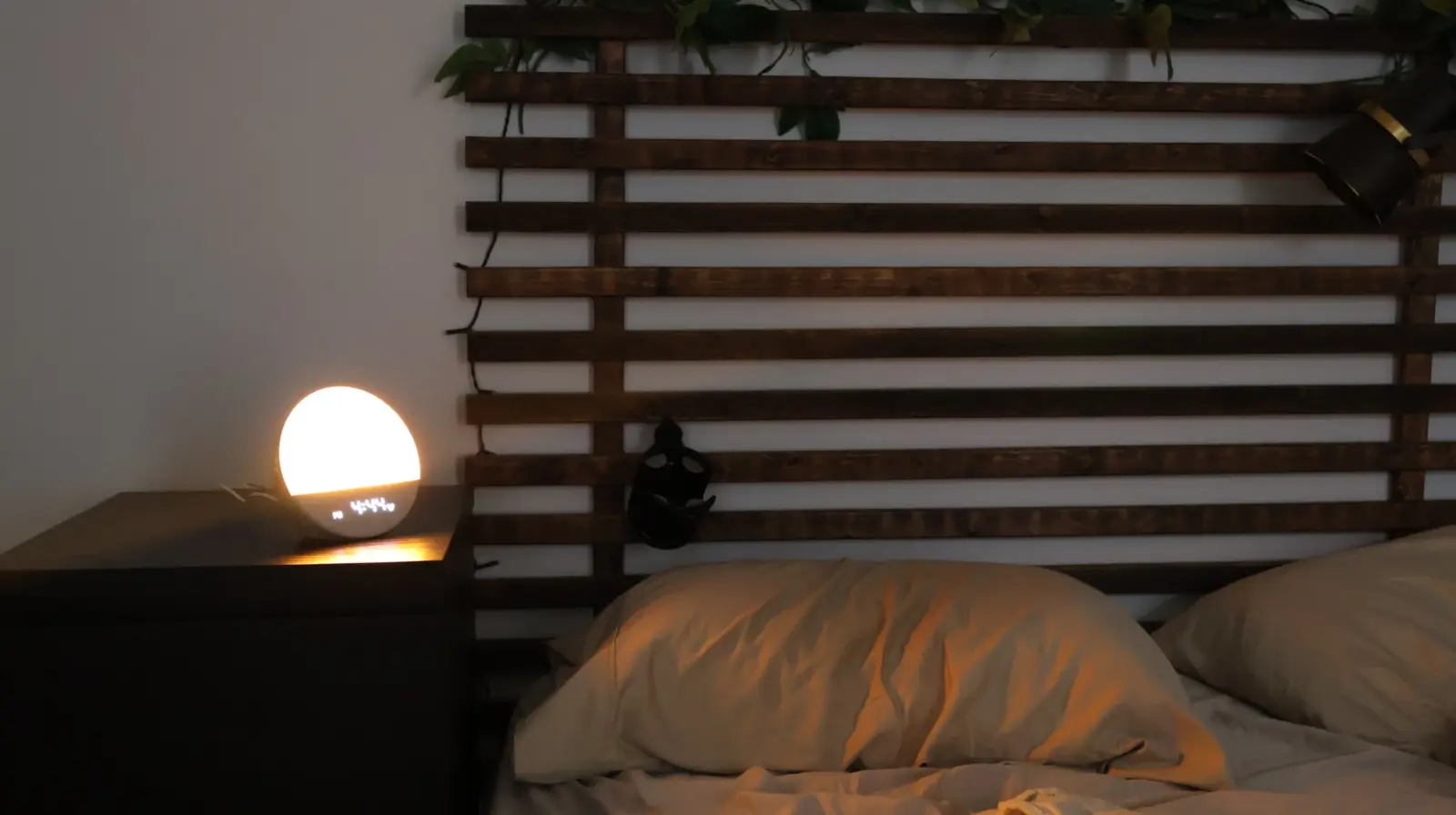
I’d skip it, because I want far more light than this gives. That’s a preference, not a verdict on everyone.
At $65 it’s a fair price for what it is: an attractive, simple bedside clock with a gentle glow and decent white noise. If that’s what you want, the Dreamegg Sunrise 1 does it without fuss. If you want the light to do the waking, pick something brighter from the best sunrise alarm clocks list.
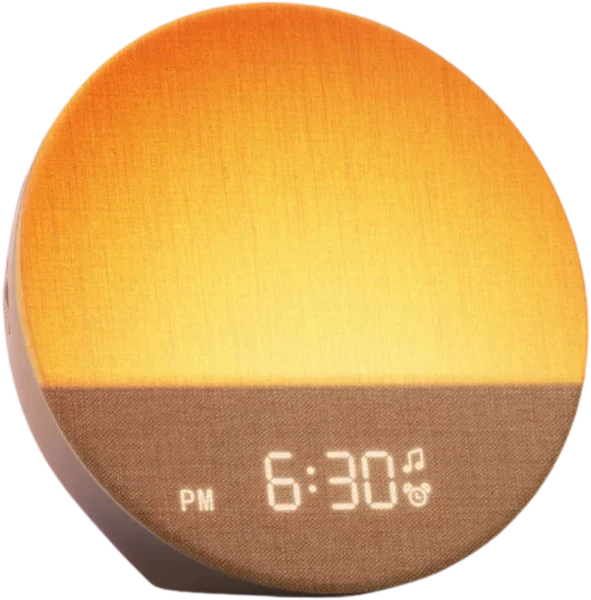
Dreamegg Sunrise 1
An attractive, app-free sunrise clock and sound machine with a gentle glow and a genuinely sleep-friendly red nightlight. The sunrise tops out at 62.6 lux with no way to turn it up, and the alarms never build. Buy it for the looks and the simplicity, not the light.
DEREK10% off
Frequently Asked Questions
Is Dreamegg a legit brand? Who makes it?
Yes. Dreamegg is a brand from Shenzhen, China (the trademark belongs to Shen Zhen Inspiration Technology Co., Ltd), and it sells through its own site, Amazon and Walmart.
Do you need a subscription for the Dreamegg Sunrise 1?
No. There’s no app or account, and every feature works from the clock itself. For what it’s worth, the Hatch Restore 3’s sunrise alarm, routines and basic sounds don’t need a subscription either.
Is the Dreamegg as good as the Hatch?
It looks similar, but no. The Hatch Restore 3 measured 4.5 times brighter at the same distance and has a better speaker. The Dreamegg is cheaper and doesn’t need an app. The full comparison is above.
What’s the difference between the Dreamegg Sunrise 1 and Sunrise 1+?
The 1+ adds app control and a sunset mode. I tried to measure its sunrise too, but its light shut off so quickly at the end of the ramp that I couldn’t get a reading at 18 inches.
How do you set the alarm on a Dreamegg?
Press and hold the alarm button, use plus and minus to set each value, and tap the alarm button to move to the next one.
How do you turn off the Dreamegg alarm?
Press the alarm-off button at the top, just to the right of snooze. They both have two raised bumps and sit side by side, so feel for the slightly smaller one.
Does the Dreamegg keep time if the power goes out?
Yes. A coin cell (CR2032) in the base keeps the clock running.
What’s the warranty?
As of September 2026, Dreamegg lists a one-year warranty and a 60-day money-back guarantee on its own site.
References
- Avery DH, Eder DN, Bolte MA, et al. Dawn simulation and bright light in the treatment of SAD: a controlled study. Biological Psychiatry 2001;50(3):205-216 https://doi.org/10.1016/s0006-3223(01)01200-8 ↩
- Gimenez MC, Hessels M, van de Werken M, et al. Effects of artificial dawn on subjective ratings of sleep inertia and dim light melatonin onset. Chronobiology International 2010;27(6):1219-1241 https://doi.org/10.3109/07420528.2010.496912 ↩