

I’ve now scientifically tested over 60 of the most popular SAD lamps, and due to popular demand, this article will go over my favorites for different categories.
Before we get into the recommendations, you may want to familiarize yourself with some of the factors that make a lamp worth buying. So feel free to read on or skip to the recommendations.
Things to Consider When Buying a SAD Lamp
Lux, circadian light, glare, color temperature, flicker, oh my!
Many things combine to make for a good light therapy lamp; it can be challenging to choose one unless you know what you’re looking for and why.
Free · 95 pages
You’re reading about one piece of this. The book is the whole day.
The Circadian Blueprint covers setting your body clock with light — the timing, the doses, and which products actually deliver them. Every number came off my own spectrometer.
Check your inbox to confirm. Plus a short note each month on what I’ve tested — unsubscribe anytime.
Let’s go through the most critical factors to consider:
Lux
You’ve probably seen a few lamps advertise “10,000 lux!” This is the most popular measurement for bright light therapy.
Lux is a simple number representing the lumens per square meter or the amount of light hitting a surface.
Lumens are spectrally weighted measurements tailored explicitly to the visual sensitivity of the human eye.
This means it fairly accurately tells us how bright a light source is, but there’s a better measurement for light therapy lamps…
Circadian Light
Circadian light, or CLA for short, is similar to lux; only spectrally weighted towards the parts of the light spectrum that most affect our circadian biology.
Just like lux, it spits out a simple numerical value, which makes it easy to compare the effectiveness of various lamps to each other.
You can read more about the model here if you’d like, but basically…
The higher the CLA, the more light sources will wake you up and align your circadian rhythm.
This is a reasonably new metric, so no one reports their CLA, but since we measure all of our devices, we have this info!
Glare (Lux/in2)
One important thing to remember regarding SAD lamps is how comfortable they are. A super bright light might be effective, but if it’s too uncomfortable in your field of view, you probably won’t like using it very much! And while it may technically help with your sleep, you won’t feel all that great while using it.
This is why we measure the light emission area of each lamp we test. This allows us to calculate the lux per square inch, which gives us an idea of how comfortable a light source will be when used.

Consider a flashlight and standing outside on a cloudy day to give you an example of why this is important.
The light outside on a cloudy day can approach 20,000 lux, but since it’s so dispersed and ambient, it doesn’t feel uncomfortable.
Now, a flashlight from two feet away might only reach 3,000 lux, but looking at it will feel like staring into the sun!
This is why the amount of photons per unit area is essential! We ideally want to strike a delicate balance between brightness/effectiveness and visual comfort.
The Best SAD Light Therapy Lamps
Without further ado… here are my recommendations for the best SAD lamps!
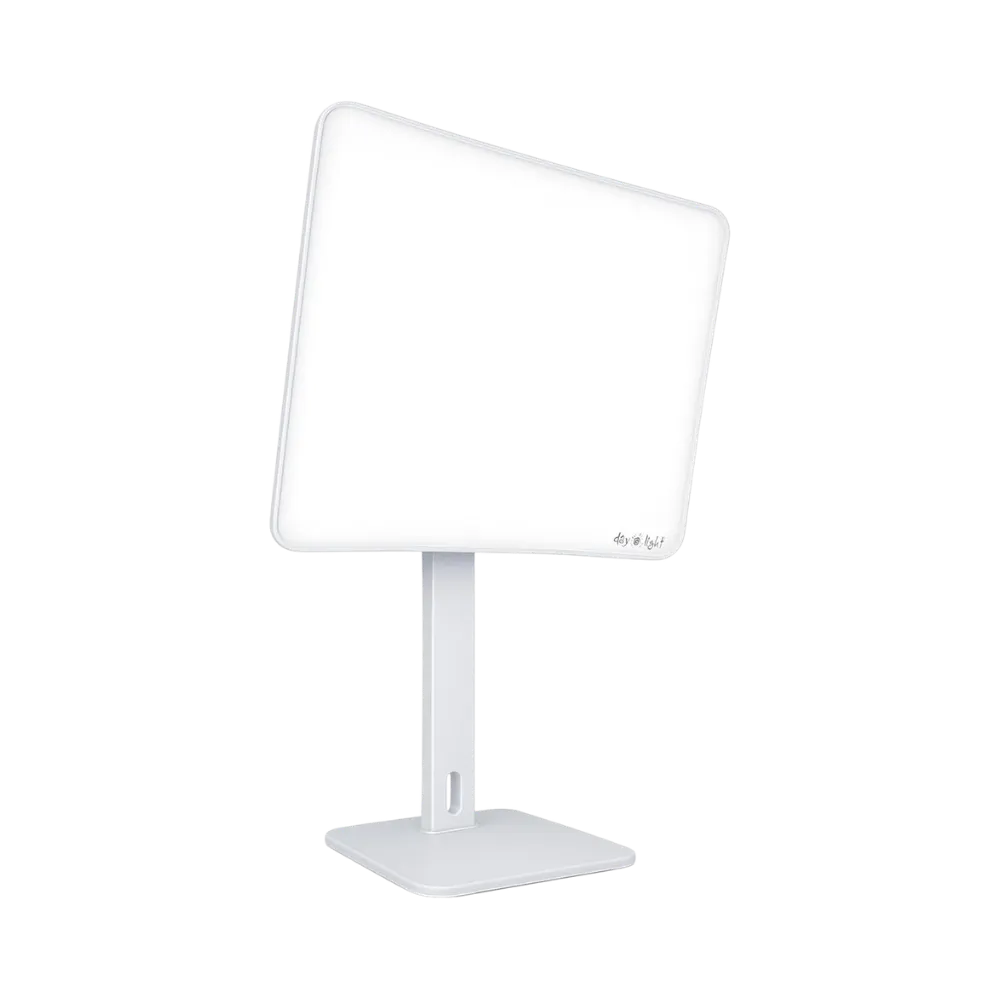
- Best Overall: Carex Elite
- Best Runnerup: Carex Day-Light Sky
- Best Spectrum: SOL PhotoVites Full Spectrum
- Most Powerful: Aurora LightPad Max or Aurora LightPad Mini
- Most Comfortable: Alaska Northern Lights NorthStar
- Best Compact Desk Lamp: Circadian Optics Lampu
- Best Floor Lamp: HappyLight Duo Floor
- Best Color Rendering: HappyLight Duo Desk
- Best for Travel/Portability: Chroma Sky Portal Mini
Best Overall: Carex Elite
The Elite is Carex’s newest offering, and it has some great new features and specs that make it my favorite SAD lamp right now.
The Elite puts out less light than the Day-Light Sky I mentioned below, but it makes up for this in several ways.
For one, it’s much more comfortable visually with a glare of 69 versus the Sky’s of 180, meaning you can get a similar amount of light without it feeling as overbearing.
The Elite is also flicker-free on all four brightness settings, unlike the Sky, if that’s important to you.
The Elite also looks quite a bit more modern if you ask me.
But the real treasure here is that the Elite has a VESA mount on the back, meaning you can mount it over your monitor!

I love this. It’s easy to do, frees up desk space, and feels great! I will go over how to do this in my full review here.
Carex Day-Light Elite

Pros:
Cons:

- Lux: 12,400
- Circadian Light: 14,190
- Glare: 69
- CCT: 4150K
- Brightness Levels: 4
- Color Temperatures: 1
🏷️ OPTIMIZE15 for 15% off
Best Runnerup: Carex Day-Light Sky
This one emits about 2500 more lux than the Elite, but the benefits end there. It’s a bit clunkier-looking, not quite as comfortable, and doesn’t have all the cool mounting options.
It is brighter, more effective, and a bit cheaper. So, if you aren’t too concerned about it being a bit less comfortable and don’t plan to mount it, this might be the better option.
I’ve done a full review of Sky if you want to see more.
Carex Day-Light Sky

Pros:
Cons:

- Lux: 14,500
- Circadian Light: 17,800
- Glare: 180
- CCT: 4200K
- Brightness Levels: 2
- Color Temperatures: 1
🏷️ OPTIMIZE15 for 15% off
Best Spectrum: SOL PhotoVites Full Spectrum
The visible light spectrum from this SAD lamp is by far the most natural I’ve tested since it uses genuine SunLike diodes in its construction.
The output is also very high, making it the third brightest SAD lamp we’ve tested at over 20,000 lux at 1 foot!

It also emits a lot of healthy infrared light, which none of these other lamps do. This is great for skin and eye health and abundant in natural morning sunlight!
It’s a bit expensive, but with a robust all-metal design coupled with a fan to help keep it cool, I have no doubt it will last a long time and provide a robust circadian response.
Get this one if light quality and effectiveness are among your chief concerns. You can read my full review here.
SOL PhotoVites Full-Spectrum Lamp

Pros:
Cons:

- Lux: 20,650
- Circadian Light: 43,140
- Glare: 2,900
- CCT: 6400K
- Brightness Levels: 1
- Color Temperatures: 1
🏷️ OYB10 for 10% off
Most Powerful: Aurora LightPad Max and Mini
The Aurora LightPad Max is my pick for the brightest lamp!
This is the one if you’re looking for something that will match a fairly sunny day but is still comfortable enough to use for an extended period.
The Max puts out around 31,000 lux at 1 foot with a glare of only 400! That means it’s certainly getting to that uncomfortable range, but many people (including myself) can push it to this number.
Its color temperature of 6500K ensures plenty of effective blue light, contributing to its high CLA of around 63,000.
You can read a more in-depth review of the LightPad Max and the other Alaska Northern Light lamps here.
Aurora LightPad Max

Pros:
Cons:

- Lux: 31,000
- Circadian Light: 62,700
- Glare: 400
- CCT: 6550K
- Brightness Levels: 3
- Color Temperatures: 1
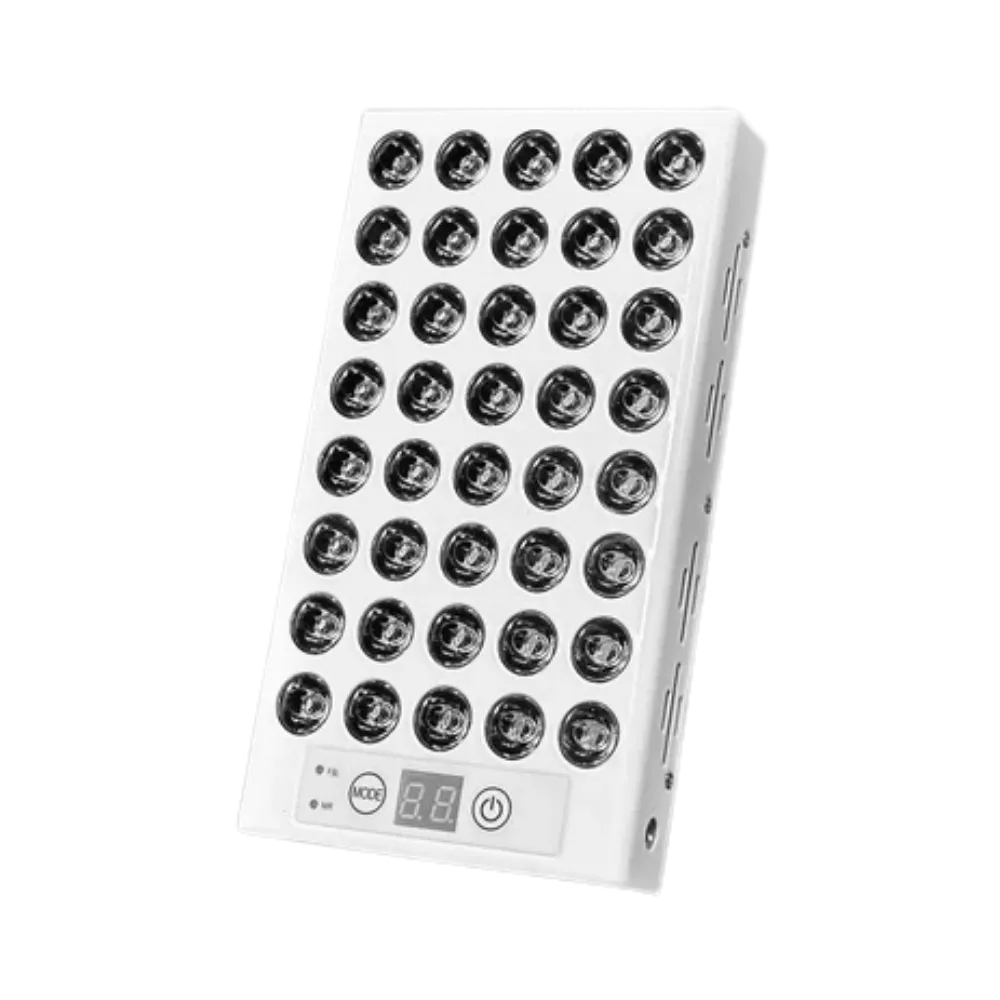
If you’re looking for something even more powerful but definitely less comfortable to use, check out the Mini.
Warning: This thing is astoundingly bright, putting out just over 42,000 lux at 1 foot, and is relatively compact, measuring just 5×7 inches.
Aurora LightPad Mini

Pros:
Cons:

- Lux: 42,400
- Circadian Light: 86,600
- Glare: 1,750
- CCT: 6400K
- Brightness Levels: 3
- Color Temperatures: 1
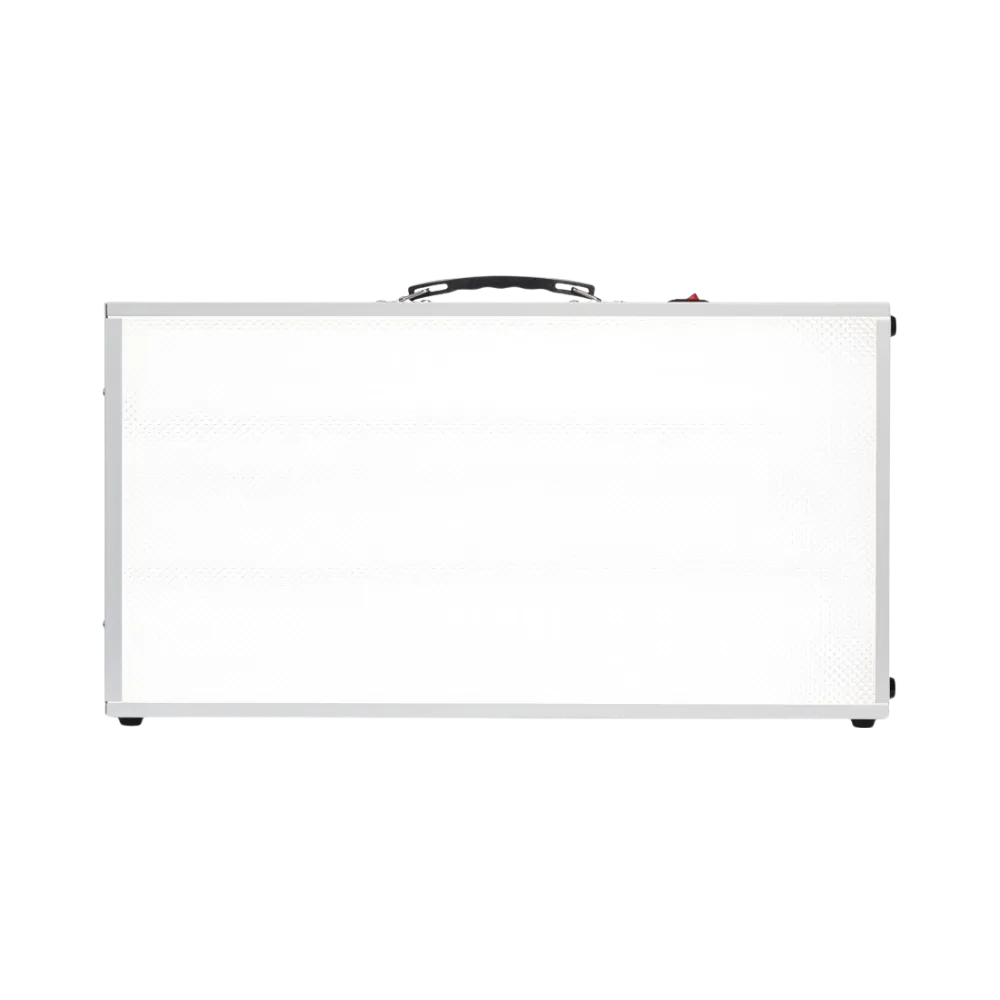
Most Comfortable: Alaska Northern Lights NorthStar
The North Star is a unique lamp because of its massive size. This makes it uniquely comfortable in the realm of bright light therapy lamps. If you’re looking for the most effective and comfortable light therapy lamp, this is hands down the one you want.
This one uses older fluorescent light technology, which emits a warmer color temperature of around 4350K, making it one of the warmer lamps on this list. Some people may prefer that, as it is closer to the CCT of morning sunlight.
You can read a more in-depth review of the NorthStar and the other Alaska Northern Light lamps here.
Alaska Northern Lights NorthStar

Pros:
Cons:

- Lux: 16,400
- Circadian Light: 17,900
- Glare: 75
- CCT: 4350K
- Brightness Levels: 1
- Color Temperatures: 1
Best Compact Desk Lamp: Circadian Optics Lampu
We’ve reviewed all of Circadian Optics’ lamps, and the Lampu is one of their standout options.
It’s pretty bright for the price and offers a reasonably large illumination area, which also helps with comfort.
The color temperature of this guy is also pretty much exactly 5700K, making it one of the few lamps that mimic the color of noon sunlight.
Overall, the Lampu is a decently priced compact desk SAD lamp that looks nice and performs well.
Circadian Optics Lampu

Pros:
Cons:

- Lux: 9,700
- Circadian Light: 15,500
- Glare: 235
- CCT: 5750K
- Brightness Levels: 3
- Color Temperatures: 1
Best Floor Lamp: HappyLight Duo Floor
The Duo Floor is my pick for a floor-based light therapy lamp due to its impressive light output and high-quality color rendering.
This lamp offers three color temperatures for those who like that option.
This is great for reading in the morning, board games, or whatever else you want to illuminate.
HappyLight Duo Floor

Pros:
Cons:

- Lux: 11,200
- Circadian Light: 18,700
- Glare: 431
- CCT: 5000K
- Brightness Levels: 5
- Color Temperatures: 3
Best Color Rendering: HappyLight Duo Desk
The Duo Desk has a fantastic CRI rating of 94.5, making it a perfect desk SAD lamp for anyone who does color-sensitive work or appreciates a high-quality light source.
This light offers seven total brightness settings, which is pretty unheard of. This allows you to dial in the exact brightness you’re looking for.
Of course, three selectable color temps are familiar to the HappyLight lineup.
You can read our in-depth review here if you’d like to learn more about the various HappyLight options.
HappyLight Duo Desk

Pros:
Cons:

- Lux: 4,500
- Circadian Light: 6,700
- Glare: 230
- CCT: 5550K
- Brightness Levels: 7
- Color Temperatures: 3
Best for Travel/Portability: Chroma Sky Portal Mini
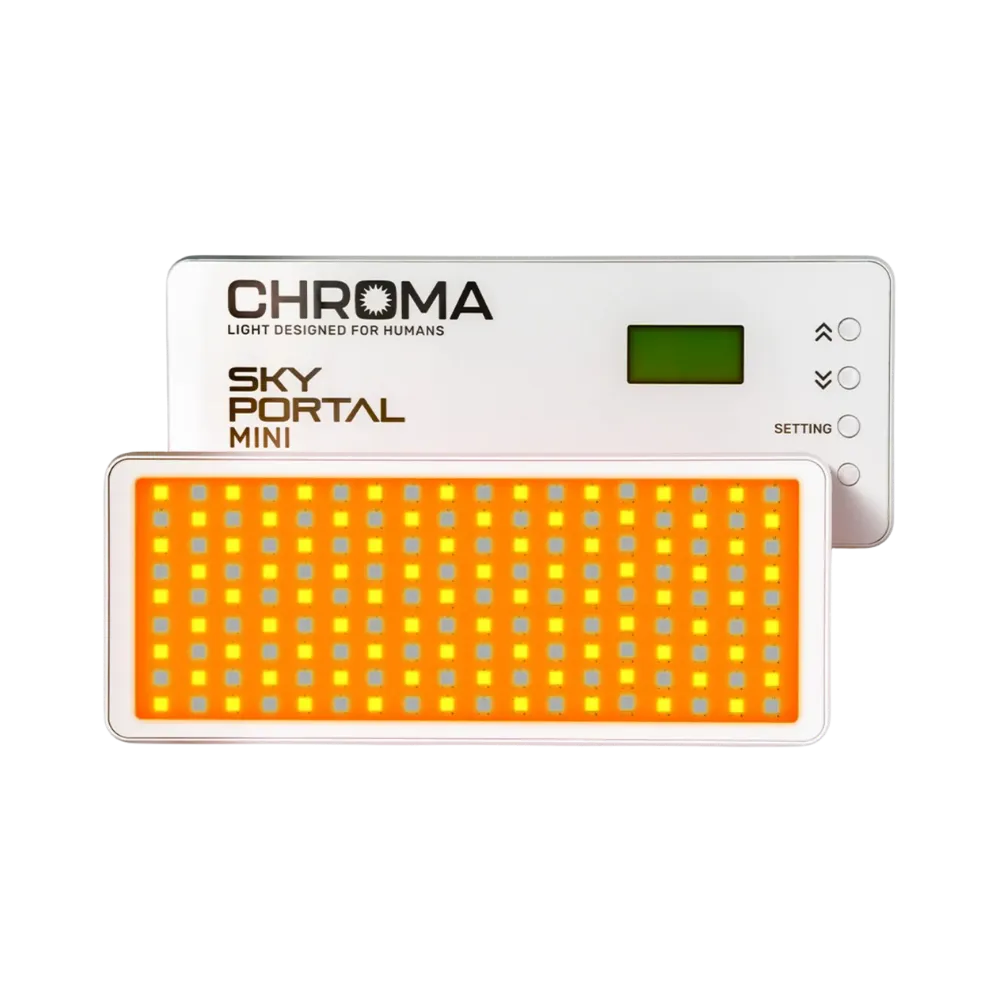
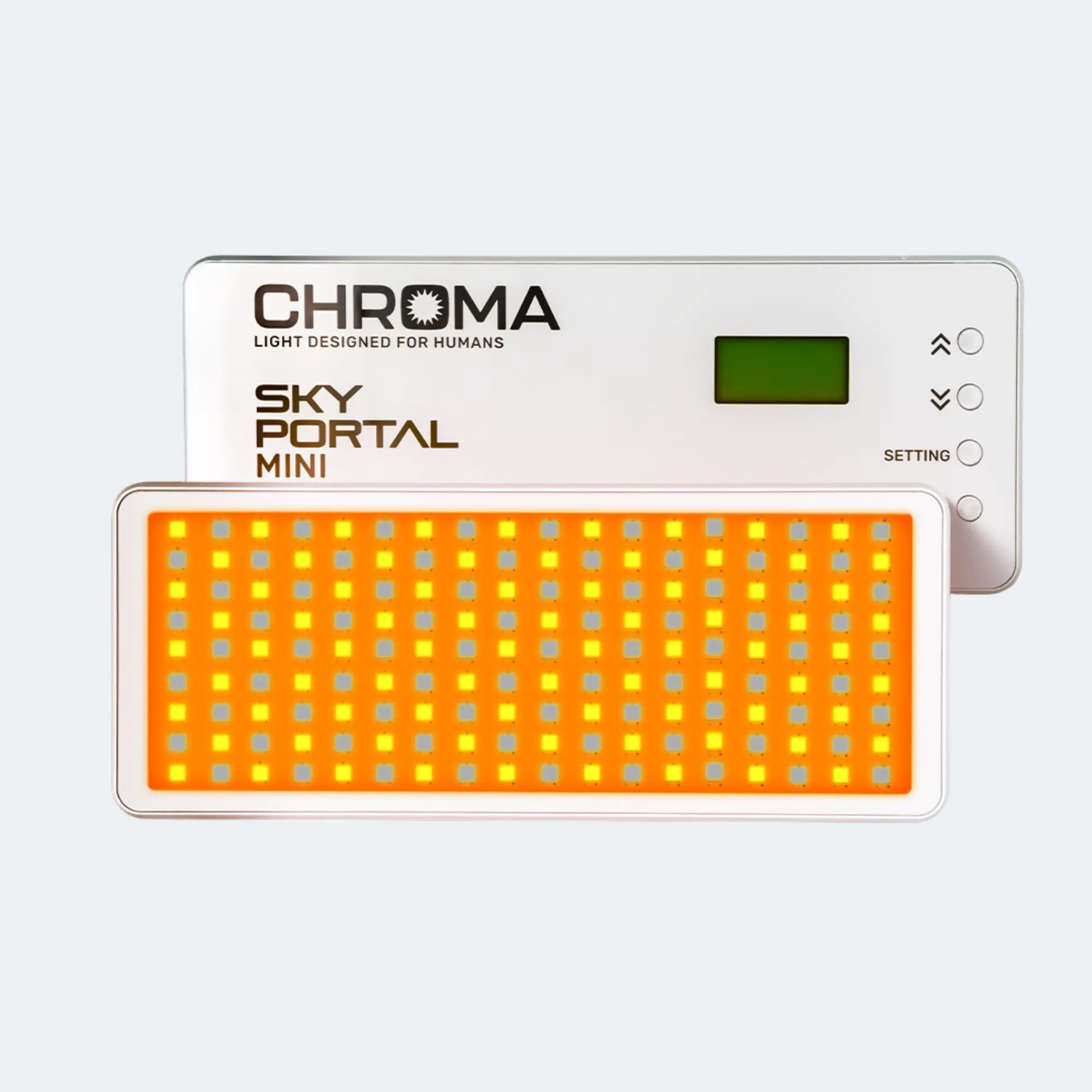
For frequent travelers this feels like a smart, well-executed option that’s hard to beat. The Sky Portal Mini offers everything you need for an on the go SAD lamp.
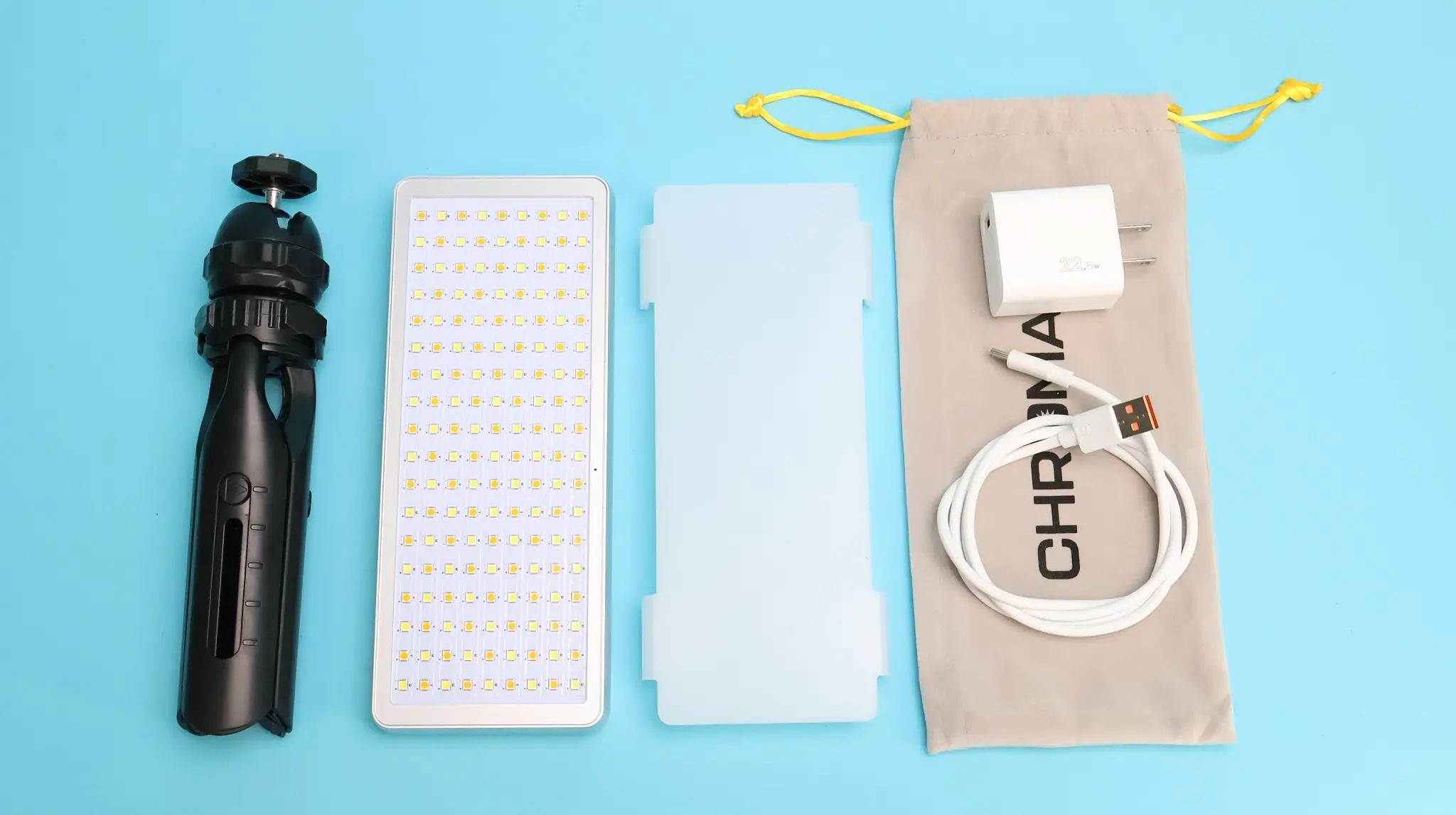
It features an all-white mode for daytime energy and the amber mode for winding down at night. Yo can also change it anywhere in between.
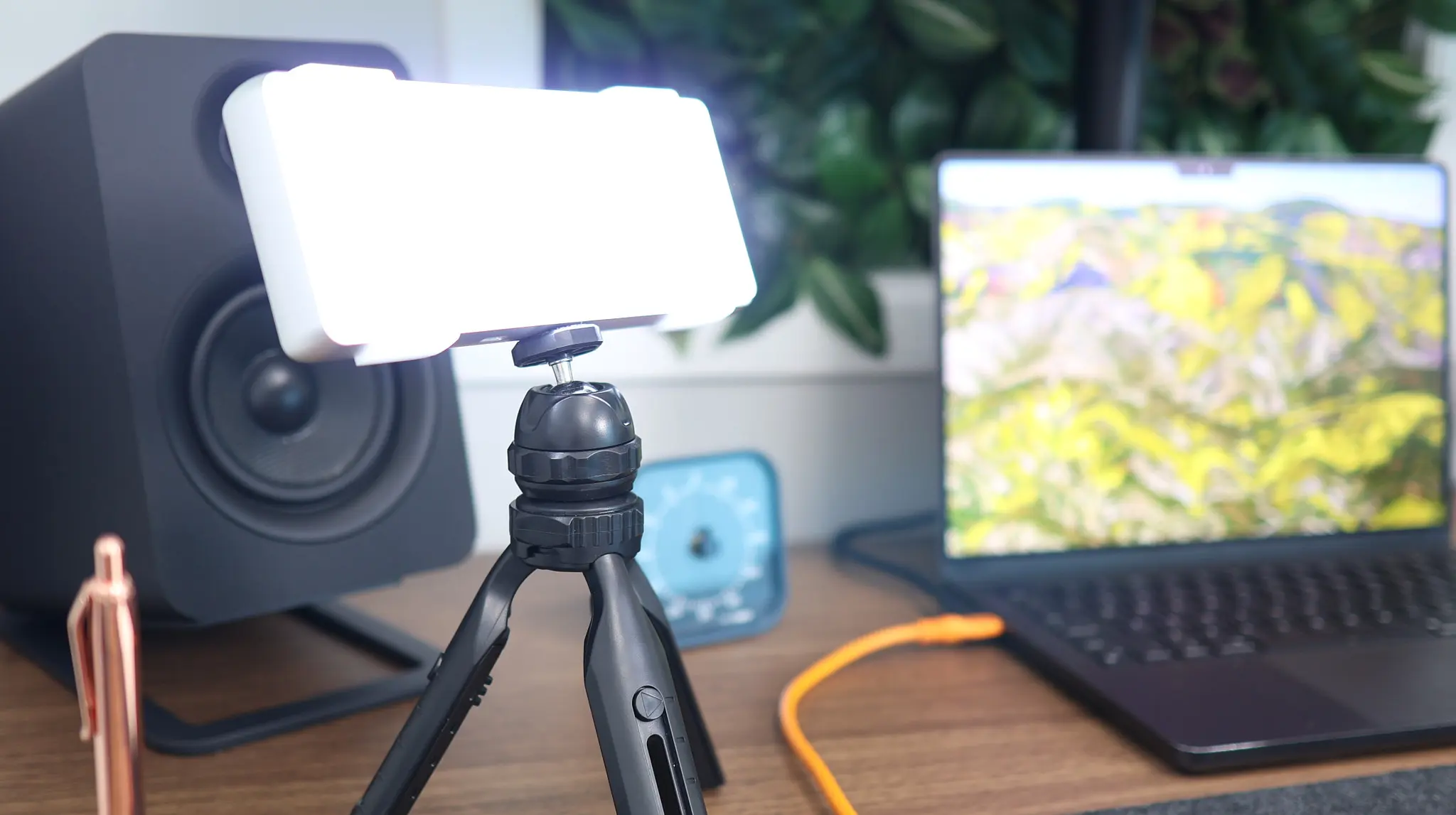
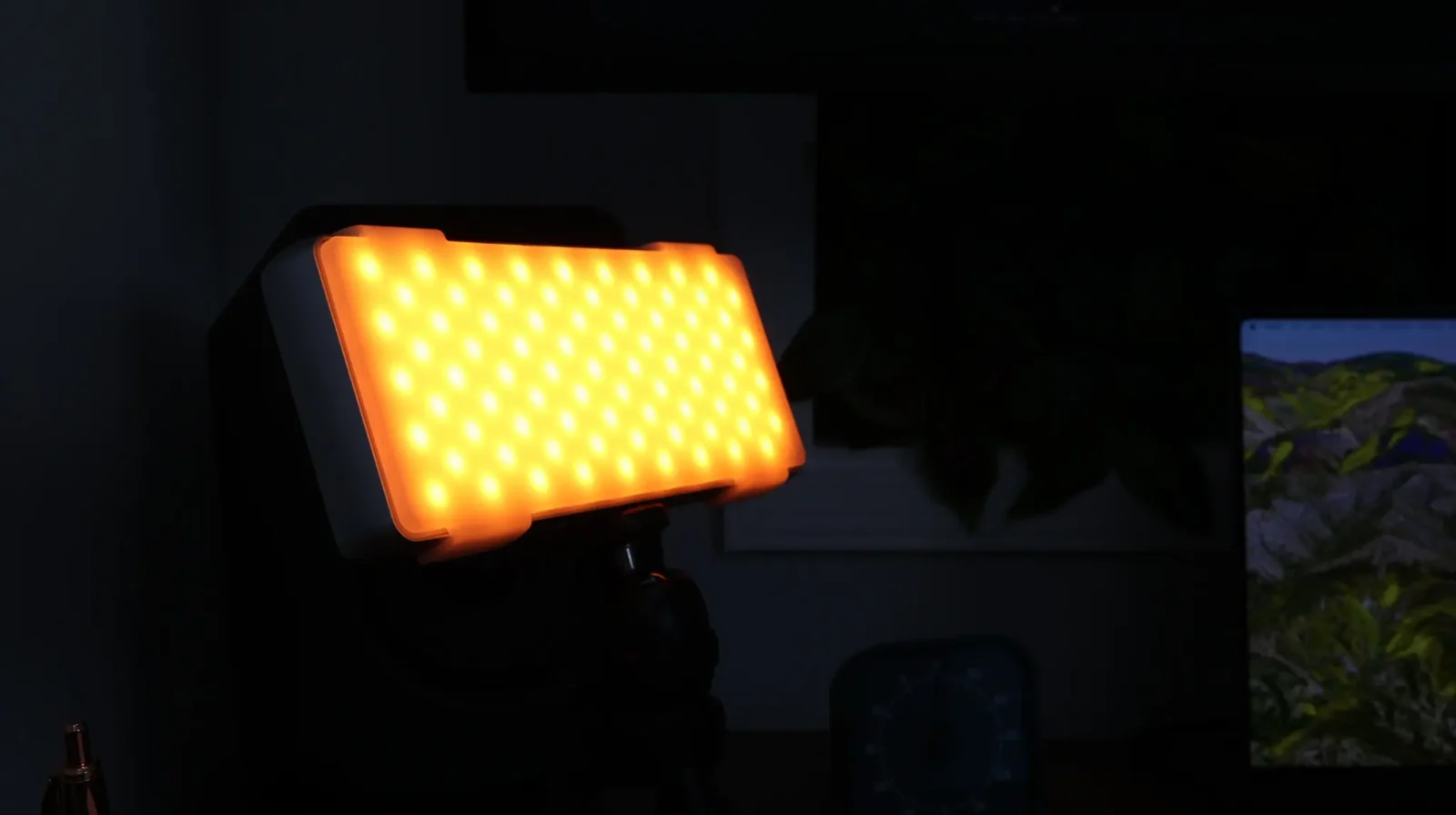
The included tripod is sturdy and adjustable, the diffuser makes it easier on the eyes, and the flicker-free performance shows real attention to quality.
You also get USB-C charging, a massive 8000 mAh battery that can double as a power bank, and the versatility to serve as both a SAD lamp and a warm evening light source.
Chroma Sky Portal Mini
Pros:
Cons:
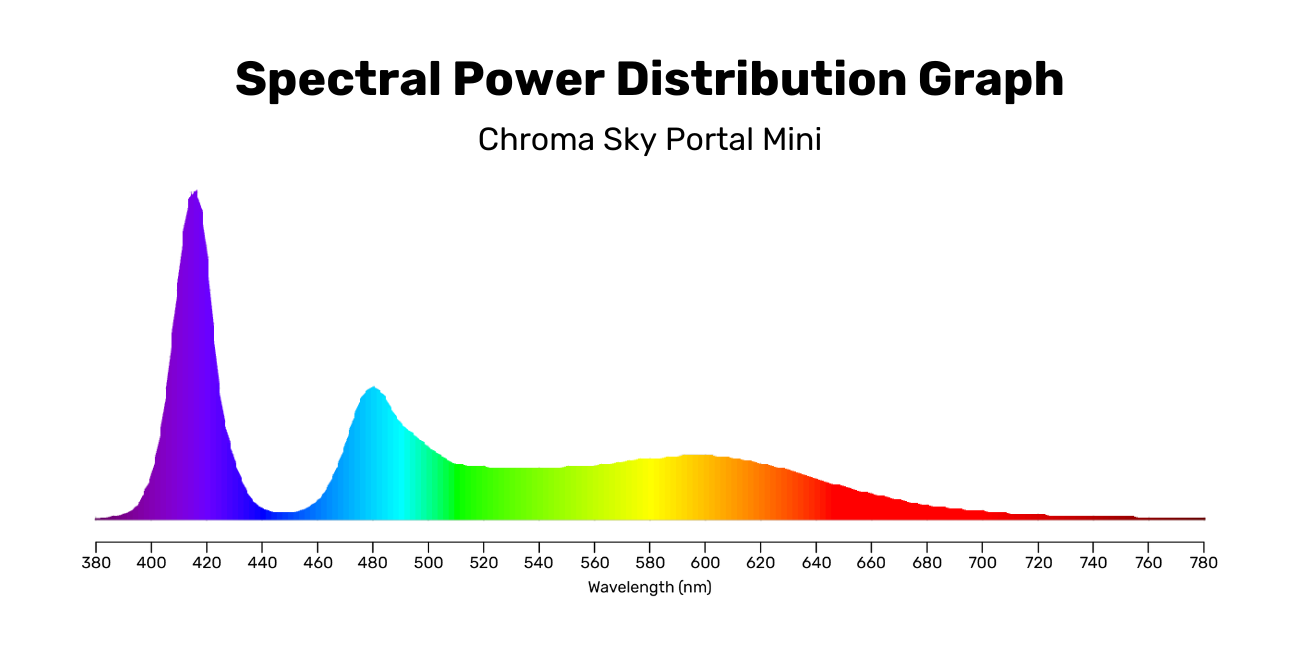
- Lux: 3,460
- Circadian Light: 6,135
- Glare: 223
- CCT: 5550K
- Brightness Levels: 20
- Color Temperatures: 21
🏷️ OYB10 for 10% off
That’s about it. Stay tuned as we test more lamps!
-
Carex Day-Light Elite Review: Better Than the Classic?
Is the Carex Elite worth the upgrade? Our lab tests reveal how its larger size, flicker-free light, and 12,000+ lux compare to the older Classic model.
6 minutes -
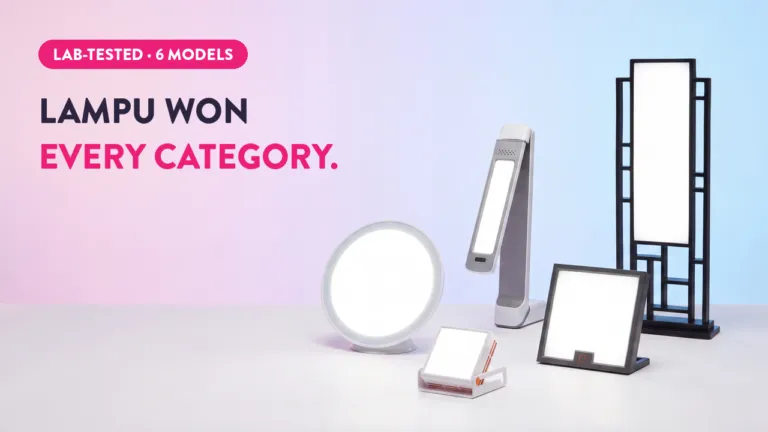
Circadian Optics Review: Lab Tested (Lampu, Luxy, Lattis)
Confused by the Circadian Optics lineup? We compared the Lampu, Luxy, and Lattis. See which one hits 10,000 lux and fits your desk setup.
9 minutes -
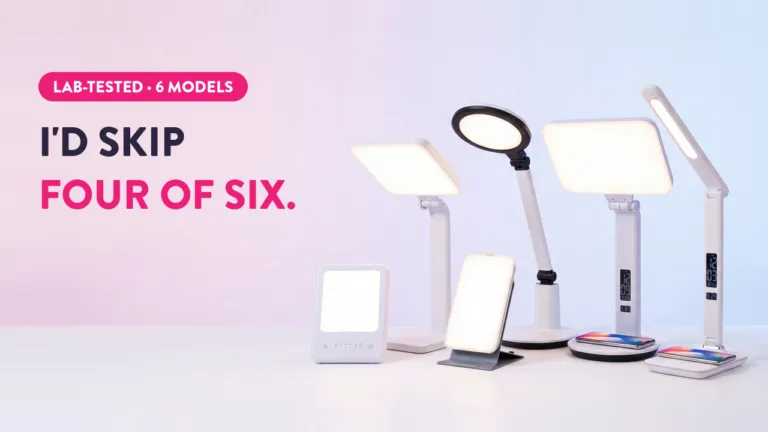
TheraLite SAD Lamp Review: Lab Tested (Aura, Halo, Radiance)
We tested 6 TheraLite lamps. See the lux output, spectral graphs, and why the Aura and Aura Qi are the only models we recommend.
4 minutes
Hello!
As I look into lamps, I’m realizing most only guarantee 10,000 lux form a 12″ distance. If I wanted to expose myself to the light as I do yoga one the mat (so kinda in one spot but definitely moving in/out of a 12″ range), are the glasses my best option?
Thank you so much for sharing all your videos & articles. Your time, effort, knowledge and compassion are very much appreciated!
Hi Karyn! Glad to help 🙂
In your case, I think a portable solution like glasses would definitely be more effective overall.
There are a few comments from people on this website (I am not going to address all the inaccuracies); I’m just replying to yours, mainly because the author’s article doesn’t mention this (plus, there are a number of serious issues with the content of his article and his response to your comment is somewhat inadequate) and because I did some research for myself during the festive period (and I’m happy to share the results). One of the best long-distance commercial options (if you’re in the US) is the Aurora LightPad Max.
The clinical protocol for SAD lamps is 10,000 lux for about 30 minutes (NB. increasing lux for a shorter period of time is not supported by evidence, as the biological response starts to saturate) within the first hour after waking. Now, the Aurora LightPad Max manages to deliver 10,000 lux to your eyes’ retina from a distance of 30 inches (76 cm). That’s fine (a comfortable distance) when it’s placed on a table, for instance. If you wish to use it whilst doing your morning yoga and you place the device at, say, a distance of 1 metre (approx. 39 inches), you will need to increase the time of exposure by about 70% (brightness falls roughly with the square of distance).
I’ve chosen one metre as an example to demonstrate the calculation: 76/100=0.76 (the distance ratio), then square it = 0.58 and multiply by the recommended clinical dose of lux = gives you the new rating of 5,800 lux. With the total clinical dose (of 300,000 lux-min) divided by 5,800 = 52 minutes as your new minimum exposure time (so, say, an hour). In summary, moving the lamp ~40% farther away (from 30 to 42 inches), you’d need to roughly double the time of exposure.
And do you ever close your eyes when doing yoga? If so, don’t bother with an SAD lamp; you’d need to keep your eyes open. Also, consider how tall you are — the device would need to be placed at a distance of no more than 100 cm from your eyes for at least 52 minutes (if you could devise a way to suspend it above your head, imitating the sun, to ensure that your face were no more than 1 metre away, that would work; doing yoga for an hour each morning may not be quite feasible, of course, plus keeping the lamp at the right distance, so you’d probably benefit from having a portable stand to move the lamp around).
PS. Follow the clinical protocol and during the winter months, expose your eyes to 10,000 lux for no less than 30 minutes within the first hour of being awake (I do that whilst sipping my morning chai/tea/coffee); never look directly into the lamp/light. There are a few other things you could add to your daily routine (e.g., look up “Bryan Johnson’s health protocols”) to help with keeping your circadian clock synchronised with the Earth’s solar day — the primary environmental cue is, of course, light (so, in the summer, go outside on sunny mornings if you can).
Hey Pete, while I appreciate you chiming in and trying to help folks, attempting to call me out for inaccurate information, while also using “lux” as your clinical northstar mteric shows a lack of understanding in this topic overall.
CLa is brought up in this article specifically to combat the outdated notion that anyone should be using lux to guide outcomes for bright light therapy. Lux is a measurement of “brightness” and was never designed for circadian entrainment purposes.
Two devices with identical lux can output significantly different levels of biologically active light, (compare for example the Carex Classic to the Circadian Optics Langham) it is therefore not useful in the slightest as a guiding principal when we have much better metrics in the modern age.
Nor is it necessary to reach this “10,000” lux threshold as plenty of studies show phase shifting using light therapy glasses that perform well below this number. But again, this is a silly thing to argue over since the metric itself is fatally flawed for the purposes of stimulating the SCN network.
This can be likened to CRI vs TM-30 (if you’re familiar with colorimetry). Most of the consumer market still uses CRI even though it has been replaced in the scientific community with TM-30. So I still use it, but only to communicate that there is a better option now.
Thank you so much for this amazing resource! So much easier to make a decision with real data and analysis.
I went to purchase the Carex Elite from the Carex (day-lights.com) site using the ‘OPTIMIZE15’ discount code, but it says the code is not valid. Is there possibly a new code to use, or a chance the code can be renewed? Thanks!
Hi Jon! I just checked and the code only works on carex.com, I’ll have to reach out to them about that, thanks for letting me know!
Just bought the Circadian Optics Lampu after reading your review on it, but noticed that the manual says its 10,000 lux when at 6″ distance. Would that mean if i’m using it at a 18″ distance I’d have to use it for 1.5 hours to get the recommended “10,000lux for 30 minutes”?
Hey Z! Looking at my data I measured roughly 10,000 lux at 12″, but yes in general that’s how it works. Lux is a bit outdated however and I prefer to look at CLa (which we also measure in the database). The Lampu is a particularly effective lamp, so I wouldn’t worry too much eve nat 18″ you should still get a pretty effective dose after 30 minutes 🙂
No, Derek’s answer is inaccurate. Lux falls with the square of distance (inverse-square rule). As a rule of thumb, if you had this particular lamp three times farther, the minimum time of exposure would increase nine-fold (to obtain the clinical dose of light) => 270 mins (4.5 hours), which isn’t helpful (you need to aim to get the right dose within the first hour after waking).
Hi!
Thank you so much for all of your hard work! I was wondering if you’ve also taken a look at full spectrum light bulbs (like the ones BlockBlueLight sells)? I like the idea of being able to just replace one of the bulbs in my lamp without needing to add more clutter to my space, but I don’t know how effective that would be.
Hi Andrea! I have tested those, just haven’t gotten around to posting something.
They emit decent quality light (better than most) and are flicker free! The main problem I have with them is the overall build quality is fairly poor and I’m not confident they’d last super long.
Overall though I think they’re a decent choice especially if you’re looking for a bulb with multiple color temperatures.
Found your article extremely informing, Derek [Thank you]…but I do have question for you. Noticed that you didn’t mention Kelvin ratings in your article, and I’m under the impression [correct or not] that the ideal k is between 5,000k to 6,500k. That said, is the CLA the new version of Kelvin? Will be moving to Vancouver BC soon, and want to get a head start dealing with the shorter availability of sunlight to counter the expected Blues associated with it; I’m primarily interested in morning treatments [blue spectrum dominant].
Have been looking closely at the “Beurer TL95” [not covered in your list, sadly ;0)] Any and all comments, both pro and con would be appreciated. Thankx in advance..
Hey Doug! Kelvin refers simply to the perceived color temperature, while this usually correlates with effectiveness and blue light content it’s not always that simple and isn’t the best way to judge a lamp.
Beurer TL95 is great! And I’ve been meaning to add it to this list.
Hi Derek,
Thanks for the extremely comprehensive list and database. I want to ask for your recommendation or advice on a lamp for the following scenario. I would like to install the lamp above my bathroom mirror, where my face would be 20″ away from the lamp. Since I use the bathroom sink every morning for at least 15 minutes, I figured it would be nice and easy to have a 10,000 lux lamp plugged in right there and turned on every morning. From your reviews, the Carex Day Light Elite sounds like the the kind of lamp I am looking for, but I am not sure if I can keep it above the bathroom mirror like that, where it is exposed to shower condensation. Any advice?
Interesting scenario! That is probably your best bet… as long as you air out the humidity fairly soon hopefully it would be fine?
Even if you can ensure you have the right device to deliver the full 10,000 lux to your eyes’ retina at that distance, 15 minutes is not enough. Check my replies to others’ comments here.
Hi, thank you for your article!
I was wondering what your thoughts are on the following statement from the Solshine website:
“Common full-spectrum lights and SAD light boxes don’t include sufficient red light and lack essential near-infrared light (NIR) that’s absolutely necessary to mitigate retinal inflammation.”
I understand this to mean that using SAD lamps without sufficient red and near-infrared light – which seems to apply to most commercially available SAD lamps — could be dangerous for eye health. Is that a fair interpretation? Is it really dangerous?
Hey Janush! I’m not aware of the science being cited there (if there is any), I’m definitely a fan of near infrared, I just don’t know exactly how crucial it really is in this instance. I think tons of people benefit from SAD lamps lacking near infrared so there is clearly merit, though the inclusion of infrared where there previously was not is always a plus.
No, it’s not a fair interpretation. It reads as if you’re messing with the author of the article to test his intelligence! 😀 And you’ve done a good job, actually. Oh and Derek’s answer is also off the mark, so let me go into all of this in some detail.
I wouldn’t interpret that SOLshine statement as meaning “standard SAD lamps are dangerous”. That’s BS. I’ve had a look at their website and they make a lot of bogus claims. The key claim, that near-infrared (NIR) is “absolutely necessary” to prevent retinal inflammation when using a light box, is not something you’ll find supported in mainstream ophthalmology or the clinical SAD-light literature. Decades of use and studies of bright light therapy (typically 5,000–10,000 lux for ~20–30 minutes in the morning) have not shown evidence of permanent retinal injury in healthy users, when lamps are used as directed (UV-filtered, don’t stare into the source, etc.).
It’s true that red/NIR “photo-biomodulation” is an active research area and there are lab and early clinical studies suggesting red/NIR can have beneficial effects in certain retinal disease contexts (mitochondria / oxidative stress / inflammation pathways). That is, however, very different from proving that absence of NIR in SAD lamps causes retinal inflammation! If standard SAD lamps were routinely inflaming retinas, we’d expect to see consistent clinical signals over many years (eye-exam findings, case reports, warnings in guidelines) and that’s not what the evidence shows.
So, the fair interpretation is not “SAD lamps without NIR are risky”. A fairer interpretation is: “NIR might have separate therapeutic potential in some contexts, but it’s not established as required for SAD lamp safety”. Also, many SAD boxes already emit some visible red (they’re white-light sources), while deliberately filtering UV (the wavelength range that is clearly harmful).
On Derek’s reply: I agree with the spirit of “lots of people benefit from SAD lamps lacking NIR”. That’s the strongest real-world point. Where I’d tighten it is that the “infrared is always a plus” part. That isn’t proven for SAD treatment or eye safety (and with infrared, you also have to think about heat; too much infrared can be dangerous!). Including red or NIR light in SAD lamps has not been proven to enhance their antidepressant effects or make them safer for the general user. The therapeutic mechanism for SAD largely relies on resetting circadian rhythms and influencing brain chemistry via specialized retinal cells (like the intrinsically photosensitive retinal ganglion cells). These cells are most responsive to blue and green light (not red or infrared).
For most people, the practical safety advice is: use a reputable UV-filtered lamp, keep it at the recommended distance, don’t stare directly into it; and, if you have retinal disease (e.g., macular degeneration / diabetic retinopathy) or take photo-sensitising meds, check with an eye doctor first.
I feel this is such a shallow question, but I want my lamp to be functional, helpful, and aesthetically pleasing since it will be in my home – my oasis, my space. 🙂 Any thoughts on the ones you’ve reviewed that meet all of those criteria. I realize it may not matter to some, but it does to me.
Hey Angee!
Not a shallow question at all! You’re going to be looking at this thing every day, so it absolutely matters that it fits your space.
What kind of aesthetic are you going for? Modern/minimal, warm/cozy, or something else? The big problem is a lot of SAD lamps are pretty clinical looking :/
Hi thanks for this! Do you have any recommendations for products in Australia?