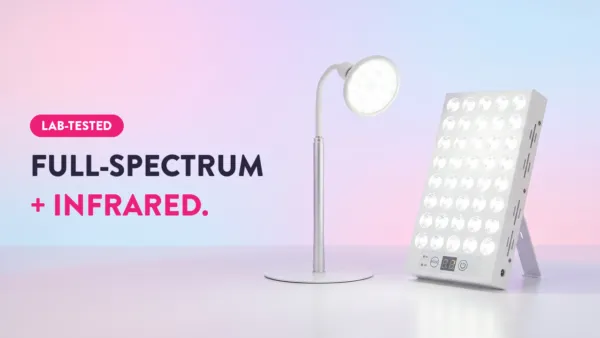
I’ve been meaning to test this “full spectrum” SAD lamp from BlockBlueLight, and now that I have it, I am not disappointed!
In this article, we’ll review all the specs, test results, and my thoughts after using it, so let’s jump in!
Check out our best SAD lamps list if you’re on the hunt! →
OPTIMIZE10
My verdict
BlockBlueLight Full Spectrum + Infrared
This SAD lamp offers outstanding performance and unique specs, combining SunLike full-spectrum visible light with healthy infrared output, making it a versatile SAD lamp and infrared light therapy panel. While it excels in effectiveness and build quality, its high glare and flicker when dimmed may be uncomfortable for those sensitive to bright light. Despite the premium price, it’s a top choice for those seeking unmatched full-spectrum and infrared benefits.
- Pro: Extremely bright and effective
- Pro: The only SAD lamp I know of using full spectrum SunLike diodes
- Pro: Very full in healthy red and infrared coverage
- Con: Expensive, but not terribly so for the performance
- Con: High glare rating, not very comfortable to use visually for a long time
See the lab results
As published
- None
- Flicker
Spectrum
Spectrum chart. BlockBlueLight Full Spectrum + Infrared, melanopic DER 0.92.
Flicker, full brightness
Chart by time. BlockBlueLight Full Spectrum + Infrared.
The Lamp
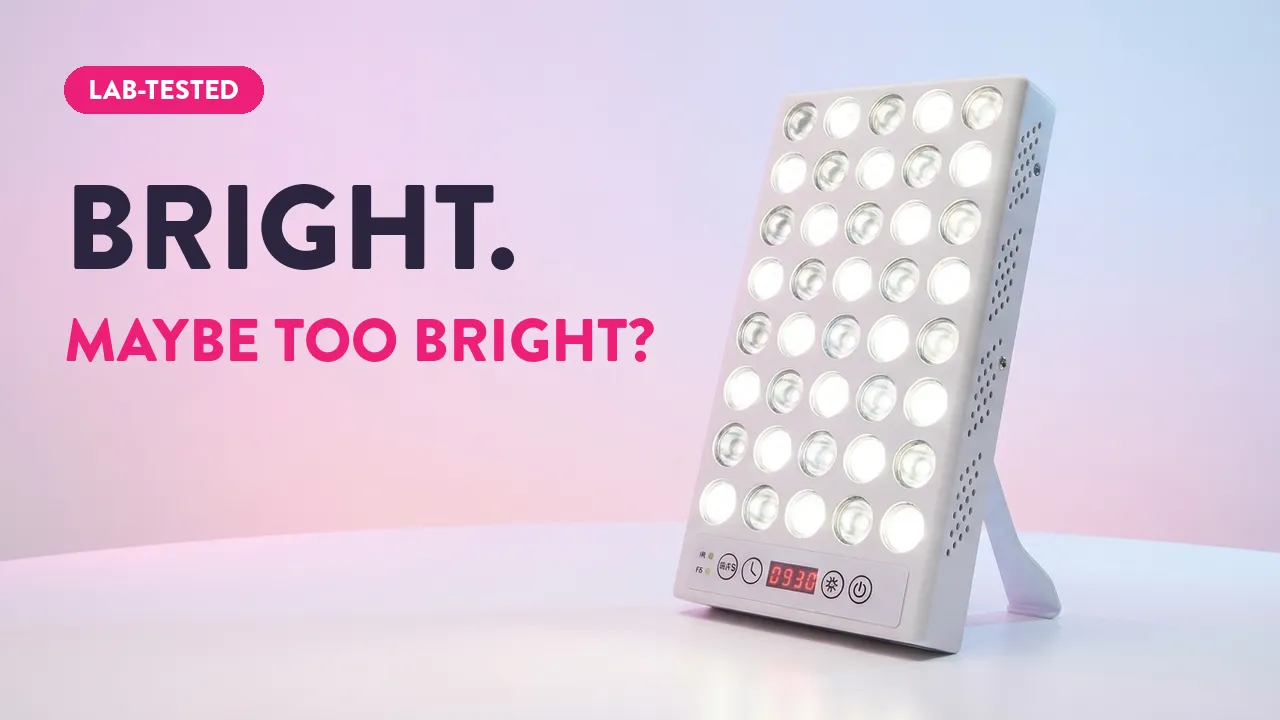
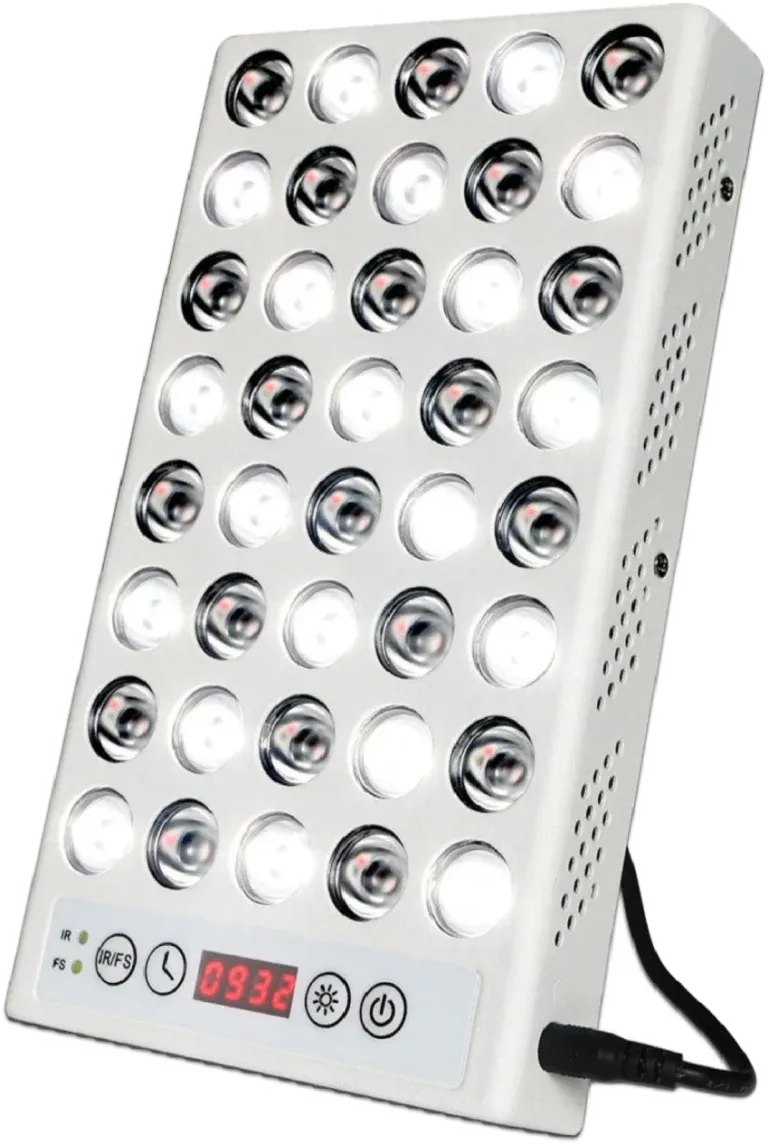
This is an all-metal lamp similar to the Mitolux vitamin D lamp I tested. The main difference is that this emits only visible and infrared light; there is no UV here!
This puppy is bright, and including infrared light is very interesting. I’ve never seen a SAD lamp with visible and infrared light, so this is pretty neat.
Free · 95 pages
You're reading about one piece of this. The book is the whole day.
The Circadian Blueprint covers setting your body clock with light — the timing, the doses, and which products actually deliver them. Every number came off my own spectrometer.

The front controls allow you to toggle between infrared only and visible + infrared. There’s also a brightness button that you can use to set the brightness from 10-25-50-75-100%.

This lamp’s unusual feature is that it only operates on a timer. Pressing the clock button lets you set the timer for 1 to 30 minutes, and hitting the power button starts the lamp and the countdown.
When the timer runs out, the lamp turns off, and the timer resets to the last duration you selected, ready for the next session. However, if you stop the lamp early—say, with 2 minutes remaining—its timer will still be set to 2 minutes the next time you turn it on.
At that point, you’ll either need to use it for the remaining 2 minutes or manually adjust the timer back to your preferred duration. To avoid this hassle, it’s best to let the lamp complete its full time cycle each time.
While this quirk isn’t a dealbreaker, it can be inconvenient.
Testing the Lamp
The specs on this lamp claim “full spectrum” as well as various infrared wavelengths:
- 730nm
- 770nm
- 810nm
- 850nm
- 890nm
They also claim to be flicker-free! Let’s see about that…
So, as usual, I placed this lamp one foot in front of our spectrometer for a full 30-minute run cycle to see what it put out!

Spectral Output
Here’s what I got:
Spectrum chart. Full Spectrum + Infrared, melanopic DER 0.92.
See the numbers
Full Spectrum + Infrared
- Color tempColor temperature only describes white light. This light is too colored to have one.
- Colored light
- Body-clock lightMelanopic DER: how much light this lamp gives the body clock for its brightness, compared with daylight at 1.00. Higher means more body-clock light per lux.
- 0.92×
I was very surprised to see the familiar SunLike visible light spectrum here. These are very high-quality diodes, so you’ll get realistic visible light from this lamp.
Here’s a graph of the visible light portion of this spectrum:
We also see five infrared spikes, so they’re not lying about that, either!
I measured around 14,500 lux at one foot and a circadian light output of around 27,000. Compare this to the Carex Day-Light Sky, a popular SAD lamp that also puts out around 14,500 lux but with a much lower circadian light output of 17,900.
That’s because this lamp has much less blue/turquoise light present, illustrated by it’s spectral graph:
Spectrum chart. Day-Light Sky, 1 ft, 4194K, melanopic DER 0.63, 15% less body-clock light than daylight.
See the numbers
Day-Light Sky, 1 ft
- Color temp
- 4194K
- Body-clock lightMelanopic DER: how much light this lamp gives the body clock for its brightness, compared with daylight at 1.00. Higher means more body-clock light per lux.
- 0.63×
- Vs. daylightBody-clock light compared with daylight of the same color temperature at the same brightness.
- 15% less
Overall the BlockBlueLight SAD lamp is incredibly bright, effective, and realistic! And the added infrared is awesome!
Testing Flicker
Now, is this thing really flicker-free? I placed it in front of our professional flicker meter to see.

Sort of.
- 10%
Light output by x. 10%.
- 25%
Light output by x. 25%.
- 50%
Light output by x. 50%.
- 75%
Light output by x. 75%.
- Full brightnessNo flicker
Light output by time. Full brightness.
A flat line at the top means steady light; dips mean flicker. Green: no risk, amber: low risk, red: higher risk (IEEE 1789).
See the numbers
| Percent flicker | Frequency | IEEE 1789 | |
|---|---|---|---|
| 10% | Not measured | Not measured | Not measured |
| 25% | Not measured | Not measured | Not measured |
| 50% | Not measured | Not measured | Not measured |
| 75% | Not measured | Not measured | Not measured |
| Full brightness | 0.1% | Steady light | No observable effect |
It’s completely flicker-free at 100% brightness, but once it’s dimmed, we do get some flicker at around 1000 Hz.
The 10-50% range technically falls into the “High Risk” category of the IEEE’s 1789 flicker standard.
Dropping it to just 75%, limits the depth so it stays within the low risk range:
So I’d keep this at 100% if you like to avoid flicker.
Overall Thoughts
I’m quite pleased with the performance and specs of this SAD lamp. It’s expensive, but the construction and output are unmatched. The SunLike visible light output, as well as the plethora of healthy infrared light, makes this a combo SAD lamp unlike any other on the market.
The fact that this can double as an infrared light therapy panel is just icing on the cake!
This does have some flicker when dimmed, and its low surface area to lux gives it a very high glare rating, meaning it’s not very visually comfortable to use at 100% brightness. So, this might not be a wise choice if you are sensitive to bright light or glare.
Overall, if you’re looking for a highly effective lamp with full-spectrum “sunlike” light and infrared, there’s no other choice.
OPTIMIZE10
My verdict
BlockBlueLight Full Spectrum + Infrared
- Pro: Extremely bright and effective
- Pro: One of the few SAD lamps using full spectrum SunLike diodes
- Pro: Very full in healthy red and infrared coverage
- Con: Expensive, but not terribly so for the performance
- Con: High glare rating, not very comfortable to use visually for a long time
See the lab results
As published
- None
- Flicker
Spectrum
Spectrum chart. BlockBlueLight Full Spectrum + Infrared, melanopic DER 0.92.
Flicker, full brightness
Chart by time. BlockBlueLight Full Spectrum + Infrared.