

Review Summary
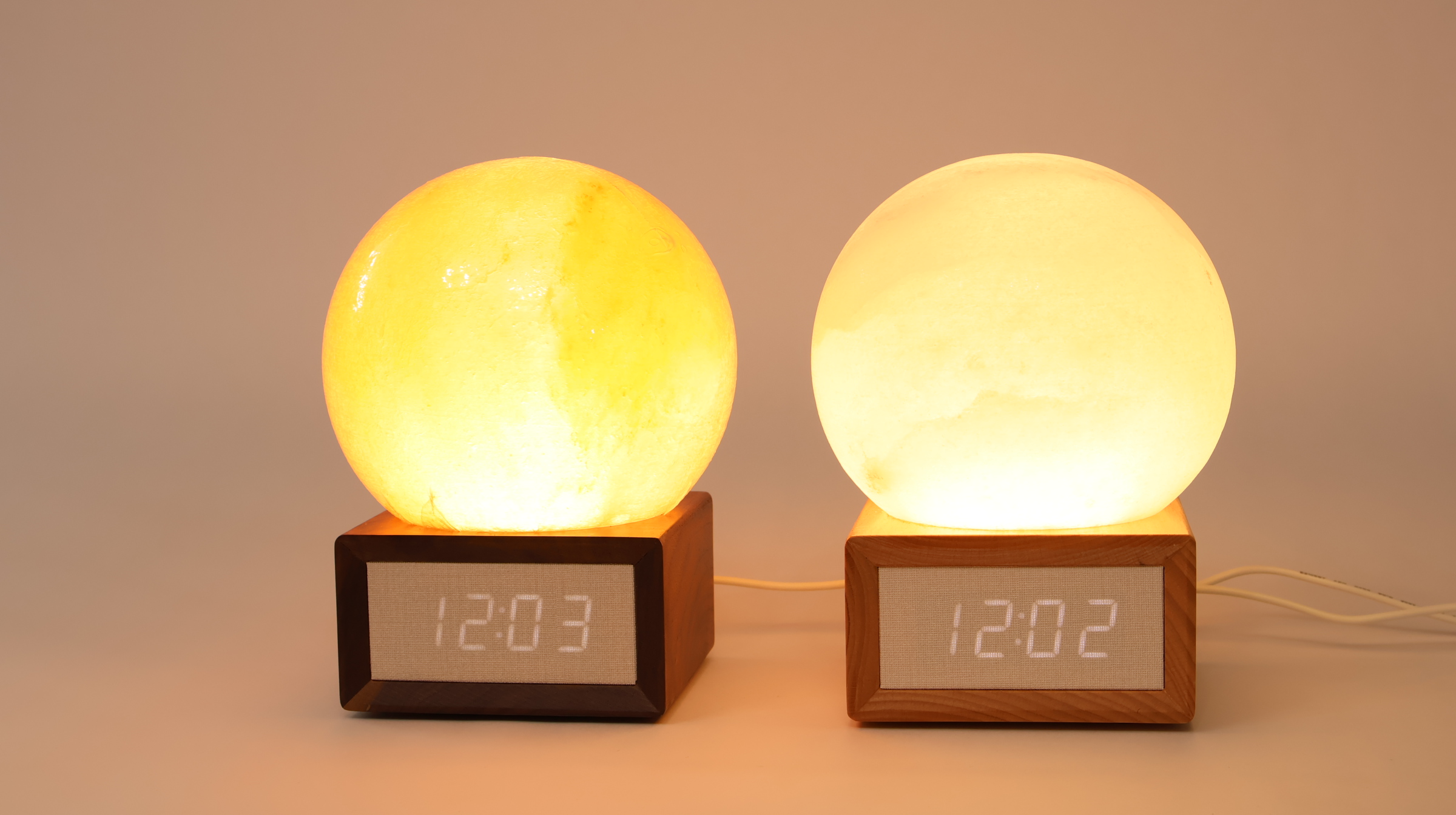
The prettiest sunrise clock I’ve tested, and one of the dimmest. Buy it as a beautiful bedside lamp with a gentle wake cue, not as a circadian tool.
Pros
Cons
The rise centered sunrise alarm clock is the nicest-looking thing I have ever put on a nightstand. It is also the dimmest sunrise clock I have measured.
Both of those came off the same bench. I put the salt sphere in front of a spectrometer, recorded a full 30-minute sunrise, measured the alarm with a dB meter, and checked the light for flicker.
If you want the whole ranked field rather than one product, start with my best sunrise alarm clocks guide. If you’re here because this thing showed up in your feed and you want to know whether it actually wakes you up, keep reading.
Nobody has measured it before. That’s the only reason this review exists.
Free · 95 pages
You’re reading about one piece of this. The book is the whole day.
The Circadian Blueprint covers setting your body clock with light — the timing, the doses, and which products actually deliver them. Every number came off my own spectrometer.
Check your inbox to confirm. Plus a short note each month on what I’ve tested — unsubscribe anytime.
What It Actually Is
Every other sunrise clock I’ve tested is an LED sitting behind a plastic diffuser. This one is an LED sitting behind a rock.
The sphere is hand-carved Himalayan salt, mounted on a beechwood and cork base. Each one is cut individually, so no two are the same, and the light reaches your eye only after passing through several centimeters of mineral.
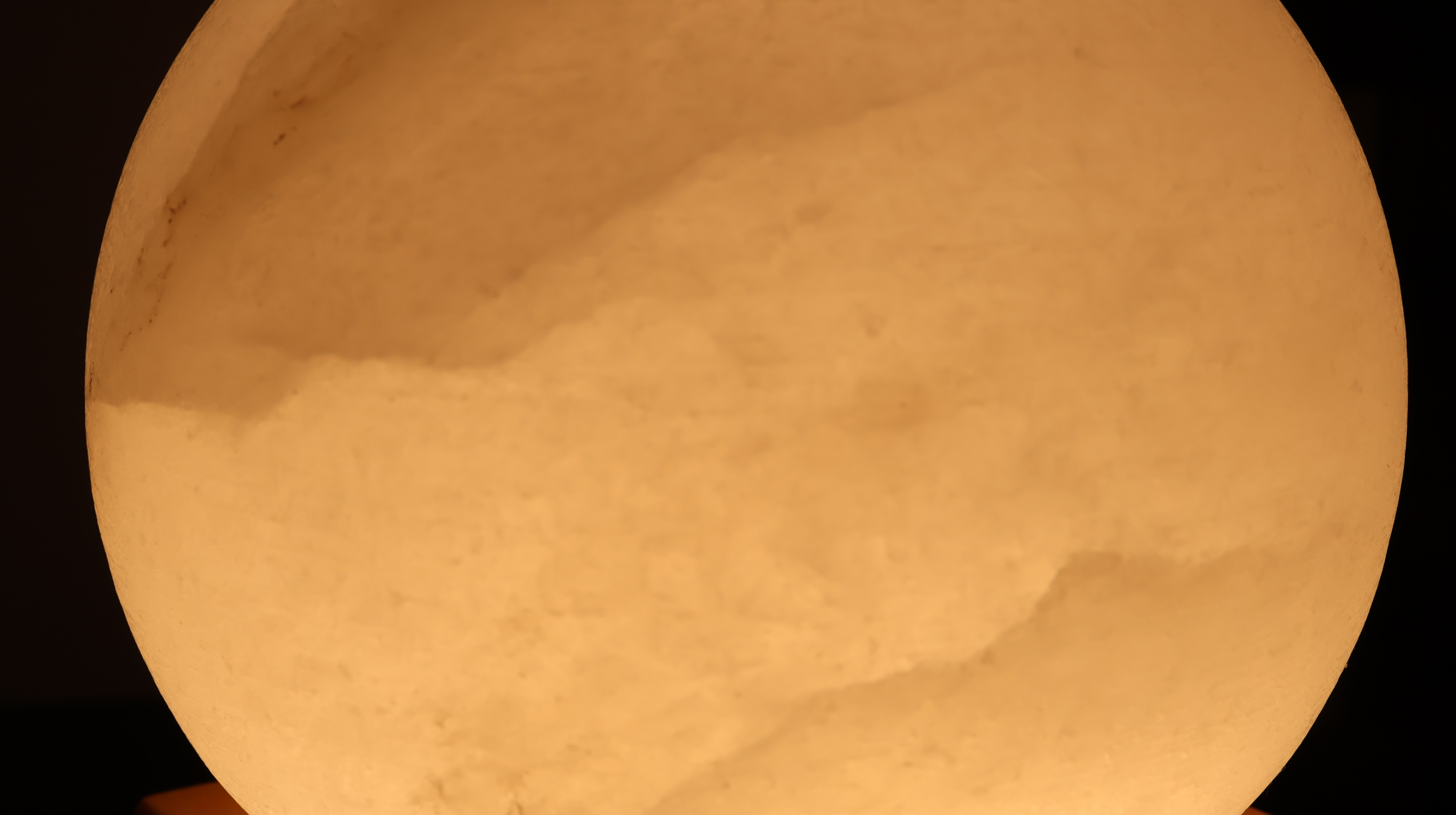
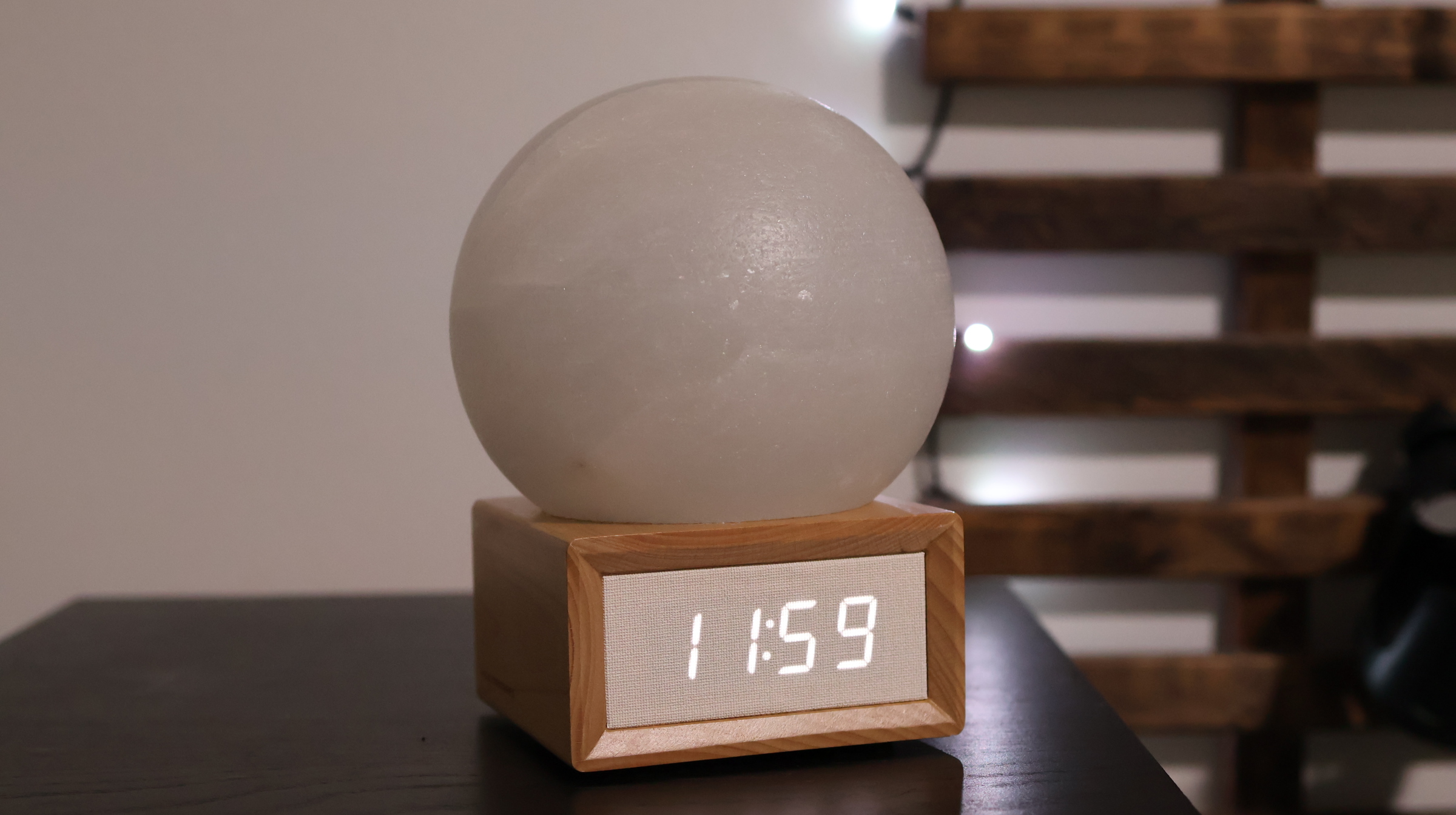
That construction is the whole product. It also dictates the light, which is where this review spends most of its time.
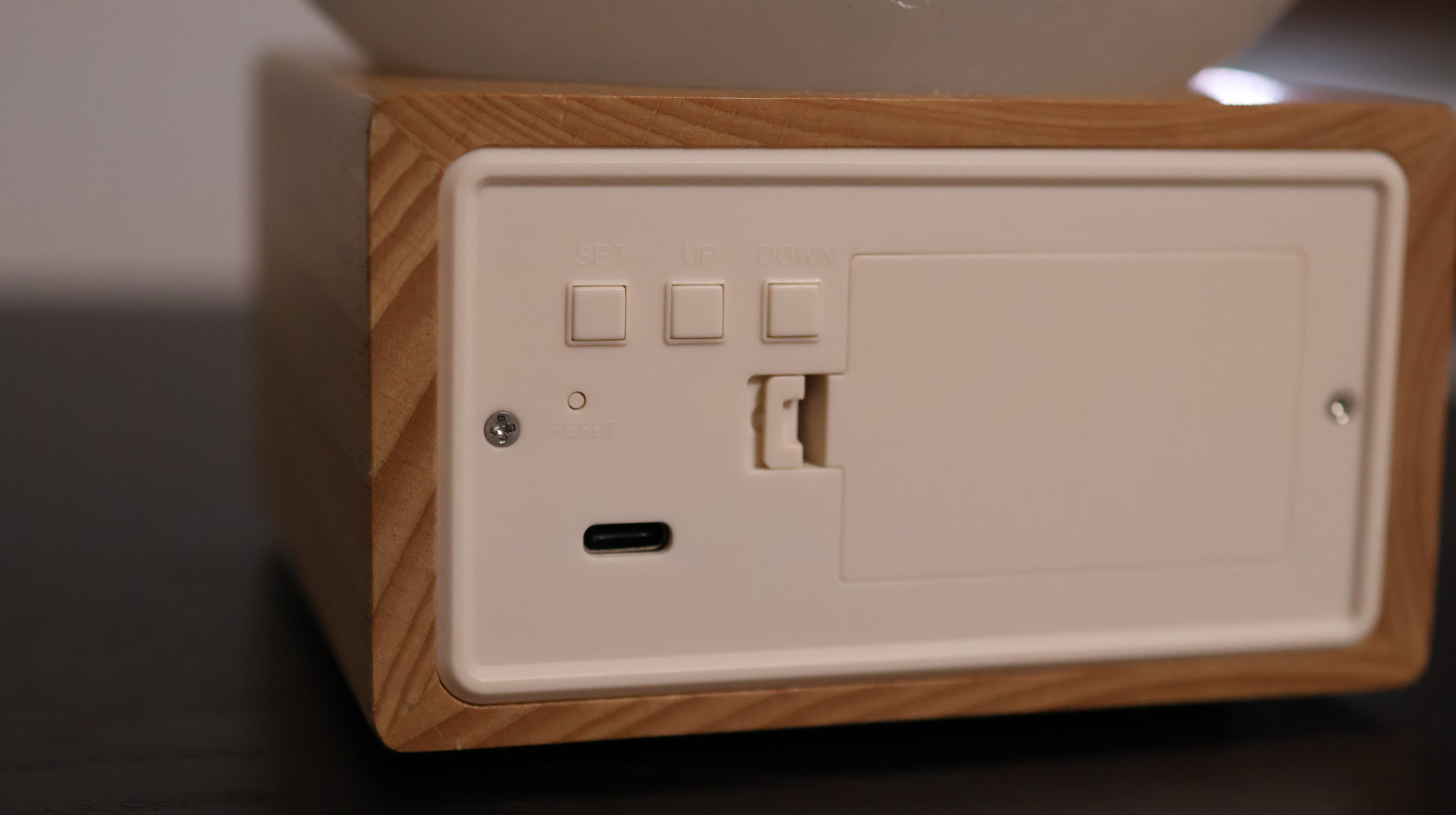
The rest of the spec sheet is short by design. Three buttons on the back, four display brightness levels including full off, a 30-minute sunrise that starts before your alarm, and one alarm sound: birds over a river.
There’s no app. No WiFi, no Bluetooth, no account, no subscription. Power is USB-C, which is more thoughtful than it sounds when every other device on your nightstand already uses it.
It came out of a Kickstarter in September 2023 that asked for $10,000 and finished with $190,016 from 1,597 backers. Three years later the company is still shipping from Jackson, Wyoming, which is more than most crowdfunded hardware manages.
If you want the mechanism behind dawn simulation rather than this particular clock, I’ve written that up separately in do sunrise alarm clocks work.
Opening the Box
I needed a razor blade to unbox a $199 lamp, and I’d like the next person to know that before they start.
The plastic problem
Salt absorbs moisture, so the sphere ships sealed in plastic film. The film peels cleanly off the curve and then refuses to come away at the bottom, where it meets the wood.
I ended up working a blade around the seam. Go slowly there. The beechwood is right underneath, and a scratch on that base is permanent.
How I Tested
Every brightness number below was taken at 18 inches from the sphere, which is roughly where this thing sits from a pillow. The one exception is the sunrise ramp, and I’ll flag it when I get there.
The light went in front of an Ocean HDX-XR spectrometer for full spectral output, illuminance, and melanopic EDI. Both salt colors were captured the same way on the same day.
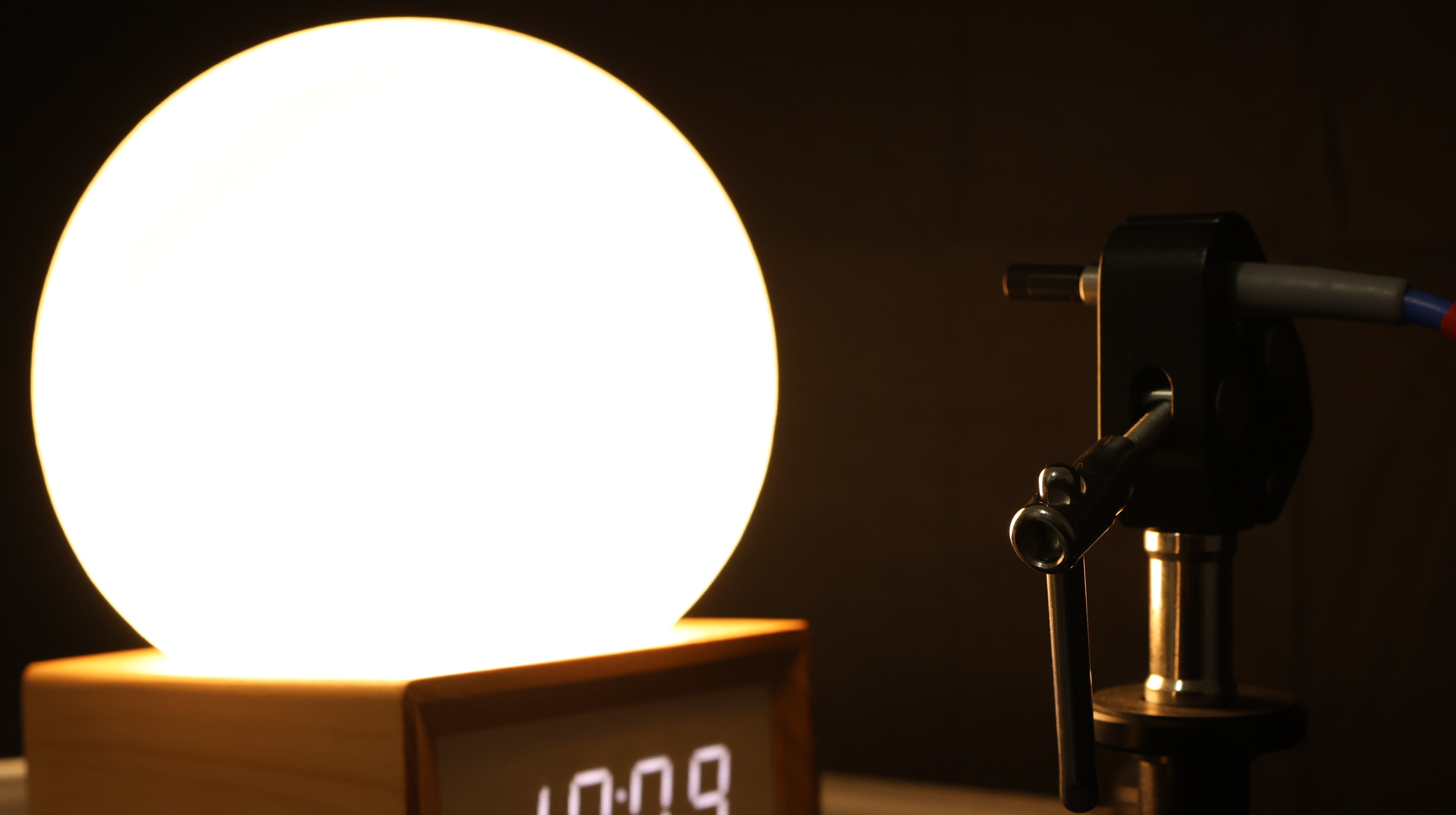
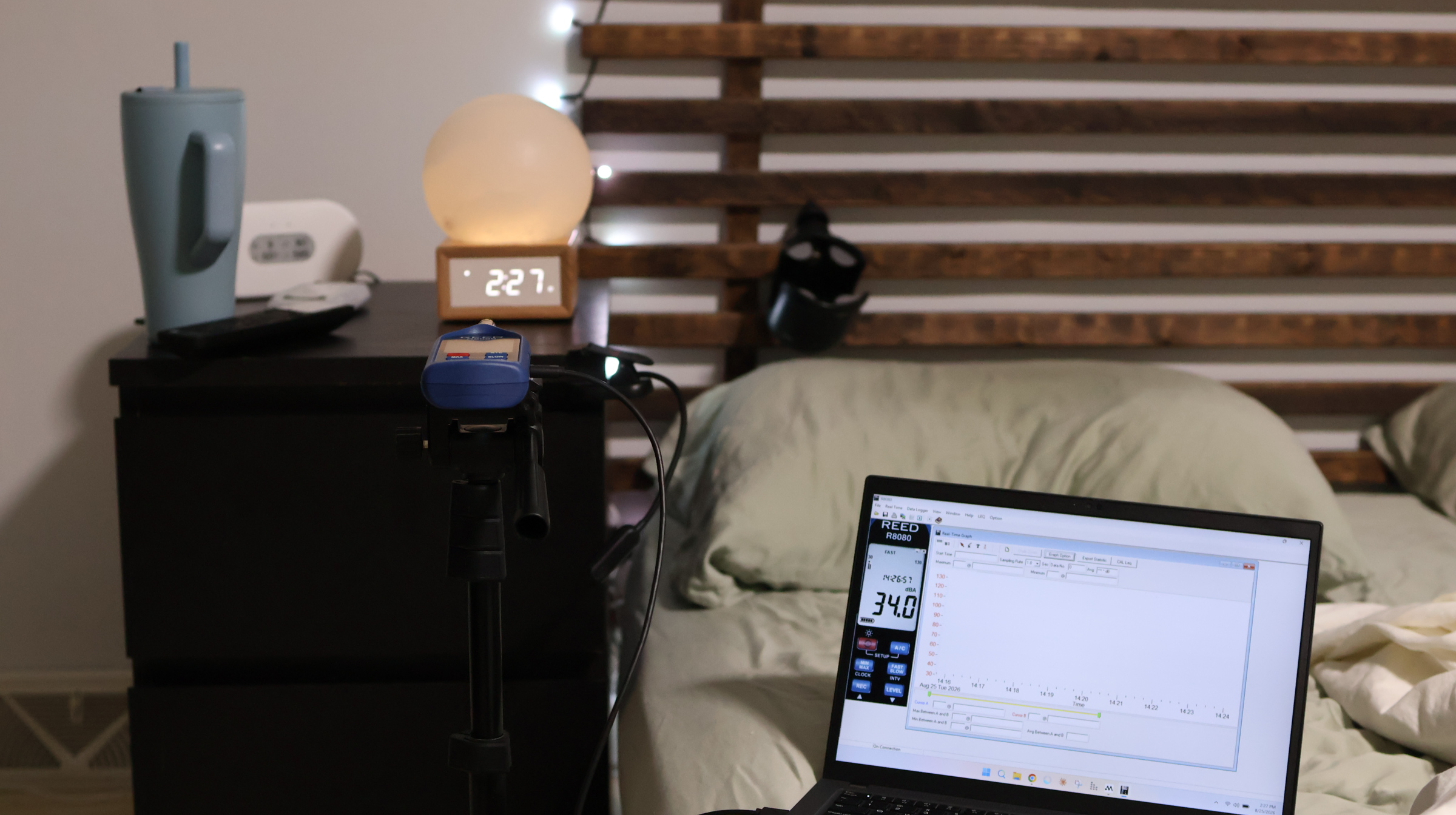
The white salt sphere on the bench. Every light number in this review came from here.
The sunrise itself was captured two ways. The spectrometer logged the full 30 minutes, and separately I recorded the whole ramp on video so I could check one instrument against the other.
For that ramp I had to move the spectrometer in close, only a few inches away. The opening of this sunrise is so dim that at 18 inches the sensor has nothing to read.
So the ramp shows you the shape of the sunrise, not its brightness, and I’ve plotted it as a percentage of full output for exactly that reason. Every absolute lux figure in this review comes from the 18-inch measurement, never from the ramp.
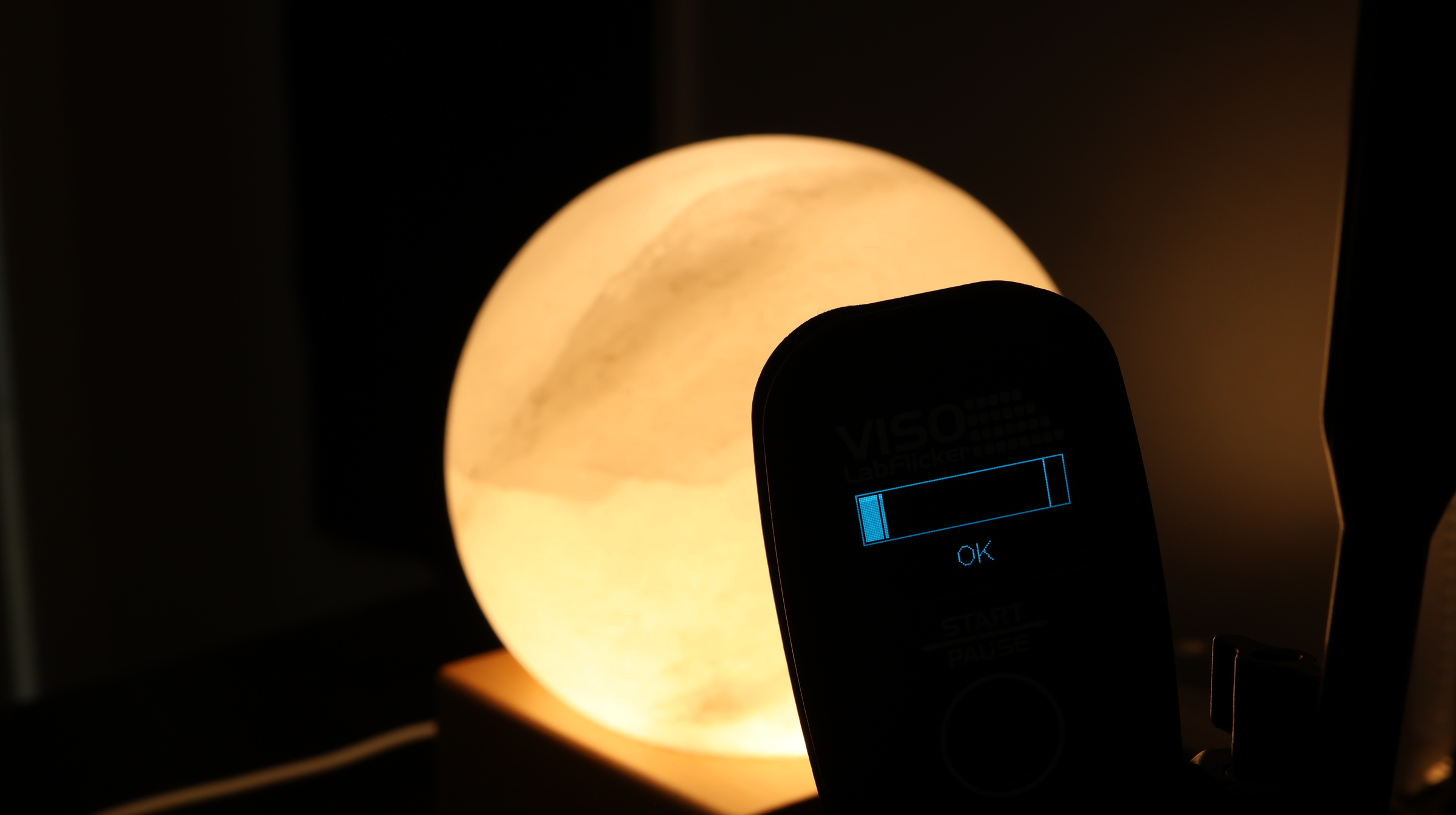
Flicker came from a Viso LabFlicker at full brightness and again while dimmed. The alarm was measured with a dB(A) meter at that same 18 inches, sampling once per second from silence through the full escalation.
The Light, Measured
The emitter inside is an ordinary blue-pump phosphor LED, the same basic part in a hundred cheap lamps. What comes out the other side of the rock is not ordinary at all.
The salt does real optical work. Both spectra are broad and smooth with no narrow spikes, and both land far warmer than the LED alone would.
Same LED, two rocks. The pink salt pushes the whole curve into amber.
The white sphere measures 2726K with a TM-30 Rf of 85 and CRI Ra 83 (Re 78, the stricter number makers rarely quote). Deep reds render positively, with an R9 of +9.
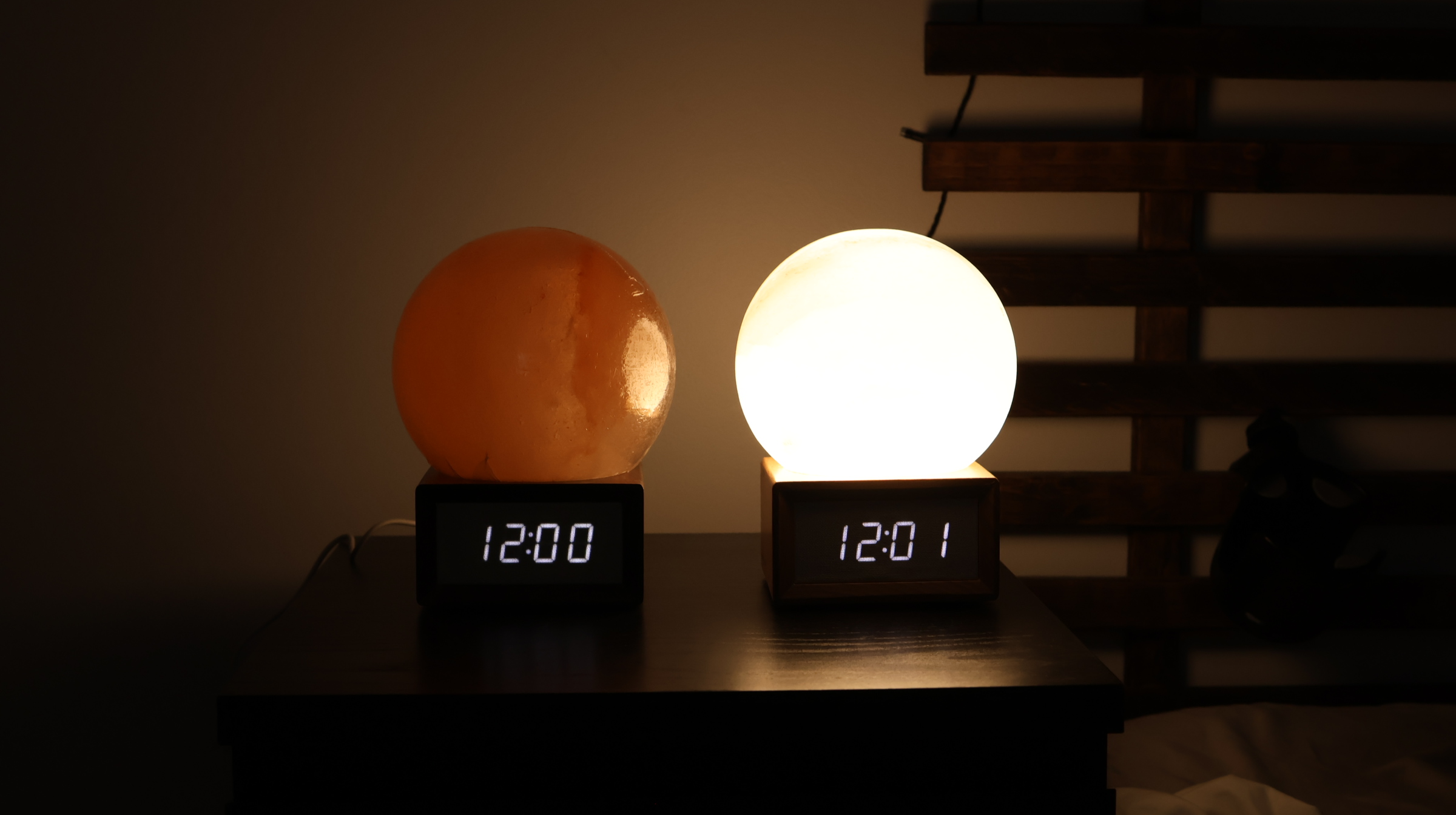
The pink sphere is a different light entirely. It reads 1997K, an amber so deep it’s closer to candlelight than to a lamp, with Rf 78, Ra 72 (Re 67), and an R9 of −24.
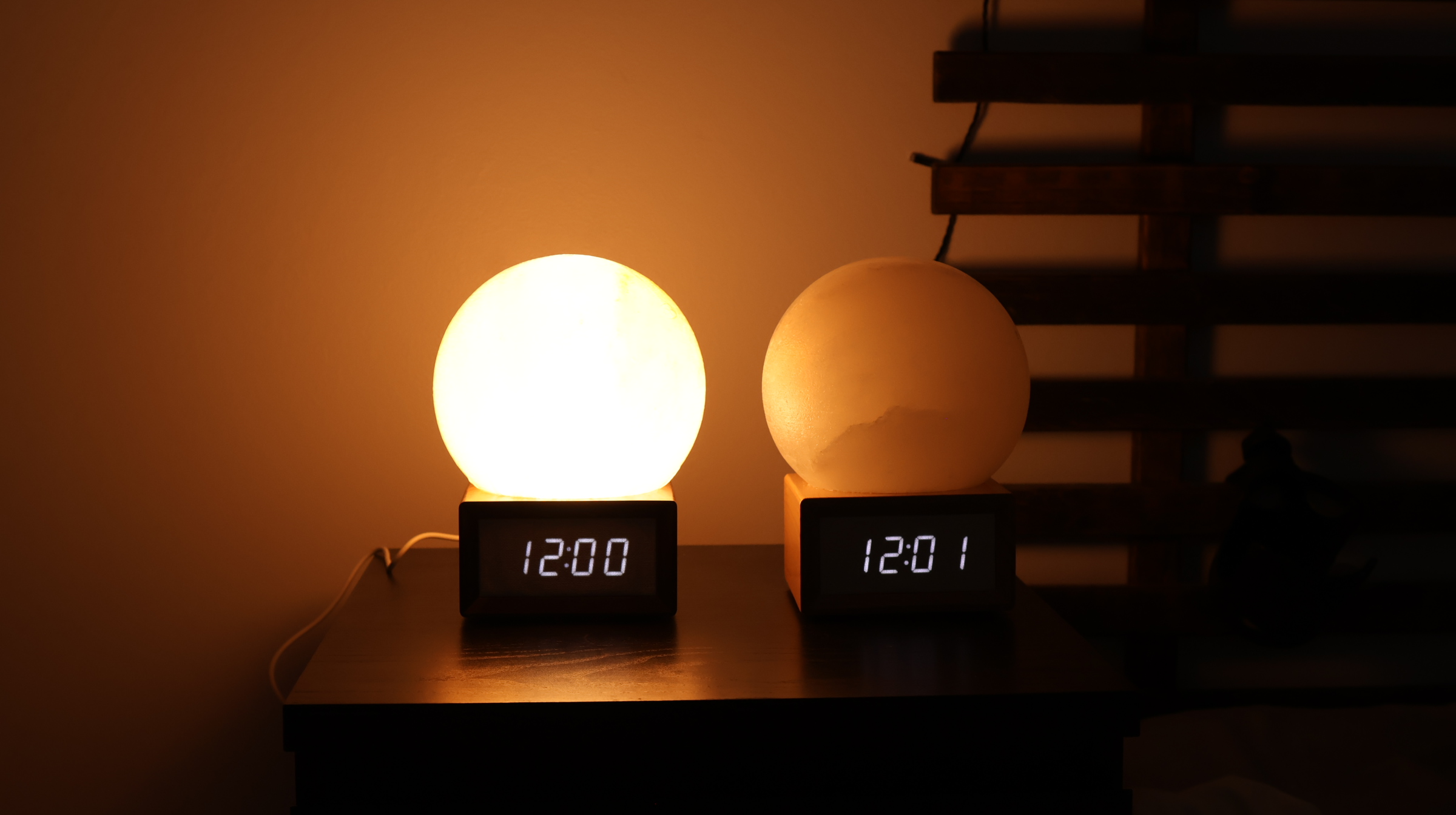
That negative R9 means deep reds fall apart under it. For a bedside lamp at night I do not care even slightly, and I’ll come back to why the pink is arguably the better buy.
The number that matters for waking is melanopic. The white delivers 21.5 lux melanopic EDI at 18 inches against 14.0 from the pink, which works out to mel-DER values of 0.42 and 0.25.
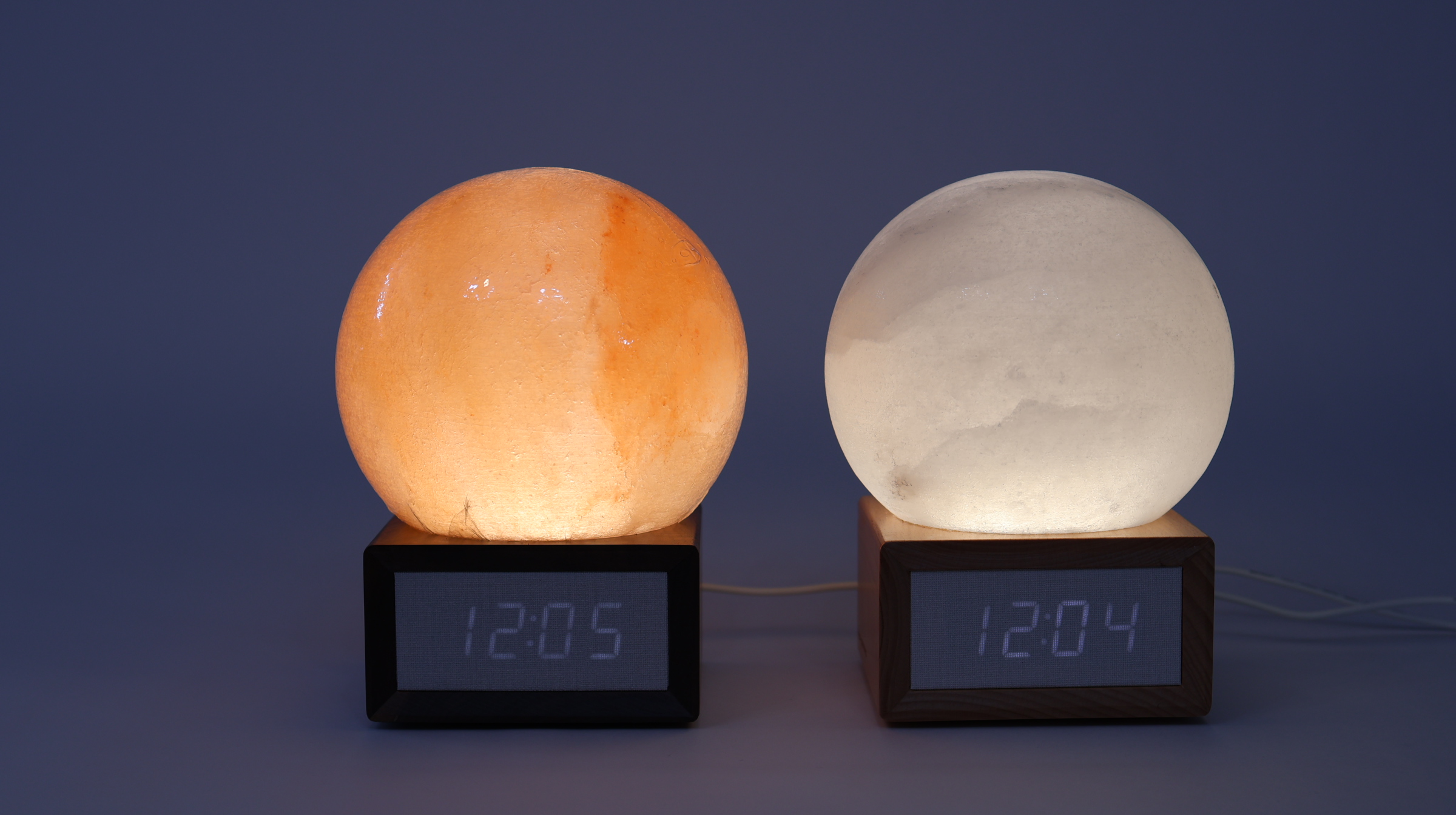
Melanopic EDI is the portion of light your circadian system actually responds to, as opposed to the portion your eyes report as brightness. Hold onto that distinction, because in the next section it does something interesting.
The 30-Minute Sunrise
Rise Centered sells a 30-minute sunrise. What I measured is an 18-minute sunrise with a 12-minute pause in front of it.
For the first twelve minutes the lamp sits essentially dark. Then it climbs, steeply and almost linearly, reaching full output right at the 30-minute mark and settling around 2810K.
Flat, then a wall. Two-fifths of the advertised sunrise happens in the dark. Shape only, captured close in — see how I tested.
I want to be careful here, because a spectrometer struggling to read a nearly-dark room is a real possibility. So I checked it a completely different way.
Alongside the spectrometer run I recorded the full 30.6-minute sunrise on video, then measured mean frame brightness across it. The camera sees the room, not the sensor’s noise floor.
The video holds flat at 17 out of 255 for the first 13.5 minutes, then climbs steadily to 44. Different instrument, different physics, same shape.
Watch the first four seconds of that clip. That’s roughly the first twelve minutes of the sunrise, and almost nothing happens.
Whether that matters depends on how you use it. If you set the alarm for 7:00 expecting light to start pulling you up at 6:30, it doesn’t. It starts working on you around 6:42.
Does It Wake You Up?
No. Not me, anyway, and I want to give you the number rather than the anecdote.
The white sphere peaks at 50.8 lux at 18 inches. The pink measures 57.0 lux.
Both spheres against the level the dawn-simulation trials used. This is the whole verdict in one chart.
For comparison, 250 lux is the level the dawn-simulation research keeps landing on.
Avery’s 2001 trial ramped to 250 lux and beat a 10,000-lux light box.[1]
Terman ran 0.0003 to 250 lux shaped to a real May dawn,[2] and Danilenko reached 250 lux at the eye.[3]
That makes 250 a good yardstick. It does not make it a requirement, and I want to be careful about the difference.
Nobody has established a minimum. The one study that compared intensities head-on found 50 lux cut sleep-inertia complaints about as well as 250.[4] Some people need more, some need less.
So it’s roughly a fifth of the level those studies ran at. Over a week of living with it, the light never once got me up. The birds did.
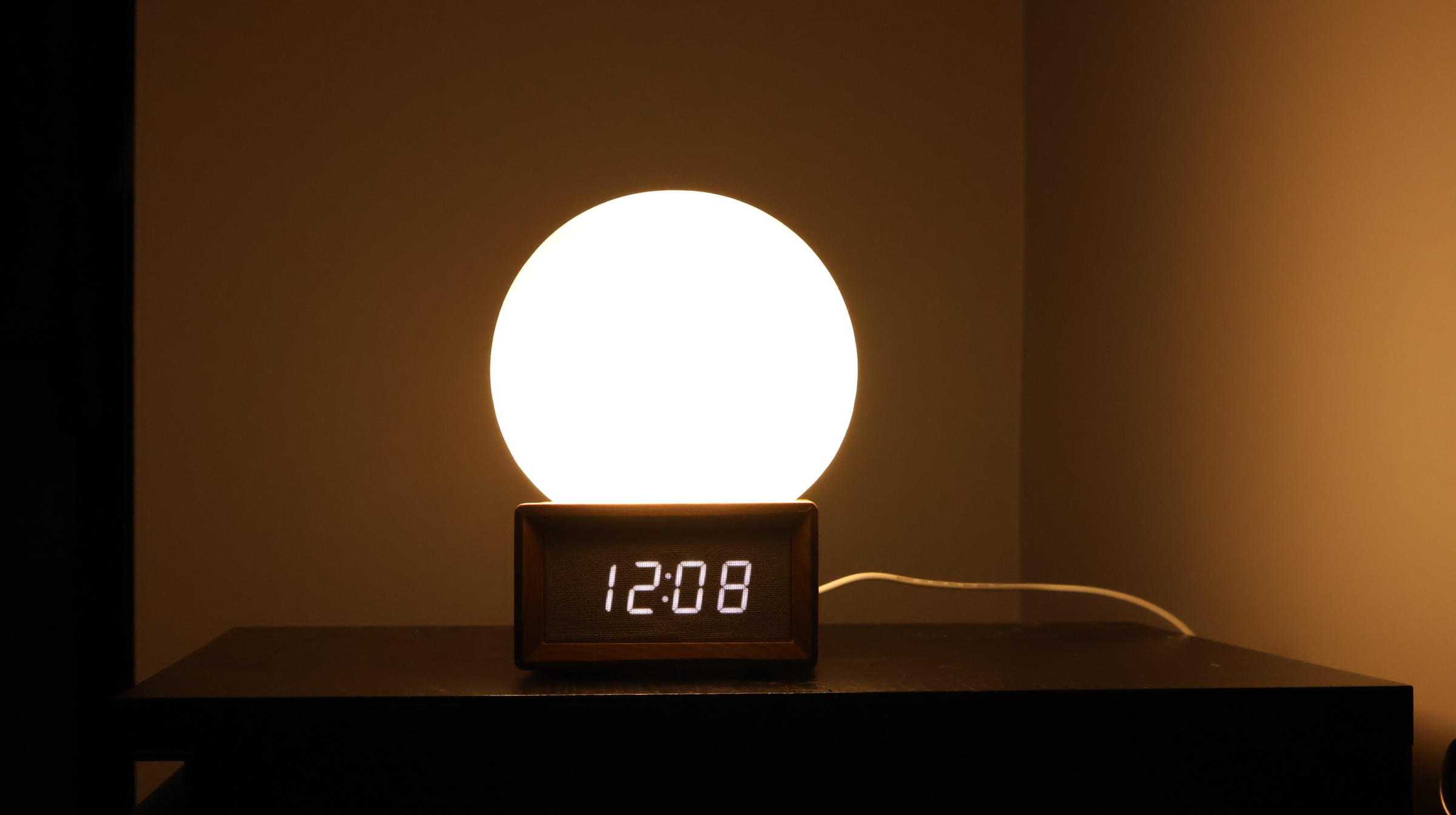
That is not the same as saying it does nothing. If you’re a light sleeper, or you’re already surfacing around your alarm time and need a nudge rather than a shove, 50 lux of warm light at close range is a pleasant way to come up.
I’d also say this plainly: my wife would have been woken by it. Sensitivity to light in the morning varies enormously between people, and if you already know you’re on the sensitive end, this clock is not disqualified for you.
If you don’t know which end you’re on, assume you need more light. Most people who buy a sunrise clock and feel let down bought one that was too dim.
White vs Pink
Rise Centered describes the white salt as “brighter, more direct” and recommends it for heavier sleepers. The pink is sold as the soft, ambient one.
The measurement says something more interesting than that. The pink is actually the brighter of the two in raw illuminance, at 57.0 lux against the white’s 50.8.
What the white has is spectrum. It delivers 21.5 lux of melanopic EDI against the pink’s 14.0, which is 54% more of the wavelengths that drive morning alerting, from a light that reads slightly dimmer to your eye.
So the maker’s recommendation is right, and the reason given for it is wrong. White is the better wake light. It isn’t brighter.
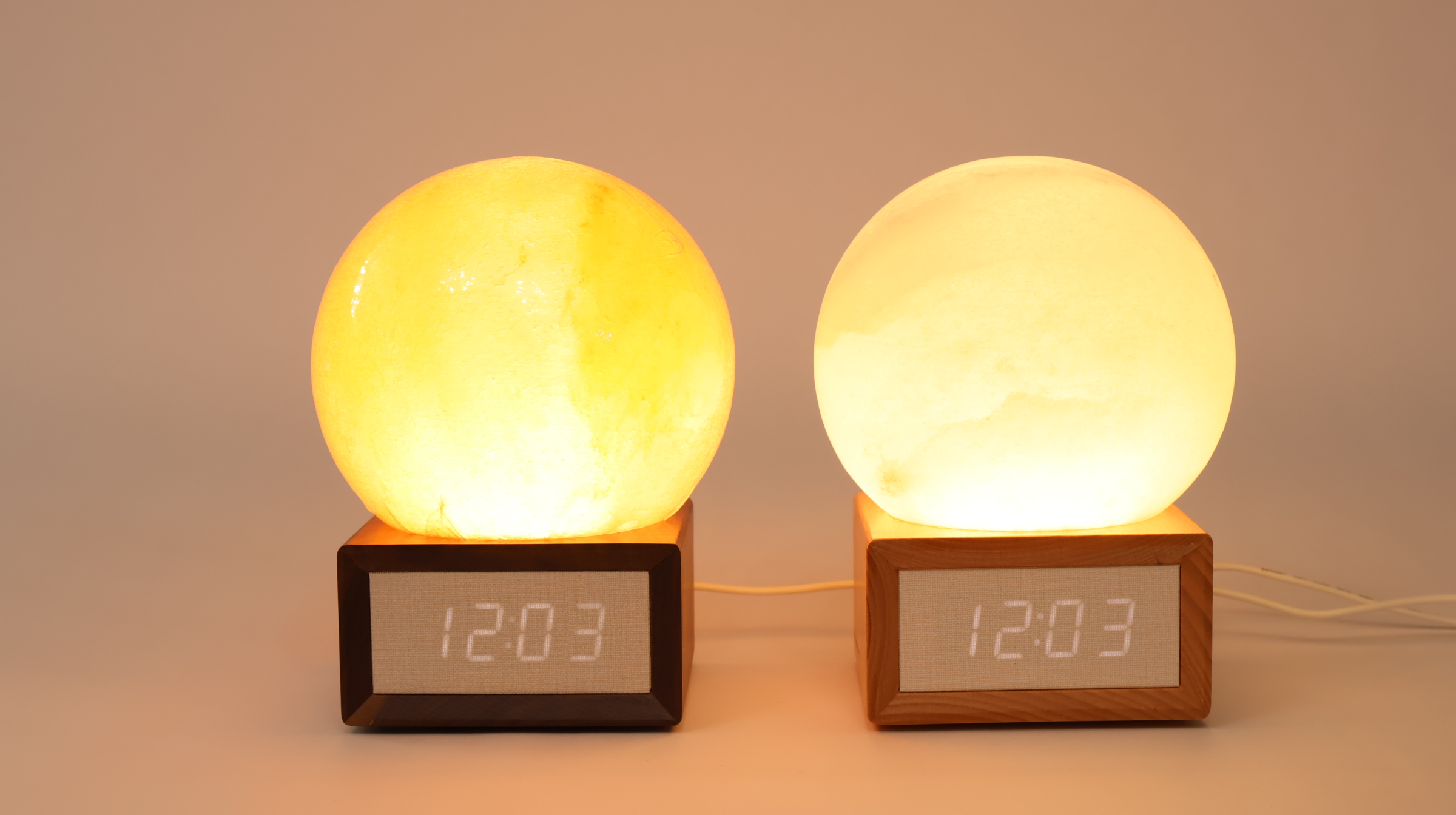
Here’s where I land anyway, and it cuts against the data in a way I want to justify rather than hide.
Neither sphere gets close to a meaningful wake dose. When both options are well under threshold, the gap between them stops being a real decision, and something else should decide it.
That something is the room. You’re in your bedroom in the morning and at night, and a deep 2000K amber is lovely at both ends of the day in a way that 2700K white isn’t.
I’d take the pink salt. If you’re buying this clock primarily as a wake-up device, though, you’ve probably already worked out from the last section that you should be buying a different clock.
The Alarm Sound
The alarm takes a minute and forty seconds to reach full volume, and it tops out around the loudness of a raised conversation.
Measured from a 29.5 dB(A) room, the first ten seconds average 45.0 dB(A). It climbs steadily from there and plateaus at roughly 63 dB(A) around the 100-second mark, with peaks reaching 77.7.
From silence to plateau in about 100 seconds. The spikes are individual bird calls.
Bird calls are transient, so peak and average sit 7 to 10 dB apart the whole way. In practice it sounds livelier than the average number suggests, which works in its favor.
The sound itself is half successful. The chirps are high-frequency and a small speaker handles them well, so the birds come through clearly.
Judge it yourself. The birds are the good half.
The river underneath them does not. Low frequencies need a driver this clock doesn’t have, and what should be moving water arrives as something closer to broadband hiss.
Credit where it’s due on one point: the loop is long. Plenty of nature-sound alarms betray themselves within twenty seconds, and this one never audibly repeated on me.
As a backstop for a heavy sleeper, it’s mid-pack. It will get you up. It takes its time about it.
Living With It
The controls
The buttons are on the back, and you spend the first two days pressing them while looking at the front. By day three it’s muscle memory.
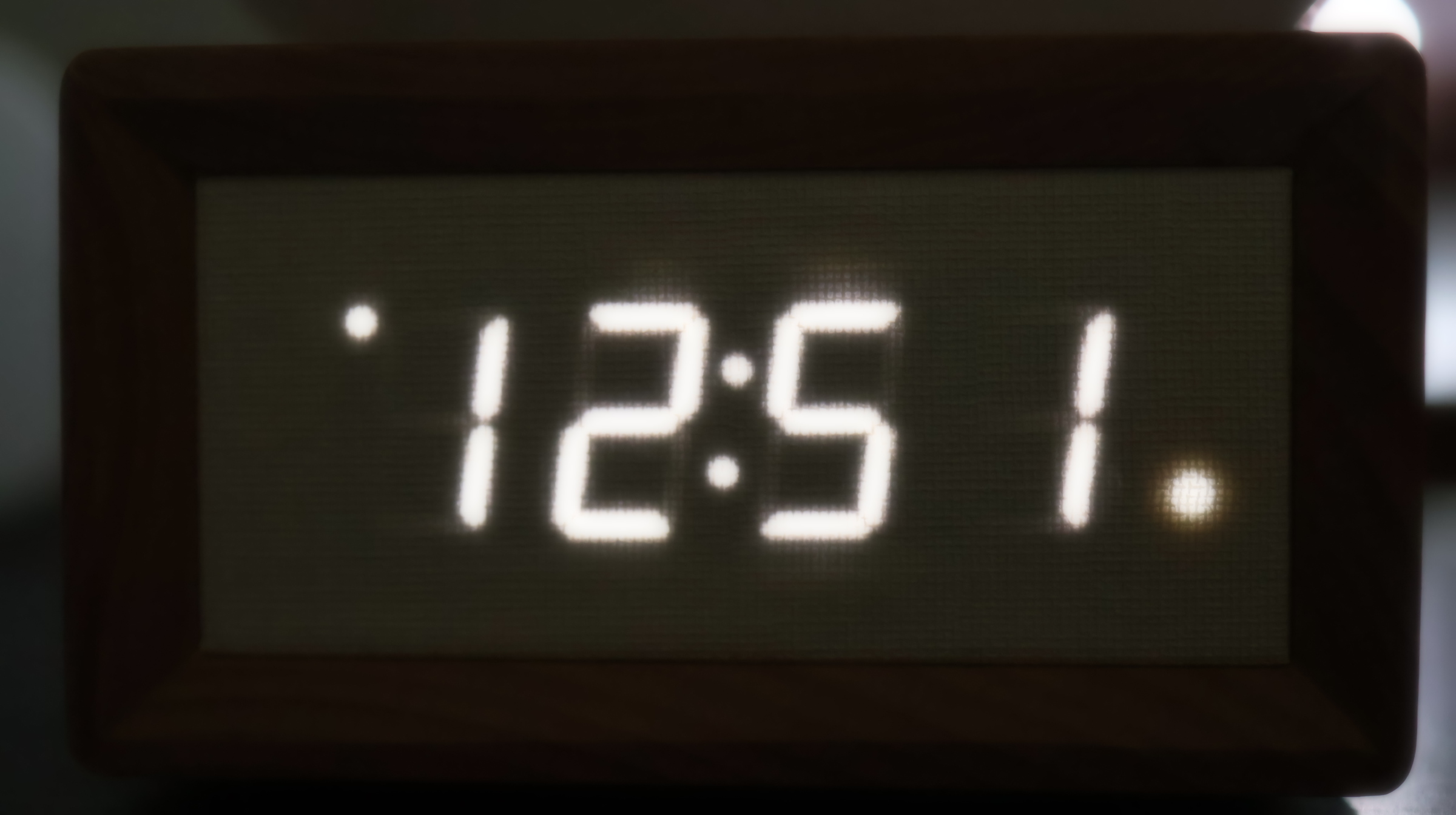
Setting the time means holding UP, choosing 12 or 24 hour, then hours, then minutes. Setting the alarm means holding SET. A short press of SET arms or disarms it, and any button silences it when it’s going.
Tapping the middle of the wood base snoozes for nine minutes, and the light stays on while it does.
The dimming gesture is the one genuinely awkward thing here. You tap, hold, and release, and it feels like trying to catch the light partway through a ramp.
It does work. It took me most of a week to stop second-guessing whether the tap had registered.
At night
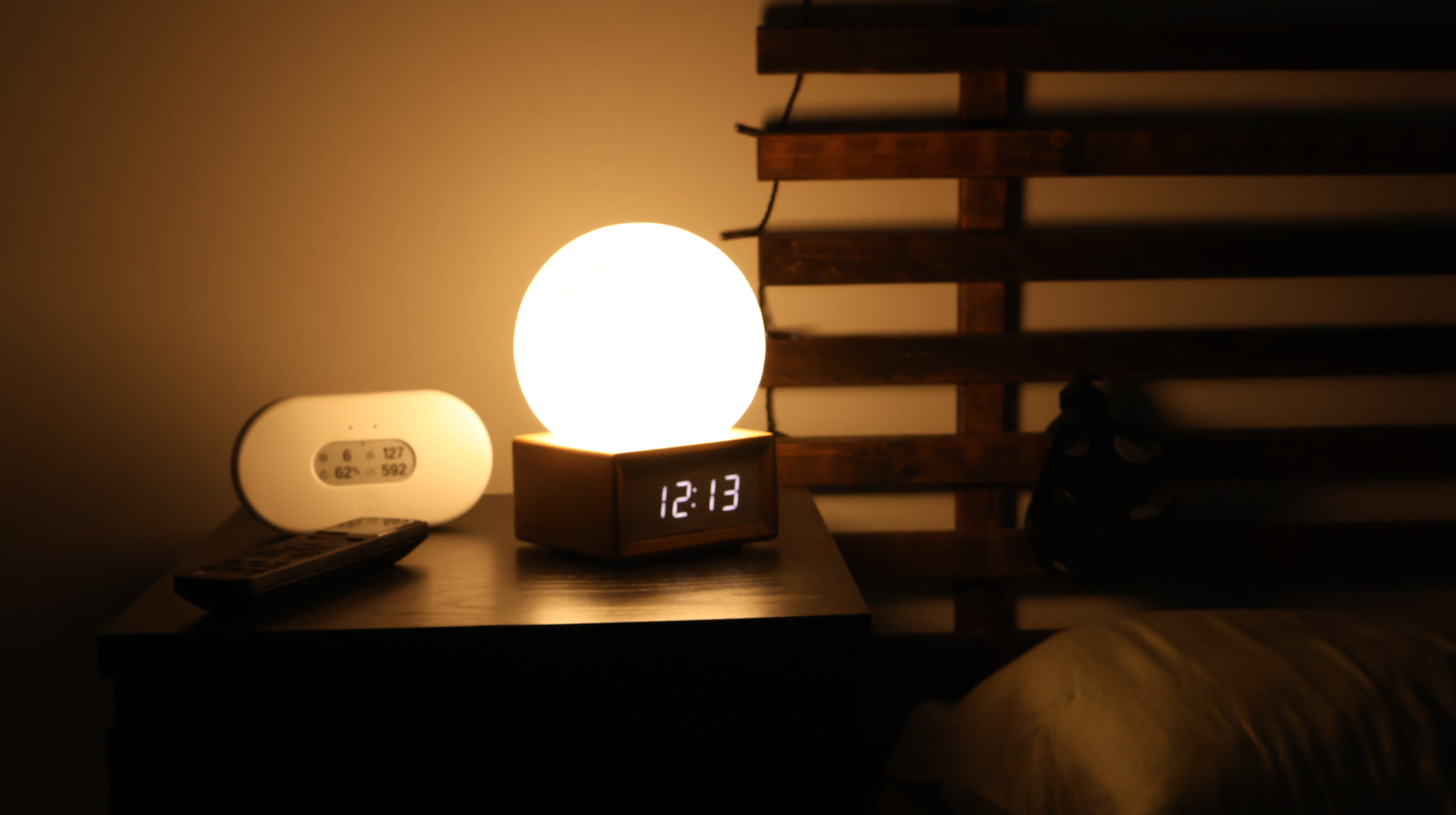
Four display levels, and the lowest is properly dim rather than nominally dim. Full off is one button press away.
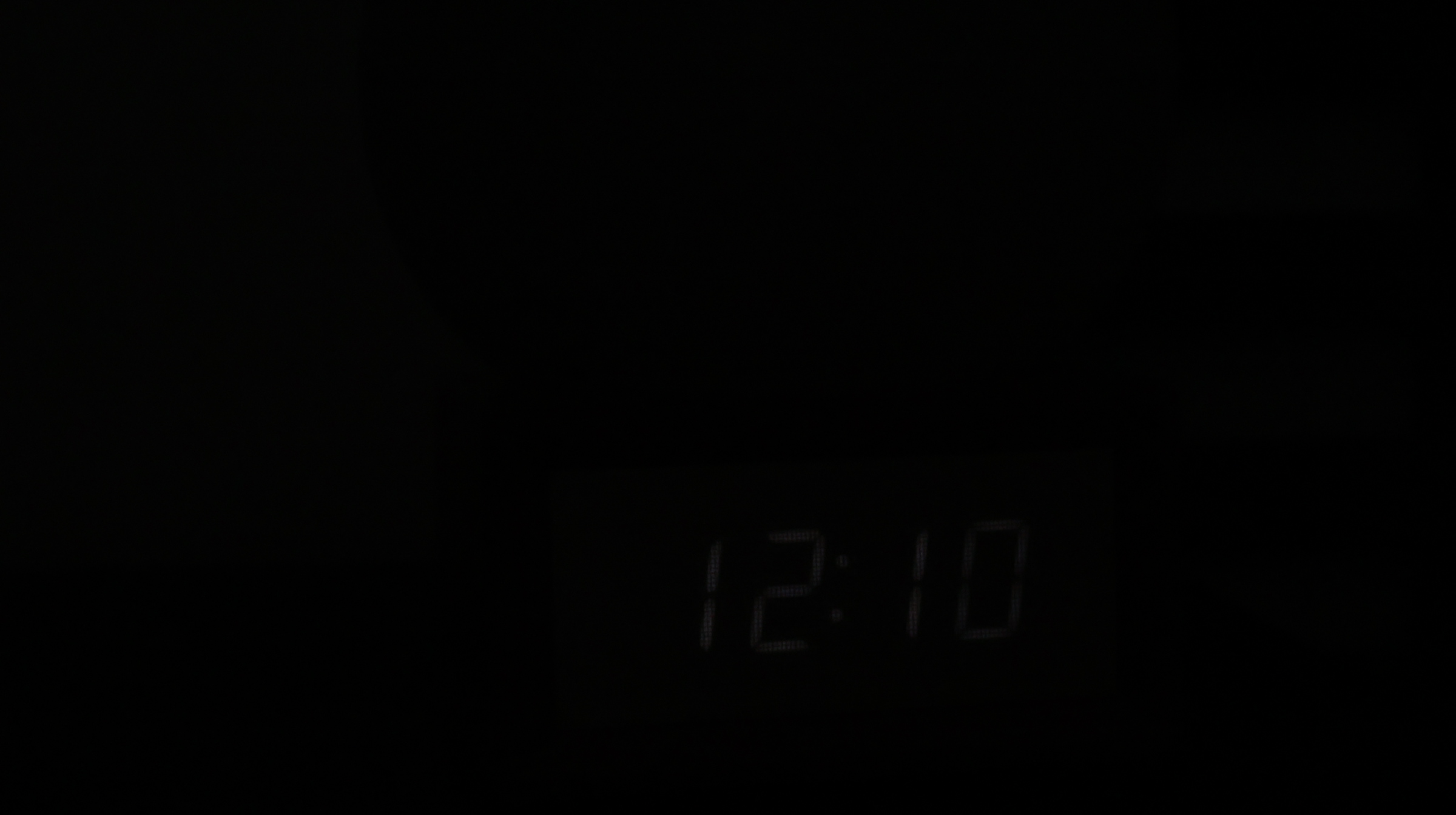
With only three buttons you can find the right one by touch in a dark room, which is a small thing that matters at 3am.
Flicker
At full brightness this is one of the cleanest lights I’ve measured. Flicker sits at 0.32% modulation at 282 Hz, roughly thirty times under the level where IEEE 1789 considers there to be any observable effect.
Dimming changes the picture. The driver switches to PWM at roughly 19% modulation, at a frequency my flicker meter can’t resolve. Viso rates the LabFlicker to 2 kHz, and 5 kHz at reduced precision. This sits above that.
That’s a limit of my instrument, not a fault in the clock, and it’s reassuring rather than worrying. IEEE 1789’s risk region stops at 3 kHz. A dimming frequency too fast for the meter to pin down is also too fast to bother your eyes.
If you’re flicker-sensitive, neither state should trouble you. I’m reporting it because a few people genuinely react to dimmed LEDs and deserve the number rather than a reassurance.
What you can’t change
Nothing is adjustable. One alarm sound, a fixed 30-minute sunrise, a fixed nine-minute snooze, no sunset or wind-down mode.
Coming from a Hatch, that list reads like a spec sheet with holes in it. Living with the thing, I found I minded far less than I expected.
There is nothing to configure, so you don’t configure it. In a room whose entire job is to help you stop thinking, a device with three buttons and no settings menu has an argument.
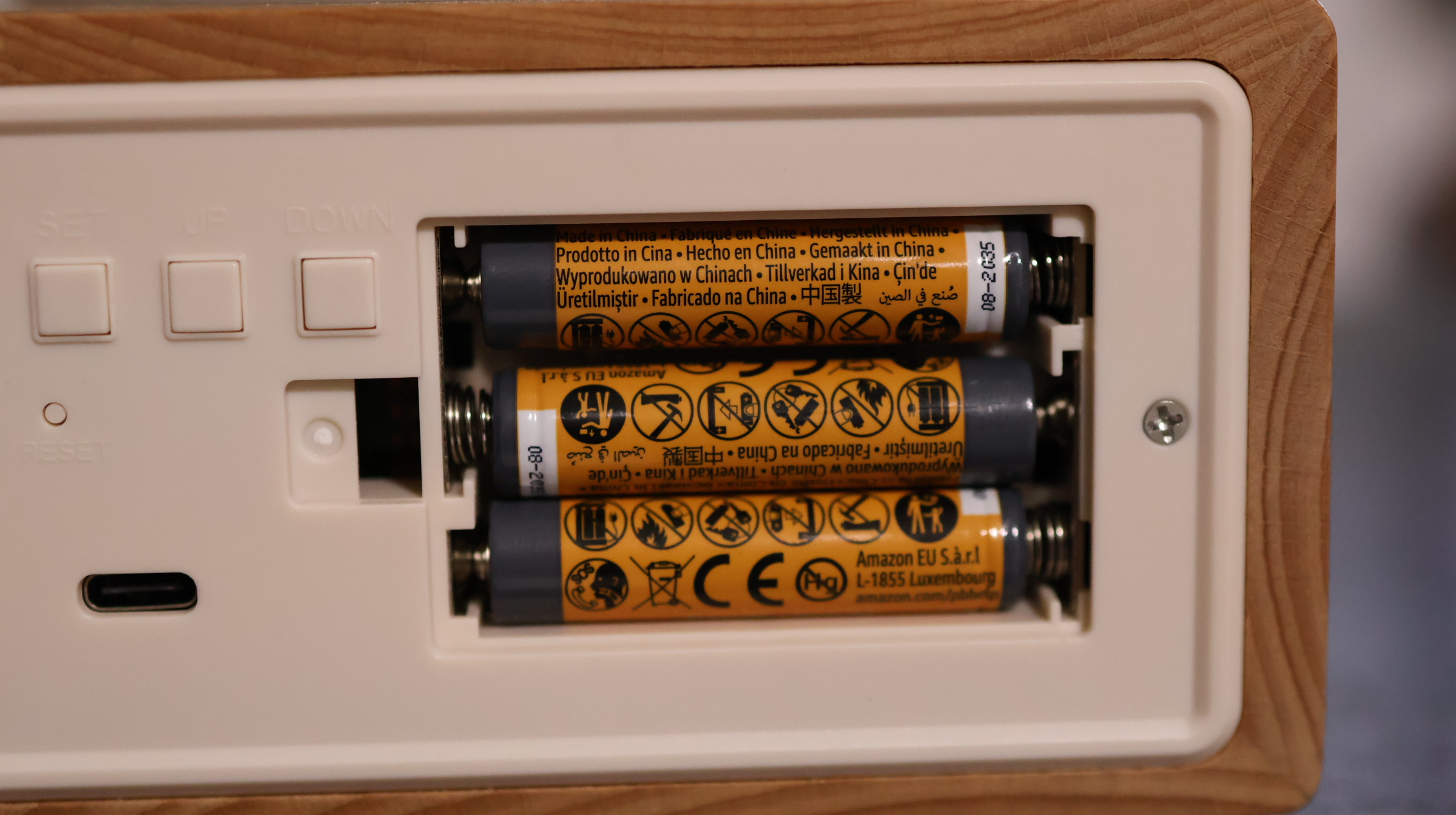
The battery backup deserves one honest note. Three AAAs keep the time and the alarm audio alive through a power cut, but the light will not run on them.
As an Evening Light
The best argument for this clock has nothing to do with mornings.
At 1997K with a mel-DER of 0.25, the pink sphere is close to an ideal pre-bed light. It puts almost nothing into the short wavelengths that tell your body the day isn’t over.
A lamp that looks like this and reads at candlelight color temperature is a genuinely good thing to have burning in a bedroom for the hour before sleep. Most people buying it will discover this by accident.
I’d go further. If you told me you wanted a beautiful evening lamp that happens to include a gentle alarm, I’d recommend this without much hesitation. It’s the same product, sold backwards.
How It Compares
Here is every sunrise clock I’ve measured at the same 18 inches, and Rise Centered is at the bottom of it.
Same distance, same measurement, every clock on the bench. Both salt spheres finish last.
The top of that chart sits near 390 lux. The middle sits around 200. Rise Centered lands at 50 to 57, which puts it behind a $30 Amazon clock by a factor of five.
That’s the honest context for everything above, and it’s why I keep saying this is a lamp with an alarm rather than a wake-up light.
The obvious cross-shop is the Hatch, and I don’t think the two are really competing.
The Hatch Restore is the maximalist answer: an app, scenes, a sound library, routines, and a subscription attached to most of it. Rise Centered is the opposite position on every one of those axes.
If you want your clock to do things, buy the Hatch. If you want your clock to sit there and look good and wake you gently, the salt sphere is a better object.
Against a clinical wake-up light like a Lumie Bodyclock, it’s a straighter loss. Those go brighter and cooler and are built to deliver a wake dose that this one doesn’t reach.
For the full ranked field with brightness numbers across every clock I’ve tested, the best sunrise alarm clocks guide is the place to go.
Who Should Buy It
Buy it if you wake easily to light, you want the bedroom to feel calm and look good, you want zero apps and zero subscriptions, and you’ll use it as an evening lamp as much as an alarm.
Skip it if you’re a heavy sleeper, or you want a measurable circadian dose in the morning. At $199 there are clocks that will do that job and this one won’t.
I like it more than the measurements say I should, and I want to be honest about that rather than dress it up.
It’s a beautiful object that produces a beautiful light and it did not wake me up once. If you already know you’re the kind of sleeper who surfaces with the light, Rise Centered is an easy recommendation. If you’re not, buy the brightest clock you can stand instead.
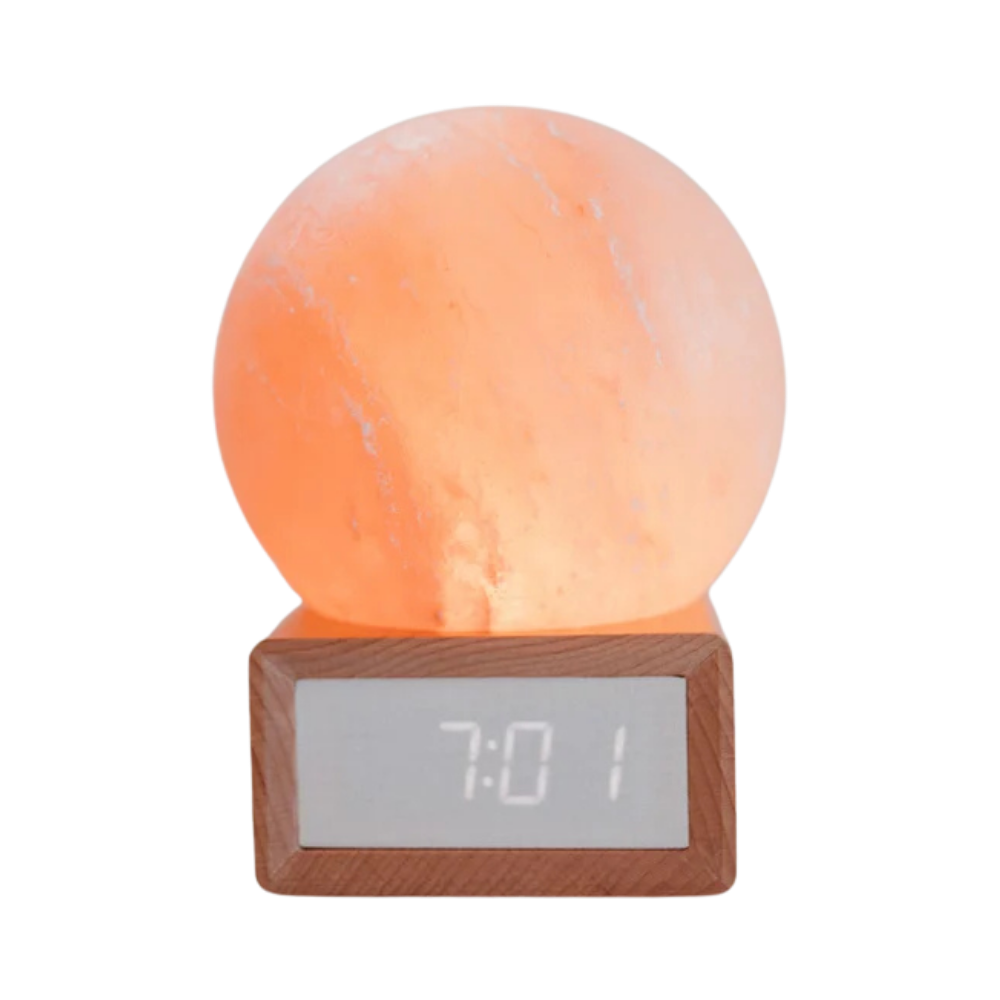
$199
Rise Centered Sunrise Alarm
The best-looking sunrise clock I’ve tested, with a lovely warm light and effectively no flicker.
At 50–57 lux it’s too dim to wake a heavy sleeper, and the sunrise does little for its first twelve minutes. Buy it for the object and the evening light.
Frequently Asked Questions
Common questions about the Rise Centered sunrise alarm clock
Press and hold SET on the back. The hour digits flash first: set them with UP and DOWN, then press SET, and the minutes flash next.
A short press of SET afterwards arms or disarms the alarm, shown by a small indicator on the front.
Press any of the three back buttons while it’s sounding. To snooze instead, tap the middle of the wooden base for nine more minutes.
No. There’s no app, no WiFi, no Bluetooth and no subscription. Everything is set with the three physical buttons.
No. The sunrise runs before your alarm, but there’s no scheduled fade at bedtime. You can turn the lamp on manually and dim it by hand.
A 30-day home trial in the US. Returns need the original packaging and carry a $20 processing fee, and shipping isn’t refundable.
One year, limited.
Less than a conventional alarm would. The light builds silently for 30 minutes before any sound starts, and the sound itself opens at around 45 dB(A).
Given how dim the light is, a partner sleeping through the light phase entirely is likely.
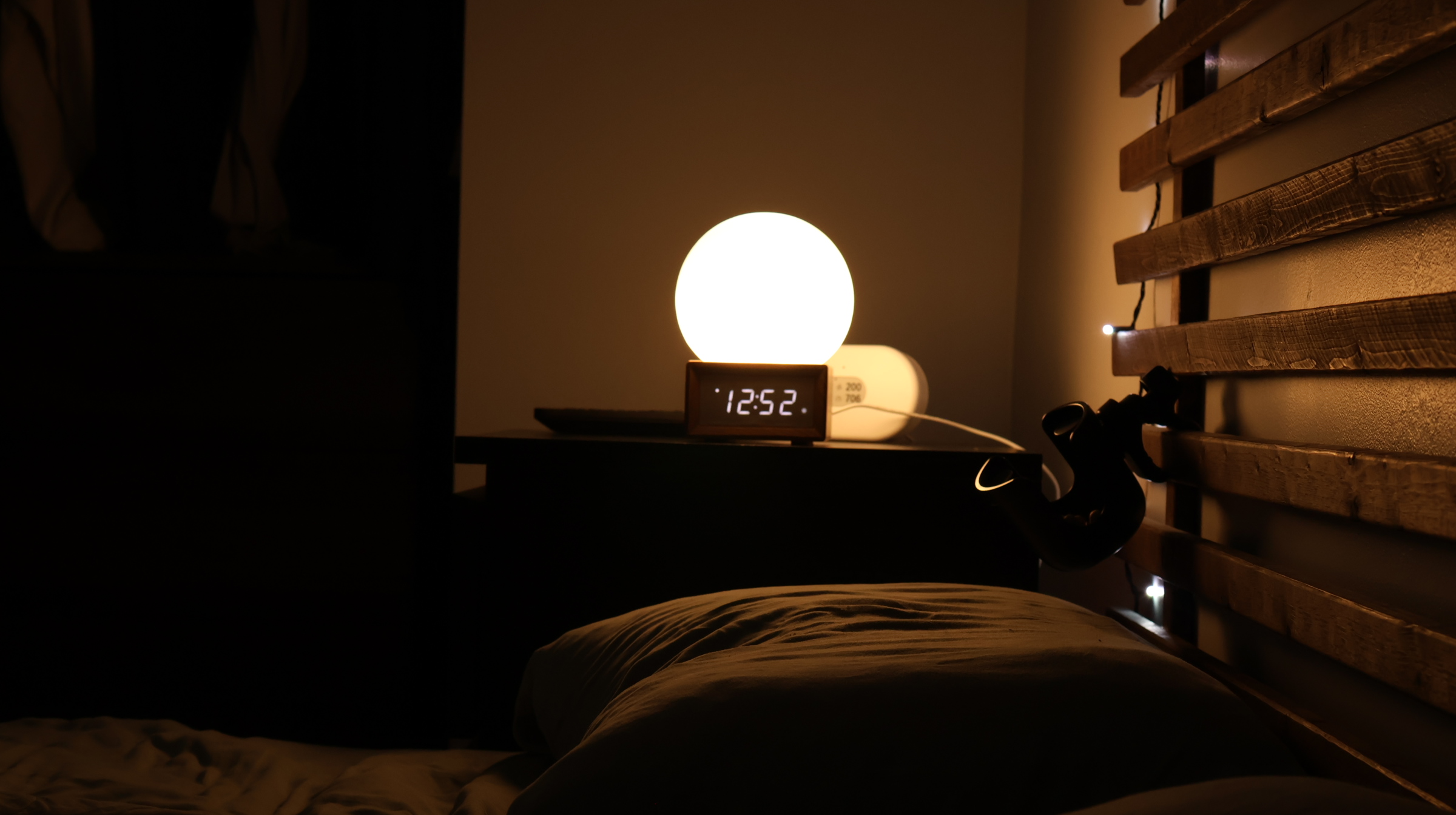
Himalayan salt softens at the edges over years, depending on room humidity. The unit runs a small internal heating element to keep the sphere dry while it’s plugged in.
In practice I’d treat the slow weathering as character rather than a defect.
No. The three AAA batteries keep the time and the alarm audio through a power cut, but the lamp itself needs wall power.
References
- Avery DH, Eder DN, Bolte MA, et al. Dawn simulation and bright light in the treatment of SAD: a controlled study. Biological Psychiatry 2001;50(3):205-216 https://doi.org/10.1016/s0006-3223(01)01200-8 ↩
- Terman M, Terman JS. Controlled trial of naturalistic dawn simulation and negative air ionization for seasonal affective disorder. American Journal of Psychiatry 2006;163(12):2126-2133 https://doi.org/10.1176/appi.ajp.163.12.2126 ↩
- Danilenko KV, Ivanova IA. Dawn simulation vs. bright light in seasonal affective disorder: treatment effects and subjective preference. Journal of Affective Disorders 2015;180:87-89 https://doi.org/10.1016/j.jad.2015.03.055 ↩
- Gimenez MC, Hessels M, van de Werken M, et al. Effects of artificial dawn on subjective ratings of sleep inertia and dim light melatonin onset. Chronobiology International 2010;27(6):1219-1241 https://doi.org/10.3109/07420528.2010.496912 ↩
-
Philips Hue Twilight Review: The Ultimate Sleep Lamp?
We tested the Hue Twilight’s sunrise and sunset features. See the spectral data, lux output, and if this expensive lamp is worth the investment.
7 minutes -
Casper Glow Light Review: Great Night Light, Weak Alarm?
We tested the Casper Glow Light. See our spectral data, flicker analysis, and why this portable sleep lamp might be better for travel than waking up.
7 minutes -
Hatch Restore Review: Worth the Subscription? (Tested)
Is the Hatch Restore 3 the best sleep assistant? Our lab tests reveal the truth about its brightness, flicker, and whether Hatch+ is worth the cost.
13 minutes